Fun journal prompts for adults
Fun journal prompts for adults are short, open-ended questions that make sitting...

Last Updated: Oct 6, 2026

Pharmacy technician worksheets drill math calculations, sig codes, drug classifications, and pharmacy law before the PTCB or ExCPT exam.
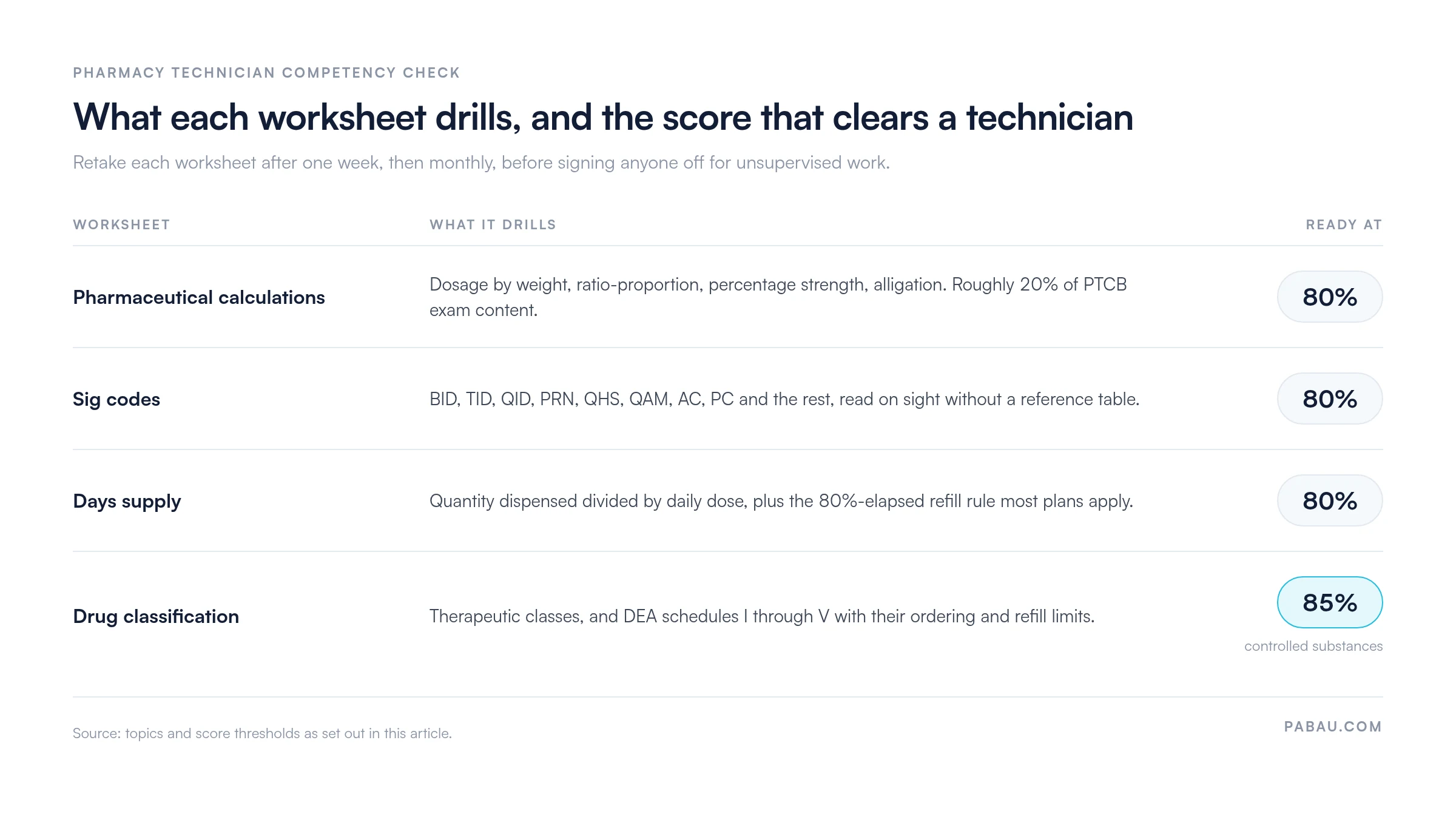
Pharmaceutical calculations make up roughly 20% of PTCB exam content, so dosage, ratio-proportion, and alligation problems earn the most practice time.
Free printable worksheets give technicians reference tables and answer keys without a paid test-prep subscription.
A score of 80% across the core topics is the usual sign a technician is ready to work unsupervised.
Practice management software like Pabau turns worksheet completion into dated competency records you can produce during a licensing audit.
A ready-to-use set of worksheets covering pharmaceutical calculations, sig codes, drug classifications, and days supply. Each one comes with worked examples and an answer key for PTCB and ExCPT prep.
Download templateA pharmacy technician worksheet is a structured practice tool that tests one competency at a time. Unlike a general study guide, it combines definitions, worked examples, and practice problems in a single document. Technicians can learn, apply, and self-assess in one sitting.
Most worksheets include answer keys, so supervisors and students can check understanding without an instructor present. That matters in a busy pharmacy, where training time comes in short bursts. The worksheets in this collection cover the four competency areas the National Healthcareer Association (NHA) ExCPT exam assesses.
Worksheets turn classroom knowledge into work that holds up at the counter. The Pharmacy Technician Certification Board (PTCB) exam tests calculations, sig code interpretation, and drug knowledge under time pressure. Those skills need deliberate, repeated practice. HIPAA compliance requirements in pharmacy settings also mean documentation has to be accurate from day one.
Worksheets give immediate, measurable feedback on weak spots long before exam day. Supervisors use them to standardize training across staff, so every technician meets the same baseline regardless of hire date or background.
Pharmaceutical calculations account for roughly 20% of PTCB exam content. Math worksheets isolate four methods: dosage by weight, ratio-proportion, percentage strength, and alligation. Each one comes up repeatedly, so technicians need fluency rather than recognition.
Worksheets set out each method step by step, with a worked example before the practice problems. Technicians learn the process first, then test it under pressure. AI-powered clinical documentation tools can carry a calculated dose straight into the record, which removes one place for a transcription slip.
Sig codes are Latin-derived abbreviations that carry the dosing instructions on a prescription. Technicians have to read BID, TID, QID, PRN, QHS and dozens more on sight, mid-verification. A sig code worksheet gives them a reference table with plain-English translations and example prescriptions.
Most worksheets add matching exercises in both directions: code to meaning, and instruction to code. Client record management in pharmacy software shows sig codes next to a patient’s full medication history. Technicians can check a new prescription against past fills before it goes out.
Days supply is a frequent PTCB topic and a daily task at the counter. Insurance verification and refill timing both depend on it. The formula itself is simple: Quantity dispensed divided by daily dose. Reading the prescription is the harder part.
Worksheets walk through the scenarios. A prescription for 30 tablets, taken three times daily, is a 10-day supply. Then they add refill logic, since most insurance plans allow a refill once 80% of the days supply has elapsed. That step separates arithmetic from judgment.
Technicians need therapeutic classes (antibiotics, antihypertensives, antihistamines) and the DEA controlled substance schedules (I through V) for compliance and patient safety. A classification worksheet pairs a reference table with matching exercises so both stick.
Technicians have to place a drug in its schedule at a glance. Worksheets test that with name-to-schedule matching and scenario questions. A prescription for morphine is Schedule II, so ordering the stock needs DEA Form 222 or a Controlled Substance Ordering System (CSOS) order.
Effective worksheet use follows a five-step cycle that mirrors how the exam tests knowledge:
Scoring is what decides when supervision stops. The board below pairs each worksheet with what it drills and the score a technician needs first.
Training coordinators run worksheets in groups. Hand out one per technician, allow 30 minutes, then review the answers together and discuss common errors. Comprehensive EMR software platforms include task assignment, so a supervisor can send a worksheet, track completion, and fold exam prep into onboarding.
Technician onboarding usually runs on scattered paperwork. Worksheets go out by email, sign-offs are handwritten, and nobody can produce the audit trail six months later when a licensing body asks.
Practice management software like Pabau keeps that work in one place. Worksheets go out as digital forms, completion is timestamped, and the result sits with the technician’s staff record next to their credentials. Every subscription includes those forms, so nothing here depends on an upgrade.
That gives a training coordinator one screen showing who completed what, what they scored, and when. Patient scheduling workflows can hold back certain shifts until the paperwork is signed off, so only trained staff take on controlled-substance duties. Medical directors pull the same records when an inspector asks for proof.

Pabau sends worksheets as digital forms, timestamps every completion, and files the result with the technician’s staff record. Your training evidence is ready before an inspector asks for it.

A worksheet sets the floor rather than the ceiling. It defines what a new technician must know before working alone, and it produces the evidence that they do.
Download the collection, adapt the problems to the drugs your pharmacy dispenses, and set the pass mark before the first technician sits down. Then track completion inside your practice management platform so you have audit-ready records from day one.
Keep the completed worksheets somewhere you can find them a year from now. Book a demo to see how Pabau stores technician competency records alongside schedules, credentials, and client notes.

Need a structured evaluation template for clinical staff? Psychiatric evaluation template demonstrates how standardized assessment forms improve documentation consistency and staff compliance.
Looking for a platform to assign and track worksheets? Clinic management software essentials explains how centralized platforms assign training materials, track completion, and store competency records.
Want to integrate worksheets into your hiring process? Digital intake forms enable structured onboarding workflows where worksheets and competency assessments happen in sequence before staff go live.
Worksheets themselves are not PTCB-endorsed products, but the topics and question types align with PTCB exam content domains published at ptcb.org. PTCB-aligned worksheets cover the same calculation methods, sig codes, and drug knowledge the certification exam tests.
Yes. Both PTCB and NHA (ExCPT) exams test pharmaceutical calculations, drug knowledge, and pharmacy law. Worksheets covering these domains prepare for either certification, though ExCPT places slightly more emphasis on pharmacy law and PTCB on math calculations.
Best practice is retaking worksheets after one week, which tests retention through spaced repetition, then monthly for ongoing competency verification. Most training programs require worksheets to be completed before unsupervised practice in high-risk areas like controlled substance handling.
A score of 80% or higher across all core topics (math, sig codes, drug schedules) is the common threshold. However, pharmacy directors may require 85% for controlled-substance handling specifically. Check your state board of pharmacy regulations for minimum competency thresholds.
Worksheets are provided as printable PDFs. Print them for in-office training, or distribute them by email or a learning management system. Digital distribution lets you track completion dates and keep version control for regulatory audits.
Review the missed topics one-on-one. Have the technician rework the reference section and worked examples, then retake the worksheet after two to three days. Consistent scores below 80% may indicate the technician needs additional classroom instruction before certification eligibility.