GI bleed nursing care plan
A GI bleed nursing care plan is a structured document for a patient with gastroi...

1
Last Updated: Oct 15, 2026
A pediatric teeth chart maps the 20 primary (baby) teeth by letter, A to T, with the age each tooth typically erupts and sheds.
Primary teeth start coming in around 6 months with the lower central incisors, and the full set is usually in place by about 33 months. Shedding runs from about age 6 to 12. Dental teams use the chart to record tooth-by-tooth findings, flag eruption outside these ranges, and explain timelines to parents.
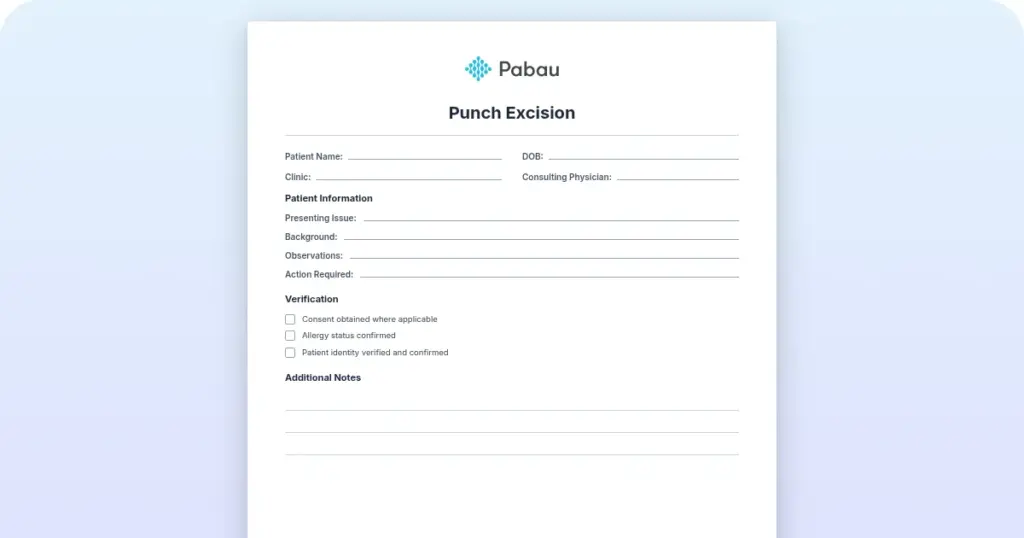
A printable recording form with a reference-values table for each tooth or quadrant and a dated findings log. Each log row records the date, the tooth, the finding, and who recorded it.
Download template
A pediatric teeth chart lists all 20 primary teeth with their Universal Numbering System letters (A-T), eruption ages, and shedding ages in one reference.
Letter A is the upper right second molar, not an incisor. Letters run to J across the upper arch, then K to T across the lower arch.
Primary teeth erupt from about 6 months, starting with the lower central incisors (O and P). The set is usually complete by about 33 months.
Flag eruption outside the typical range of approximately 6-33 months, or primary teeth retained past age 13, for dentist review.
Practice software such as Pabau keeps treatment notes, digital forms, and intraoral photos in one record per child, so chart findings carry over between visits.
A pediatric teeth chart is a clinical reference listing the 20 primary (deciduous) teeth with their letters, eruption ages, shedding ages, and arch positions. Dentists, hygienists, and pediatric specialists use it to monitor oral development from infancy to early adolescence.
The chart typically includes:
Children move onto the permanent numbering as adult teeth arrive, and our adult tooth charts cover that 1-32 system.
Once you record findings on the chart, it becomes part of the patient record, so your practice’s HIPAA rules apply to it. A completed chart at each visit also supports documentation of age-appropriate assessment.
The Universal Numbering System assigns letters A-T to the 20 primary teeth. Lettering starts at the upper right second molar (A), crosses to the upper left second molar (J), then runs from the lower left second molar (K) to the lower right second molar (T).
Many printed charts start at the incisors, misfiling every finding that follows. The diagram shows the correct order.
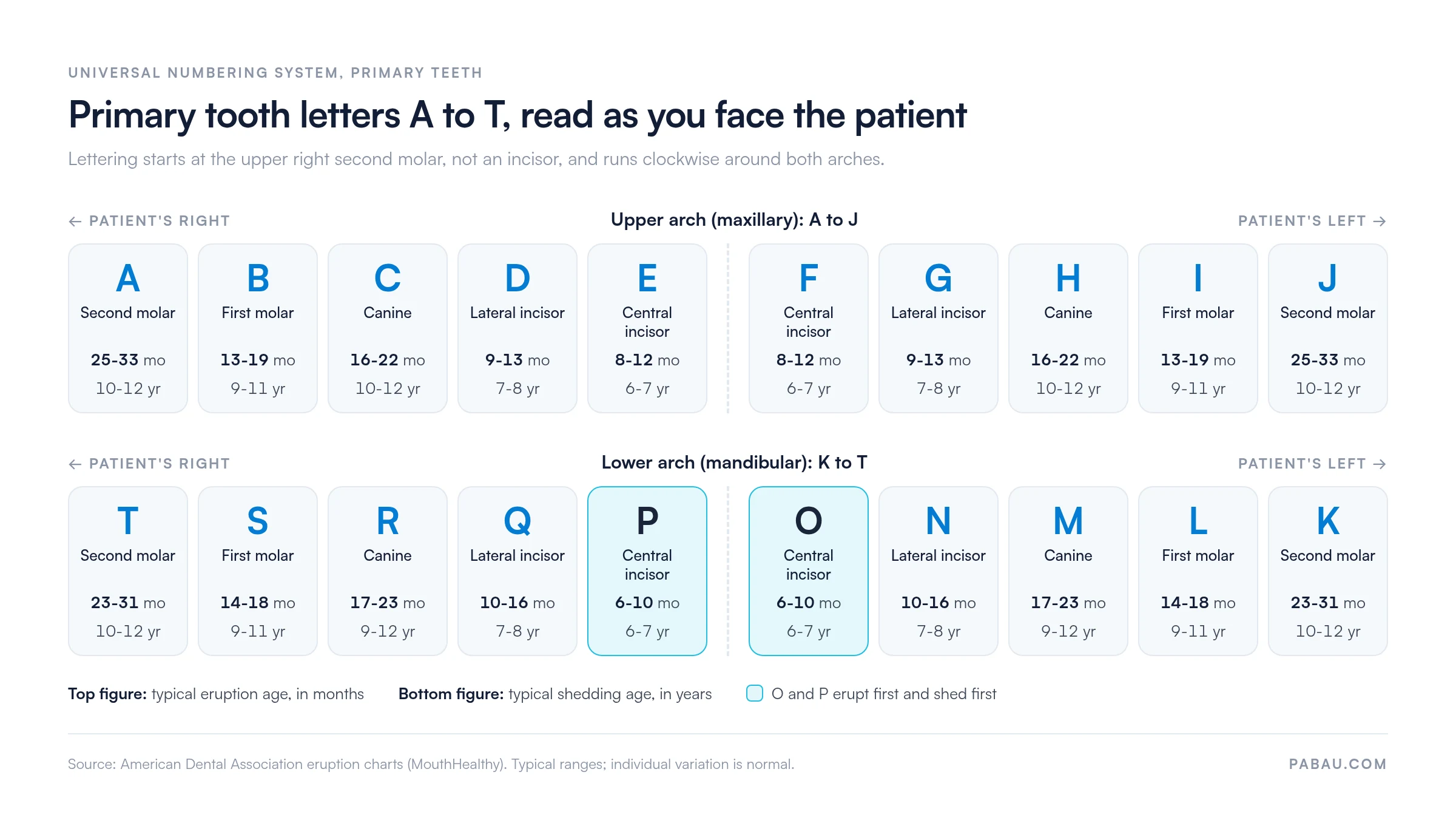
The table gives each primary tooth’s letter, name, and eruption and exfoliation ages.
Eruption runs from about 6-33 months, so read findings against the child’s age and growth history.
Baby teeth usually start falling out around age 6, as permanent teeth erupt to replace them. Shedding follows the same order as eruption. The first teeth to come in, the lower central incisors (letters O and P), are usually the first to shed.
The transition from primary to permanent teeth takes about six years for most children, from age 6 to 12. By age 13, most primary teeth have shed and most permanent teeth are in place. Third molars (wisdom teeth) are the exception and erupt in late adolescence or adulthood.
Flag primary teeth retained past age 13 for orthodontic evaluation. Do the same for asymmetric loss, where one side sheds well ahead of the other. Both can affect where permanent teeth come in and when.
The ADA eruption charts give typical eruption and shedding ages for each primary and permanent tooth.
Using the chart at an exam comes down to five steps:
A consistent entry at every exam turns single findings into a developmental record. For each visit, record:
The downloadable form gives you a dated log for these entries, with a column for who recorded each one.
Pediatric dental practices use the chart at exams, cleanings, and consultations to monitor development and talk parents through it. Specialists also rely on it to plan treatment timing around natural tooth loss.
General dental practices that see families use it when treating children alongside adults, which keeps care continuous as patients grow. Hygienists use it at intake to record each child’s baseline.
Pediatric medical practices may use the chart when screening for developmental delays. Dental assessment isn’t their main job, but knowing normal eruption timelines helps clinicians spot possible systemic or genetic conditions.
Orthodontic practices planning mixed-dentition treatment use it to time interventions around shedding and permanent eruption during the main growth phase.
Standardized documentation: Every clinician records findings with the same letters and age ranges. That shared language makes handoffs between appointments and providers straightforward.
Early detection of delays: Comparing eruption timing with the chart shows quickly whether development is on track. Delayed eruption can point to systemic conditions, nutritional deficiencies, or genetic syndromes that need medical follow-up.
Parent education: The chart gives caregivers an evidence-based view of eruption and loss timelines. Parents often worry about late teeth or early loss, and the ranges show what is developmentally normal.
Treatment planning: Orthodontists and pediatric dentists time interventions around natural shedding and eruption. Knowing which primary teeth will shed next informs decisions on space maintenance, interceptive appliances, and referral timing.
Quality reviews: A completed chart at each visit supports documentation of age-appropriate assessment when your practice reviews its clinical records.
Record the month each tooth erupts, as well as whether it falls inside the typical range. Over several years, those dates show you each child’s own growth pattern and make outliers easier to spot.
A printed chart works well for a single exam. Across six years of recall visits, though, the sheets pile up in a paper file. Spotting a canine that lags behind its partner then means flipping through every page.
Pabau, the practice management platform we build, keeps those findings in digital patient records instead. Your team writes each visit’s tooth letters and status into a treatment note. Intraoral photos sit in the same file, so the next clinician sees the last exam before the child sits down.
Parents can complete medical history and consent forms online before the appointment, for faster patient intake on exam day. Appointment reminders then bring the child back at the recall interval your dentist sets.

Pabau stores treatment notes, digital forms, and intraoral photos in each patient’s record. Your team can review the last exam before every recall visit.

Use the chart as your reference and the patient record as the history. Letters A to T give your whole team one name for each tooth. That shared name is what makes a delay visible from one visit to the next.
The detail worth checking first is the starting point. Letter A is the upper right second molar, and a chart that starts the letters anywhere else misfiles every finding after it.
Download the form, confirm your team reads the letters the same way, and record a status for each tooth at every exam. Book a demo to see how Pabau keeps each child’s findings, photos, and recall reminders in one record.

Want a second reference for timing? Baby teeth eruption chart sets out the order and typical age for each primary tooth.
Charting adult teeth as they arrive? Tooth charts covers the permanent 1-32 numbering your records switch to.
Recording gum health at the same exam? Perio chart form template gives you a structured periodontal charting form.
Completing a military dental record? DD 2813 dental form explains what the form records and how to fill it out.
The Universal Numbering System uses letters A-T for the 20 primary teeth. Letters A-J cover the upper arch, A-E on the right and F-J on the left. Letters K-T cover the lower arch, K-O on the left and P-T on the right. Permanent teeth use numbers 1-32 instead.
Most children start losing primary teeth around age 6. The lower central incisors (letters O and P) usually shed first, and the remaining primary teeth follow through about age 12. The move to permanent teeth is usually complete by about age 13.
Primary teeth usually erupt in the same order. The lower central incisors come first at around 6-10 months, followed by the upper central incisors, the lateral incisors, the first molars, and the canines. The second molars arrive last, by approximately 23-33 months. Individual variation of several months is normal.
Children have 20 primary teeth in total, 10 in the upper arch (maxilla) and 10 in the lower arch (mandible). The 20 primary teeth are replaced by permanent teeth, and 12 additional molars erupt behind them, giving 32 by early adulthood.
Deciduous teeth (primary or baby teeth) are temporary and shed between ages 6 and 12 as permanent teeth erupt. Permanent teeth are larger and are expected to last for life. A primary teeth chart tracks the change from one set to the other.