Despina Petrushevska

Nursing care plan for aggressive behavior
A nursing care plan for aggressive behavior is a structured clinical document fo...

2
Last Updated: Oct 26, 2026
Free PDF 4 pages, print-ready Clinician-reviewed
The NICHQ Vanderbilt Assessment Scale: Teacher Informant is a 43-item rating form that teachers complete to describe a child’s ADHD symptoms and classroom performance. It suggests possible ADHD when a teacher rates six of nine items in a symptom domain as often or very often, alongside a performance problem.
A positive screen calls for further evaluation and does not confirm a diagnosis. Many practices collect the form through digital intake forms, so school observations reach the clinician before the child’s next appointment. This guide covers how to complete, score, and interpret the form, and where to download the free PDF.
A printable teacher form with all 35 symptom items, from inattention to anxiety and depression, plus eight academic and classroom performance ratings. It also records the observation period and whether the child was on medication.
Upload this PDF, or any form you already use, and Pabau's AI Form rebuilds it with tick boxes, text fields and a signature. Attach it to the treatment once, and every patient gets it on time.
AI Form rebuilds the consent, history and aftercare forms you already use. You review each one, then publish.
Patients complete forms on their phone before they arrive, so the front desk stops retyping paper.
Every signed form is versioned and attached to the treatment record, ready when you need it.
Set how long a consent stays valid. Returning patients skip forms they have already signed.
Supports HIPAA and GDPR compliance AES-256 encryption 4.8 on G2 4.7 on Capterra Trusted by 4,000+ practices worldwide

The teacher form has 35 symptom items and eight performance items for children aged 6 to 12.
Six of nine inattention or hyperactivity items rated often or very often, plus a performance problem, makes a positive ADHD screen.
Oppositional-conduct and anxiety-depression items screen for co-occurring conditions that can change the treatment plan.
A positive screen calls for further evaluation and never confirms ADHD on its own.
Pabau’s practice management software keeps completed teacher and parent screens together in the patient record.
The NICHQ Vanderbilt Assessment Scale: Teacher Informant is the school-based companion to the NICHQ Vanderbilt parent form. The two are designed to be read together. It is meant for children aged 6 to 12. The form lists 35 symptom items and eight performance items.
Each symptom item asks how often the teacher has seen a behavior, from never to very often. The items group into four symptom domains and one performance section.
The scale was developed at Vanderbilt University and is copyrighted by the American Academy of Pediatrics (AAP) and NICHQ. The AAP ADHD clinical practice guideline advises gathering information from parents and school staff before diagnosing ADHD. The National Institute of Mental Health describes ADHD around three core symptom areas: inattention, hyperactivity, and impulsivity.
Completing the form means rating each item in order, from the symptom items through to the performance section.
The table below shows which items belong to each section and how each section is rated.
| Section | Items | What the teacher rates | Rating scale |
|---|---|---|---|
| Inattention | 1–9 | Careless mistakes, sustaining attention, listening, organizing, losing things, distractibility, forgetfulness | 0 (never) to 3 (very often) |
| Hyperactivity-impulsivity | 10–18 | Fidgeting, leaving the seat, running or climbing, talking excessively, blurting out answers, waiting, interrupting | 0 (never) to 3 (very often) |
| Oppositional-defiant and conduct | 19–28 | Losing temper, defiance, anger, spitefulness, bullying, fighting, lying, cruelty, stealing, destroying property | 0 (never) to 3 (very often) |
| Anxiety and depression | 29–35 | Worry, self-consciousness, fear of mistakes, worthlessness, guilt, loneliness, sadness | 0 (never) to 3 (very often) |
| Academic performance | 36–38 | Reading, mathematics, written expression | 1 (excellent) to 5 (problematic) |
| Classroom behavioral performance | 39–43 | Peer relationships, following directions, disrupting class, assignment completion, organizational skills | 1 (excellent) to 5 (problematic) |
Our printable PDF numbers the symptom boxes 1 to 4 instead of 0 to 3. When you score it, box 1 means never (0) and box 2 means occasionally (1). Box 3 means often (2), and box 4 means very often (3).
Count the items rated 2 (often) or 3 (very often) in each symptom domain. Then compare each count with its threshold.
Each screen also needs a performance problem. Many current copies of the scoring instructions count any performance item rated 4 or 5. Some copies of the scoring instructions ask for a 4 on at least two performance items or a 5 on at least one.
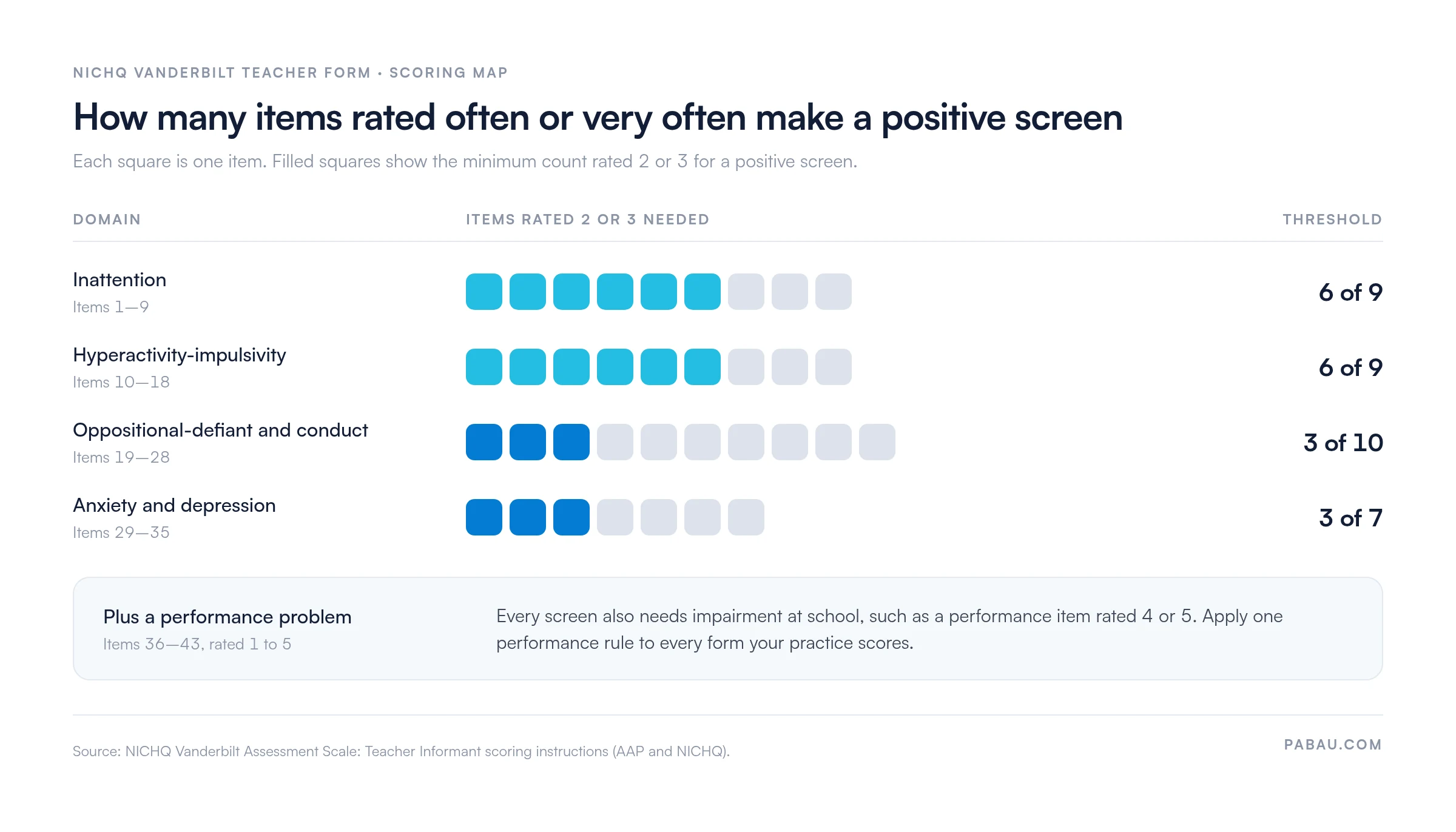
Pick one rule and apply it on every form your practice scores. Also record the total symptom score for items 1 to 18 and the average performance score. Both become baselines for the follow-up form.
A positive screen means the teacher’s ratings meet the symptom threshold and show impairment at school. It is the trigger for a full evaluation, and only that evaluation can lead to a diagnosis.
Once treatment starts, the NICHQ Vanderbilt follow-up teacher form tracks symptom change and asks about medication side effects. Compare its total symptom score and average performance score with the baseline form.
The teacher and parent forms share the first 18 ADHD items, but their other domains are built differently. Scoring a teacher form with the parent form’s item ranges is a common error. Our guide to scoring the Vanderbilt scale applies both sets of ranges with worked examples.
| Feature | Teacher informant | Parent informant |
|---|---|---|
| Total items | 43 (35 symptom, 8 performance) | 55 (47 symptom, 8 performance) |
| Inattention and hyperactivity | Items 1–18, six of nine per domain | Items 1–18, six of nine per domain |
| Oppositional and conduct | One combined domain, items 19–28, three of 10 | Two domains: oppositional items 19–26 (four of eight) and conduct items 27–40 (three of 14) |
| Anxiety and depression | Items 29–35, three of seven | Items 41–47, three of seven |
| Performance | Items 36–43, academic and classroom behavior | Items 48–55, school, family, and peer functioning |
Teacher forms often come back on paper, days after the parent form, and get filed separately. The clinician then has to piece the two views together before the visit.
In Pabau’s software for therapy practices, you can set up the Vanderbilt teacher form as a digital form. Staff enter the returned ratings once, and the completed form sits in the child’s patient record next to the parent form and visit notes.
Parents can complete their own form before the appointment through pre-visit forms, so both views are ready when the visit starts. Automated reminders then bring the family back for follow-up ratings once treatment begins.

Pabau’s digital forms store teacher and parent ADHD rating scales in the patient record, so clinicians can compare both views before each review.

Treat the teacher informant form as one half of a pair. Its ratings carry the most weight beside the parent form and a clinical interview, scored against the teacher form’s own item ranges.
Before the first visit, decide which performance rule your practice follows and use it on every baseline and follow-up form. A consistent rule makes change over time easier to trust.
Book a demo to see how Pabau keeps parent and teacher ratings together ahead of every ADHD review.

Scoring both forms side by side? Vanderbilt scoring: How to score parent and teacher forms walks through the thresholds for each informant with worked examples.
Want a ready-made scoring sheet? Vanderbilt ADHD scoring template gives you a printable sheet for tallying symptom and performance counts.
Need a second rating scale? Conners scale for ADHD explains what the Conners measures and how to read its results.
Screening with a shorter form? SNAP-IV assessment covers the brief parent and teacher rating scale for ADHD symptoms.
Collecting history before the visit? Childhood ADHD questionnaire gives you a printable intake form for younger patients.
Teachers use it to rate a child’s ADHD symptoms and classroom performance. Clinicians read it with the parent form to decide whether a full ADHD evaluation is needed. It also screens for oppositional, conduct, anxiety, and depression symptoms.
The form is designed for children aged 6 to 12. The teacher should rate the child’s behavior since the start of the school year, judged against what is typical for the child’s age.
Count items rated 2 or 3 in each domain. Six of nine inattention or hyperactivity items, three of 10 oppositional-conduct items, or three of seven anxiety-depression items meets a screen. Each screen also needs a performance problem, such as an item rated 4 or 5, under the rule your practice uses.
No. It is a screening tool, and a positive result only shows that further evaluation is needed. A diagnosis needs a clinical interview and evidence of symptoms in two or more settings.
The teacher form has 43 items and combines oppositional and conduct behavior into one 10-item domain. The parent form has 55 items with separate oppositional and conduct domains, so its item ranges and thresholds differ.