CRM for chiropractors: how to manage patients, bookings and marketing
A CRM for chiropractors is a patient relationship management system built around...

Last Updated: Oct 13, 2026
A motivation chart for weight loss turns a distant goal into a row of marked milestones. Each milestone carries its own reward, so progress gets recognized long before the final number arrives. Mark off 5 pounds and the week still counts, even when the scale has barely moved.
This page hands you the Exercise Motivation Inventory-2 (EMI-2), a validated questionnaire that shows what drives a given patient to exercise. Run it at the first consultation and you can build the reward tiers around that answer instead of guessing. Practice management software like Pabau then keeps the chart on the patient record, where the next appointment can pick it up.
The Exercise Motivation Inventory-2 measures the reasons a patient exercises, from stress management and health pressure to appearance and enjoyment. It ships with the scoring rubric and clinician notes, so you can set each milestone’s reward to match the profile you get back.
Download template
A motivation chart for weight loss pairs visible progress with a reward at each milestone, which is what keeps patients marking it.
Non-food rewards such as a spa day, new shoes or a weekend trip hold up better than food-based incentives.
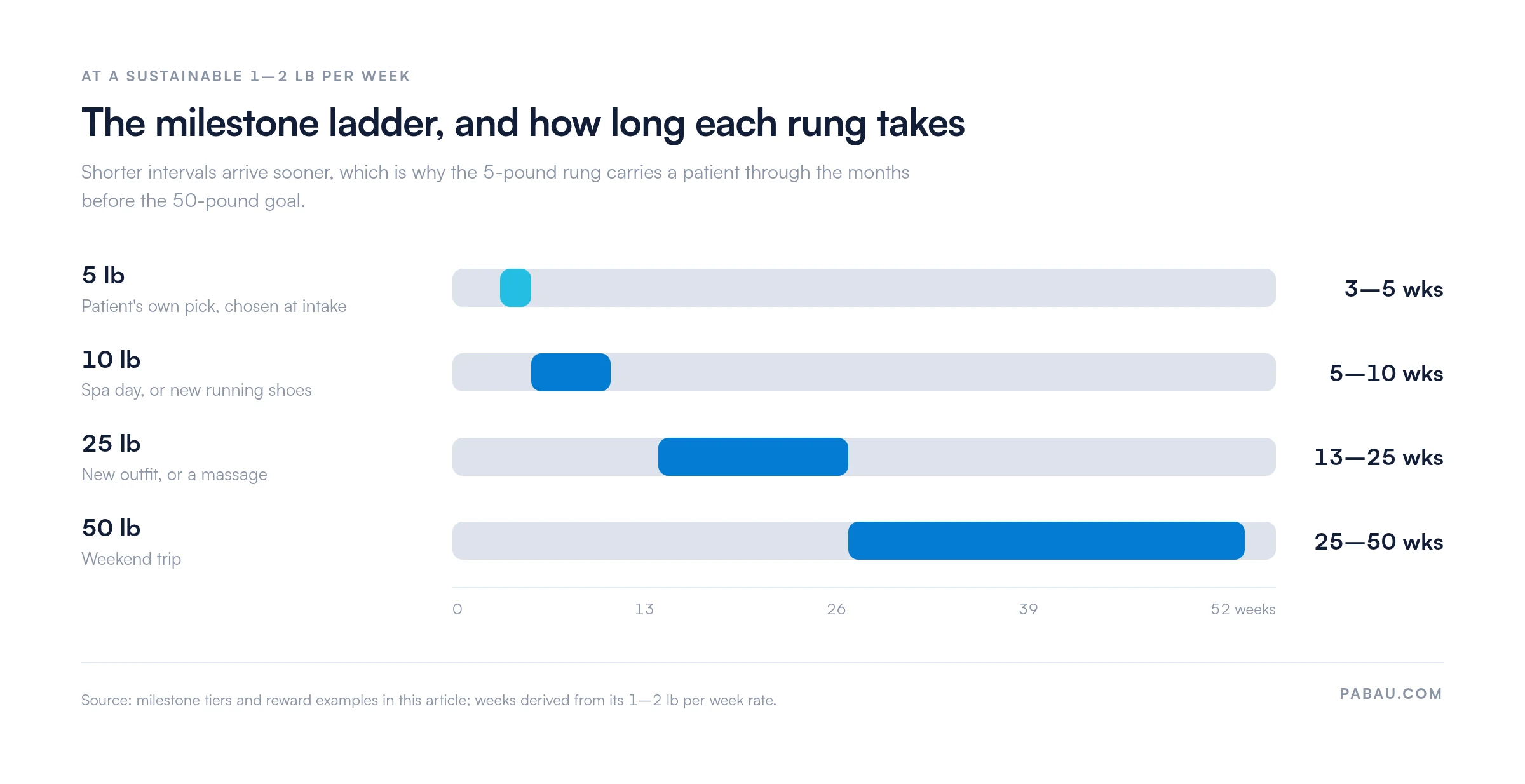
Five-pound intervals give a patient a win every three to five weeks, which beats waiting months for one big number.
SMART goals turn a vague resolution into dated milestones the chart can plot and score.
The EMI-2 tells you which drivers a patient responds to, so the reward tiers fit the person rather than the template.
A motivation chart is a weight log with a reward schedule attached. Alongside starting weight, target weight and the weekly entries, it carries milestone markers and a named reward for each one.
Some versions stay on paper, where coloring in a milestone by hand builds the habit. Others live in a digital form the practice issues, so the chart updates in the patient record at every appointment.
Self-monitoring is one of the strongest predictors of sustained weight loss in the behavioral literature. Seeing progress laid out activates the brain’s reward system, and the dopamine that follows reinforces the behavior that produced it.
Three mechanisms explain why a chart holds a patient when a resolution does not.
Treat the chart as part of the protocol rather than a handout at the door. A chart reviewed at every appointment gives the clinician a conversation opener and the patient a reason to come back.
Setting the chart up takes five steps, and the order matters.
The tiers stack up differently than they look on paper. At the pace above, the first rung arrives inside a month while the last one is most of a year away.
A goal like “lose 50 pounds” leaves the chart blank until the very end. SMART goals break that intention into dated, measurable targets the chart can hold.
Apply the same test to every milestone. “Reach 170 pounds by March 14” can be marked or missed, while “hit 170 sometime” can only be deferred. Patients in midlife can record those dated targets on an over-40 weight loss plan, which holds up to five measurable goals.
Rewarding a 10-pound loss with pizza asks the patient to undo the behavior that earned it. Non-food rewards close the loop without touching the eating pattern you are trying to change.
Ask at intake instead of guessing: “what would feel like a reward, if food were off the table?” A tailored reward gets earned rather than collected, which is why it holds up over months. If you want the tiers already laid out, our weight loss reward chart gives you the grid to fill in.
Redefine what counts as progress. Plateaus are metabolic rather than a failure of will, and a chart that only reads the scale goes blank during one.
Marking gym sessions is easier when the patient already has a program to follow. Our women’s strength training plan schedules four weeks of them.
Tape measurements are the most useful non-scale entry, because they keep moving when the scale does not. A weight loss measurement chart gives you the sites to record and a place to put them.
Start at intake, because that is where you learn what the reward tiers should be. Here is how the chart fits into the rest of the appointment cycle.
The EMI-2 separates intrinsic drivers, such as health and enjoyment, from extrinsic ones, such as appearance and social pressure. A patient at one end of that split will not be moved by the reward that works at the other.
The intake step decides most of this, so collect the motivation profile on the same form as the medical history. Our weight loss intake form covers both, so the answers arrive together.
Running this across a full caseload needs somewhere to store it. Weight loss clinic software keeps the charts, the questionnaires and the follow-up schedule against each patient. Nobody has to rebuild the picture at the next visit.
Most practices hand the chart over as a printout and never see it again. The patient marks it at home, forgets it before the follow-up, and the clinician restarts the conversation from the scale reading alone.
Pabau holds the chart as a digital form attached to the patient record. You build the milestone grid and the EMI-2 once, then send them to every weight loss patient from their record.
Weight, circumference and progress photos go in through measurements tracking, so the chart updates as the appointment happens. Automated reminders fire on milestone dates, and a patient with no entry for three weeks shows up as a flag rather than a memory.
So the chart stops being a handout and becomes a field your team can act on. Every subscription includes the forms, the tracking and the automations, so none of it sits behind a higher tier.


Pabau turns the motivation chart into a digital form on each patient’s record, with milestone reminders and measurement tracking built in. Your team sees who has stalled without chasing paper.

The chart is the easy part. What decides whether it works is whether the rewards belong to the patient and whether anyone looks at it between appointments.
So run the EMI-2 before you print anything. A patient driven by health and a patient driven by how a dress fits need different rungs on the same ladder. You only find that out by asking.
The trade-off is simple. A shorter interval costs more review appointments and buys a patient who is still marking the chart in month six. Download the template, run it at the first consultation, and review it monthly. Book a demo to see how Pabau keeps each patient’s chart, measurements and milestone reminders in one record.

Running a post-surgical program? Gastric sleeve weight loss chart covers the stretch after surgery, where the milestones look different.
Choosing the software side of the program? EMR for a weight loss clinic walks through what a weight loss practice needs from its record system.
Start with the current weight and the target weight. Divide the distance between them into 5- or 10-pound intervals, because shorter intervals create more frequent wins. Assign a non-food reward to each milestone. Plot the milestones on a printable chart or a digital form, then review them weekly with a clinician or an accountability partner.
Weight comes first, recorded weekly or every two weeks. Non-scale wins come second: how clothes fit, energy levels, and tape measurements. Track behavior too, such as gym sessions completed and weeks of meal prep, because behavior predicts the outcome. Some patients also benefit from a mood or stress rating, which helps surface emotional eating triggers.
Spa treatments, new workout gear, weekend getaways, courses, event tickets, grooming services, and tech upgrades such as a fitness tracker. Personalize each one to what the patient values, because a tailored reward holds up better than a generic list.
A plateau is a metabolic adaptation, so treat it as expected rather than as a setback. Track non-scale wins such as how clothes fit, energy and measurements. Shift to quarterly milestones until the plateau breaks. Mark behavior consistency alongside weight, and check in with the clinician, since the calorie deficit or training intensity may need adjusting.
Both work, and a hybrid usually works best. A printable chart makes the patient mark progress by hand, which reinforces the habit. A digital tracker syncs to the patient record and triggers automated reminders. Give the patient the printable version for home, then capture the weekly weight on a digital form at each appointment.
SMART goals turn a vague resolution into measurable, dated targets the chart can track. Instead of “lose 50 pounds sometime”, write “reach 170 pounds by March 14”. The date creates accountability, and the chart makes the progress toward it visible. Milestones of 10 pounds every eight weeks sustain motivation better than one distant number.