Maja Popovska

OT SOAP note sample: Free template and worked examples
Download your free OT SOAP note sample A four-page form with an identifying head...

3
Last Updated: Nov 5, 2026
Free PDF 3 pages, print-ready Clinician-reviewed
The Mankoski pain scale is a 0-to-10 pain rating tool that describes every level in words. Each description covers how far pain limits daily life and how well painkillers control it. Clinicians use it when a bare number does not say enough, because patients can match their day to a written picture. This guide walks through all 11 levels, the research behind the scale, and how to use the free printable PDF in everyday documentation.
A ready-to-use PDF covering the 0-to-10 Mankoski rating, functional descriptors at each level, and a pain diary section for recording changes over time.
Start from scratch, or upload this PDF or any form you already use, and Pabau's AI Form rebuilds it with tick boxes, text fields and a signature. Attach it to the treatment once, and every patient gets it on time.
AI Form rebuilds the consent, history and aftercare forms you already use. You review each one, then publish.
Patients complete forms on their phone before they arrive, so the front desk stops retyping paper.
Every signed form is versioned and attached to the treatment record, ready when you need it.
Set how long a consent stays valid. Returning patients skip forms they have already signed.
Supports HIPAA and GDPR compliance AES-256 encryption 4.8 on G2 4.7 on Capterra Trusted by 4,000+ practices worldwide

The Mankoski pain scale gives each level from 0 to 10 its own description of daily function and how well painkillers help.
Andrea Mankoski, a chronic pain patient, wrote the scale, and it may be copied freely as long as her attribution is kept.
It has not been through formal validation, but a 2019 study found a strong correlation (r = .83) with the numeric rating scale.
Mankoski scores ran lower than numeric scores at the top of the range, so keep one scale per patient for the whole course of care.
Pabau, the practice management platform we build, keeps each score, medication note, and diary entry in the patient record for review.
The Mankoski pain scale is a 0-to-10 pain rating tool that describes every level in words. Each description covers how far pain intrudes on daily life and how well painkillers control it. Clinicians use it when a bare number does not tell them enough about a patient’s pain.
Andrea Mankoski wrote the scale as a patient living with chronic pain. Her copyright notice covers 1995 to 1997, and she grants the right to copy it freely with attribution. The free PDF on this page reproduces her credit line in full for that reason.
The scale has not been through formal psychometric validation, and the PDF says so on its first page. Its value is shared language. A patient’s 6 and a clinician’s 6 can mean very different days, and the descriptions pin both to the same picture.
Each of the 11 levels has a short label and a description of function and medication response. The wording below follows the author’s published scale, as reproduced in the free PDF.
Ask the patient to pick the level whose description fits best, then record the number with its label. The label carries the meaning when someone reads the note months later.
The descriptions change in character as the numbers climb. Grouping them helps you see when a patient has moved into a different kind of pain. These bands are a reading aid built from the author’s wording, not part of the original scale. The chart after the list also marks which levels lean on painkiller response.
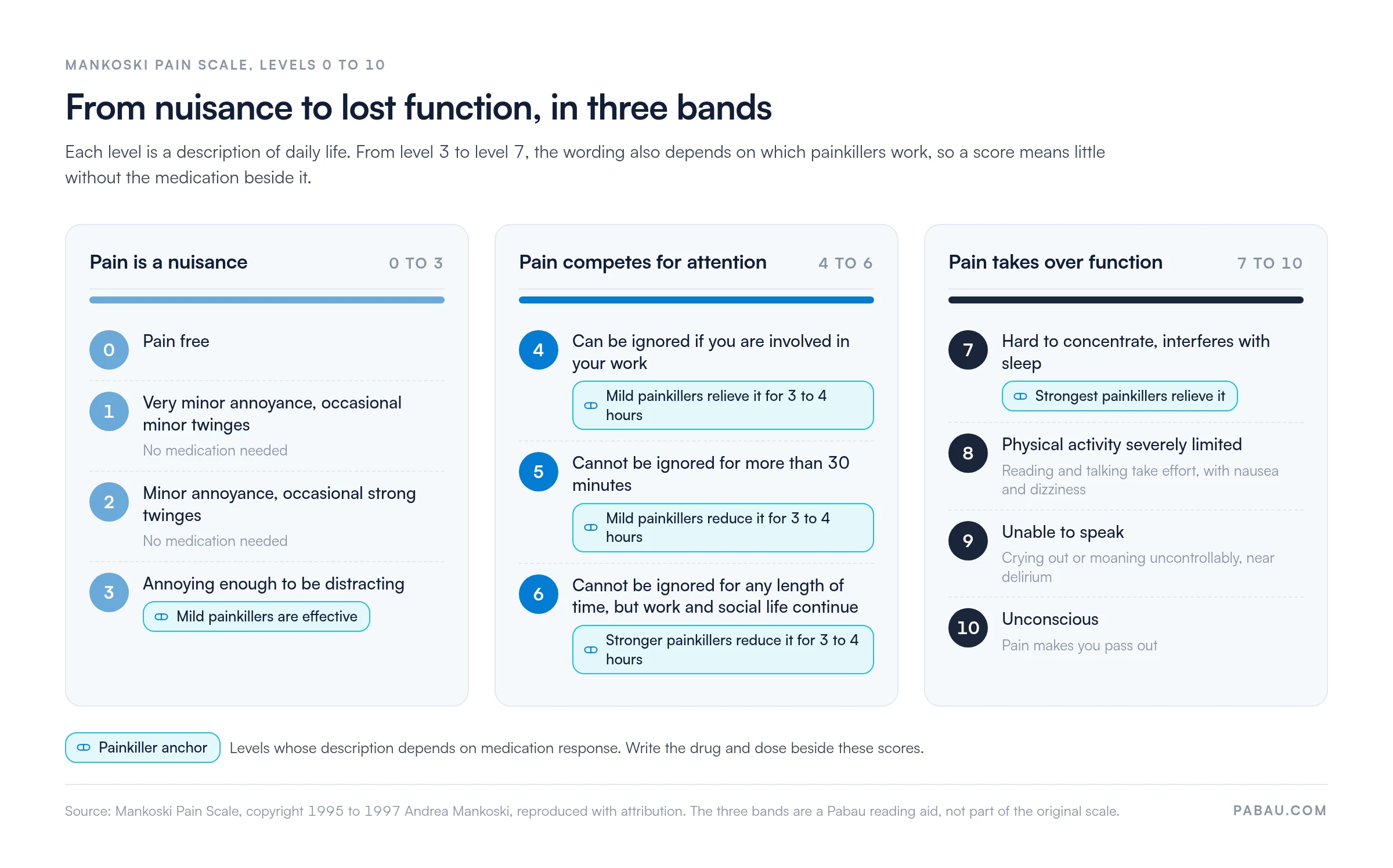
From level 3 to level 7, the descriptions are partly defined by which painkillers work. A patient on stronger medication may report a lower level while the underlying pain is unchanged. Record the medication and dose next to every score.
The pain diary in the PDF has a “Medication taken” line and an “After meds” level for each entry. Filling in both shows you how much of a score’s movement comes from the prescription.
A patient who cannot speak, or is unconscious, cannot rate their own pain at that moment. Those two levels are usually recalled afterward or judged by someone at the bedside.
When a patient chats with you and says their pain is a 9, they are using the number rather than the description. Read them the wording for levels 7, 8, and 9 and let them choose again. That conversation usually shows how the pain limits activity, which is the detail the record needs.
Hand the patient the full written scale, ask them to match their pain to a description, and record the medication alongside the score. The steps below keep each rating consistent from visit to visit.
Between visits, the diary pages in the PDF let patients log the date, level, medication, and activity. The last page asks what makes the pain better or worse, and what they want to raise at the next appointment.
The research on the Mankoski scale is small and mostly comes from doctoral nursing projects rather than large trials. Two projects from 2019 are the ones most often cited.
The headache figures came from different patient groups a year apart, so read them as promising rather than settled. The first study carries a lesson for record keeping. A patient who rates 8 on a numeric scale may land lower on the Mankoski scale the same day.
Switching tools mid-treatment can make pain look improved when only the scale changed. Choose one scale per patient at intake and keep it for the whole course of care.
The Mankoski scale adds functional and medication detail that numeric and line-based scales leave out. Each tool suits a different patient, and the deciding factor is whether the patient can read and weigh written descriptions.
If you already use the numeric pain rating scale, the Mankoski scale gives each number a description patients can test against their own day. The visual analogue scale suits settings that want a continuous measure rather than whole-number levels.
The FLACC scale is built for nonverbal or pediatric patients, whereas the Mankoski scale depends on self-report. Each tool answers a different question, so the choice depends on the patient in front of you. Our guide to pain assessment scales matches each tool to a patient group.
Use the Mankoski scale with adults who can self-report and whose pain affects daily function, especially when a bare number has stopped telling you much. The descriptors give both sides a shared vocabulary.
The written descriptions are the scale’s strength, and they are also its limit. Pick another tool for these patients:
The scale does not diagnose a condition or set a treatment threshold. Scores should be read alongside the clinical examination and the patient’s own account.
Scores only compare across visits when the scale runs at intake and at every follow-up, not as a one-off form. These four steps keep each record in the same shape.
Paper versions of these steps tend to scatter. The intake score sits in one file, the diary goes home with the patient, and the medication list lives somewhere else.
Comparing pain over time means pulling the score, the medication, and the diary into one view. On paper, that happens by hand before every review, and missing pages leave the trend incomplete.
Pabau’s digital forms let you rebuild the Mankoski scale as a form attached to the patient record. Each completed form is saved to the patient’s file with its date. Earlier scores stay in the same record, so the trend is there when the review starts.
With Pabau GO, our iOS app for practitioners, a care pathway can ask patients to complete their forms before each appointment. The scale arrives filled in, so the visit opens on the conversation about what changed. Forms and patient records are core features in every plan, and the physical therapy EMR overview shows how they fit a rehab practice.

Pabau’s digital forms turn the Mankoski scale into a form patients complete before their visit. Each score and medication note lands in their record, ready to compare at review.

The Mankoski pain scale earns its place once a number alone has stopped being useful. For the price of one question, you learn how the pain affects function and how well the medication works. The trade-off is evidence. It is less tested than the NRS, so pair it with a validated measure wherever a record or study demands one.
Choose one scale per patient and stay with it, and write the medication beside every score. Do both, and a falling score across visits is far more likely to mean the pain has eased. Book a demo to see how Pabau keeps pain scores, diaries, and treatment notes together in one patient record.

Need a faster score for busy follow-ups? Numeric pain rating scale gives you a numbers-only 0-to-10 template for quick adult self-report.
Want a continuous measure for outcome tracking? Visual analogue scale (VAS) explains how to administer and score the line-based pain scale.
Assessing how pain interferes with daily life? Brief pain inventory rates pain severity alongside its impact on activity, mood, and sleep.
Looking for another descriptive scale patients relate to? Hyperbole and a Half pain scale walks through every level of the illustrated scale, with a free template.
Choosing between pain assessment tools? Pain assessment scales covers how to choose a scale for each patient group and document the result.
The Mankoski pain scale is a 0-to-10 pain rating tool with a written description at every level. Each description covers daily function and how well painkillers help, so pain is documented in words as well as numbers.
Andrea Mankoski, a patient living with chronic pain, created the Mankoski pain scale. Her copyright notice covers 1995 to 1997, and she allows the scale to be copied freely with attribution.
No, the Mankoski pain scale has not been through formal psychometric validation. A 2019 study did find a strong correlation (r = .83) with the numeric rating scale in acute pain patients. Use it alongside a validated measure where a record or study requires one.
A 7 on the Mankoski pain scale means pain makes it difficult to concentrate and interferes with sleep. The patient can still function with effort, and the strongest painkillers relieve it.
Both run from 0 to 10, but the Mankoski scale describes each level in terms of function and medication response. The numeric rating scale asks for a number only. Mankoski scores can run lower for the same patient, so avoid switching between the two mid-treatment.
Yes. The free Mankoski pain scale PDF can be downloaded from this page and printed for use in practice. It includes the full scale, a level-today rating line, and pain diary pages for use between visits.
Yes. Patients can choose the level that best matches their pain and log it between visits. That makes the scale a good fit for a pain diary.
The Mankoski pain scale is written for adults who can read and weigh its descriptions. For young or nonverbal children, use an observational tool such as the FLACC scale instead.
The Mankoski scale relies on patient self-report, while the FLACC scale is designed for nonverbal or pediatric patients who are assessed by observed behavior.
Rate pain at every visit with the same scale, and ask patients to log it in their pain diary between visits. Diary entries are most useful when they include the time, the medication taken, and what the patient was doing.