HIPAA compliant texting: What you can send patients & how to communicate securely
HIPAA compliant texting is possible when a text holds no protected health inform...

Last Updated: Oct 16, 2026
A J-1 waiver is a formal exemption from the two-year home-country physical presence requirement under INA 212(e). The US Department of State grants it to exchange visitors, most often international medical graduates. Without one, you cannot change visa status, apply for permanent residence, or stay in the United States.
That two-year rule can derail career plans for physicians finishing residency in the US. A waiver removes the barrier when you commit to work in an underserved area or win federal agency sponsorship. Four pathways are open to physicians who trained here: Conrad 30, an interested government agency, hardship, or persecution. This guide covers eligibility, each pathway, the application steps, and how to track your case.
A ready-made structure for tracking J-1 visa waiver compliance requirements, including documentation checklists and timeline tracking. It also carries employer obligation reminders for practices sponsoring international medical graduates.
Download template
A J-1 waiver exempts exchange visitors from the two-year home-country physical presence requirement under INA 212(e).
Physicians who became subject to that requirement through graduate medical education have four routes open to them.
Those four are Conrad State 30, an interested government agency, hardship, and persecution.
The no-objection statement is closed to them by statute, however common it is for other exchange visitors.
Conrad 30 gives each state up to 30 slots a year, in exchange for three years in an HPSA or MUA.
Case status is tracked at j1visawaiverstatus.state.gov, and most decisions land between four weeks and six months.
Exchange visitors admitted on J-1 visas fall under Section 212(e) of the Immigration and Nationality Act. It requires two years of physical presence in the home country before certain next steps. Those steps include most other nonimmigrant visas, such as H-1B, L-1 and O-1. Employment-based permanent residence is covered too.
For international medical graduates (IMGs), the rule creates a hard stop. Many finish residency with job offers, hospital privileges, and family ties in the United States. A waiver lets them stay and pursue employment-based immigration without the two years abroad.
You are eligible for a J-1 waiver if you meet these core criteria:
Hardship and persecution waivers carry their own evidence requirements, covered below.
The Department of State recognizes several pathways, and not all of them are open to every applicant. Physicians most often pursue Conrad 30 or a federal agency waiver. Knowing what each one asks of you decides which is worth preparing.
Conrad State 30 is the most common route for physicians. Each state receives up to 30 waiver slots a year. To qualify, you must:
Availability varies by state and by year. Contact your state health department for current Conrad 30 contacts and slot status. Competitive states can run out well before the year ends.
Federal agencies can sponsor a waiver application through the IGA pathway. Common sponsors include Health and Human Services (HHS/HRSA) and Veterans Affairs (VA). The Department of Agriculture (USDA) and the Department of Defense (DOD) sponsor applications as well. Unlike Conrad 30, an IGA waiver often carries no HPSA commitment, and HHS and VA routes are the most accessible for clinical roles.
Hardship waivers apply when your departure would create exceptional hardship for a US citizen or permanent resident spouse or child. Persecution waivers are available when you can show a credible fear of persecution at home. Both are evidence-heavy and take longer to decide than Conrad 30.
Other exchange visitors can also request a no-objection statement from their home government. Physicians who became subject to 212(e) through graduate medical education or training cannot use it. Congress excluded them by statute, so only Conrad 30, IGA, hardship and persecution remain open.
Every waiver application needs the same core set of documents, submitted through the Department of State’s online portal. Gathering them in advance shortens your timeline.
You must submit:
Incomplete applications cause delays. Many applicants ask an immigration attorney to check the file before it goes in.
The application follows a predictable sequence. For Conrad 30, most of the groundwork happens at state level before the Department of State sees your file.
Confirm which route you qualify for before gathering a single document. Talk to your state health department about Conrad 30. For an agency waiver, work out which federal sponsors align with your specialty and your job offer.
Contact your state health department’s Conrad 30 coordinator. Provide your employment offer, ECFMG certificate, and proof that the position sits in a designated HPSA or MUA. The state then issues a recommendation letter confirming a slot is free and your job meets the criteria. That letter is essential for Department of State approval.
Submit Form DS-3035 online at j1visawaiverrecommendation.state.gov. Attach your employment contract and ECFMG certificate. Add the state recommendation for Conrad 30, or the agency sponsorship letter for an IGA. The portal validates document format and size as you upload.
The Department of State issues a case number after submission. Use it to check your status at j1visawaiverstatus.state.gov. Updates typically appear within one to four months, though complex cases run longer.
Timelines vary by pathway and by how complex the case is. Conrad 30 applications typically finish in six to twelve weeks once the state issues its recommendation. IGA waivers can run faster, at four to eight weeks, where the sponsoring agency expedites the file. Hardship and persecution waivers take three to six months, because they need extra review.
The service commitment attached to each route matters as much as the wait. The chart below sets the two against each other.
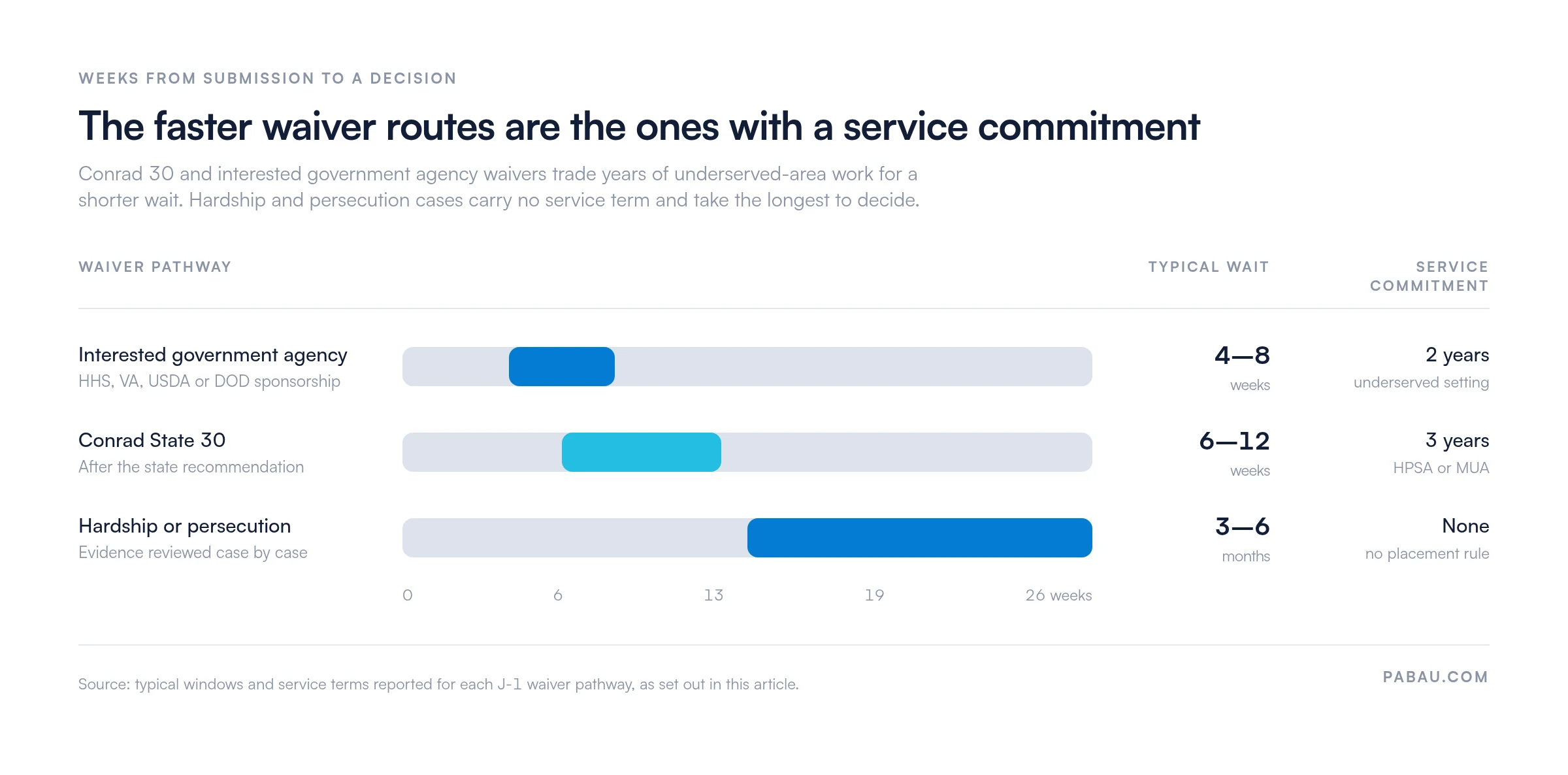
The Department of State publishes no guaranteed timeline. Delays follow incomplete documents, a passport close to expiry, or a security-related administrative hold. Build several months of buffer into your plan, so a late approval does not break your visa status.
The Department of State’s status portal at j1visawaiverstatus.state.gov tracks your application as it moves. After you submit DS-3035, you receive an email with a case number and instructions for status checks.
Visit j1visawaiverstatus.state.gov and enter your case number and the email address you applied with. Status codes include “Under review”, “Approved”, and “Additional information needed”. Respond promptly when more information is requested. Missing documents are the fastest way to add weeks to the wait.
Once the waiver is approved, the Department of State issues a formal notification. You can then petition for an H-1B visa, which is the most common next step. Employment-based permanent residence sponsorship through your employer is the other route.
Approval does not change your visa status by itself. Your J-1 visa stays valid for travel until the change goes through. You and your employer’s immigration counsel still have to file the right petition. That means an I-129 for H-1B, or an I-140 for a green card.
A waiver is permission to stay with binding conditions attached. Under Conrad 30, you must work in the designated HPSA or MUA for three full years. Falling short can jeopardize your visa status, block future petitions, or in rare cases trigger removal proceedings.
Some physicians negotiate early termination through the Conrad 30 state authority, but approval is never guaranteed. Your employer should keep records of your work location, practice setting, and patient population to evidence HPSA service. Purpose-built compliance management software makes that evidence easy to produce three years later.
IGA obligations vary by agency. HHS and VA waivers typically require two years of service in underserved settings. Read your approval letter closely to confirm what yours demands.
Incomplete or incorrect DS-3035 submissions are the leading cause of delay. Every field must match your passport, visa, and ECFMG records exactly. Employment contracts have to state the location, practice setting, and commitment period. A vague offer letter will not satisfy the Department of State.
Conrad 30 applicants should confirm the employer sits in a state-designated HPSA or MUA before signing. Discovering afterwards that the position is ineligible costs months and forces a fresh application.
Applicants also assume that waiver approval equals a visa status change. It does not. Approval is a prerequisite, and you or your employer must then file the H-1B petition with USCIS. That step takes weeks to months, so plan for it.
A practice sponsoring a waiver physician carries the paperwork for years, not weeks. The offer letter, the ECFMG certificate, the state recommendation, and the HPSA service record all have to stay findable. Most practices keep them in a shared drive and a spreadsheet, and the trail thins out as staff change.
Practice management software like Pabau stores staff credentials, contracts, and compliance documents against each team member’s record. Expiry dates trigger reminders, so a lapsed certificate surfaces before an auditor asks about it. Onboarding a waiver physician also brings the ordinary new-hire compliance work. HIPAA training for employees has to be delivered and logged like any other credential.
The outcome is a record you can hand to a state health department or an auditor without a hunt. The contract, the credential, and the service evidence all sit on one team member profile, for the full length of the commitment.

Pabau stores staff credentials, contracts, and compliance evidence against each team member’s record, with expiry reminders built in. Your HPSA service trail stays audit-ready for the full three years.

A waiver clears the two-year home-country requirement, so an international medical graduate can stay and move toward an H-1B or a green card. Getting there means picking the right pathway, filing a complete DS-3035, and tracking the case to approval. The service commitment that follows carries as much weight as the waiver itself.
Practices that hire waiver physicians carry that commitment on their side of the record. Pabau keeps staff credentials, contracts, and service documentation in one system. Compliance then stays audit-ready for the full length of the waiver obligation. Book a demo to see how Pabau supports international recruitment and credential tracking.

Onboarding an international medical graduate onto your team? HIPAA training for employees covers what to deliver, how often, and what to log.
Want to know your documentation holds up? Medical chart audit walks through running an internal review before an external one finds problems.
Unsure how long to hold on to records? How long to keep medical records sets out the retention periods by state and record type.
A J-1 visa waiver is a formal exemption from the two-year home-country physical presence requirement for exchange visitors, commonly international medical graduates. It lets practitioners change visa status, apply for permanent residence, or stay in the US. Working in an underserved area or holding federal agency sponsorship is what earns it.
No. Physicians who became subject to INA 212(e) through graduate medical education or training are barred by statute from the no-objection route. Conrad State 30, an interested government agency, hardship, and persecution are the four pathways open to them.
Each state receives up to 30 J-1 waiver slots annually under the Conrad State 30 Program. Availability is first-come, first-served and can be exhausted by mid-year in competitive states. Contact your state health department to check current slot status.
Conrad 30 applications typically process in six to twelve weeks after the state issues its recommendation. IGA waivers often complete faster, at four to eight weeks. Hardship and persecution waivers may require three to six months. The Department of State publishes no guaranteed timeline, and incomplete applications extend the process.
Failing to complete the three-year HPSA or MUA service commitment can jeopardize your visa status. It can also make you ineligible for future US visas, or in extreme cases trigger removal proceedings. Some practitioners negotiate early termination through the state authority, but this is not guaranteed. Keep detailed employment records to evidence compliance.
For Conrad 30, changing employers is permitted only if the new position stays in the same HPSA or MUA. You must still meet the three-year service commitment. Switching to an ineligible location terminates your waiver status. Consult your state health department before accepting a new position.
No. Waiver approval removes the two-year home-country requirement, but it does not automatically change your visa category. You or your employer must then file an H-1B petition, or another visa petition, with USCIS. Plan for another two to four weeks after approval to complete the status change.
An IGA waiver is sponsored by a federal agency that needs your expertise in an underserved setting or specialty. Sponsors include HHS, the VA, USDA and DOD. IGA waivers often have shorter service commitments than Conrad 30, typically two years. They also skip state-level processing, which can accelerate approval.