Montgomery-Åsberg Depression Rating Scale (MADRS)
The Montgomery-Åsberg Depression Rating Scale (MADRS) is a clinician-administer...

Last Updated: Oct 6, 2026

An individualized service plan is a written document that sets out a person’s goals, services, and supports across behavioral health, disability, and social work settings.
Medicaid HCBS waivers and state disability programs require an ISP as a condition of funding. IDEA Part C uses a related plan for early intervention.
The template on this page is a social work treatment plan. It covers identifying details, relevant history and background, treatment goals with objectives, progress tracking, a treatment contract, and signatures.
The form carries no crisis plan, no review schedule field, and no services and supports grid. Add those sections yourself if your funder requires them.
Practice management software like Pabau stores completed plans with the client record, links goals to session notes, and keeps review dates on schedule.
A four-page social work treatment plan form. It covers identifying details, relevant history and background, three treatment goals with objectives, progress and outcomes tracking, a treatment contract, and three signature lines.
Download templateAn individualized service plan (ISP) is a written document that sets out the services, goals, and supports a person needs to receive coordinated, person-centered care. ISPs are required for people receiving Medicaid waiver services, behavioral health treatment, or disability support through state and federal programs.
The template on this page is a social work treatment plan built around goals, objectives, and a session contract. It suits case management, substance use, and reentry caseloads, where a named social worker and supervisor both sign off. This guide explains what an ISP is, exactly what the downloadable form contains, what it leaves out, and how to complete each section.
An individualized service plan is a person-centered document that becomes the foundation for care delivery. Unlike a generic treatment protocol, an ISP is tailored to one person’s strengths, preferences, challenges, and goals.
Where Medicaid pays for the services, the plan has to meet federal home and community-based services (HCBS) requirements. The federal rule at 42 CFR 441.301 sets out what a person-centered service plan has to contain. A completed plan also creates an audit trail of the planning and gives families and care teams a shared roadmap.
ISPs apply across behavioral health settings, disability services, and mental health outpatient programs. The plan acts as the operational contract between the provider, the person receiving services, and any funding source.
Eligibility for an ISP depends on the funding source and the service setting. People who qualify include:
If your practice takes part in state-funded disability programs or Medicaid waivers, your staff likely writes or updates ISPs every week. A shared template keeps that work consistent from one caseload to the next.
The downloadable form runs to four pages and holds six sections. Here is what you get when you open it, field by field:
This form is deliberately short, so several elements that many funders expect are absent. The chart below sets the six built-in sections against the five you have to add yourself.
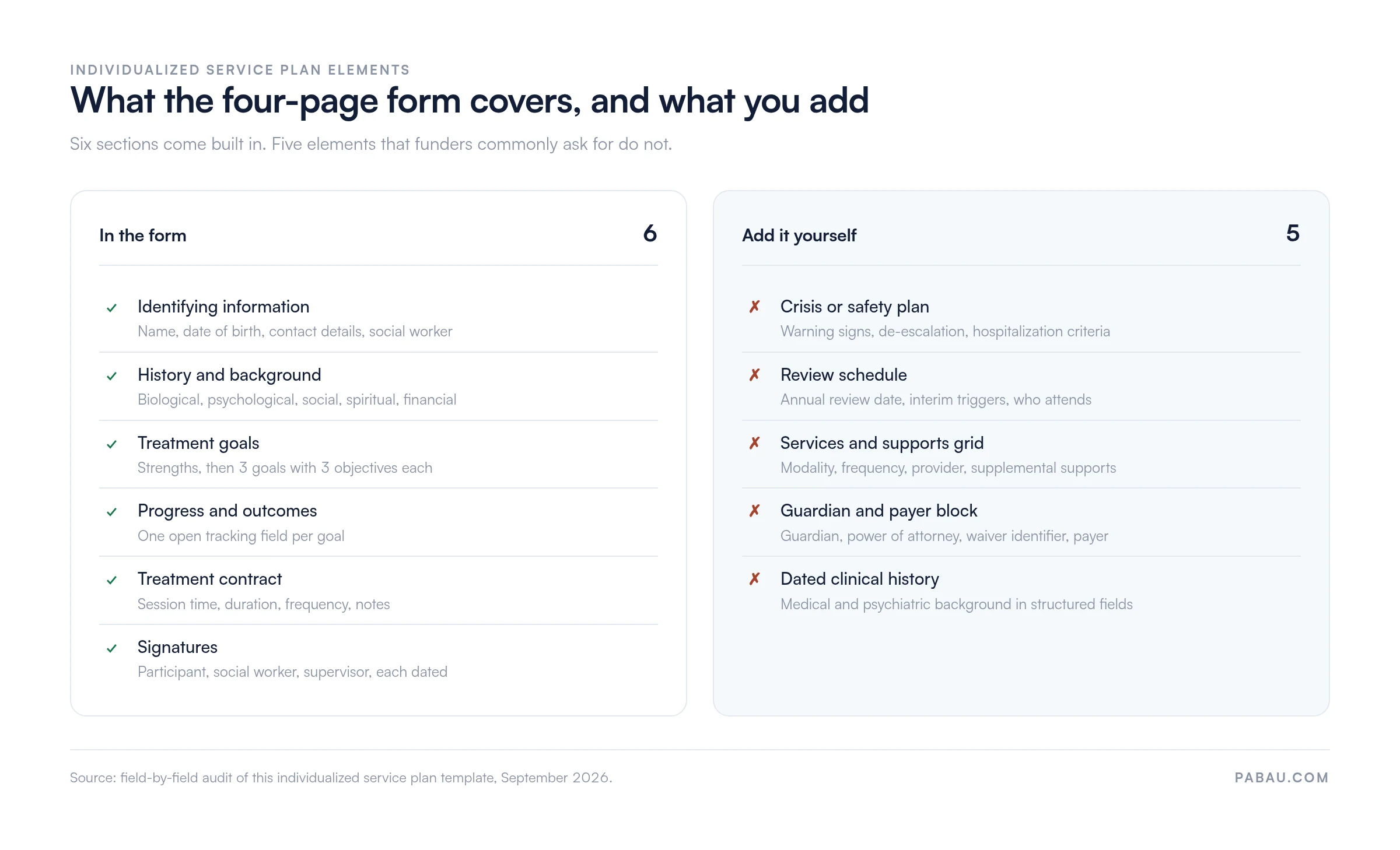
Check each of those five against your own program rules before you adopt the form:
None of these omissions rules the template out. Add a page for the elements your funder requires, or attach your existing crisis plan and review sheet to the completed form. A mental health safety plan covers the crisis section this form leaves out.
If you work under a Medicaid waiver, check your state’s required ISP elements first. Those lists differ by program, and a missing element is the quickest route to a finding at audit.
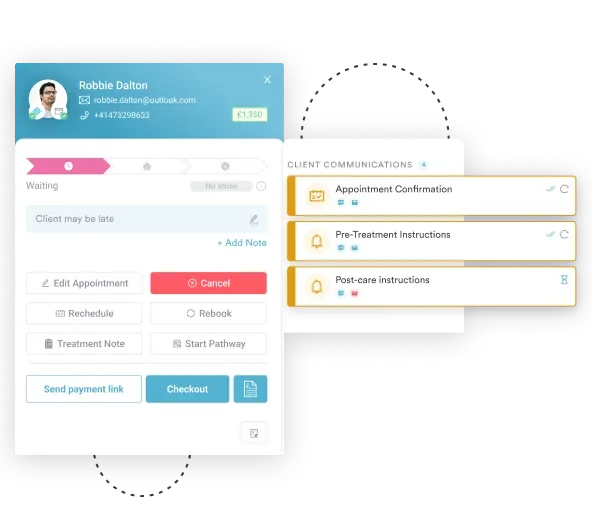
Work through the form in the order it is printed. Each step below matches a section of the downloadable PDF:
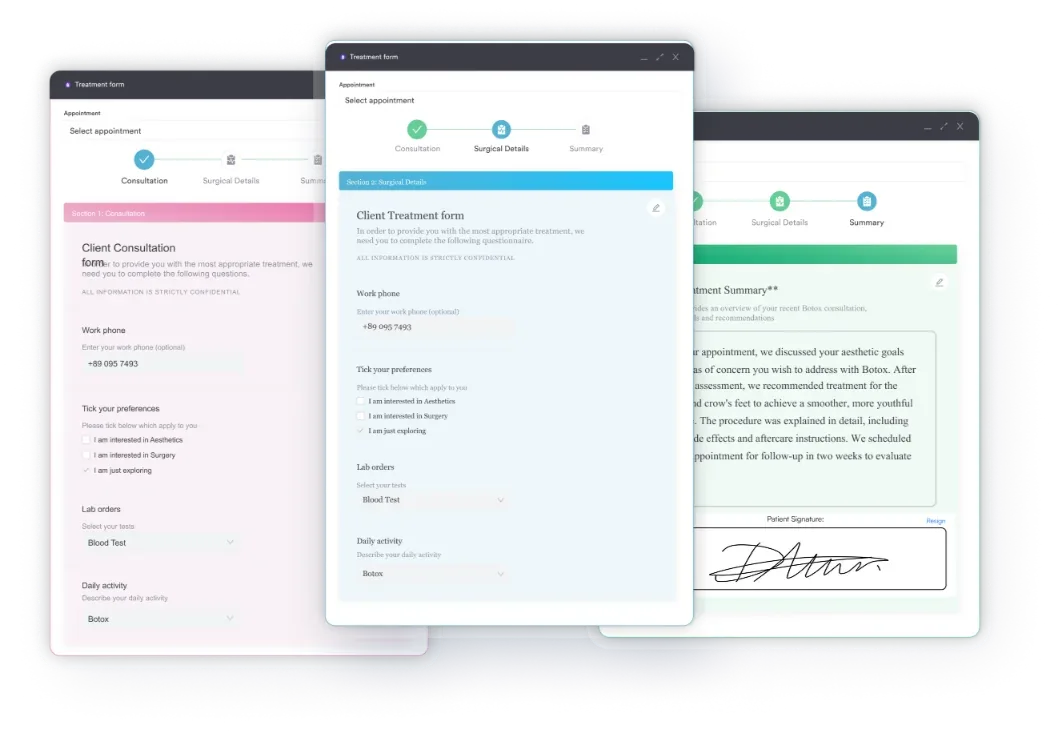
Digital intake forms let you gather the header and history details before the first appointment. The social worker then arrives at the session with the background already recorded and can spend the hour on goals.
ISP goals should be SMART: specific, measurable, achievable, relevant, and time-bound. A vague goal such as improving mental health guides no treatment and measures no progress. Write it as a target instead. By March 31, 2027, the participant will attend weekly therapy without cancellation and report a PHQ-9 score below 10.
The form gives each goal three numbered objectives. Treat those as the steps between today and the goal, not as three restatements of the same target. Where a goal needs a specific therapy, name the modality and the dosage in the objective. The form carries no separate services grid to hold that detail.
The same goal-and-objective structure runs through our psychology treatment plan template, which is built for outpatient therapy caseloads rather than case management.
The progress and outcomes section is one open field per goal, which makes it easy to leave empty. Give each entry a date, a short statement of what changed, and the measure you used. That keeps the record readable when a supervisor or auditor reviews the file months later.
Write the entry against the objective it belongs to. If the objective set a PHQ-9 target, record the score rather than a general note about how the participant seemed. Where progress stalls, say so and note what the team changed in response.
The form signs three people, but a good plan draws on more. The support team usually includes:
A shared clinical record is what keeps that team aligned. When each member works from the same document, nobody delivers against a version of the plan that was superseded two reviews ago.
Individualized service plans and individualized education programs (IEPs) are often confused. Here is how they differ:
A student may hold both an IEP at school and an ISP in a community mental health or disability services program. The two documents answer to different regulators, so keep their goals aligned rather than contradictory.
Most teams keep completed plans in a shared drive and track review dates in a spreadsheet. Practice management software like Pabau replaces both. It is built as software for therapy teams, so the signed plan sits in the client record next to every session note. The current version is never in doubt.
Because this template has no review schedule field, that deadline has to live somewhere else. In Pabau you set a recurring task or reminder for the review date, and the care coordinator gets prompted ahead of it. That single change removes the most common cause of a lapsed plan.
Structured forms, consent capture, and role-based access come with every subscription. Those are the documentation controls a mental health EMR has to provide before a behavioral health team can rely on it.

Pabau stores signed service plans with the client record, links goals to session notes, and reminds your care coordinator before each review date. Your team spends less time chasing paperwork and more time on the caseload.

This template gives you a clean, four-page structure for goals, objectives, progress, and a signed session contract. It is a social work treatment plan, so it fits case management, substance use, and reentry work more closely than a full HCBS waiver plan.
Before you roll it out, read your funder’s required elements and add whatever is missing. Crisis planning and a review date are the two most likely additions. Both are easier to attach now than to retrofit after an audit finds them absent.
Download the form, adapt it to your program, and decide where the review date will live. Book a demo to see how Pabau stores signed service plans and keeps review deadlines on track.

Need the crisis section this form leaves out? Mental health safety plan template gives you warning signs, coping steps, and emergency contacts to attach to the plan.
Writing plans for an outpatient therapy caseload? Psychology treatment plan template sets out presenting problems, goals, and interventions on one form.
Documenting substance use treatment? Substance abuse treatment plan template structures goals and objectives around recovery milestones.
Need to record what happens between reviews? Case management note template keeps contact notes and follow-up actions in one place.
Mapping a client’s support network first? Ecomap social work template shows which relationships and agencies already support the person.
An individualized service plan is a written document that sets out personalized goals, clinical services, and support strategies for one person’s needs, strengths, and preferences. ISPs are required for people receiving Medicaid waiver services, behavioral health treatment, or disability support.
The four-page form holds six sections. They are identifying information, relevant history and background, treatment goals with objectives, progress and outcomes tracking, a treatment contract, and signatures. The contract sets session time, duration, and frequency, and the participant, social worker, and supervisor all sign. It does not include a crisis plan, a review schedule field, or a services and supports grid.
ISPs serve four core purposes. They keep care person-centered and goal-oriented, coordinate services across multiple providers, and meet regulatory and funding requirements. They also create an audit trail showing that planning followed each person’s preferences and needs.
Most ISPs are reviewed annually, as Medicaid and state disability rules require. Interim reviews happen when a significant life change occurs, treatment goals shift, or progress falls short of expectations. This template has no review date field, so record that date in your own system.
No. An ISP is governed by CMS and state Medicaid rules and is used in community mental health and disability services. An IEP is governed by IDEA and is a school-based special education document. Both set personalized goals, but they answer to different regulators.