CPT code 52648: Laser ablation of the prostate billing guide
What CPT code 52648 covers, and what it bundles in CPT code 52648 is the code fo...

Last Updated: Oct 21, 2026
Billable Code Specific Code
L99 is the billable ICD-10-CM code for other disorders of skin and subcutaneous tissue in diseases classified elsewhere.
L99 sits in the FY2026 edition of ICD-10-CM, the US clinical modification maintained by the National Center for Health Statistics. That edition took effect on October 1, 2025 and stays valid through September 30, 2026.
Let Pabau's smart automation suggest the right codes, reduce claim denials, and keep your practice compliant—effortlessly.
Automate repetitive tasks and focus on what matters most—your patients.
Reduce coding errors and ensure compliance with the latest regulations.
Clean claims, fewer denials, and faster reimbursements.
Powerful insights and reporting to help your practice thrive.
HIPAA compliant SOC 2 certified GDPR-compliant Trusted by 4,000+ clinics worldwide

ICD-10 code L99 is a billable diagnosis code for other disorders of skin and subcutaneous tissue in diseases classified elsewhere, valid for FY2026.
L99 always sequences as a secondary code. The underlying systemic disease, such as diabetes, lupus, or amyloidosis, is coded first under the etiology/manifestation convention.
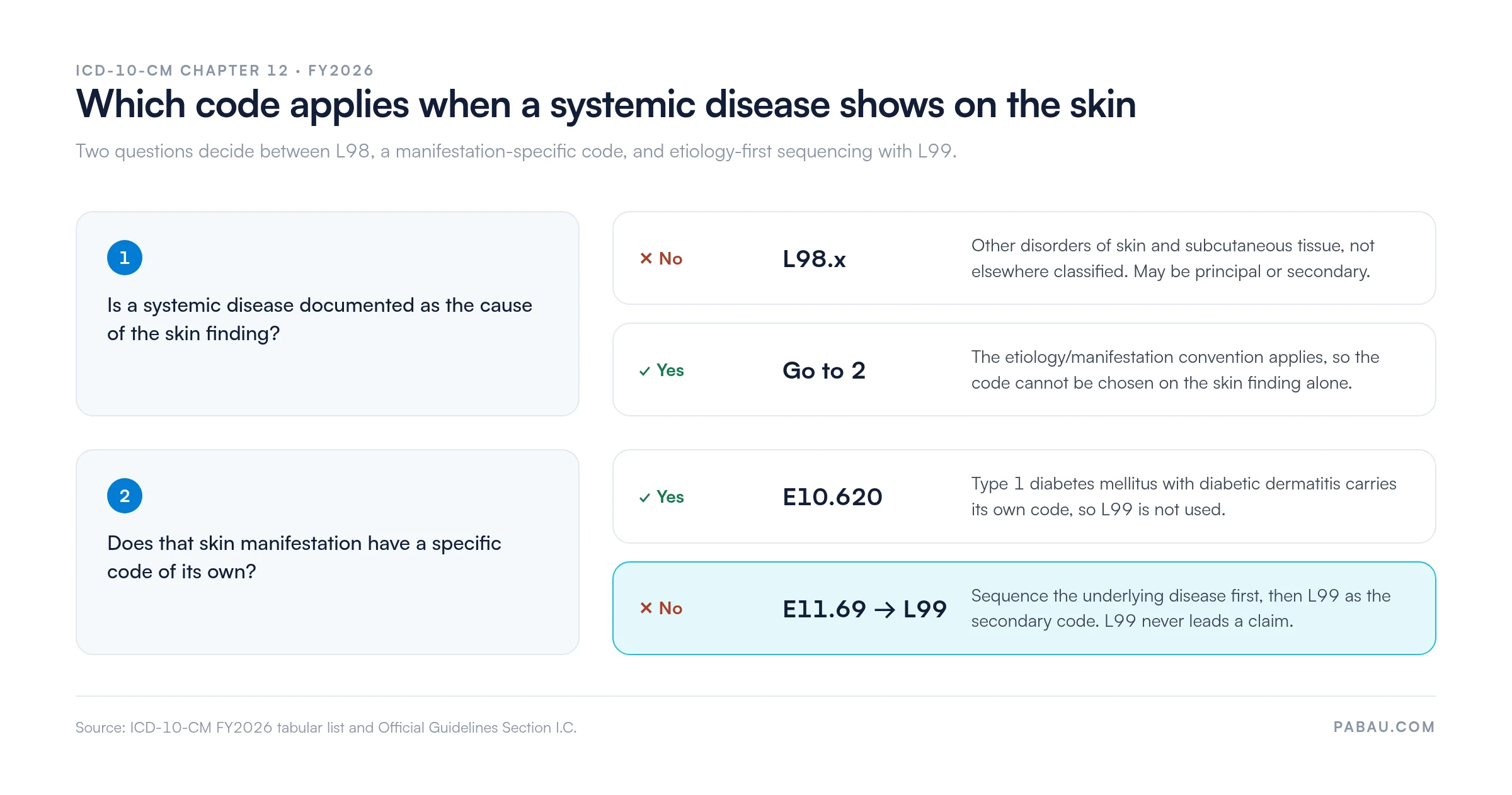
Coders frequently confuse L99 with L98. L98 covers skin disorders not classified elsewhere, while L99 applies only when a classified systemic disease causes the skin finding.
A manifestation with its own code, such as E10.620, is coded instead of L99, so check the tabular list first.
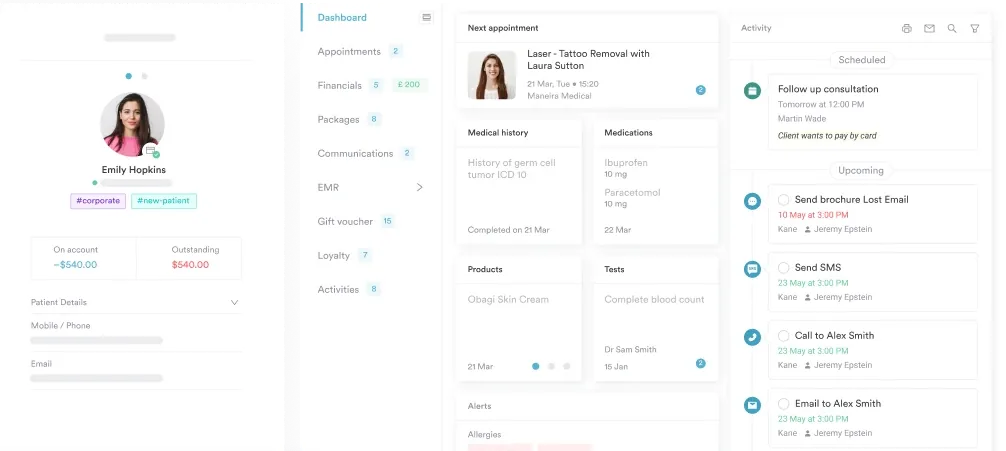
Practice management software like Pabau links the diagnosis code to the clinical note, so the causal documentation payers ask for is already on file.
Chapter 12 of the ICD-10-CM published by CMS covers all diagnoses in the L00-L99 range. L99 sits at the very end of the chapter, inside the L80-L99 block for other and unspecified skin disorders. Knowing the block boundaries lets a coder rule out the neighboring options quickly. Our ICD-10-CM code index lists those neighboring code pages if you need to confirm one.
L99 applies when a systemic disease classified elsewhere in ICD-10-CM produces a skin or subcutaneous tissue manifestation. The ICD-10-CM official guidelines set out the etiology/manifestation convention in Section I.C. It requires the underlying condition to be sequenced first, with L99 following as the secondary code.
Run a billing audit on all skin-disorder claims submitted in the last 90 days. Flag any encounter where L99 appears as the principal diagnosis code and resubmit with the correct sequencing before the timely filing deadline.
Certain systemic conditions frequently produce skin manifestations that need L99 as the secondary code. Practices treating patients with these diseases should build L99 into the standard code set for those encounters.
L98 and L99 sit adjacent in the tabular list, and confusing them is the most common coding error in the L80-L99 block. L98 covers skin disorders with no classified underlying systemic disease. ICD-10 code L99 covers disorders that arise because of a disease classified elsewhere.
In practice the choice comes down to two documentation questions, and one of them can rule L99 out entirely.
Clinical documentation has to support both the skin manifestation and its causal link to the underlying systemic disease. According to the American Academy of Dermatology, a complete dermatology record documents the primary condition driving treatment. It also documents any systemic comorbidity producing a secondary skin effect.
The ICD-10-CM convention for manifestation codes is strict. Billing teams at dermatology and aesthetic practices lose a predictable share of claims each cycle to the same sequencing mistakes. Practices that route skin-disorder claims through cleaner claims management software catch these errors before submission.
These codes appear alongside ICD-10 code L99 in the same encounter, or get confused with it. Keep them somewhere a coder can reach mid-encounter, such as our medical coding cheat sheet.
L99 denials rarely start in the billing office. They start in a note that records the skin finding in one place and the systemic disease in another. No sentence ties the two together. A coder reading that note has no attested causal link to bill from.
Pabau keeps both halves in one encounter record. The clinician writes the underlying diagnosis, the skin manifestation, and the causal statement on the same note. Digital intake forms collect the systemic history before the appointment starts, so the coder is not chasing it afterwards.
That changes what the payer receives. The claim arrives with the etiology code first and L99 second, supported by a note naming the disease behind the skin finding. Billing teams also catch a wrong sequence before submission rather than after a remittance.


Pabau’s claims management tools help dermatology and skin practice billing teams reduce code errors, track diagnosis sequencing, and submit cleaner claims.

L99 is an easy code to bill and an easy one to bill wrong. What settles it is the note. If the note names the disease behind the skin finding, and no more specific code exists, L99 is correct in the second position.
Build that check into the encounter rather than the claim review. A clinician who writes the causal sentence while the patient is still in the room saves a coder a query and the practice a resubmission. Book a demo to see how Pabau links diagnosis codes to the note that has to support them.

Coding another manifestation in chapter 12? ICD-10 code L62 applies the same etiology-first rule to nail disorders in diseases classified elsewhere.
Coding a papulosquamous manifestation? ICD-10 code L45 covers papulosquamous disorders in diseases classified elsewhere, sequenced the same way.
Need the bullous equivalent? ICD-10 code L14 covers bullous disorders in diseases classified elsewhere, under the same secondary-code sequencing.
Seeing sequencing errors in your remittances? Denial codes in medical billing explains the codes payers send back and how to work them.
ICD-10 code L99 is the diagnosis code for other disorders of skin and subcutaneous tissue in diseases classified elsewhere. It is a billable, specific code. Use it when a systemic disease such as diabetes, amyloidosis, or lupus erythematosus produces a skin manifestation that no more specific ICD-10 code captures.
Yes, L99 is a billable and specific ICD-10-CM code valid for FY2026, which runs from October 1, 2025 through September 30, 2026. It can be submitted for reimbursement, but only as a secondary diagnosis code with the underlying disease sequenced first.
L98 covers other disorders of skin not classified elsewhere, meaning no underlying systemic cause is identified. L99 covers skin disorders that arise because of a systemic disease classified elsewhere in ICD-10-CM. L99 always requires a primary code for the underlying disease, and L98 does not.
Use L99 as a secondary code whenever a systemic disease directly causes a skin or subcutaneous tissue disorder. That systemic disease must carry its own ICD-10 code. The systemic disease code sequences first, and L99 sequences after it to identify the skin manifestation.
Common underlying diseases include diabetes mellitus, amyloidosis, systemic lupus erythematosus, and scleroderma. The systemic disease must be documented as causally linked to the skin finding in the clinical note for L99 to be supported.