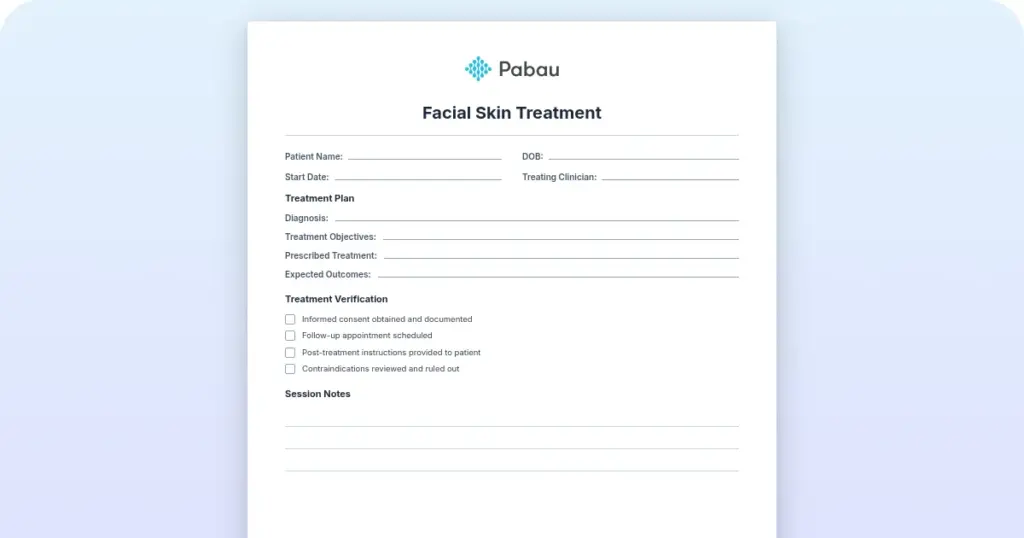
Facial skin treatment consent form template: Microneedling and phi-ion
A facial skin treatment consent form is the signed proof that a patient was scre...

2
Last Updated: Oct 21, 2026

An esthetician client intake form collects essential health, skin, and consent information before treatment to ensure safety and build a treatment plan.
Intake forms are a professional best practice that reduce liability, document informed consent, and ensure you have critical medical history before treating clients.
Every intake form must include personal contact info, medical history, current medications, skin type or concerns, allergies, skincare routine, and signed consent.
Practice management software like Pabau can send intake forms automatically before appointments, capture e-signatures, and file them straight into the client record.
A ready-to-use intake form covering client and emergency contact details, medical history and current medications, and skin type, concerns, and allergy screening. It ends with a signed confirmation of accuracy to keep on file before every treatment.
Download templateA new client sits down for her first facial. You have no idea if she’s pregnant, on a blood thinner, or allergic to salicylic acid.
That’s exactly the situation an esthetician client intake form exists to prevent. It pulls together a client’s health history, skin condition, and signed consent before you touch their skin. That way, you can treat safely and prove you did your due diligence if a question ever comes up later.
You’ll find a free, customizable template below, along with what belongs in each section and how to fit it into a normal appointment.
An esthetician client intake form is a structured document. It gathers essential information about a client before their first appointment, or before starting any new treatment series.
The form covers contact details, medical history, current skin conditions, allergies, medications, and lifestyle factors, all useful for tailoring safe, effective treatment.
Most forms close with a consent section, at minimum a statement confirming the client’s answers are accurate, alongside their signature and the date. Some practices expand that section to cover treatment risk, photography, or cancellation policy too.
Licensed estheticians use intake forms to establish a clinical baseline, reduce liability, and show evidence of professional care if a treatment is ever questioned.
Whether you run a solo skin studio or work in a busier med spa, three reasons make intake forms non-negotiable:
A solid intake form covers six core sections. Each one captures different data you need for safe, effective treatment planning.
Start with the client’s gender, address, and city, state, and ZIP code. Add an emergency contact’s name, relationship to the client, and phone number. Your booking system already holds the client’s name, phone, and email. This section only needs to capture what you don’t already have on file.
Ask about chronic conditions, such as diabetes, autoimmune disorders, pregnancy, or heart conditions, and all current medications. Blood thinners, immunosuppressants, and retinoids matter most, since they change how skin heals.
If you want to structure this part of the conversation in more depth, aesthetic consultation notes cover the same medical-history and contraindication fields. Even a condition that seems unrelated can affect skin healing or treatment safety.
Document skin type, whether oily, dry, combination, sensitive, or normal, along with primary concerns like acne, hyperpigmentation, dehydration, rosacea, fine lines, or texture.
This tells you which facials, peels, or treatments to recommend. A client with sensitive, rosacea-prone skin needs a gentler approach than someone with oily, acne-prone skin.
Ask directly about known allergies, especially to common ingredients like salicylic acid, glycolic acid, benzoyl peroxide, or essential oils.
Also ask about past reactions to skincare products and sensitivities to specific textures or scents. This step alone prevents most adverse reactions during treatment. If you also offer waxing, ask how much discomfort a client tolerates. A wax pain rating chart turns that answer into a number you can compare between visits.
Ask what products the client uses at home, morning and night. Note which active ingredients show up: retinoids, AHAs, BHAs, vitamin C, or niacinamide. A client using prescription-strength tretinoin needs a different combination of professional treatments than one who isn’t.
This template’s consent section is simple: the client confirms their answers are correct and complete, then signs and dates the form. Store the signed original in the client’s record as your proof of informed consent.
If your practice wants stronger consent language, covering treatment risk, photography, or cancellation policy, add it as an extra section. Do that before you print or send the form. Waxing appointments need their own sign-off as well. Keep a waxing consent form alongside the intake so hair removal risks are covered in writing.
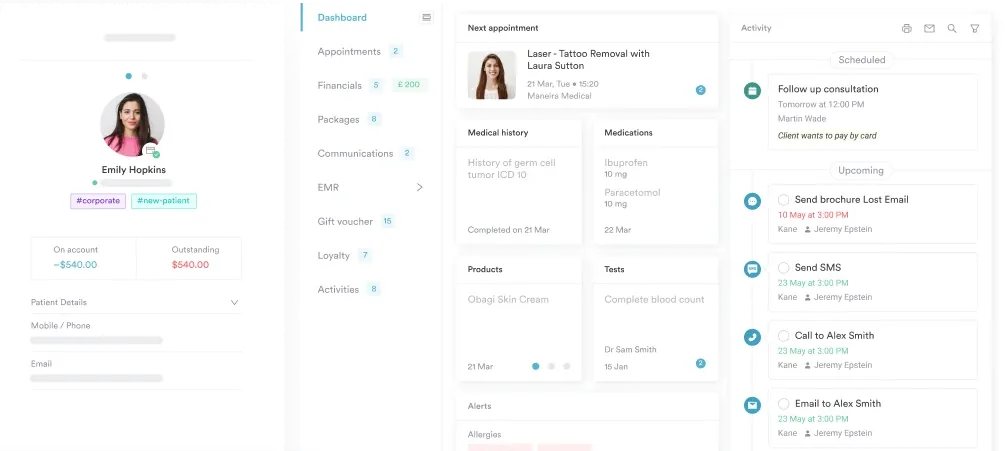
Most medspas store completed forms like this in a medical spa EMR, beside photos and consents.
Using the template is straightforward. Follow these five steps to work it into your regular workflow.
Spas that also offer bodywork need a parallel record between appointments. A massage log template tracks each session, the patterns noticed over time, and questions to raise at the next visit.
You can administer intake forms on paper or digitally, online, by tablet, or by email. Each format has its own trade-offs.
Bottom line: digital forms are more efficient if you already have the infrastructure in place. Pabau’s digital intake forms feature lets you send forms by email, have clients complete them online, and file signed consent automatically. That cuts out manual scanning, filing, and re-entry.
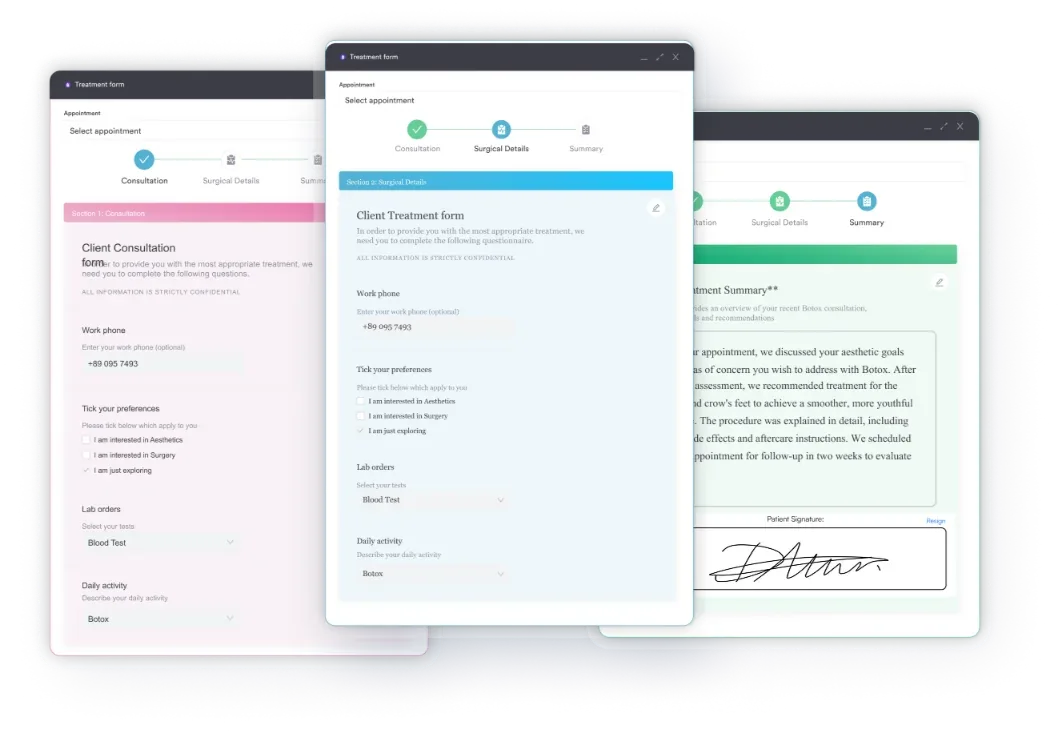
Chasing down intake forms by hand eats into your front-desk time every week. Pabau’s digital intake forms feature lets you build a custom form once, then send it automatically by email or text before each appointment.
Clients complete it and sign electronically from their phone. Once they submit it, the form files itself straight into the client’s record, with no printing, scanning, or filing cabinets required.
When a client arrives, their intake and skin history are already sitting in their chart. You can review it on a tablet or desktop before they walk in, ask follow-up questions, and note anything that’s changed.
A timestamped e-signature also holds up better than a handwritten one in a filing cabinet. Solo practices such as Skin with Bea Esthetics use this kind of automation to run a five-star practice without extra admin help.

Pabau’s digital intake forms feature sends consent and medical history forms to clients automatically, captures their e-signature, and files everything straight to the client record. That means less paperwork chasing and a cleaner audit trail for your practice.

An intake form is only as useful as the follow-through behind it. Collecting the information matters less than what you do with it. Flag a contraindication before you start. Keep signed consent on file, and update the record before the next treatment.
Whichever format you choose, paper or digital, treat that discipline as part of the treatment itself, not paperwork bolted on beforehand. The clients who come back are the ones who felt looked after from the first form onward. That starts with asking the right questions before you ever touch their skin. Software for spas and wellness practices links the treatment record to the appointment history.
Want that whole process to run itself? Book a demo and see how Pabau handles sending, signing, and filing intake forms for esthetician practices.

Need a form for the consultation conversation itself? Esthetician consultation form pairs with this intake form to guide the in-person discussion about goals and treatment history.
Looking to upgrade your practice management software? wellness clinic software comparison compares nine wellness clinic software platforms with pricing to help you choose.
Running a salon in the UK? UK salon software comparison compares seven salon software platforms for UK businesses on pricing and features.
Check your state cosmetology board and liability insurer first, since minimums vary. Many practices keep client records for at least three to seven years after the last visit, longer for minors until they reach legal adulthood.
Yes. A parent or legal guardian must review and sign the intake and consent sections for any client under 18. Many states also require the guardian to be present for the treatment itself, so confirm your state’s rule before booking a minor.
Requirements vary by state and licensing board, and most don’t mandate a specific form. It’s still standard professional practice, recommended by ASCP, and it’s your best evidence of informed consent if a treatment is ever questioned.
An intake form gathers health and skin history to plan treatment safely. A consent form documents that the client understood the risks and agreed to proceed. Most practices combine both into one document, with consent as the final section.