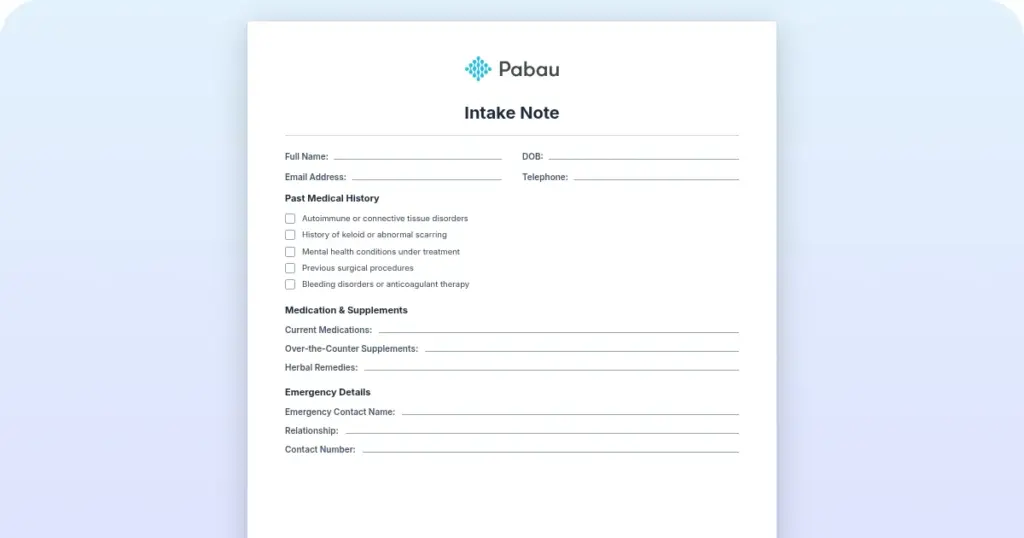
Intake note template
An intake note is the clinical record a therapist or counselor writes at the sta...

2
Last Updated: Oct 22, 2026
A waxing consent form is the document a client signs before any waxing service. It confirms they understand the procedure and its risks. It also records contraindications such as Accutane or retinoid use, and the client’s agreement to your liability terms.
The free template below covers client details, contraindication screening, consent and waiver wording, and signature blocks for adults and minors. This guide explains what each section asks, how to run the form digitally, and how to adapt it by service.
A ready-to-use consent form with client details, contraindication screening, informed consent acknowledgments, a liability waiver, and signature blocks. It works for every waxing service, from brows to Brazilians.
Download template
A waxing consent form records a client’s health history, contraindications, and informed consent, and it protects your salon if a reaction occurs.
Every form should cover contact details, Accutane and medication disclosure, skin sensitivities, a liability waiver, and the client’s signature.
Minors need parental or guardian consent, and age thresholds and signature rules vary by US state.
Digital waxing consent forms with e-signatures are legally valid under the ESIGN Act (US) and eIDAS (EU), and UK eIDAS covers the UK.
HIPAA usually applies only to covered entities, so most waxing salons follow state privacy rules and good practice instead.
A waxing consent form confirms that the client understands the procedure, has disclosed relevant health information, and accepts the known risks. It also records their agreement to hold the esthetician and salon harmless. For estheticians, it works as both a safety check and a protective record.
Unlike an esthetician intake form, which gathers general client information and preferences, a consent form deals with informed consent. That is the client’s documented agreement to go ahead after hearing the risks. The two work together. The intake form asks about health history, and the consent form confirms the client understands what those answers mean for today’s service.
A complete form captures client contact details, health history screening, contraindication disclosure, informed consent language, a liability waiver, and signature blocks.
Ask clients to disclose the following.
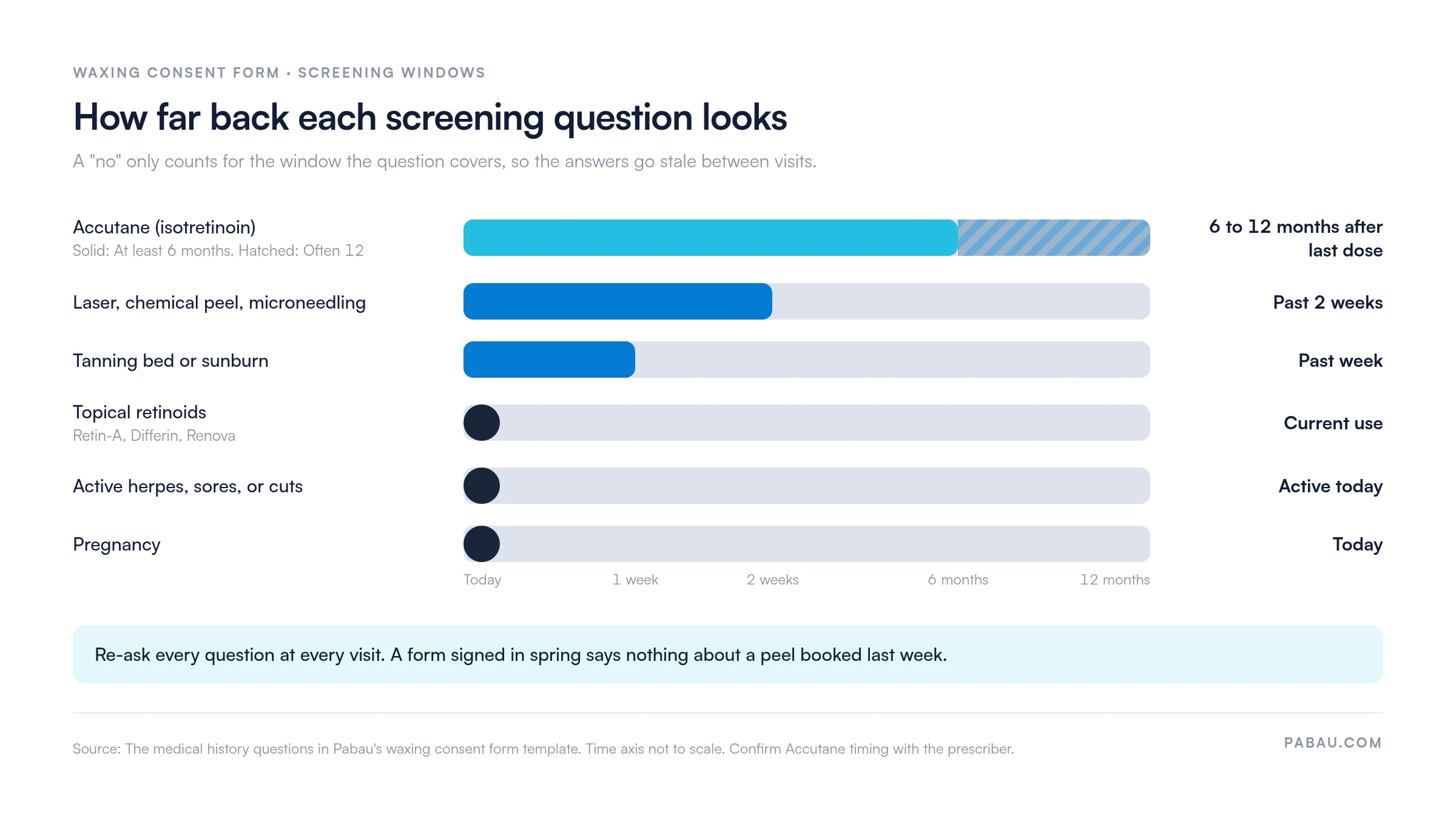
Each question looks back over a different window, from today to a full year. The chart below shows how long a “no” to each one stays valid.
Include explicit acknowledgment statements such as this one.
“I confirm I have disclosed all relevant health information. I understand waxing may cause temporary redness, irritation, ingrown hairs, or allergic reactions. I agree that the esthetician and salon are not liable for any adverse effects. I have read this form and agree to proceed.”
Require the client’s signature and date. For minors, also require the parent’s or guardian’s printed name, signature, and date. Digital signatures are legally valid under the ESIGN Act in the US, EU eIDAS in the EU, and UK eIDAS in the UK.
Most US states require parental or guardian consent for minors. Age thresholds vary. Some states let 16- and 17-year-olds consent on their own, while others require parental consent until 18. Check your state cosmetology board’s rules before serving minors.
Include a dedicated minor consent section with fields for the parent’s or guardian’s full name, relationship to the minor, signature, and date. This documents that an adult with legal authority approved the service.
Digital consent forms are legally valid, and they take paperwork out of check-in. Five steps get one running.
The template covers every waxing service type, but you can tailor it to the services you offer.
Also add your own details. That means your salon name and contact information, the treatments you offer, and your cancellation policy. Include aftercare instructions too. Clients should moisturize within 24 hours, avoid tight clothing, and stay out of the sun for 24 hours. For brow clients, pair the form with an eyebrow waxing aftercare sheet they take home.
Storing client health information securely also supports GDPR compliance (UK). HIPAA usually applies only to covered entities, so most US waxing salons follow state privacy rules and good practice instead.
On paper, waxing consent tends to be signed once and filed. The answers then sit in a cabinet while the client starts a new retinoid or books a peel somewhere else.
Practice management software like Pabau sends the consent form to the client ahead of the appointment, so they complete it on their phone. Pabau GO, our iOS app for practitioners, shows the pre-appointment checklist. You see the signed form before the client sits down.
After the service, Pabau Scribe, our AI scribe, drafts the treatment notes. Your record of the wax is finished before the next client arrives.
Because digital consent sits inside your spa management software, the form, the booking, and the treatment note share one record. Check-in gets faster, and you can show an insurer the signed form for any visit.

Pabau sends digital consent forms before each appointment and keeps every signed version on the client record. Your screening answers stay current, and your files are ready for any insurer query.

A waxing consent form only protects you if it describes the client in front of you today. A form signed last spring says little about the retinoid they started last month.
Treat the signature as the last step of a screening conversation, not a substitute for one. Re-ask the contraindication questions at every visit, and update the form whenever your insurer or service menu changes. The trade-off is a minute or two at check-in, set against a skin-lifting injury that can scar.
Paper forms make that routine hard to keep, because the latest answers sit in a filing cabinet. Pabau sends the form before the appointment and stores each signed version on the client’s record. Book a demo to see how Pabau keeps waxing consent current for every client and every visit.

Need aftercare instructions for brow clients? Eyebrow waxing aftercare gives you a ready-made sheet to send home after each brow service.
Want health history on file before the first wax? Esthetician client intake form collects contact details, skin history, and medications in one template.
Planning treatment with a new client? Esthetician consultation form structures the first conversation about goals, skin type, and service options.
Offering facials alongside waxing? Facial consent form covers the risks and acknowledgments specific to facial treatments.
Running a spa with a mixed service menu? Spa intake form template captures client preferences and health details across every treatment you offer.
Include client contact details, date of birth, an emergency contact, and current medications. Screen for Accutane and retinoid use, photosensitizing medications, skin conditions, pregnancy, and recent procedures. Then add informed consent language, a liability waiver, and a dated signature. For minors, also require a parent or guardian’s name, relationship, and signature.
Yes, in practice. Many salon liability insurers and professional associations such as ASCP recommend written consent before waxing, and some policies require it. A signed consent form documents informed consent and may reduce your liability if a client has an adverse reaction.
Not until a prescriber or the 6-12 month waiting period clears it. Waxing is generally advised against for at least 6 months, often 12, after the last dose of Accutane (isotretinoin). Until then, it risks skin lifting, tearing, and scarring. Ask clients about Accutane use in the past 12 months, and check with their prescriber before booking.
Yes. Digital consent forms with electronic signatures are legally valid under the ESIGN Act (US) and eIDAS (EU), and UK eIDAS covers the UK. Choose a platform that encrypts data and keeps audit logs. UK and EU salons must follow GDPR. HIPAA usually applies only to covered entities, so most US waxing salons follow state privacy rules and good practice instead.
A consultation form gathers client goals, preferences, and lifestyle information to help design a service plan. A consent form documents informed consent to the procedure and acknowledgment of risks. Both are useful, and many salons combine them into one intake process.