Mood Disorders Questionnaire Scoring
Mood disorders questionnaire scoring checks three answers on the Mood Disorder Q...

2
Last Updated: Oct 19, 2026

A body dysmorphia worksheet is an open-ended reflection tool that helps therapists open a conversation with clients about appearance-related concerns and possible body dysmorphic disorder symptoms.
The evidence-based first-line psychological treatment for BDD is cognitive behavioral therapy with exposure and response prevention (ERP). This worksheet’s reflections help clinicians identify where that treatment should focus.
Clinicians can integrate the worksheet into sessions as an intake exercise, an in-session prompt, or a repeatable check-in, with client portal sharing for better engagement.
Pabau’s digital forms and client portal let you send the worksheet to clients, collect completed responses, and link them directly to clinical notes for seamless BDD treatment tracking.
A ready-to-use reflection worksheet for mental health clinicians working with clients on body image concerns. Includes 11 open-ended questions covering mirror perception, appearance-related emotions, social comparison, camouflaging behaviors, and coping strategies, plus a closing reflection field – all in one printable format.
Download templateA body dysmorphia worksheet is an open-ended reflection tool that helps mental health professionals start a structured conversation with clients about body image concerns and possible body dysmorphic disorder (BDD) symptoms. It isn’t a diagnostic instrument or a full CBT/exposure and response prevention (ERP) protocol.
Instead, it asks clients a series of guided questions about mirror perception, appearance-related emotions, social comparison, camouflaging behaviors, and coping strategies, surfacing material clinicians can use to inform assessment and treatment planning.
This article walks through what the worksheet contains, how to use it effectively in your practice, and how it fits alongside more structured clinical tools for BDD.
Body dysmorphic disorder affects an estimated 1.7-2.4% of the population, yet remains significantly underdiagnosed and undertreated in routine clinical practice. Clients often present with complaints about appearance that seem minor or non-existent to others, yet the concern can consume hours of their time in checking, comparing, or camouflaging behaviors.
A body dysmorphia worksheet serves as the clinician’s structured conversation starter. It opens the topic, gives clients a way to put appearance-related thoughts and feelings into words, and creates a record clinicians can revisit between sessions.
The worksheet does one job well: it gives clients a structured, low-pressure way to put their body image experience into words. That includes what they see in the mirror, which body parts preoccupy them, how they compare themselves to others.
That reflective material becomes the clinician’s starting point for deeper assessment and, where appropriate, referral to a validated screening tool or a structured CBT/ERP treatment plan. Without a structured tool, clinicians risk missing BDD entirely or defaulting to reassurance (“Your appearance is fine”) that reinforces the disorder.
Body dysmorphic disorder is classified in the DSM-5 under the Obsessive-Compulsive and Related Disorders section, reflecting its core feature: an obsessive preoccupation with appearance defects that are either non-observable or appear minor to others. The disorder involves compulsive repetitive behaviors (checking mirrors, seeking reassurance, camouflaging, skin picking) and cognitive distortions (catastrophizing appearance, overestimating social judgment).
Clinically, BDD often co-occurs with depression, anxiety, and elevated suicide risk, making early, confident screening essential. A crisis intervention plan should be part of your standard protocol for clients presenting with these risk factors.
According to the NICE guidelines on OCD and BDD, CBT with ERP is the gold-standard first-line psychological treatment. The body dysmorphia worksheet doesn’t replace that structured treatment – but it gives clients a low-stakes way to start articulating their appearance-related thoughts and feelings, which helps clinicians decide where formal CBT and ERP work should focus.
A reflection-style body dysmorphia worksheet like the one built into practice management software such as Pabau works because it stays simple. Rather than replicating a full clinical interview, it organizes three components:
This open-ended format is deliberately different from a structured CBT thought record or ERP hierarchy – it’s designed to surface material in the client’s own words, which clinicians can then use to inform a more structured assessment or treatment plan.
Completed forms belong in structured medical records management, not a filing cabinet.
Effective worksheet integration follows a simple sequence. At an early assessment session, introduce it as a reflection exercise rather than a diagnostic test: “I’d like you to spend a few minutes reflecting honestly on how you see and feel about your body. There’s no right or wrong answer here – it just helps me understand your experience.”
Let the client work through the eleven questions in their own words, either in session or as homework. Explain that a BDD diagnosis requires preoccupation causing significant distress or functional impairment, not simple dissatisfaction.
Once you’ve reviewed the client’s answers, use them as a bridge into more structured clinical work. If responses suggest significant preoccupation, distress, or camouflaging and checking behaviors consistent with BDD, follow up with a validated screening or severity measure (see the assessment tools below) and, where appropriate, build a formal CBT program incorporating thought records and a graded ERP hierarchy.
Deliver the reflection worksheet via digital forms so clients can complete it between sessions, then review findings at the next appointment. This asynchronous work deepens the therapeutic alliance and surfaces material clients may find easier to write than say out loud.

Once treatment moves into a formal CBT and ERP program. Document client progress weekly: “Client completed 4 out of 5 mirror-checking reductions this week; reports decreased anxiety when makeup-free for 30 minutes.”
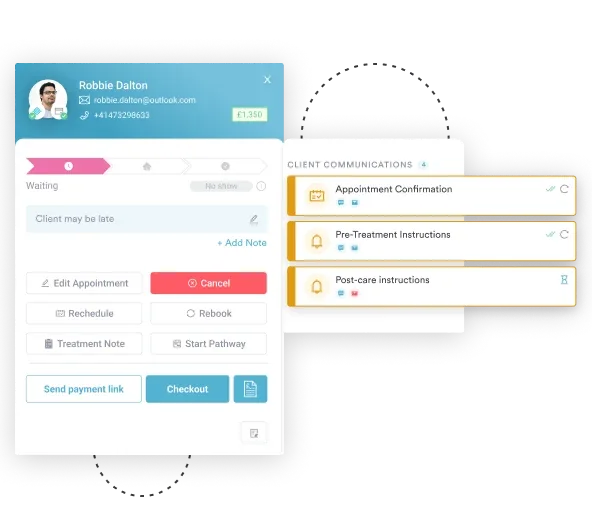
Improving patient compliance with worksheets requires regular review cycles, celebratory feedback on completed assignments, and clear linkage between worksheet gains and symptom improvement – not one-time handouts. Build worksheet completion into your standing appointment structure.
Beyond the reflection worksheet itself, validated screening instruments complement your assessment. The BDD-YBOCS (Yale-Brown Obsessive Compulsive Scale for BDD) is a clinician-administered 12-item severity measure scoring preoccupation time, resistance, and impact, making it ideal for baseline and outcome tracking.
The Body Dysmorphic Disorder Examination (BDDE) is a 34-item structured interview assessing appearance concerns, repetitive behaviors, and avoidance.
General distress measures such as the CORE-10 can complement these BDD-specific tools when you also want to track a client’s overall psychological wellbeing alongside their BDD-specific symptoms.
Pabau’s open-ended worksheet is not a substitute for either of these validated tools. Use it to open the conversation, then apply a dedicated screening or severity measure once BDD is suspected.