GLP-1 usage by state: Who’s taking, searching and paying in 2026
GLP-1 usage by state peaks in West Virginia, America’s GLP-1 capital, with...

Last Updated: Oct 16, 2026
A 1500 calorie diet plan for weight loss sets daily energy intake at 1,500 kilocalories, a level that creates a deficit for most adults. Typical adult needs run from 2,000 to 2,500 calories a day, so the plan cuts roughly 500 to 1,000 calories. At that rate a patient loses about 0.5 kg (1 lb) a week.
Who the plan suits matters more than the number itself. For women with light to moderate activity, 1,500 kcal is a 20% to 25% cut and generally safe for 8 to 12 weeks. For most men the same intake lands at a 40% to 50% cut, which few can sustain.
NHS guidance ranks a structured calorie deficit among the most effective weight-loss approaches for adults. The harder part is giving patients a plan they can follow at home, then finding out whether they did. This template hands dietitians, nutritionists, and practice teams that structure, and weight loss clinic software like Pabau tracks what happens next.
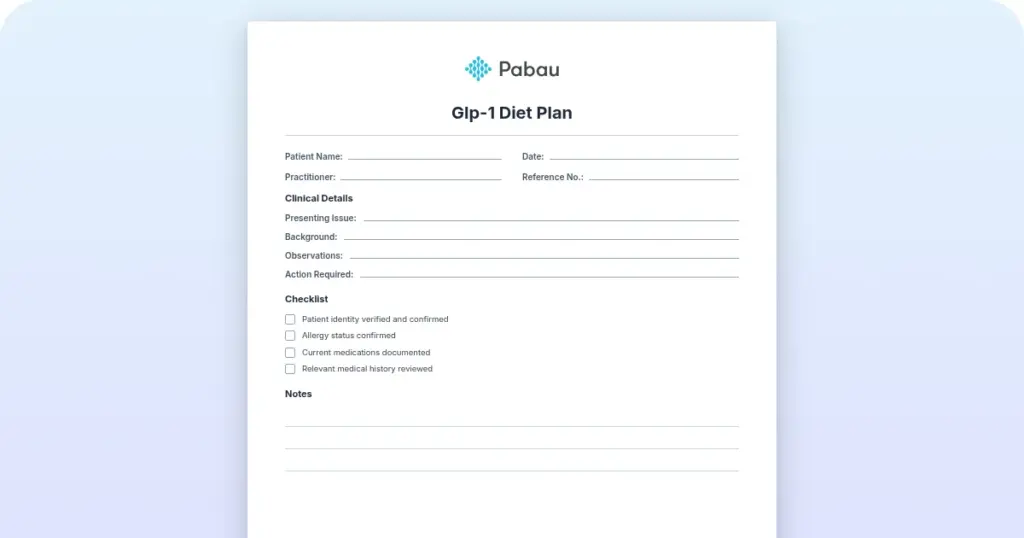
The PDF carries a seven-day meal schedule, per-meal calorie targets, macronutrient goals, a grocery list, and space to log hunger and adherence. Add the patient’s name and daily targets before you send it.
Download template
A 1,500 kcal intake cuts about 500 calories a day for a typical adult, which is roughly 0.5 kg of loss a week.
Protein at 1.2 to 1.6 g per kg of body weight protects muscle during restriction and keeps patients fuller for longer.
The same 1,500 kcal is a 20% to 25% cut for most women and a 40% to 50% cut for most men.
Men usually need 1,800 to 2,000 kcal to lose weight without fatigue, muscle loss, or an early dropout.
Pabau’s digital forms and client portal distribute the plan, collect adherence answers, and let you adjust macros without a follow-up call.
It fixes daily intake at 1,500 kcal so the body runs a steady shortfall and draws on stored fat to cover it. The size of that shortfall sets the pace. A 500 kcal daily deficit, the difference between typical adult needs and 1,500 kcal, produces about 0.5 kg (1 lb) of loss a week.
Results vary widely between individuals. Two patients of the same height and weight can lose at very different rates, depending on metabolism, activity, muscle mass, and hormonal factors.
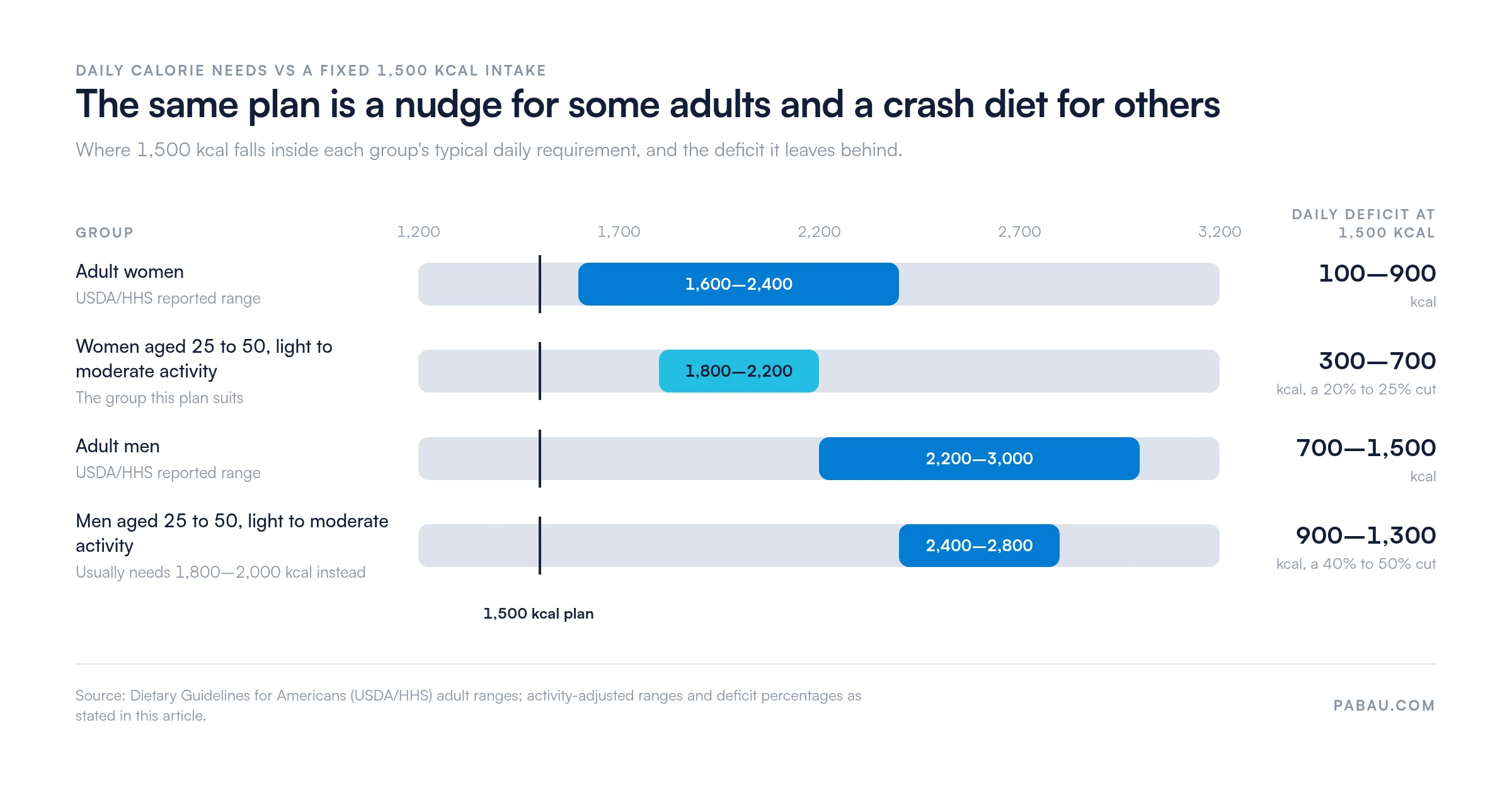
Total daily energy expenditure (TDEE) is the variable that decides all of this. It shifts with age, sex, body composition, activity level, and resting metabolic rate. The Dietary Guidelines for Americans (USDA/HHS) report adult ranges of 2,200 to 3,000 kcal a day for men. For women the reported range is 1,600 to 2,400 kcal a day.
Those are broad ranges rather than prescriptions. A sedentary woman of 65 may need 1,600 kcal a day, so 1,500 barely moves her. A tall, active man may need 3,200 kcal, so 1,500 is severe. Set the target against the patient’s own requirement instead of applying one number to every case.
It suits adult women with moderate activity levels and no contraindications. It is usually too low for adult men, tall adults, and highly active people. Several groups should not follow it at all without clinical supervision.
Sex and baseline calorie needs: Women aged 25 to 50 with light to moderate activity usually need 1,800 to 2,200 kcal a day. At 1,500 kcal that is a 20% to 25% cut, which is generally safe for 8 to 12 weeks.
Men of the same age and activity usually need 2,400 to 2,800 kcal. At 1,500 kcal they face a 40% to 50% cut, which is too aggressive to hold. Most men need at least 1,800 to 2,000 kcal to lose weight while keeping muscle and adherence intact. The chart below shows how far 1,500 kcal sits from each group’s typical requirement.
Macronutrient distribution decides satiety, muscle retention, and compliance at this intake. Protein does the most work of the three, so set it first and build carbohydrate and fat around it.
Protein sits at the high end of that range for a reason. High-protein plans hold up better on adherence and body composition than standard low-fat plans at the same calorie level. Fiber and whole foods add volume, so patients feel fed on fewer calories.
Build meals from whole, nutrient-dense foods that deliver the most satiety per calorie. Protein sources, colorful vegetables, whole grains, and healthy fats all do that job.
Processed foods, added sugars, refined carbohydrates, and high-calorie drinks all undermine the plan. Ask patients to cut sugary drinks, fried foods, pastries, confectionery, and ultra-processed snacks. Alcohol carries 7 kcal per gram and returns no nutrients for it. These foods displace nutrient-dense options and set off hunger cycles.
Each day below totals roughly 1,500 kcal and meets the macronutrient targets above. Adapt it to what the patient will actually eat, using the preferences captured on your weight loss intake form.
The week above works for most women aged 25 to 50 with moderate activity. Most men need 200 to 500 kcal more each day, and at 1,500 kcal they meet hunger, fatigue, and muscle loss instead of steady progress.
Move men to 1,800 to 2,000 kcal by adding a protein-focused snack, a larger dinner portion, or an extra serving of whole grains. Reassess every two weeks. If weight stalls or compliance slips, step the target up to 1,600 kcal first, then 1,700.
Print and share this list with patients starting the plan. Grouping items by store section shortens the trip and cuts down on impulse buys.
Adherence rises sharply when patients batch-cook. Recommend a two-hour prep session on Sunday and hand them this sequence.
This plan is not suitable for everyone. Patients should consult a registered dietitian or physician before starting if they:
Micronutrient risks: NIDDK defines a very-low-calorie diet as 800 kcal a day or fewer, and 800 to 1,200 kcal a day as a low-calorie diet. Both can leave patients short on vitamin D, iron, calcium, and B12. At 1,500 kcal the risk drops but does not disappear, particularly among plant-based eaters.
Recommend a standard multivitamin plus 1,000 IU of vitamin D daily, and reassess after eight weeks. If a patient reports fatigue or hair loss, order serum ferritin, B12, and 25-OH vitamin D levels.
A patient who genuinely needs a tighter target belongs on a supervised 1200 calorie diet plan rather than an improvised version of this one.
Most practices email the plan as a PDF attachment and then wait. The practice has no record of whether the patient opened it, started it, or quit in week two. The next consultation opens with the practitioner reconstructing three weeks from memory.
Pabau distributes this template through the patient portal and attaches it to the treatment plan. A digital form then collects daily meals, calorie intake, hunger levels, and the barriers the patient ran into that week.
Automated workflows send the Monday check-in without a staff member having to remember it. Answers land on the patient record, so the practitioner reads three weeks of adherence before the patient sits down.
You can then adjust macros, swap foods, or raise the target for a male patient inside the same form. The patient sees the change straight away, and the practice keeps a dated record of who changed what.


Distribute diet templates, collect adherence answers, and adjust macro targets from the patient record, so every check-in starts with what the patient actually ate.

The number on the plan matters less than who you hand it to. For a moderately active woman, 1,500 kcal is a deficit she can hold for two or three months. For most men it is a cut they abandon by week three, so start them at 1,800 to 2,000 kcal.
Personalize the target, keep protein at the top of the range, and reassess every two weeks. Patients who batch-cook and log what they eat stay on plan far longer than patients handed a printout at the door.
The trade-off worth remembering is speed against adherence. A deeper deficit loses weight faster right up to the point the patient stops. Book a demo to see how Pabau distributes diet plans and tracks adherence for weight-loss practices.

Planning a longer program? The 30 day meal plan for weight loss extends the same approach across a full month of meals.
Working from macros rather than calories? The macro diet plan sets protein, carb, and fat targets first and builds meals from there.
Adding activity to the deficit? The weight loss workout plan pairs resistance and cardio sessions with a calorie-restricted week.
Starting a new patient from scratch? The weight loss intake form captures baseline weight, medications, and food preferences before you pick a target.
A 500 kcal daily deficit produces about 0.5 kg (1 lb) a week. Followed consistently, that works out at approximately 2 kg monthly. Results vary with metabolism, starting weight, activity level, and water retention. Most patients lose steadily for four to eight weeks, then plateau as the body adapts. More activity or a change in meal timing usually restarts progress.
For most women with moderate activity, 1,500 kcal is a safe, moderate deficit. For most men it is too low to sustain, and fatigue, muscle loss, and rebound hunger follow. Very short or sedentary patients may also find the deficit excessive. Calculate personal TDEE first, then aim for a 20% to 30% cut rather than a 40% one.
Build meals from lean proteins such as chicken, fish, eggs, and Greek yogurt. Add non-starchy vegetables, whole grains like oats and brown rice, and healthy fats from olive oil, nuts, and avocado. Avoid processed foods, added sugars, fried items, and high-calorie drinks. The food lists and sample week above give specific portions.
Yes. Weight loss happens whenever calories in fall below calories out, with or without activity. Adding 150 minutes of moderate cardio and two strength sessions a week preserves muscle, speeds up loss, and improves compliance. Exercise also steadies hunger and mood during restriction, so combining the two beats dieting alone.
Set aside two hours on Sunday to batch-cook proteins and grains and to chop vegetables. Portion them into containers labeled with the date and the calorie count, then pre-pack snacks. Refrigerated portions keep for four to five days and frozen ones for up to a month. Ready meals remove the daily decision and prevent calorie overshoot.