CPT code 93503: Swan-Ganz catheter billing and modifiers
CPT code 93503: Official descriptor and procedure overview In the AMA CPT code s...

Last Updated: Oct 23, 2026
J7635 is the HCPCS Level II code for atropine, inhalation solution, compounded product, administered through DME, concentrated form, per milligram. It covers a pharmacy-compounded atropine concentrate that needs a separate diluent before nebulization, billed at one unit per milligram.
Medicare does not pay it. The DME MAC nebulizer policy, LCD L33370, denies J7635 as not reasonable and necessary, like every compounded inhalation solution. J7636 is the atropine unit dose counterpart, and albuterol never belongs on either code.
Let Pabau's smart automation suggest the right codes, reduce claim denials, and keep your practice compliant—effortlessly.
Automate repetitive tasks and focus on what matters most—your patients.
Reduce coding errors and ensure compliance with the latest regulations.
Clean claims, fewer denials, and faster reimbursements.
Powerful insights and reporting to help your practice thrive.
HIPAA compliant SOC 2 certified GDPR-compliant Trusted by 4,000+ clinics worldwide

HCPCS code J7635 covers atropine inhalation solution, compounded product, administered through DME, concentrated form, per milligram.
J7635 is the concentrate that needs a separate diluent, while J7636 is the ready-to-use atropine unit dose form.
Medicare denies J7635 as not reasonable and necessary under LCD L33370, and no ICD-10-CM code changes that outcome.
KO, KP and KQ never go on J7635, because they apply only to unit dose form codes.
Albuterol bills under J7609, J7610, J7611 or J7613, so an albuterol product never belongs on J7635.
HCPCS code J7635 is the Level II code for a pharmacy-compounded atropine inhalation solution in concentrated form, billed per milligram of atropine. The official CMS long descriptor reads: Atropine, inhalation solution, compounded product, administered through DME, concentrated form, per milligram.
The CMS short descriptor is “Atropine comp con.” The code has sat in the HCPCS file since January 1, 2000, and it remains active in the October 2026 release.
Three words in the descriptor carry the billing rules. “Compounded” decides Medicare coverage, “concentrated” separates it from J7636, and “per milligram” sets the units.
The code attributes above come from the CMS HCPCS quarterly file for October 2026. Check it again each quarter, because CMS can revise a descriptor or add an action code at any release.
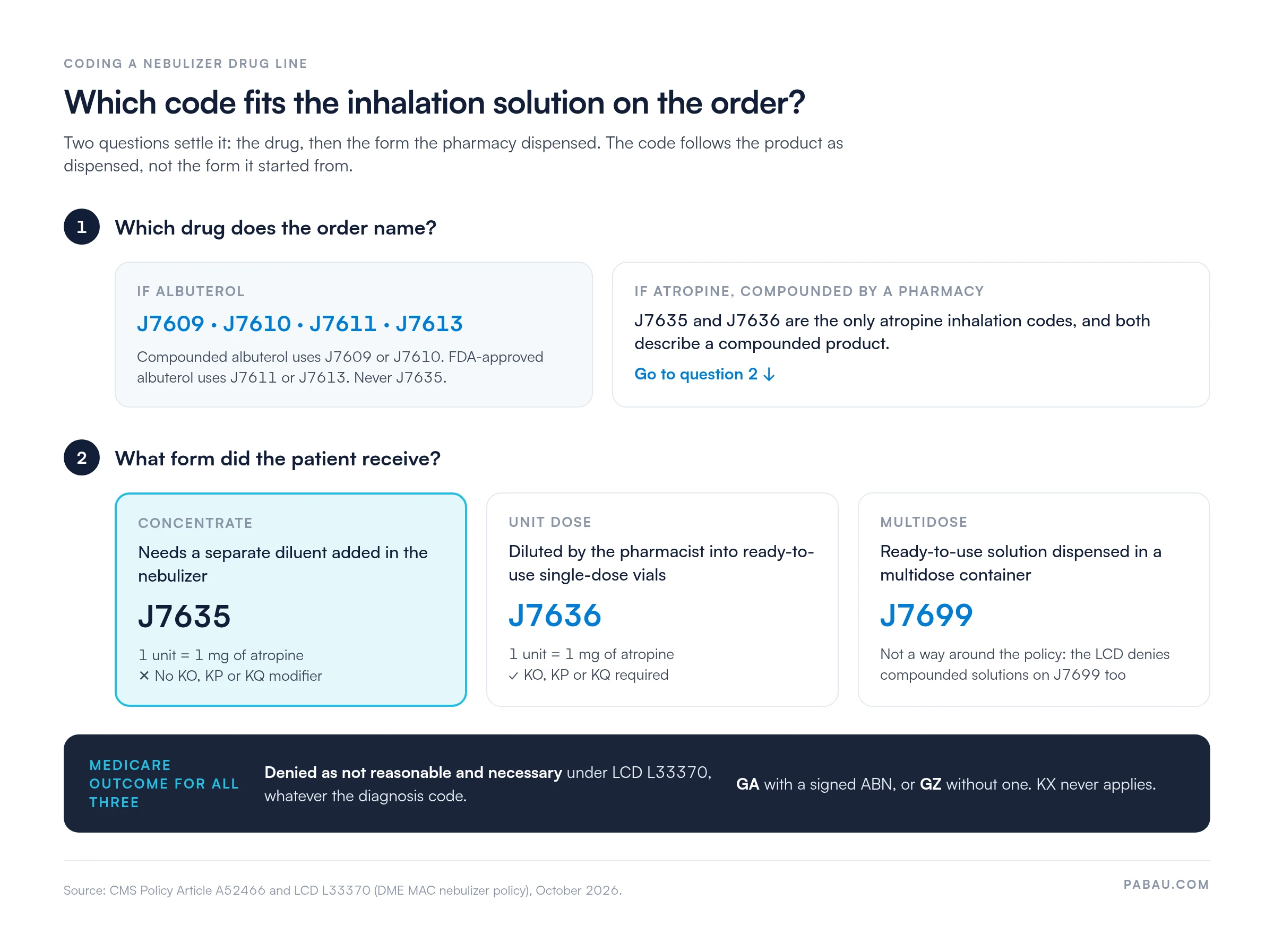
J7635 and J7636 are the only two atropine inhalation codes in HCPCS, and both describe a compounded product. The difference is the strength of the solution the patient receives.
Policy Article A52466 defines the two forms. A concentrated form needs a separate diluent added in the nebulizer. A unit dose form comes in a single-treatment container, dilute enough to use as dispensed.
The code follows the formulation as dispensed, not the form the pharmacy started from. A52466 gives the rule: a concentrate diluted by the pharmacist into ready-to-use single-dose vials is billed as the compounded unit dose form.
So a pharmacy that dilutes atropine concentrate into single-dose vials bills J7636, not J7635. A ready-to-use solution dispensed in a multidose container goes under J7699 instead, per the same article. The diagram below routes a nebulizer drug order to its code in two questions.
J7635 is sometimes confused with albuterol because both sit in the J7600 range and both reach the patient through a nebulizer. The HCPCS file gives albuterol four codes of its own, and none of them is J7635.
Albuterol 0.083% vials from a manufacturer are an FDA-approved unit dose product. They bill under HCPCS code J7613, never J7635.
If a claim shows J7635 against an albuterol NDC or an albuterol order, the code is wrong. Fix the code before you check the units, the modifiers or the diagnosis.
Atropine also sits next to ipratropium bromide, another anticholinergic given by nebulizer. Its FDA-approved unit dose solution bills under HCPCS code J7644. Which drug the patient gets is the prescriber’s decision, not the biller’s.
Medicare denies J7635 because the code describes a compounded product. LCD L33370, the DME MAC nebulizer policy, lists J7635 among the compounded inhalation solutions that “will be denied as not reasonable and necessary.”
The current LCD revision took effect for services on or after February 1, 2026. All four DME MACs apply it, so the outcome does not change between jurisdictions.
A52466 defines a compounded inhalation solution as one that is not an FDA-approved preparation. It is mixed, combined or altered by a pharmacy for one beneficiary.
An FDA-approved ingredient does not change that. Atropine injection mixed by a pharmacy into an inhalation solution still counts as compounded, so it still lands on J7635 or J7636.
The denial reaches the equipment too. Under L33370, when none of the drugs used with a nebulizer are covered, the compressor, the nebulizer and related supplies are denied as well.
J7699 and J7999 are no way around the policy. The LCD denies compounded solutions billed with J7699, and A52466 says J7999 must not be used for compounded nebulizer drugs.
One unit of J7635 equals 1 mg of atropine. Work out the milligrams of atropine dispensed, then bill that number as units of service.
A52466 gives the conversion for a percentage strength. A 1% solution holds 10 mg of drug in each milliliter, so milligrams equal the percentage times 10, times the milliliters dispensed.
As an illustration only, take 10 mL of a 1% concentrate. That is 10 mg/mL times 10 mL, or 100 mg of atropine, billed as 100 units of J7635.
Watch for the injection codes. Atropine sulfate injection codes such as J0461 bill per 0.01 mg, so their units run 100 times higher than J7635 for the same dose. Carrying units across from an injection code inflates the inhalation claim a hundredfold.
Ask the compounding pharmacy for the concentration and the total volume in writing before the claim is built. Those two numbers decide the units, and they also prove the product was a concentrate rather than a unit dose.
J7635 never takes KO, KP or KQ. A52466 says those modifiers are not used with the concentrated form codes, and every unit dose form code must carry one of them.
The modifiers that do matter on J7635 are the liability modifiers. Claim lines without KX, GA or GZ are rejected as missing information under A52466.
A GA line moves financial liability to the patient, because they agreed in writing to pay. A GZ line leaves the supplier to absorb the denial. For a code Medicare always denies, the ABN is the step that protects the practice.
J7635 has no Medicare payment limit to look up. It is missing from the October 2026 Part B payment limit file and the matching ASP NDC-HCPCS crosswalk. CMS publishes both with its ASP pricing files.
Only FDA-approved, non-compounded inhalation codes appear in those files. J7613 is listed, for example, while J7635 and J7636 are not.
That absence fits the product. A compounded solution prepared for one patient has no manufacturer NDC that CMS could map to the code. Do not expect an NDC lookup to confirm J7635.
Dispensing fees follow the same logic. A52466 limits G0333, Q0513 and Q0514 to covered inhalation drugs, so a denied J7635 line does not support one. Our guide to medical billing denial codes helps you read the remittance when it comes back.
A J7635 claim will deny, but the file behind it still matters. It proves which code was right, who carries the cost, and that the patient was told in advance.
Keeping these together is basic medical billing compliance. It also lets the team answer a patient’s billing question without rebuilding the story from three systems.
Medicaid and commercial plans set their own rules, so check each plan’s policy before dispensing. Do not assume the Medicare outcome carries over in either direction.
Some commercial policies follow the same logic as Medicare. Independence Blue Cross, for example, has listed J7635 and J7636 as not medically necessary since 2018, because commercially manufactured products are available.
State Medicaid programs differ on compounded drugs, prior authorization and which codes they accept at all. Read the current state fee schedule and provider manual, and keep a copy with the claim.
Most J7635 problems start before the claim is built. The table below lists the errors that turn up on this code and how to stop each one. A denial management routine helps separate fixable denials from ones that were never payable.
A clean claim on J7635 is one with the right code, the right units and the right liability modifier. It will still deny under Medicare, but it denies for the expected reason.
Errors on J7635 start where the product detail and the claim live apart. The pharmacy record holds the concentration, the chart holds the order, and the ABN sits in a paper file.
Pabau, the practice management and billing platform we build, keeps the order, signed forms and the claim against the same patient record. The biller can see the drug, the dose form and the ABN before choosing a code or a modifier.

Claims management in Pabau prepares and tracks each claim from that record. When a remittance comes back, the denial reason sits next to the documentation that explains it.
No software makes a compounded atropine claim payable under Medicare. What it changes is how early the team sees the product question, and how complete the file is when the denial arrives.

Pabau keeps the order, the signed ABN and the claim on one patient record. Billing teams can check the drug, the dose form and the modifier before a J7635 claim goes out.

J7635 is a narrow code: compounded atropine concentrate, billed per milligram. Medicare denies it under LCD L33370, so the job is to code it correctly and keep the cost off the practice.
Confirm the drug is atropine and the product is a concentrate. Count milligrams, leave KO, KP and KQ off the line, and collect the ABN before delivery. If the order names albuterol, the right code is J7609, J7610, J7611 or J7613.
Practices that settle the product question before dispensing avoid most of the rework on this code. Book a demo to see how Pabau keeps orders, ABNs and nebulizer drug claims in one place.

Billing a compounded acetylcysteine solution as well? HCPCS code J7604 covers another compounded inhalation solution that LCD L33370 denies, and the payable code beside it.
Coding the albuterol product this page is not about? HCPCS code J7613 covers FDA-approved albuterol unit dose solution, billed per milligram.
Need the anticholinergic code Medicare does pay? HCPCS code J7644 covers FDA-approved ipratropium bromide unit dose solution.
Billing the nebulizer itself? HCPCS code E0570 explains how the nebulizer and compressor are covered under the same policy.
Sorting fixable denials from expected ones? Denial management in healthcare sets out how to triage denials and prevent repeats.
HCPCS code J7635 covers atropine inhalation solution, compounded product, administered through DME, concentrated form, per milligram. It applies to a pharmacy-compounded atropine concentrate that needs a separate diluent before nebulization.
J7635 is compounded atropine in concentrated form, which needs a diluent added in the nebulizer. J7636 is compounded atropine in unit dose form, ready to use as dispensed. Both bill per milligram, and Medicare denies both under LCD L33370.
No. J7635 is an atropine code. Albuterol inhalation solution bills under J7609 or J7610 when compounded, and under J7611 or J7613 when it is an FDA-approved product.
No. LCD L33370 denies J7635 as not reasonable and necessary, along with other compounded inhalation solutions. Policy Article A52466 lists every ICD-10 code as non-covered for J7635.
Bill one unit per milligram of atropine dispensed. A 1% solution holds 10 mg per milliliter, so multiply the mg/mL figure by the milliliters dispensed.
Use GA when a signed ABN is on file, or GZ when it is not. KO, KP and KQ are not used with concentrated form codes, and KX does not apply because the LCD criteria cannot be met.
No. LCD L33370 also denies compounded solutions billed with J7699. Policy Article A52466 says J7999 must not be used for compounded nebulizer drugs either.