Inpatient billing cheat sheet
An inpatient billing cheat sheet is a quick reference for the codes and claim ru...

Last Updated: Oct 19, 2026
J7510 is the HCPCS Level II code for prednisolone oral, per 5 mg.
One billing unit equals 5 mg dispensed or administered, so a 20 mg dose is billed as 4 units. Every claim line also carries the national drug code for the product given. Billers most often confuse J7510 with methylprednisolone oral (J7509), a different drug billed per 4 mg.
Let Pabau's smart automation suggest the right codes, reduce claim denials, and keep your practice compliant—effortlessly.
Automate repetitive tasks and focus on what matters most—your patients.
Reduce coding errors and ensure compliance with the latest regulations.
Clean claims, fewer denials, and faster reimbursements.
Powerful insights and reporting to help your practice thrive.
HIPAA compliant SOC 2 certified GDPR-compliant Trusted by 4,000+ clinics worldwide

HCPCS code J7510 covers prednisolone oral only, and one billing unit equals 5 mg dispensed or administered
NDC reporting is mandatory on every J7510 Medicare claim line, and a missing one triggers automatic rejection
J7509 covers methylprednisolone oral, a different drug, so the wrong code denies on medical-necessity grounds
Pabau matches J7510 to the correct encounter, dose, and NDC before the claim is submitted
HCPCS code J7510 is an active HCPCS Level II drug code maintained by the Centers for Medicare and Medicaid Services (CMS). It reports the oral administration or dispensing of prednisolone in 5 mg billing increments. CMS defines billing units at the 5 mg level, which means a 20 mg dose requires 4 units on the claim.
The code is active for fiscal year 2026, with no published termination date as of the current CMS annual update file. Billers should verify the active status each October when CMS releases its annual HCPCS revision. The HCPCS Level II index covers the other drug codes a billing team meets alongside J7510.
Prednisolone is an FDA-approved corticosteroid used across several indications, including inflammatory and autoimmune conditions. The oral route is its most common delivery method in outpatient settings. That is why CMS created a dedicated J-code instead of routing it through the unclassified drug code J3490.
Having a dedicated code supports consistent NDC crosswalk reporting and more reliable payer adjudication. Verify the current code status each year via the CMS HCPCS Level II code set.
Each billing unit for HCPCS code J7510 equals exactly 5 mg of prednisolone oral dispensed or administered. A prescriber ordering 40 mg per day generates 8 units on that day’s claim line. Miscounting units is one of the top denial drivers for J7510 because insurers audit against the documented dose in the clinical note. If the note says 20 mg but the claim says 6 units (30 mg), the payer flags the discrepancy and denies.
The calculation is always the total milligrams dispensed or administered on a single date of service divided by 5. Bill only the amount actually given, not the package size. If a 5 mg tablet was dispensed but the patient did not take it during the visit, that unit should not appear on the claim.
When billing J7510 to Medicare or most commercial payers, each claim line must carry the national drug code (NDC) for the specific prednisolone product dispensed. CMS requires the NDC in the form: Qualifier (N4) + 11-digit NDC + unit qualifier (UN = each, ML = milliliter) + quantity. Omitting the NDC or using an incorrect format causes automatic rejection at the clearinghouse or payer level, before a human reviewer ever sees the claim.
NDC numbers change when manufacturers update packaging, shift suppliers, or reformulate products. The table above is illustrative. Always verify the current NDC against your drug supplier’s labeling or the FDA’s DailyMed database before placing it on a claim.
A stale NDC from last year’s crosswalk table causes a rejection just as surely as no NDC at all. Practice management software like Pabau stores the number against the drug inventory record, so you get claims management without rekeying. That removes the manual transcription step behind most of these errors.
Medicare Part B may cover HCPCS code J7510 when prednisolone oral is administered incident-to a physician’s service in the office. Coverage can also apply in certain other covered outpatient contexts.
Coverage is not blanket. It depends on the clinical indication, the care setting, and whether the applicable MAC has issued a local coverage determination (LCD). An LCD can restrict which diagnoses are covered, so check your MAC’s list for oral corticosteroids before submitting.
Specific dollar reimbursement amounts change quarterly as CMS updates ASP data. Look up the current rate using the CMS Physician Fee Schedule search tool and note the effective quarter alongside any rate you record internally.
Citing a rate from a prior quarter as “current” during a billing audit is a documentation problem auditors flag routinely. Confirming Part B drug coverage before the encounter, rather than after, avoids the costly rework of post-service denial appeals.
In ambulatory surgical center (ASC) settings, J7510 carries a payment status indicator. That indicator decides whether the drug is separately reimbursable or packaged into the procedure payment. Most low-cost oral drugs given in ASC settings are packaged, so the facility cannot bill J7510 separately alongside a surgical procedure. The allowable status changes with CMS’s annual ASC payment system update.
In professional billing (CMS-1500), J7510 appears on a separate drug claim line with the units, NDC, and appropriate diagnosis code. In facility billing (UB-04), J7510 requires a corresponding revenue code, typically 636 for drugs requiring detailed coding. Teams in hospital outpatient departments use both claim form types, so mixing the two rulesets is a common and less obvious error.
The compliance framework for facility billing differs meaningfully from the professional billing ruleset. Billers working across both settings should confirm which form type governs each J7510 claim.
Check your ASC’s current payment status indicator for J7510 in the CMS annual ASC payment rate files before building your charge schedule. If the status is ‘packaged,’ billing J7510 as a separate ASC line will be denied every time. Fixing it takes a corrected claim, not a simple appeal.
J7509 covers methylprednisolone oral and J7510 covers prednisolone oral. These are two different corticosteroids, and billing teams swap them because both treat similar indications. They are not interchangeable on a claim.
Submitting J7510 when the prescriber ordered methylprednisolone produces a medical necessity denial. The documented drug does not match the billed code. The reverse error is equally common and equally deniable.
The billing unit difference adds another complication. J7509 bills per 4 mg, while J7510 bills per 5 mg. A biller who swaps the codes also applies the wrong unit size. That produces a code mismatch and a unit count error on the same line. The AAPC’s HCPCS Level II code lookup confirms the official descriptor for each code before submission. Always match the HCPCS code to the specific drug name on the prescriber’s order, not to the drug class.
Prednisolone oral claims have a higher-than-average rework rate among corticosteroid J-codes. The unit calculation is not intuitive, and the NDC requirement catches teams that handle the drug infrequently. Five error patterns account for most J7510 denials:
All five errors land on one claim line, and the fields that carry them sit side by side on it.
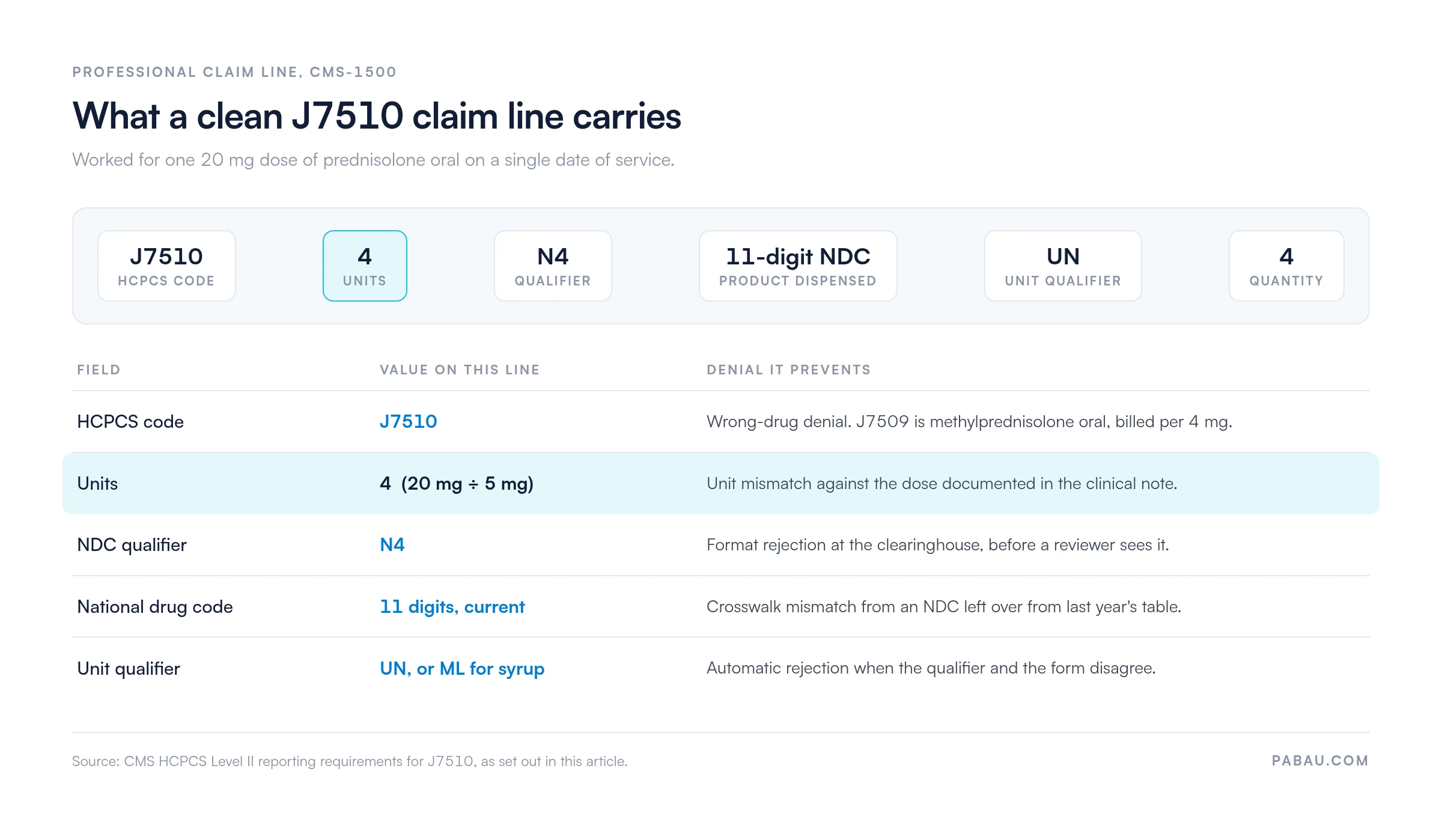
A pre-submission checklist prevents each of them. Teams that review code, units, route, and NDC before batching drug claims catch most of these issues before the payer does.
Payers reviewing J7510 claims look for documentation that establishes medical necessity. That means the diagnosis supporting prednisolone use, the prescribed dose and duration, and who administered or dispensed the drug. Thin documentation is a leading reason J7510 claims pass initial submission but fail on post-payment audit. The encounter note or superbill must contain specific elements that make it auditable.
Prior authorization requirements vary by payer and plan. Some Medicare Advantage plans require prior authorization for oral corticosteroids beyond a defined course length. Confirm those requirements with each individual payer before dispensing for extended treatment courses.
The National Library of Medicine publishes a free HCPCS Level II API that supports automated code-to-diagnosis crosswalk lookups inside practice management systems. Keeping documentation consistent across the clinical note, superbill, and claim is what stops incomplete records from turning into denials.
Build a J7510-specific documentation prompt into your prednisolone order workflow. When the clinician selects prednisolone oral, the system should prompt for dose in mg, duration, and the specific indication ICD-10 code. Capturing those three data points at the point of prescribing means the biller never has to guess what the note left out.
Plenty of practices bill J7510 from a paper superbill or a code list that sits outside the clinical record. The biller reads the dose off the note, divides by 5, and retypes the NDC from a drug label or a spreadsheet. Each of those steps is somewhere a number can change.
Pabau works the other way round. The dose recorded against the treatment note is the dose the claim line bills, and the unit count is calculated from it. The NDC comes from the inventory record for the product you dispensed. Nobody retypes a figure that already exists in the record.
The outcome is fewer rework cycles on drug lines. A claim that leaves with the right code, the right unit count, and a current NDC clears the payer. It does not come back three weeks later for a corrected submission.

Pabau’s claims management workflow links each drug claim line to the documented dose, NDC, and diagnosis code before submission. Fewer errors at the source means fewer rework cycles downstream.

HCPCS code J7510 is straightforward once the 5 mg unit rule and the NDC requirement live inside the billing workflow. Denials cluster in two places. Wrong unit counts come first, then missing or stale NDC numbers on the claim line. Confusing J7510 with J7509 adds a third category that documentation discipline removes.
So the decision worth making is where the check happens. A minute spent verifying code, units, and NDC before the batch goes out replaces a week of appeal work afterwards. Practices that bill corticosteroids only occasionally pay the highest price here, because the drill never becomes routine.
Teams that want to see how that check runs inside the patient record should book a demo.

List Item #1
List Item #2
HCPCS code J7510 is the Level II drug code for prednisolone oral, per 5 mg. It reports the dispensing or administration of oral prednisolone in outpatient and physician office settings. Billers report one unit for every 5 mg administered on the date of service.
Divide the total milligrams of prednisolone oral administered by 5. A 20 mg dose is 4 units, and a 40 mg dose is 8 units. Bill only the amount actually administered, not the package size or prescribed quantity for home use.
Medicare Part B may cover J7510 when prednisolone oral is administered incident-to a physician’s service in the office or in another covered outpatient context. Coverage depends on the clinical indication, applicable MAC local coverage determination, and whether the documentation supports medical necessity. Prior authorization requirements vary by Medicare Advantage plan.
J7509 is the HCPCS code for methylprednisolone oral (billed per 4 mg) and J7510 is the code for prednisolone oral (billed per 5 mg). They are different drugs with different billing units. Using the wrong code produces a medical necessity denial, because the billed drug does not match what the prescriber ordered.
Yes. Medicare and most commercial payers require the national drug code (NDC) on every J7510 claim line. The NDC must be in 11-digit format, paired with the qualifier N4 and a unit qualifier. A missing or incorrect NDC triggers automatic rejection before adjudication.
The prednisolone J-code for oral administration is J7510. The prednisolone injectable formulations use different HCPCS codes. J7510 applies only to the oral route. Billing it for an injectable prednisolone product is a coding error.