CCSD code H4430: Examination of rectum under anaesthetic
CCSD code H4430 pays for the examination alone CCSD code H4430 is the UK private...

Last Updated: Oct 20, 2026
J2510 is the HCPCS Level II code for injection, penicillin g procaine, aqueous, up to 600,000 units.
Three things decide whether the claim pays. The NDC comes from the vial used, the billed units match the dose administered, and the diagnosis supports the injection.
Let Pabau's smart automation suggest the right codes, reduce claim denials, and keep your practice compliant—effortlessly.
Automate repetitive tasks and focus on what matters most—your patients.
Reduce coding errors and ensure compliance with the latest regulations.
Clean claims, fewer denials, and faster reimbursements.
Powerful insights and reporting to help your practice thrive.
HIPAA compliant SOC 2 certified GDPR-compliant Trusted by 4,000+ clinics worldwide

HCPCS Code J2510 is the Level II J-code for an injection of penicillin G procaine, aqueous, up to 600,000 units.
The 600,000-unit figure is a per-administration block, not a daily cap, so a larger dose is billed as multiple units.
The NDC from the vial used must appear on the claim for most payers, and omitting it is the most common denial trigger.
Medicare Part B generally covers J2510 where the setting is covered and the chart documents medical necessity.
Practice management software like Pabau captures the NDC, the dose in units, and the diagnosis at charge entry, before the claim goes out.
HCPCS Code J2510 is a Level II HCPCS J-code that describes Injection, penicillin G procaine, aqueous, up to 600,000 units. Maintained by the Centers for Medicare and Medicaid Services (CMS), it falls under the category “Drugs Administered Other Than Oral Method.” Physicians, hospitals, and outpatient facilities use it to bill for penicillin G procaine injections given in physician office, outpatient, and ambulatory settings.
The table below summarizes the key attributes of HCPCS Code J2510 at a glance.
Penicillin G procaine is a long-acting, repository formulation of the antibiotic. The procaine salt slows absorption, producing sustained tissue levels over 12 to 24 hours after a single intramuscular injection. It treats bacterial infections susceptible to penicillin G, including certain cases of syphilis, pneumococcal pneumonia, and streptococcal infections.
The drug is given intramuscularly only, and intravenous administration is contraindicated. Other injectable drugs carry the same kind of route restriction. HCPCS Code J2550 covers promethazine HCl, which is contraindicated by the subcutaneous route because of severe tissue injury risk. The 600,000-unit ceiling in the descriptor matches the standard single-dose range in most treatment protocols.
A dose above 600,000 units is billed as multiple units of J2510, each covering up to 600,000 units. The chart must show the total dose administered. Check current dosing against FDA labeling before billing more than one unit for a single encounter.
Medicare Part B generally covers penicillin G procaine injections when the drug is administered in a covered setting and medical necessity is documented. Coverage is subject to the Local Coverage Determinations (LCDs) and National Coverage Determinations (NCDs) for your jurisdiction. Check for an active LCD before you submit. Confirm current payment rates through the CMS Physician Fee Schedule lookup tool for the applicable benefit year, as rates update annually.
Practices running high volumes of injectable drug claims should check eligibility before the encounter rather than after a denial. Pabau’s claims management software captures the fields a J-code claim needs at charge entry. That keeps staff from reconstructing vial detail a week later.
HCPCS Code J2510 carries specific Ambulatory Surgery Center (ASC) payment indicators under the CMS Outpatient Prospective Payment System (OPPS). The ASC status indicator decides how the drug is paid in that setting. It is either separately payable or packaged into the facility payment for the primary procedure. Verify the current indicator in the CMS OPPS addendum for the relevant year before billing J2510 in an ASC context. In physician office settings, the drug is typically billed separately alongside the injection administration code.
Most commercial payers and Medicaid programs require a National Drug Code (NDC) on claims for injectable drugs billed under J-codes. The NDC links the specific manufacturer’s product to the HCPCS code for audit and tracking purposes. Omitting the NDC is the single most common reason J2510 claims are rejected on first submission.
NDC codes are 11-digit numbers in the 5-4-2 format, meaning labeler, then product, then package. For penicillin G procaine the number varies by manufacturer and package size.
Check it against the FDA NDC Directory for the specific vial or syringe used at the time of service. A manufacturer can retire a package configuration, so a number that worked last quarter is worth re-checking. The table below covers the format and the submission rules rather than any single product code.
Pull the NDC from the vial or packaging used at the point of administration, never from a generic drug formulary list. NDC codes are specific to the manufacturer and the package size. Billing one from a different package configuration is a documentation mismatch, and it can trigger audits and payer recoupments.
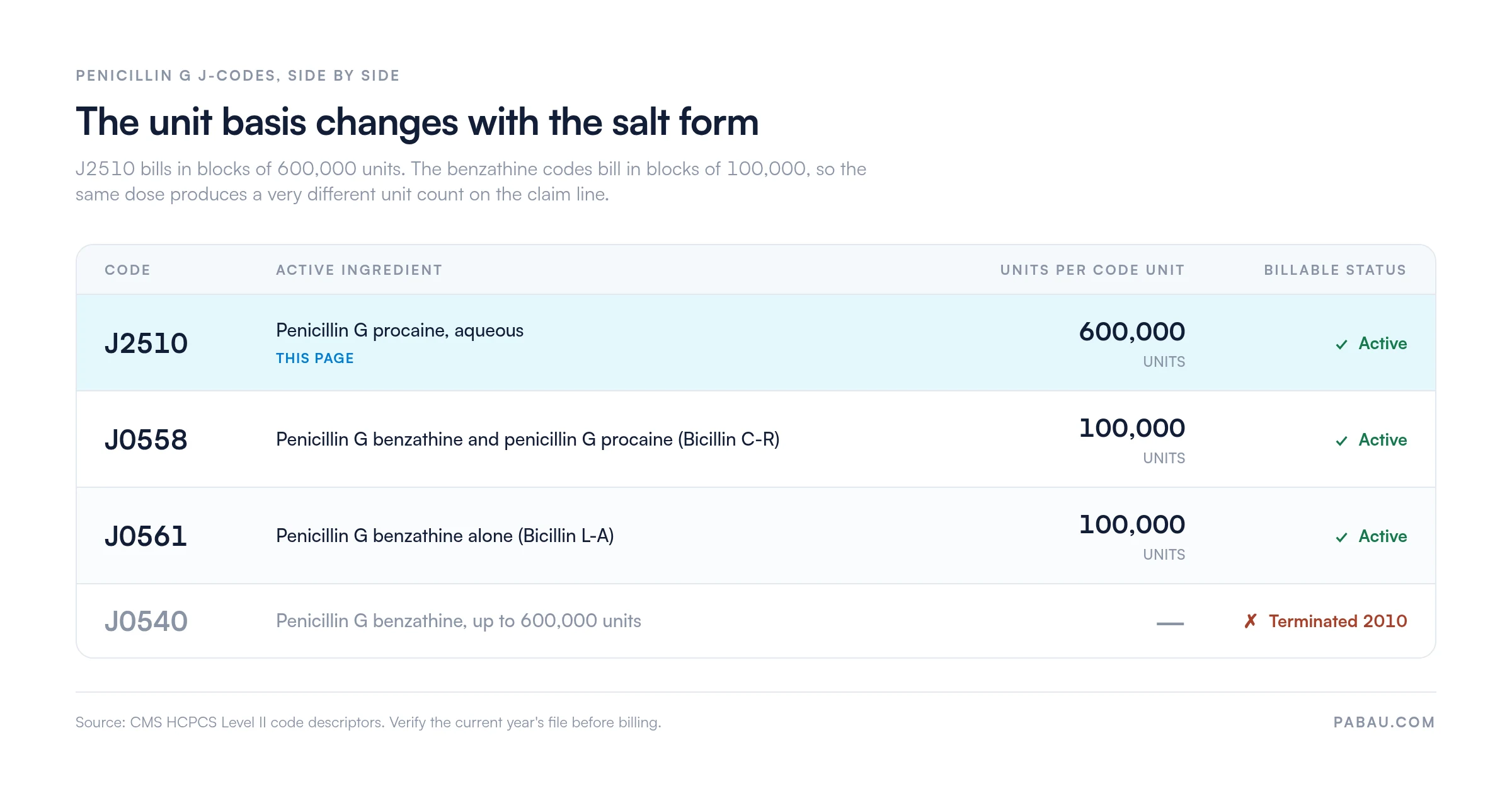
Coders working with penicillin G procaine injections should be familiar with the adjacent J-codes covering other penicillin formulations and antibiotic injections. Choosing the wrong code, particularly confusing penicillin G procaine with penicillin G benzathine, is a frequent upcoding or incorrect-code error. The table below maps the most closely related HCPCS codes.
Watch the unit basis rather than the drug name. J2510 bills in blocks of 600,000 units, while J0558 and J0561 both bill in blocks of 100,000. A 600,000-unit dose is therefore one unit of J2510 but six units of J0561.
One more code still shows up in older cheat sheets. J0540, penicillin G benzathine up to 600,000 units, was terminated in 2010 and is no longer billable. Benzathine products now bill under J0561, or under J0558 for the benzathine and procaine combination.
Every J2510 claim needs documentation a payer or auditor can trace back to the clinical record. Weak documentation is the second-most-common denial cause after a missing NDC. The chart note must establish that the drug was ordered, that it was administered, and that the dose stayed within the unit threshold billed.
Build J-code line items into your billing templates, with the NDC and unit fields set as required entries. That stops the two omissions payers reject most often. Practices that submit a clean claim the first time spend less of the month on rework and appeals.
J2510 claims fail for a predictable set of reasons. Each one is avoidable with the right documentation workflow.
Denial prevention starts before the claim goes out. When rejections do arrive, group them by code and read the remark text. The denial codes on a J2510 rejection tell you whether the cause was the NDC, the unit count, or medical necessity.
HCPCS Code J2510 is active and valid for both 2025 and 2026. CMS has not deleted or replaced this code in recent annual HCPCS updates. The code description remains unchanged: Injection, penicillin G procaine, aqueous, up to 600,000 units.
Confirm the current year’s Medicare payment rate against the CMS OPPS addenda or the fee schedule lookup before quoting reimbursement figures internally. Rates change annually and vary by geographic pricing locality. A billing system with an integrated code library refreshes those rates for you, which beats updating fee schedules by hand.
Bookmark the CMS HCPCS quarterly update page and check it every January and April. CMS releases HCPCS updates throughout the year, and a J-code that was valid in Q1 may carry a revised description or payment rate by Q3. Building a quarterly code-review step into your billing team calendar prevents coding on stale data.
Most J2510 rejections start at charge entry. The NDC and the unit count get typed in by hand, often from a vial that has already gone in the sharps bin. Staff then rebuild the detail from memory or chase the clinician who gave the injection.
Pabau keeps the drug detail on the record that already holds the appointment and the administration note. The NDC, the dose in units, and the supporting diagnosis are captured once, at the point of care, and carried through to the claim line.
That changes the biller’s job. Rather than assembling a claim from three places, they review a line that is already populated. Rejections for a missing NDC or a mismatched unit count stop arriving, and the appeals queue shrinks with them.

Pabau structures J-code claim lines from NDC capture through to unit reporting. Your penicillin G procaine claims go out clean the first time.

J2510 rewards a habit more than a lookup. The descriptor has not changed in years. The work is getting the vial’s NDC, the administered dose, and the supporting diagnosis onto the claim line. Do it while the patient is still in the room.
The trade-off worth remembering is the unit basis. A coder moving between J2510 and the benzathine codes switches between 600,000-unit and 100,000-unit blocks. That arithmetic is where the audit risk sits, not in the descriptor.
Build the check into charge entry and most of the appeals never need writing. Book a demo to see how Pabau captures NDC and unit detail on injectable drug claims before they leave your practice.

Want to understand how claim submission works end to end? Our medical billing guide walks through the full lifecycle from charge capture to payment posting.
Seeing recurring rejections on drug claims? Denial management in healthcare explains how to categorize, track, and resolve common J-code denial patterns.
Need to verify payer eligibility before administering the injection? Insurance eligibility verification covers the workflow for checking coverage before the encounter.
HCPCS Code J2510 bills the injection of penicillin G procaine, aqueous, up to 600,000 units per administration. It is a Level II HCPCS J-code for drugs given by a route other than oral. It covers the drug cost in a physician office, outpatient practice, or ambulatory facility.
J2510 covers up to 600,000 units per unit of the code billed. A dose above 600,000 units is billed as multiple units. Each unit represents up to 600,000 units administered. The total billed units must match the total dose recorded in the administration note.
Required documentation starts with a signed physician order specifying the dose in units. You also need an administration record carrying the date, time, route, and site. The dose in units must match what is billed, and a supporting ICD-10-CM diagnosis code must be present. The claim itself carries the 11-digit NDC with qualifier N4. Many payers also require the lot number and expiration date in the clinical record.
NDC codes for J2510 are manufacturer-specific and vary by package size and labeler. No single fixed NDC applies to the code. The correct one is printed on the vial or packaging used at the time of service. Verify current NDC numbers against the FDA NDC Directory before submitting, as manufacturer changes can affect validity.