CCSD code H4430: Examination of rectum under anaesthetic
CCSD code H4430 pays for the examination alone CCSD code H4430 is the UK private...

Last Updated: Oct 20, 2026
J1980 is the HCPCS Level II code for injection, hyoscyamine sulfate, up to 0.25 mg.
A clean J1980 claim needs four fields right at once. Those are the drug code, the unit count, the 11-digit NDC, and a companion administration CPT code.
One point separates J1980 from the tablets that share its name. The injection has a much narrower set of labeled uses, so billing it against an oral-only indication is where medical-necessity denials start.
Let Pabau's smart automation suggest the right codes, reduce claim denials, and keep your practice compliant—effortlessly.
Automate repetitive tasks and focus on what matters most—your patients.
Reduce coding errors and ensure compliance with the latest regulations.
Clean claims, fewer denials, and faster reimbursements.
Powerful insights and reporting to help your practice thrive.
HIPAA compliant SOC 2 certified GDPR-compliant Trusted by 4,000+ clinics worldwide

HCPCS Code J1980 describes an injection of hyoscyamine sulfate (Levsin), up to 0.25 mg per billed unit
Medicare Part B pays J1980 under the ASP plus 6% methodology, and CMS updates the rate every quarter
A valid 11-digit NDC is mandatory on every Medicare Part B claim for J1980, and a missing one is the top denial cause
Pair J1980 with a drug administration CPT code, usually 96372, because the drug code alone gets denied
The injection’s labeled uses are peri-operative and procedural, so an oral-only diagnosis such as irritable bowel syndrome will not support the claim
Practice management software like Pabau keeps the dose, NDC, and diagnosis on the patient record, then pulls them into a pre-filled claim
HCPCS Code J1980 is the Level II HCPCS permanent national code for injection of hyoscyamine sulfate, up to 0.25 mg. It sits in the J-code series, which the Centers for Medicare and Medicaid Services (CMS) maintains for injectable drugs. Those drugs are given in physician offices, outpatient facilities, and ambulatory surgical centers. The code is still valid for 2026, with no pending deletions or replacements.
The billing unit is per 0.25 mg administered. If a patient receives 0.5 mg in a single encounter, you bill two units of J1980 on the same claim line. When the administered dose falls between units, rounding down to the nearest 0.25 mg increment is the standard approach. Verify your MAC’s local coverage determination for its rounding guidance.
Hyoscyamine sulfate is an anticholinergic drug that blocks muscarinic acetylcholine receptors. That action reduces glandular secretions and damps the vagal reflexes that slow the heart. Levsin is the best-known brand name, though generic injectable products are dispensed under the same J-code.
The injection’s FDA-labeled indications are narrower than the tablet’s, and most of them are peri-operative or procedural. So document the supporting ICD-10-CM diagnosis on every J1980 claim.
Those reversal agents are given to reverse curariform neuromuscular blockers, so the setting is almost always an operating room or a recovery unit. Atropine sulfate covers that same reversal indication, and it bills under HCPCS Code J0461 at 0.01 mg per unit. That is 25 times smaller than the J1980 unit, so convert each dose separately.
Record the route, the indication, and the dose in mg, because the payer reads those three against the code.
Gastrointestinal and bladder complaints are indications for oral hyoscyamine rather than for the injection. A J1980 claim carrying an irritable bowel syndrome diagnosis is the medical-necessity denial you can predict in advance.
Medicare Part B reimburses most physician-administered drugs, including J1980, using the Average Sales Price (ASP) plus 6% methodology. CMS updates ASP figures quarterly, so the exact payment rate for J1980 changes four times per year. Verify the current quarter’s figure in the CMS ASP Drug Pricing Files before you estimate reimbursement. The Physician Fee Schedule lookup tool prices RVU-based services, so it will not return a drug rate for J1980.
Because hyoscyamine sulfate is a generic drug with multiple manufacturers, ASP for J1980 is typically low relative to branded biologics. The administration CPT code (see billing guidelines below) often generates more revenue per encounter than the drug code itself. Ensure both are on every claim.
CMS requires the National Drug Code (NDC) on all Medicare Part B claims for physician-administered drugs, per the Medicare Claims Processing Manual, Chapter 17. Submitting J1980 without a valid NDC is one of the most frequent reasons claims are returned without payment. Also, the NDC must reflect the exact product administered, not a generic placeholder.
Hyoscyamine sulfate injection is manufactured by several companies under different NDC numbers. The table below shows the format rules. Always verify the product against the current CMS ASP NDC/HCPCS crosswalk file, which updates quarterly alongside ASP pricing. As a result, an NDC that does not appear on that quarter’s file rejects at the clearinghouse. Make NDC verification a pre-submission step rather than a post-denial one.
Keep a running log of every NDC your practice stocks for hyoscyamine sulfate. When you switch manufacturers or lot numbers, update the NDC in your billing system before the next claim goes out. A mismatch between what the crosswalk file expects and what you submit is a straightforward denial that should never reach the appeals stage.
Accurate J1980 billing depends on four elements being correct at the same time. Those are the drug code, the unit count, the NDC, and the companion administration CPT code. Get any one of them wrong and the claim comes back denied or unprocessable.
The panel below shows where each element lands on the claim.
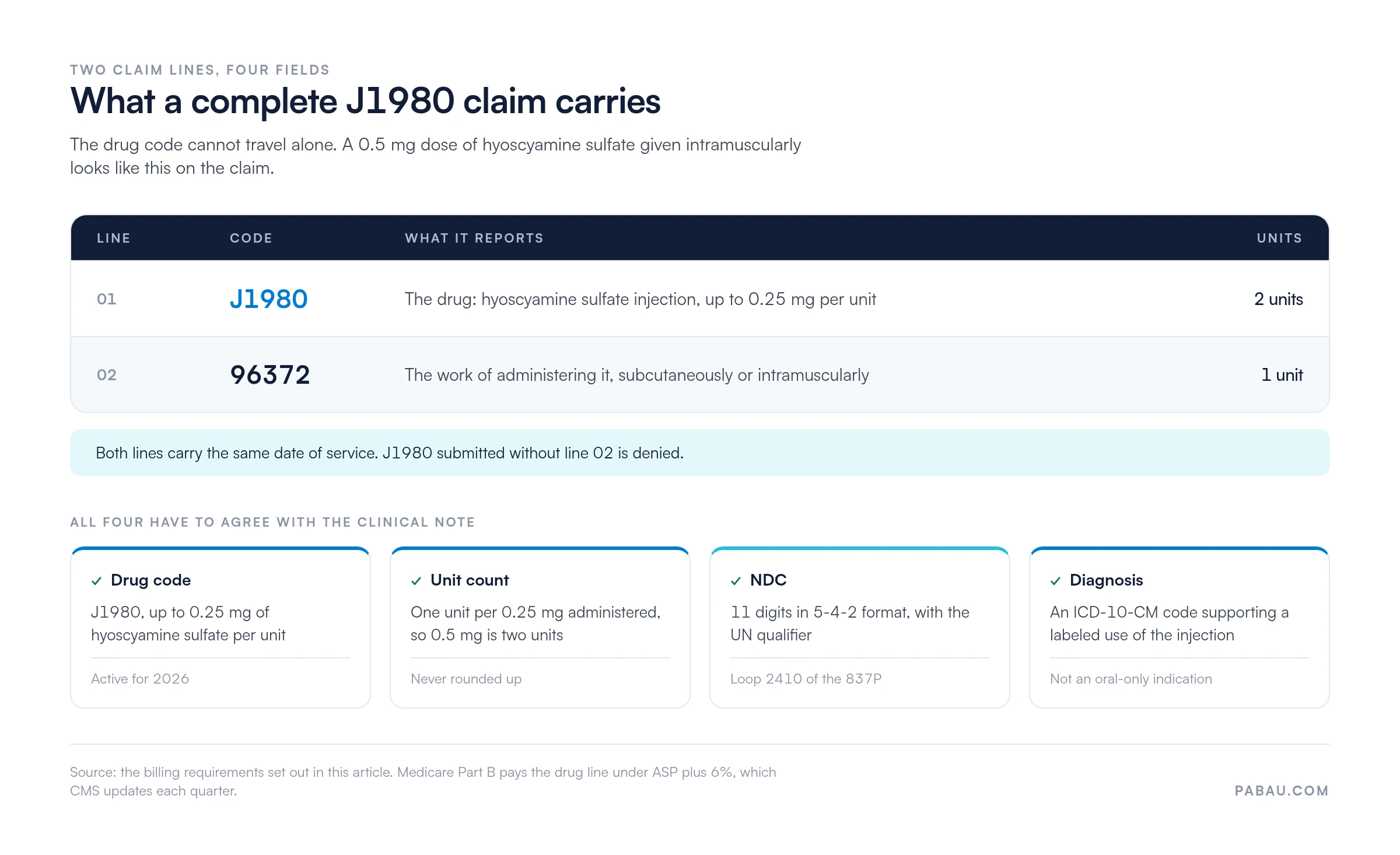
Each unit of J1980 equals up to 0.25 mg of hyoscyamine sulfate. Then bill one unit per 0.25 mg administered. A 0.5 mg dose = 2 units; a 0.25 mg dose = 1 unit. Do not round up beyond what was actually administered. Over-reporting units is a billing compliance violation, and under-reporting means leaving reimbursement on the table.
J1980 is a drug code only. Also, it does not capture the work of administering the injection. You must also bill a companion drug administration CPT code on the same claim. The table below shows the most common pairing options; always verify against the AAPC HCPCS code reference and your applicable Local Coverage Determination (LCD).
CPT 96372 is the standard companion code for J1980 in most outpatient settings. Next, bill it on a separate claim line from J1980, with the same date of service. Payers expect both codes to be present; submitting J1980 alone without an administration code is a top-five denial trigger for this drug.
Document the route of administration explicitly in your clinical notes. If your note says subcutaneous or intramuscular, CPT 96372 is correct. Billing 96374 (IV push) against a note that documents SQ administration creates a mismatch. That mismatch is what triggers a post-payment audit. Keep the route consistent across the clinical record, superbill, and submitted claim.
Hyoscyamine sulfate injection is a physician-administered drug, so the practice buys the stock itself. You administer the dose, then bill J1980 to recover the acquisition cost plus the ASP+6% margin. In short, this is the buy-and-bill model. Tracking each step protects the margin, which is thin on a generic drug.
The margin on hyoscyamine sulfate injection is narrow given its generic pricing. Practices that lose claims to avoidable denials (missing NDC, wrong units, absent admin code) are effectively administering the drug at a loss. A clean first-pass submission rate above 95% is the benchmark for well-managed buy-and-bill workflows.
Medicare Part B covers J1980 when the drug is physician-administered, medically necessary for a covered indication, and properly documented. Coverage sits under any applicable Local Coverage Determination (LCD) or National Coverage Determination (NCD). So your Medicare Administrative Contractor (MAC) enforces them. Check with Noridian, Novitas, CGS, or whichever MAC covers your jurisdiction for an active LCD that restricts J1980 to specific diagnoses.
The payer-by-payer picture for J1980 breaks down like this:
Always confirm coverage before administering the drug when the payer is anything other than traditional Medicare. A pre-service phone verification call to the payer takes two minutes and prevents a $0 payment three weeks later.
These errors account for most rejections on hyoscyamine sulfate injection claims. Each one is cheaper to prevent at submission than to appeal after the fact.
The denial codes that accompany J1980 rejections are worth knowing before you appeal. Common CARC codes on this drug’s remittance are CO-4 (inconsistent modifier), CO-16 (claim lacks information), and CO-197 (precertification or authorization absent). So each one maps to a specific documentation or submission fix.
CO-B15 is a different problem, so do not read it as a missing authorization. Instead, it means a qualifying service was never received or adjudicated.
The denial patterns above have one thing in common. Each starts with a field that was correct somewhere in the practice and wrong on the claim.
In most practices the dose lands in the clinical note and the NDC sits on a purchase invoice. The biller then retypes both into the claim. So every re-keyed field is a chance to send out a J1980 line that no longer matches the record.
Practice management software like Pabau keeps those fields on the patient record instead. The administered dose, the product NDC, the route, and the diagnosis are captured at the point of care. They are then carried into the claim rather than typed again. Pabau’s claims management software submits the finished claim through your clearinghouse and tracks it from the same screen.
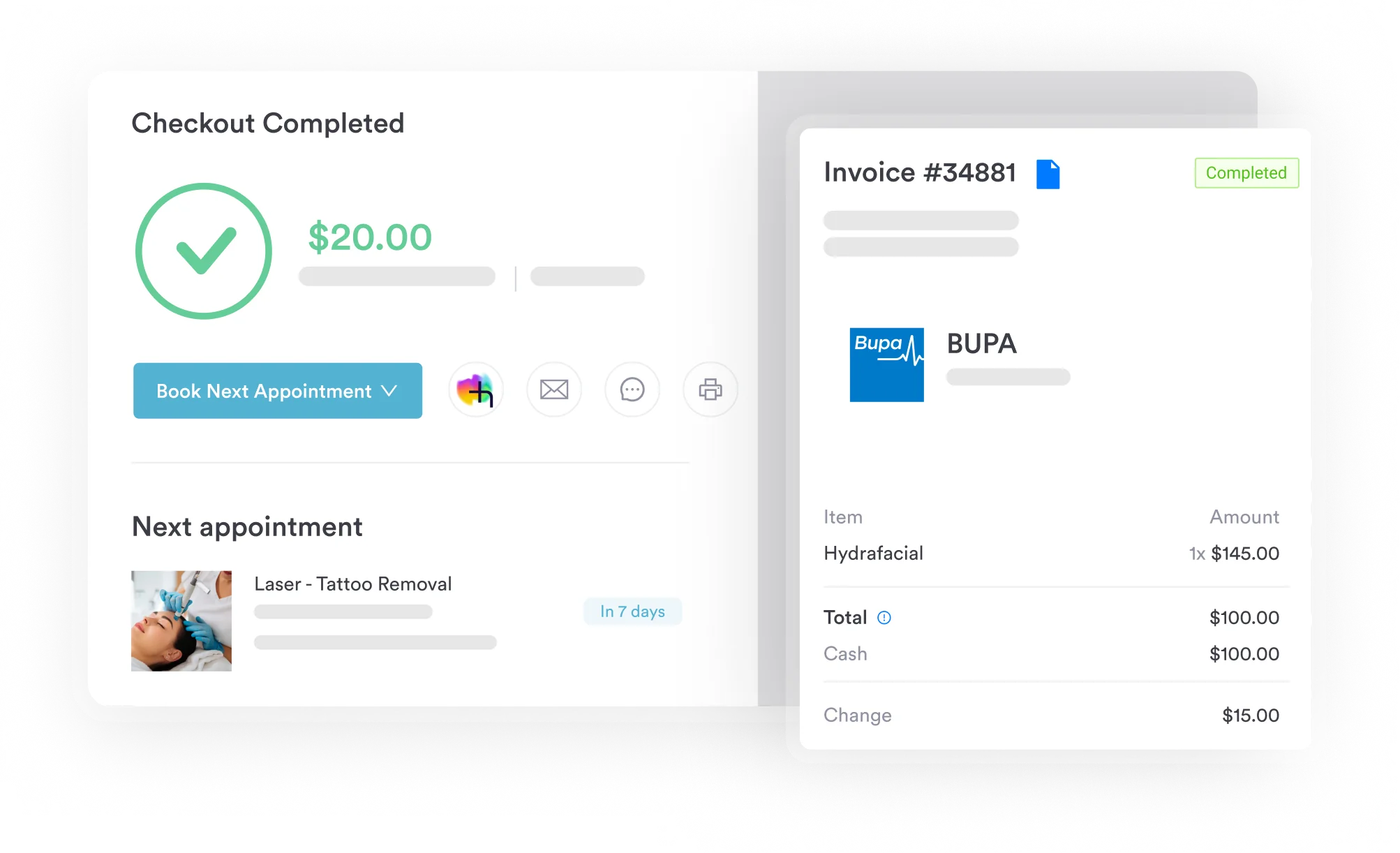
For a practice billing injectable drug codes regularly, the link between the clinical note and the claim decides the denial rate. One system holding both removes the retyping step that produces most J1980 errors.
Run a quarterly audit of every J1980 claim submitted in the prior 90 days. Pull the denial rate, the most frequent CARC code, and the average days to payment. If the denial rate passes 5% or payment takes over 30 days, check NDC reporting, unit counts, and administration code pairing first. Most J1980 denials cluster around one or two root causes that a single process fix can eliminate.

Pabau stores the administered dose, the product NDC, and the diagnosis on the patient record. It pulls those fields into a pre-filled claim you submit and track without leaving the system.

J1980 is a low-dollar code with a high-friction claim. The drug payment is small, the administration code carries more of the revenue, and one missing field costs you both.
Check the four fields before you submit and there is no appeal to write. The narrow labeled indications are the part worth re-reading, because that is where a technically clean claim still gets denied on medical necessity.
In short, the practices that bill this code well are the ones where the dose, the NDC, and the diagnosis never get retyped. Book a demo to see how Pabau holds those three on one record for buy-and-bill drugs like hyoscyamine.

Need to understand the broader HCPCS code system? What is medical billing explains how HCPCS Level II codes fit into the overall reimbursement workflow.
Getting denials on drug claims? Denial management in healthcare covers how to build a systematic appeals process and prevent recurring rejections.
Want to reduce claim submission errors across all codes? Pabau’s claims management software automates pre-submission scrubbing for HCPCS drug codes, NDC validation, and administration code pairing checks.
HCPCS Code J1980 reports an injection of hyoscyamine sulfate, up to 0.25 mg per unit, to Medicare Part B and commercial payers. Its labeled uses are peri-operative control of secretions and vagal reflexes, and protection during cholinergic reversal. It is also labeled for radiologic visibility of the kidneys and for biliary or renal colic with a narcotic.
J1980 covers injectable hyoscyamine sulfate, an anticholinergic drug sold under the brand name Levsin. Several generic manufacturers produce injectable hyoscyamine sulfate under different NDC numbers. All of them map to J1980, which bills at up to 0.25 mg per unit.
Multiple NDC numbers map to J1980 because several manufacturers produce injectable hyoscyamine sulfate. The authoritative source is the CMS ASP NDC/HCPCS crosswalk file, updated quarterly on CMS.gov. Always verify the NDC for the specific product you stock against the current quarter’s crosswalk file before submitting claims.
J1980 may be payable in an ambulatory surgical center (ASC) setting, but payment indicators vary by MAC jurisdiction and locality. Some ASC contracts bundle the drug payment into the facility fee rather than paying it separately under J1980. Verify J1980 ASC status with your MAC or payer contract before administering in that setting.