CPT code 48152: Whipple procedure without pancreatojejunostomy
CPT code 48152: Official description and procedure overview CPT code 48152 descr...

Last Updated: Nov 13, 2026
J1790 is the HCPCS Level II code for injection, droperidol, up to 5 mg. It covers droperidol given by intramuscular or slow intravenous injection, mainly to reduce nausea and vomiting around surgical and diagnostic procedures.
One unit equals up to 5 mg, so the usual 2.5 mg adult dose is billed as 1 unit. Droperidol vials are single-dose, so a separately paid Medicare line also needs modifier JZ or JW.
Let Pabau's smart automation suggest the right codes, reduce claim denials, and keep your practice compliant—effortlessly.
Automate repetitive tasks and focus on what matters most—your patients.
Reduce coding errors and ensure compliance with the latest regulations.
Clean claims, fewer denials, and faster reimbursements.
Powerful insights and reporting to help your practice thrive.
HIPAA compliant SOC 2 certified GDPR-compliant Trusted by 4,000+ clinics worldwide

HCPCS Code J1790 covers injection of droperidol, up to 5 mg, given intramuscularly or by slow intravenous injection.
One billing unit equals up to 5 mg, so the usual 2.5 mg adult dose is billed as 1 unit.
Droperidol vials are single-dose, so a separately paid Medicare line needs modifier JZ, or JW for whole discarded units.
The boxed warning calls for a 12-lead ECG before the dose, so the chart has to show it to support the claim.
Pabau’s claims management software keeps the treatment note, stock record and claim in one patient file, so units and codes match.
HCPCS Code J1790 is a Level II HCPCS drug code that describes injection, droperidol, up to 5 mg. The CMS quarterly ASP pricing files list J1790 as droperidol injection, priced per unit of up to 5 mg. CMS maintains HCPCS Level II codes, including J1790, in its annual code set release.
Droperidol is a butyrophenone neuroleptic with sedative and antiemetic effects. It is supplied as a 2.5 mg/mL solution for intramuscular or intravenous use. Some older references wrongly list J1790 as estradiol valerate, which is a different drug billed under J1380.
J1790 covers only provider-administered droperidol injections. A few look-alike drugs and products fall outside it.
The most common mix-up on a postoperative or emergency claim is J1790 versus J1630. Both drugs are butyrophenones, and both codes use a 5 mg unit. The vial label decides the code, so check it before the line goes out.
The FDA label for droperidol injection lists one indication. It reduces the incidence of nausea and vomiting associated with surgical and diagnostic procedures. Emergency departments also use it off-label for acute agitation and migraine headache, where payer rules on off-label use apply.
The label carries a boxed warning for QT prolongation and torsade de pointes, reported at or below recommended doses. That warning shapes the claim as much as the care, because it sets what the chart has to show.
Medical necessity for J1790 rests on the diagnosis code on the claim line. R11.2 is the most common pairing, used for postoperative nausea with vomiting. The table below maps it and the other common scenarios to their ICD-10-CM codes.
When droperidol is given to prevent nausea, before any symptom appears, the claim carries the diagnosis for the procedure itself. Check the applicable MAC’s policy, since some contractors expect a symptom code on the drug line.
A clean J1790 line needs four things. Those are the right unit count, a valid NDC, the correct wastage modifier and a matching administration code. Claims management software that checks each element before submission cuts manual entry errors. A clean claim is always faster than working a denial.
One billing unit of J1790 equals up to 5 mg of droperidol. Divide the administered dose by 5 and round up to the nearest whole unit.
Medicaid and many commercial payers require the NDC on the drug line, and Medicare asks for it on dual-eligible crossover claims. Report it in 11-digit 5-4-2 format with qualifier N4, then the quantity and unit of measure, usually ML.
CMS’s October 2026 ASP crosswalk lists two Hikma packages for J1790. These are 00143-9515-25 (1 mL vials) and 00143-9514-25 (2 mL vials). American Regent also markets 2 mL vials under NDC 0517-9702-25. Always copy the NDC from the vial you used.
The droperidol vials CMS crosswalks to J1790 are all single-dose, so the CMS wastage rules apply to any separately paid Part B line. Medicare has required JZ since July 1, 2023 when no drug is discarded from a single-dose container.
J1790 does not appear on CMS’s JW and JZ code list, which leads some billers to drop the modifier. CMS says that list is not all-inclusive, and single-dose container drugs still need JW or JZ when they are not on it.
The common case looks like waste but is not billed as waste. A 2.5 mg dose drawn from a 5 mg vial leaves 2.5 mg in the vial. The CMS JW and JZ FAQ says JW is not used when the dose is less than the billing unit. Bill 1 unit with JZ instead.
Put together, the dose decides the unit count and the vial decides the modifier, as the chart below shows.
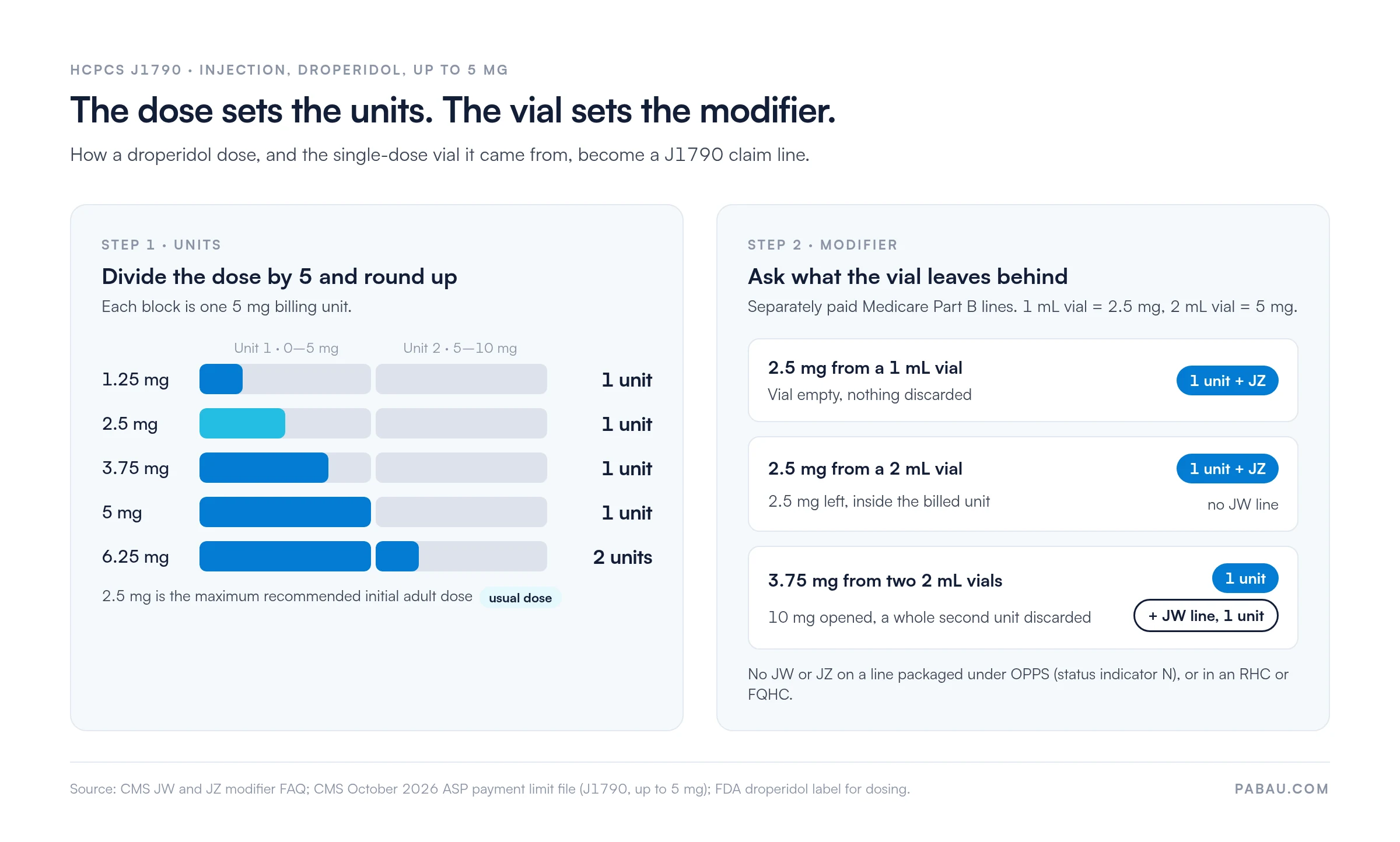
Set the default J1790 line in your billing system to 1 unit with JZ. That matches the usual 2.5 mg dose from either vial size. Change it only when the dose passes 5 mg or a second vial leaves a whole unit of waste.
The administration code depends on the route. CPT 96372 covers a therapeutic, prophylactic or diagnostic injection given IM or subcutaneously. CPT 96374 covers a single or initial IV push of a drug.
When droperidol follows another drug by IV push at the same encounter, CPT 96375 reports each sequential push of a new substance. When an anesthesia provider gives the dose during a case, the administration is part of the anesthesia service. Only the drug is reported then, usually on the facility claim.
Medicare Part B pays J1790 under the Average Sales Price (ASP) methodology, at ASP plus 6% in the physician office. The October to December 2026 payment limit is $5.348 per unit of up to 5 mg, with 20% patient coinsurance. ASP rates reset every quarter, so check the current file before quoting an expected payment.
In the hospital outpatient department, a drug this inexpensive is usually packaged into the payment for the main procedure. Check the current OPPS Addendum B for the J1790 status indicator. Commercial allowables are contract-specific and often tied to a percentage of ASP or average wholesale price.
Four codes account for most J1790 substitution errors. The table below shows what each one bills and when it applies.
Complete documentation for J1790 covers the clinical record and the claim line together. The boxed warning adds cardiac items that most J-code charts never need. A superbill that captures each field at the point of care keeps omissions off the claim.
Most J1790 denials are preventable. Denial management workflows for J-code claims follow one pattern. Identify the CARC reason code, correct the source error, then resubmit or appeal with documentation.
A J1790 line touches three records. The dose and ECG sit in the treatment note, the NDC and lot sit on the vial, and the diagnosis sits in the chart. When a biller copies each one into a separate claims tool, small mismatches creep in.
Pabau, the practice management platform we build, keeps those pieces in one patient record. The treatment note, the vial logged in stock, the invoice and the claim sit together. Units, modifier and diagnosis are checked against the same visit.
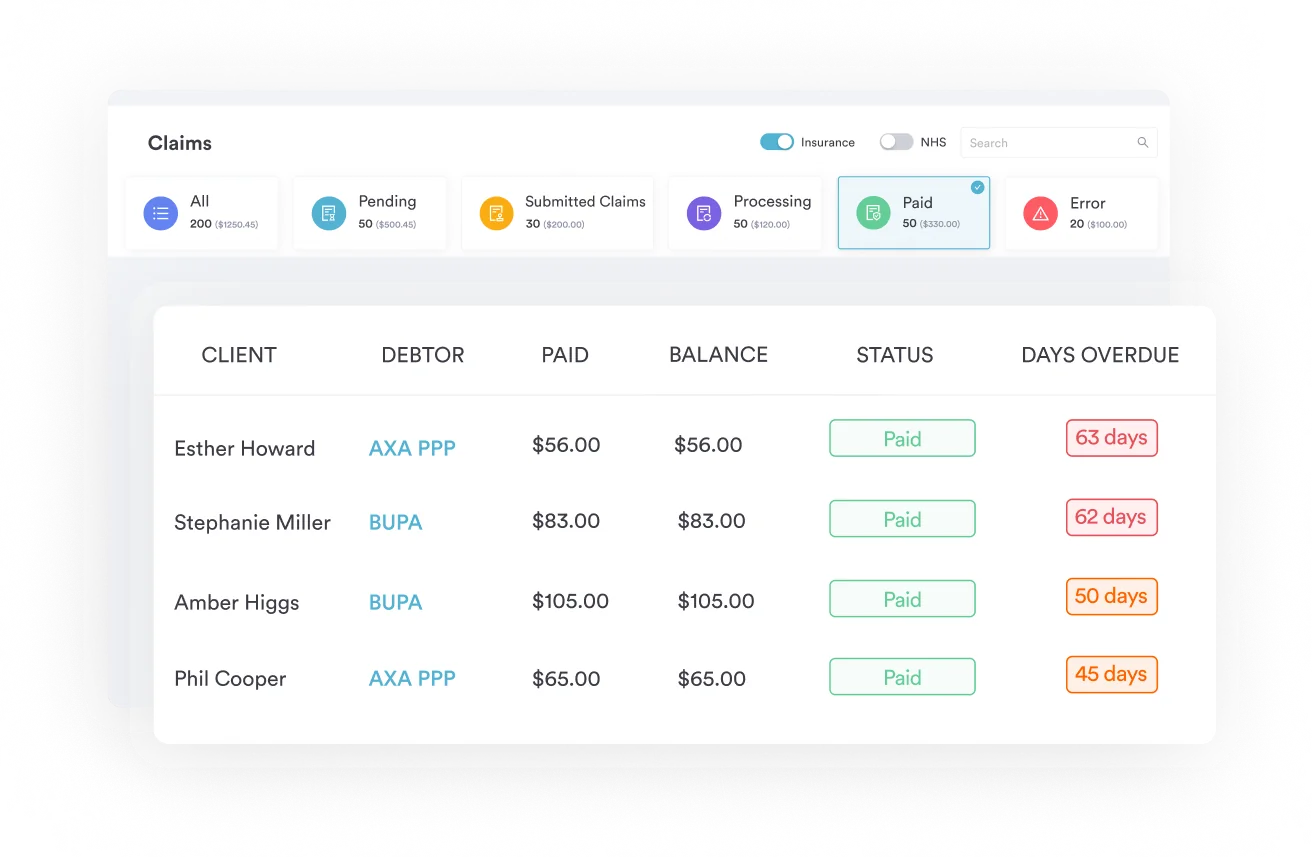
The result is fewer resubmissions on a low-value drug line that is rarely worth an appeal. Your team works errors from one dashboard, and the days-overdue column shows which payer is holding money longest.

Pabau keeps the treatment note, stock record and claim in one patient file, so J1790 units, NDC, modifier and diagnosis match before submission.

J1790 is a cheap drug line with an expensive failure mode. The unit math is easy, since one 5 mg unit covers almost every dose. The modifier is where claims slip, because a 2.5 mg dose from a 5 mg vial still takes JZ rather than a JW line.
The chart carries the other half of the risk. A baseline ECG and a reason for choosing a second-line antiemetic are what an auditor looks for first. Build both into the order set, and the claim follows from the note.
Book a demo to see how Pabau keeps dose, NDC and diagnosis in one record so your J1790 claims go out clean.

Billing ondansetron at the same visit? HCPCS code J2405 covers ondansetron units per 1 mg and how they differ from J1790.
Need to understand denial codes on your remittance? Denial codes in medical billing explains CARC and RARC codes and how to respond to each.
Want a primer on the revenue cycle for injectable drug claims? What is revenue cycle management covers the claim workflow from eligibility through payment posting.
HCPCS Code J1790 covers injection of droperidol, billed in units of up to 5 mg each. It applies to droperidol given IM or by slow IV injection by a provider. Haloperidol (J1630), ondansetron (J2405) and the discontinued droperidol and fentanyl product (J1810) fall outside this code.
Bill one unit of J1790 for each 5 mg, or fraction of 5 mg, of droperidol administered. The usual 2.5 mg adult dose is 1 unit, and so is a 3.75 mg total. A dose above 5 mg is 2 units.
Usually JZ, on separately paid Part B lines, because droperidol vials are single-dose containers. A 2.5 mg dose from a 5 mg vial is billed as 1 unit with JZ. CMS does not allow JW when the dose is less than the billing unit.
CPT 96372 covers an IM injection, and CPT 96374 covers a single or initial IV push. CPT 96375 applies when droperidol is a sequential IV push after another drug. During anesthesia, the administration is part of the anesthesia service.
R11.2 (nausea with vomiting, unspecified) is the most common pairing. R11.0 and R11.10 cover nausea or vomiting alone. Off-label uses are coded to the documented condition, such as R45.1 for agitation or a G43 migraine code.
Droperidol carries a boxed warning for QT prolongation and torsade de pointes. The label calls for a 12-lead ECG before administration, and monitoring for 2 to 3 hours afterward. A chart without the ECG weakens the claim on audit.