CCSD code H4430: Examination of rectum under anaesthetic
CCSD code H4430 pays for the examination alone CCSD code H4430 is the UK private...

Last Updated: Oct 20, 2026
J1458 is the HCPCS Level II code for injection, galsulfase, 1 mg.
Let Pabau's smart automation suggest the right codes, reduce claim denials, and keep your practice compliant—effortlessly.
Automate repetitive tasks and focus on what matters most—your patients.
Reduce coding errors and ensure compliance with the latest regulations.
Clean claims, fewer denials, and faster reimbursements.
Powerful insights and reporting to help your practice thrive.
HIPAA compliant SOC 2 certified GDPR-compliant Trusted by 4,000+ clinics worldwide

HCPCS Code J1458 covers injection, galsulfase, 1 mg. That is the billing code for Naglazyme, an enzyme replacement therapy for mucopolysaccharidosis VI.
One unit equals 1 mg of galsulfase, so a 50 kg patient dosed at 1 mg/kg is billed as 50 units.
Medicare Part B pays J1458 under buy-and-bill at ASP+6%, and the allowable rate changes every quarter.
Naglazyme ships in a single-dose 5 mg/5 mL vial, so every Part B line needs a JW or JZ modifier.
Report 96365 and 96366 for the infusion itself, not the chemotherapy administration codes 96413 and 96415.
HCPCS Code J1458 describes Injection, galsulfase, 1 mg under the CMS HCPCS Level II code set. It is a J-code, so it covers a drug given by injection or infusion rather than a procedure or service. J-codes bill by unit, and for J1458 the unit is 1 mg of galsulfase.
J1458 is typically billed in outpatient hospital, physician office, and infusion center settings. The code applies wherever the infusion happens, so confirm the place-of-service code before you submit.
Galsulfase is a purified form of the human enzyme N-acetylgalactosamine 4-sulfatase, made using recombinant DNA technology. MPS VI comes from a deficiency of that enzyme, which lets glycosaminoglycans build up in tissues throughout the body. Naglazyme, made by BioMarin Pharmaceutical, replaces the missing enzyme to slow disease progression.
Payers read the FDA-approved indication to validate medical necessity, so the drug’s clinical context matters at charge capture. The FDA approved Naglazyme for MPS VI only. Billing J1458 for another lysosomal storage disorder, without separate code authority, is not appropriate.
Galsulfase is given by weekly intravenous infusion at 1 mg/kg, and each session runs about four hours. That weekly schedule sends the same code out on a recurring claim. Unit accuracy and NDC reporting therefore compound across a patient’s treatment year.
The billing unit for HCPCS Code J1458 is 1 mg. To get the unit count, divide the administered dose in milligrams by 1. Naglazyme is dosed at 1 mg/kg, so a 50 kg patient receives 50 mg and the provider bills 50 units.
Unit counts are the highest-risk step in the J1458 workflow. Over-reporting units invites OIG compliance scrutiny. Under-reporting leaves reimbursement on the table. Confirm the administered dose from the infusion record before you complete the claim.
NDC reporting: Medicare Part B requires the National Drug Code (NDC) on every claim line that carries J1458. The NDC identifies the vial dispensed and supports drug traceability. CMS requires it under Medicare Claims Processing Manual, Chapter 17.
Submit the NDC in the N4 qualifier loop on the 837P electronic claim, or in the matching field on the CMS-1500 paper form. Missing or malformed NDCs are a leading cause of J1458 rejections.
JW and JZ modifiers: Naglazyme ships as a 5 mg/5 mL single-use vial, which puts J1458 inside Medicare’s discarded-drug policy. Since October 2023, every Part B claim line for a single-dose-vial drug must carry one of two modifiers.
Report JW with the units you discarded, and JZ to attest that no amount was wasted. Reporting neither is a claim-level error, even when the vial was used in full. Both modifiers go on the J1458 line itself, not on the administration codes.
Medicare Part B covers galsulfase (Naglazyme) under the buy-and-bill model as a physician-administered drug. Coverage sits under Medicare Benefit Policy Manual, Chapter 15, which governs drugs and biologicals that are not usually self-administered.
CMS pays J1458 at ASP+6%. That is the Average Sales Price of galsulfase plus a 6% add-on covering acquisition and handling. ASP is the weighted average price manufacturers report to CMS across all purchasers, net of rebates and price concessions.
ASP data lags the market by two quarters and updates quarterly, so the J1458 allowable changes four times a year. Part B drug rates come from the CMS ASP Drug Pricing File, not the physician fee schedule. Check that file before you finalize billing projections.
Bookmark the CMS ASP Drug Pricing File and check it at the start of each quarter. Naglazyme is a high-cost drug, so a small per-unit rate change moves real money across a year of weekly infusions.
J1458 rates under Medicare come from the ASP methodology above. The dollar amount changes quarterly, so the table below gives the rate structure rather than a fixed figure. Pull the live rate from CMS before you submit.
Medicaid coverage for J1458 varies widely by state. Some programs cover Naglazyme under a rare-disease or specialty drug benefit. Others require a specific coverage determination. Verify coverage with the patient’s state Medicaid program before you schedule infusions.
Every J1458 claim needs a diagnosis code that establishes medical necessity for galsulfase therapy. Naglazyme has FDA approval for MPS VI only, so the diagnosis on the claim should reflect that condition. Coders who cover several drug codes can check pairings against the ICD-10-CM code library.
E76.22 is the primary and most specific code for J1458 claims. Using E76.3 on a confirmed MPS VI case raises denial risk, because payers may call it insufficient for a high-cost biologic. Document the confirmed diagnosis in the clinical record before submission.
Traditional Medicare Part B does not require prior authorization for buy-and-bill drugs under standard fee-for-service. That exemption does not extend to Medicare Advantage plans, and it does not cover most commercial payers. For a high-cost biologic like Naglazyme, authorization is the norm outside traditional Medicare.
Most payers ask for the following before they approve J1458:
Requirements vary by payer and plan type, so verify with each plan before the first infusion. Administering Naglazyme without required authorization leaves the provider holding the full drug cost.
Under buy-and-bill the practice purchases Naglazyme, administers it, and then claims reimbursement from the payer. For a drug priced in the tens of thousands per vial, the financial and compliance stakes are high.
Six steps produce a clean J1458 buy-and-bill claim:
Seven fields on that claim line decide whether the payment lands, and each one has its own failure mode.
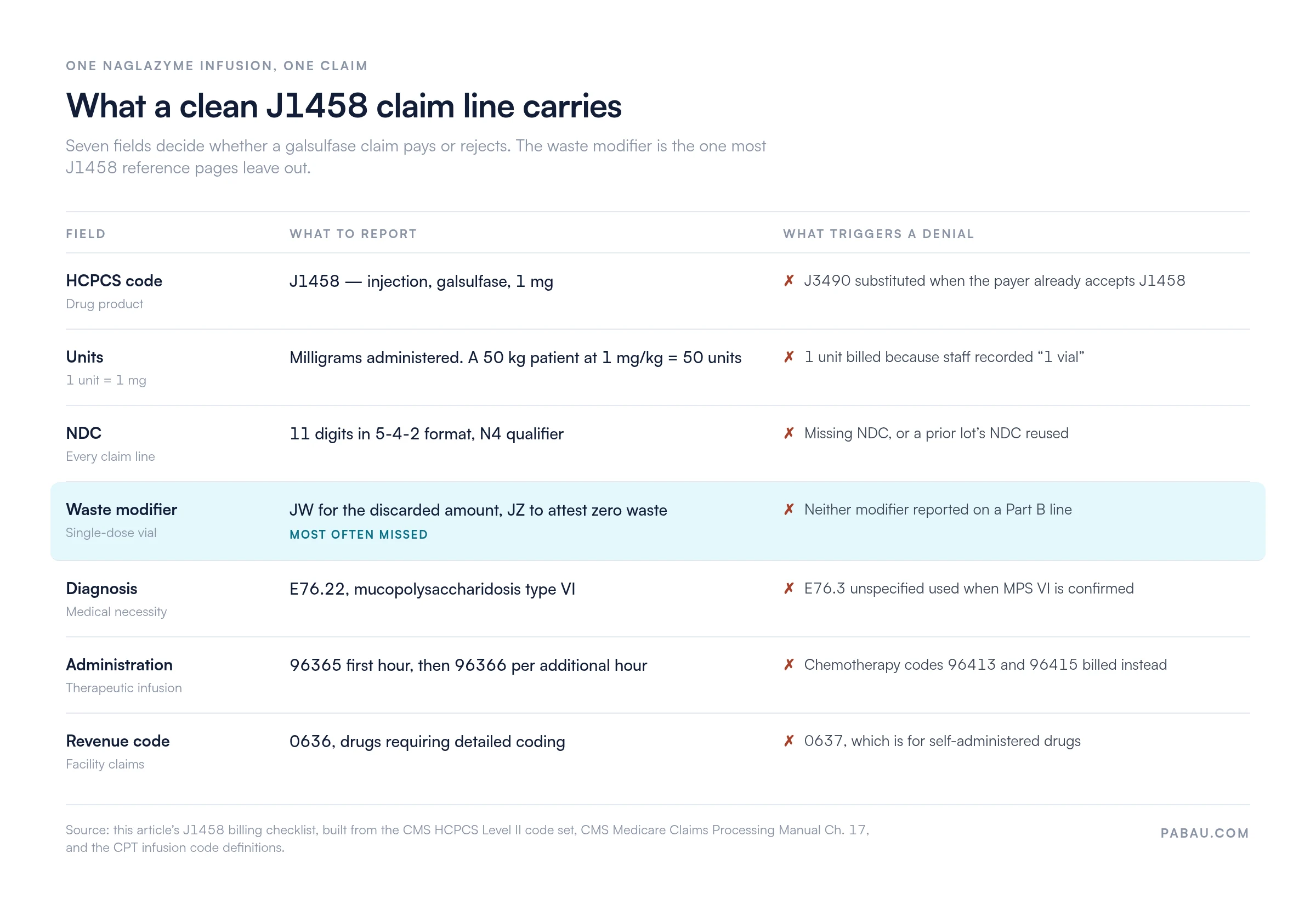
J1458 is rarely the only code on an infusion claim. The drug code covers the product. Companion codes cover the service of administering it, so capture both when you document a Naglazyme session.
Galsulfase is not chemotherapy and does not meet CPT’s highly complex biologic standard, so the therapeutic infusion codes apply rather than 96413 and 96415. Our 96365 reference covers the initial-hour rules in more detail. Confirm bundling with your payer, since some apply different edits by setting.
These are the mistakes most likely to generate a denial or a compliance review on a galsulfase claim. Each one starts at charge capture, which is also where each is cheapest to catch.
Error 1: Incorrect unit calculation. Billing 50 units for a 50 mg dose is correct. Billing 1 unit because staff recorded one vial is a frequent and costly mistake. Calculate units from the administered milligrams in the infusion record, never from vial count.
Error 2: Missing or malformed NDC. A J1458 claim without a valid NDC rejects at the clearinghouse. The NDC must be 11 digits in 5-4-2 format, carry the N4 qualifier, and match the lot administered. Reusing a prior lot’s NDC after a new shipment arrives is a compliance risk as well as a billing error.
Error 3: Wrong or missing ICD-10 code. Linking J1458 to E76.3 instead of E76.22 gives payers grounds to deny on medical necessity. Choose the diagnosis at charge capture, while the infusion record is still in front of you.
Error 4: Submitting without required prior authorization. For Medicare Advantage and commercial plans, administering Naglazyme without an approved authorization usually means a denial. Some plans require re-authorization at set intervals, even for ongoing therapy.
Error 5: Wrong infusion administration codes. Billing 96413 and 96415 treats a non-chemotherapy enzyme replacement as a highly complex biologic infusion. Report 96365 for the first hour and 96366 for each additional hour instead.
Error 6: No JW or JZ modifier. A Part B line for a single-dose-vial drug needs one of the two. A practice that discards no drug still has to report JZ, and that attestation is the easiest step in the workflow to skip.
Specialty infusion billing has more moving parts than routine claim submission. Coders look J1458 up in one tool and then key the claim into another, and details drift between them. Weight, dose, lot number, and discarded volume all live in the infusion record before they reach a claim line.
Practice management software like Pabau closes that distance. Pabau’s claims management software supports HCPCS J-code entry, NDC field tracking, and structured charge capture for infusion and specialty therapy practices. So the unit count on the claim comes from the dose your clinician documented, not from a retyped number.
Every Pabau subscription includes the full billing and claims feature set, so a two-chair infusion suite gets the same claim scrubbing as a multi-site group. On a J1458 claim, one missed NDC or a wrong unit count costs more than a year of software.

Pabau supports HCPCS J-code entry, NDC tracking, and charge capture for specialty infusion practices. See how it connects clinical documentation to claim submission.

The J1458 workflow is not complicated, but it is unforgiving. Each field on the claim line either matches the infusion record or it does not. Galsulfase is expensive enough that one mismatch outweighs a week of clean claims.
So the work belongs upstream, at charge capture. The dose, the lot, and the discarded volume are still in front of the person who gave the infusion. A claim assembled from the record rarely needs a second pass. One assembled from memory usually does.
Book a demo to see how Pabau turns a Naglazyme infusion record into a J1458 claim line without a retyped number.

Working a J1458 denial? Denial management in healthcare covers the appeal workflow and the denial patterns that repeat on high-cost drug claims.
Chasing an authorization? The prior authorization process explains what payers ask for and how to shorten the turnaround.
Building a cleaner claim? What makes a clean claim sets out the fields that have to agree before a claim is submitted.
Billing other Part B drugs? Medicare billing walks through the Part B rules that govern physician-administered drugs.
HCPCS Code J1458 is used to bill for Injection, galsulfase, 1 mg. Galsulfase is the generic name for Naglazyme, an enzyme replacement therapy made by BioMarin Pharmaceutical. The FDA approved it to treat Mucopolysaccharidosis VI (MPS VI). MPS VI is a rare inherited metabolic disorder caused by deficiency of the enzyme N-acetylgalactosamine 4-sulfatase.
The billing unit for HCPCS J1458 is 1 mg of galsulfase. Report units equal to the total milligrams administered during the infusion session. For a 50 kg patient receiving the standard 1 mg/kg dose, report 50 units of J1458 on the claim.
Medicare Part B reimburses J1458 at ASP+6%, meaning the Average Sales Price of galsulfase plus a 6% add-on. CMS updates the ASP rate quarterly based on manufacturer-reported sales data. Always check the current quarter’s CMS ASP Drug Pricing File for the applicable allowable rate before finalizing billing projections.
The primary ICD-10-CM code used with J1458 is E76.22 (Mucopolysaccharidosis, type VI). This is the most specific diagnosis code for MPS VI and should be used on J1458 claims whenever the MPS VI diagnosis has been confirmed. Avoid using E76.3 (unspecified mucopolysaccharidosis) when a more specific code can be supported by the clinical record.
Yes. Naglazyme is supplied in a 5 mg/5 mL single-use vial, so J1458 falls under Medicare’s discarded-drug policy. Since October 2023, every Part B claim line must carry JW for the amount discarded, or JZ to attest that no drug was wasted. Report one of the two on every line, even when the vial is used in full.