CPT Code 62284: Injection procedure for myelography
CPT Code 62284: official descriptor and procedure overview The American Medical ...

Last Updated: Oct 19, 2026
J0710 is the HCPCS Level II code for injection, cephapirin sodium, up to 1 gm. CMS terminated it with effect from 31 December 2025, so it is no longer valid for claims after that date.
Let Pabau's smart automation suggest the right codes, reduce claim denials, and keep your practice compliant—effortlessly.
Automate repetitive tasks and focus on what matters most—your patients.
Reduce coding errors and ensure compliance with the latest regulations.
Clean claims, fewer denials, and faster reimbursements.
Powerful insights and reporting to help your practice thrive.
HIPAA compliant SOC 2 certified GDPR-compliant Trusted by 4,000+ clinics worldwide

HCPCS Code J0710 is the deleted Level II code for injection of cephapirin sodium, up to 1 gram, given parenterally.
The code is no longer active for billing. Claims filed under J0710 for current dates of service are denied by Medicare and most payers.
J3490 is the primary crosswalk for cephapirin sodium, and it needs a drug narrative covering dose, route and NDC.
Practice management software like Pabau submits claims electronically, checks required fields before submission, and tracks each claim through five status stages.
HCPCS Code J0710 is a Level II National Code maintained by CMS under the HCPCS code set. The official descriptor reads: Injection, cephapirin sodium, up to 1 gm. It sits in the J-series, which covers drugs given by injection in physician office and outpatient settings under Medicare Part B.
Cephapirin sodium is a first-generation cephalosporin antibiotic. The beta-lactam compound is given parenterally, either intravenously or intramuscularly. It treated serious bacterial infections in settings where oral antibiotics were not an option. The billing unit of up to 1 gram set the threshold per administration, so doses above 1 gram took multiple units.
HCPCS Code J0710 carries a deleted status in the CMS code file. Deleted means the code is no longer recognized for billing on current dates of service.
The HCPCS National Panel retires a J-series drug code for one of three reasons:
Cephapirin sodium’s limited market presence in the United States is why J0710 was retired. The drug is not widely available for physician office or outpatient use. That removed the need for a dedicated billing code.
One nuance matters for older encounters. If a claim carries a date of service from when J0710 was still active, some payers may still process the original code. MAC guidance varies here. Verify with your Medicare Administrative Contractor before you submit a retroactive claim under a deleted code.
Check your MAC’s Local Coverage Determination (LCD) bulletin archive before submitting any retroactive claim under a deleted J-code. CGS Medicare, Noridian, and Palmetto GBA each publish quarterly code update bulletins that confirm which codes were active during specific date-of-service windows.
When a dedicated J-code is deleted, CMS routes claims through the unclassified drug code. J3490 covers any injectable drug with no assigned HCPCS code. It is not tied to one product, so the payer has to be told what was given.
Three routes cover almost every cephapirin sodium claim, and the date of service picks between them.
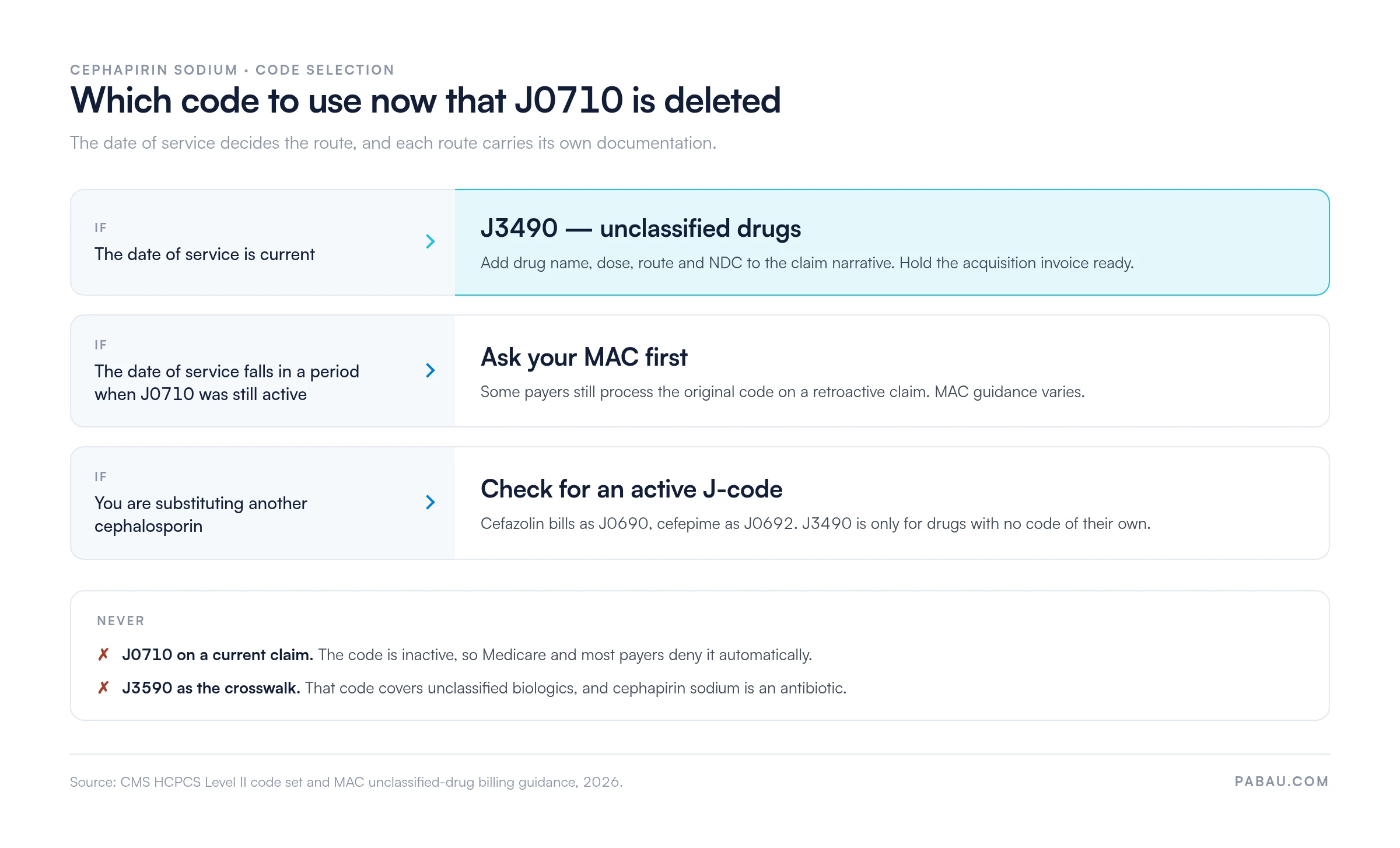
Payer acceptance of J3490 is not automatic. Most Medicare Administrative Contractors and commercial payers require supporting documentation when an unclassified code is submitted.
That documentation names the drug, the dosage, and the route of administration. It goes on the claim itself or travels as an attachment. Without it, the claim is held for additional development or denied.
When using J3490, AAPC coding guidance recommends a narrative description in Box 19 of the CMS-1500 form. The equivalent field in your 837P transaction does the same job. The narrative should state the drug name, the strength administered, the route, and the NDC number where available. Omitting any of these raises the chance of a medical review request.
Under Medicare Part B, injectable drugs given in outpatient settings and physician offices are paid on Average Sales Price (ASP). A percentage add-on sits on top of that. J0710 is deleted, so no current Medicare rate is attached to it. The CMS ASP drug pricing files list rates for active J-codes only.
For claims submitted under J3490 as the crosswalk, Medicare payment is settled through individual payer review. Unclassified drug codes carry no assigned ASP rate, so the payer assesses cost from invoice or acquisition documentation. Keep acquisition cost invoices ready to submit alongside the claim.
Place of service matters too. Medicare Part B drug administration coverage differs by setting. Physician office (POS 11) and outpatient hospital (POS 22) claims run on distinct payment methodologies. Verify the POS code before submission, since a mismatch with the administered drug’s billing code is a common denial trigger.
Expect remittance advice on J3490 claims to carry remark codes about additional documentation or manual pricing review. Build a step into your billing process that flags these claims for follow-up within 30 days. The denial patterns for unclassified codes are predictable, which makes them correctable.
Practices that still administer cephapirin sodium need a settled billing workflow. The six steps below follow CMS policy for deleted drug J-codes.
The clinical record has to support the claim. The note should carry the drug name, dose, route, time administered, and the practitioner’s signature — payers auditing J3490 claims routinely pull records to check them.
Build a J3490 billing checklist in your billing workflow: drug name confirmed, dose and route noted, NDC documented, acquisition invoice attached, ICD-10 diagnosis code linked. Claims that carry all five elements draw far fewer additional development requests.
Several injectable antibiotics have carried dedicated HCPCS codes over the years. The table below lists the ones closest to cephapirin sodium, with their current status. Check status in our HCPCS code index before you submit any J-code claim, because a code that was active last year may not be now.
First-generation cephalosporins like cefazolin kept their codes because they remain in widespread clinical use. Cephapirin sodium’s limited availability is what drove J0710’s deletion. If you are substituting a more available antibiotic in the same class, check for its own active code first. Defaulting to J3490 costs you documentation work you may not need.
Billing an unclassified code by hand means one person holding the narrative requirements in their head. The drug name, dose, route and NDC have to reach the claim every time. A missing field usually surfaces only after the payer sends the claim back.
Practice management software like Pabau moves those checks earlier. Pabau’s claims management software validates required fields in the background before a claim goes out. Incomplete claims get caught at your desk rather than at the payer’s.
Each submitted claim then moves through five status stages. Your team can see where a J3490 claim is sitting without calling the payer. When remittance comes back, it lands against the same patient record that holds the encounter.
J0710 is retired, and putting it on a current claim guarantees a denial. J3490 is the way forward, paired with a complete drug narrative. Where the payer asks, add an acquisition cost invoice. What decides whether those claims pay is documentation discipline, not the crosswalk.
Set the checklist once and the denials stop being a surprise. That matters most for teams handling several unclassified drug codes across a busy outpatient schedule. Book a demo to see how Pabau tracks each claim from submission to remittance.
HCPCS Code J0710 is a deleted Level II code that described injection of cephapirin sodium, up to 1 gram. It billed Medicare Part B and commercial payers for parenteral administration of a first-generation cephalosporin antibiotic. The code is no longer active and cannot be used on current dates of service.
J3490 (unclassified drugs) is the primary replacement code for billing cephapirin sodium after J0710 was deleted. Submitting J3490 requires including the drug name, dose, route, and NDC number in the claim narrative. Some payers also require acquisition cost documentation before processing payment.
No. HCPCS Code J0710 is deleted and inactive. Claims submitted under J0710 for current dates of service will be denied by Medicare and most commercial payers. For retroactive claims with a date of service from when the code was active, check with your MAC before submitting under the original code.
J3490 is the billing fallback for any injectable drug that lacks a dedicated HCPCS code, including drugs whose codes have been deleted. When J0710 was active, it gave cephapirin sodium a specific code. After deletion, J3490 became the right code, but it needs more documentation than a drug-specific J-code. Payers must review pricing manually rather than apply a standard ASP rate.