



CCSD code G5100: Bypass of duodenum billing guide
CCSD code G5100 bills a bypass that leaves the duodenum in place CCSD code G5100...

Last Updated: Oct 16, 2026
CPT code 99407 is the billing code for intensive smoking and tobacco use cessation counseling lasting more than 10 minutes. It sits in the Behavior Change Interventions subsection of the AMA CPT code set. Medicare Part B covers it as a preventive benefit with no beneficiary cost-sharing when billed correctly.
Most denials come down to two failures: Insufficient time documentation, and a missing or mismatched diagnosis code. This guide covers how 99407 differs from companion code 99406, who can bill it, and what Medicare and Medicaid pay. It also covers the ICD-10 pairing codes, the documentation auditors look for, and the mistakes that trigger a rejection.

CPT code 99407 covers intensive tobacco cessation counseling lasting more than 10 minutes, and 99406 covers the 3 to 10 minute session.
Medicare Part B covers up to 8 counseling sessions a year, 2 quit attempts of 4 sessions each, with no patient cost-sharing.
Every claim needs an ICD-10 pairing code from the F17.x nicotine dependence family, or Z72.0 for tobacco use. Missing the diagnosis is the top denial trigger.
Pabau’s claims management software flags missing diagnosis codes and tracks counseling time inside the note, so fewer 99407 claims come back denied.
CPT code 99407 is defined by the American Medical Association as: “Smoking and tobacco use cessation counseling visit; intensive, greater than 10 minutes.” The code sits in the Medicine section of the CPT code book, under the Behavior Change Interventions subsection, alongside companion code 99406.
The counseling session must address tobacco use directly. Recording tobacco use status during a routine visit does not qualify. Content typically covers the patient’s readiness to quit, the triggers they identify, and the behavioral strategies introduced. It also covers pharmacotherapy options, such as nicotine replacement or prescription aids, and the quit plan itself.
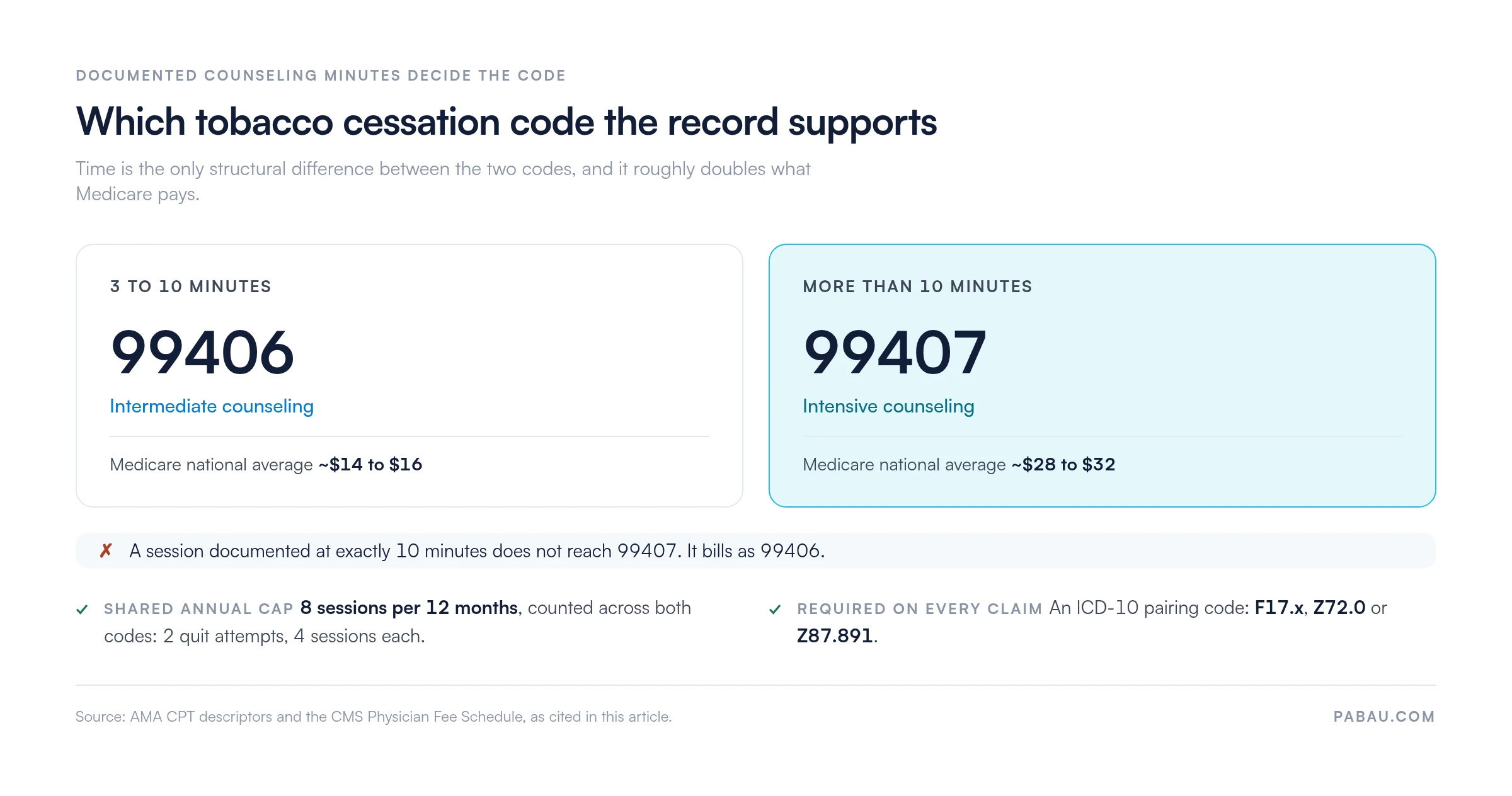
The 10-minute threshold is a hard line. A session of exactly 10 minutes does not qualify for 99407, so bill it as 99406.
Session duration is the only structural difference between 99406 and 99407, and it roughly doubles what Medicare pays. CPT code 99406 covers intermediate counseling lasting 3 to 10 minutes. CPT code 99407 covers intensive counseling lasting more than 10 minutes.
Choosing the wrong code is the most common error in tobacco cessation billing. Practices that consistently under-bill this service are usually using 99406 for sessions that ran past the 10-minute mark.
Both codes share the same annual session limits and preventive benefit status under Medicare. Time is what the documentation has to settle. Practices record start and stop times, or state the elapsed counseling duration, to support the code they select. The chart below puts the threshold, the shared session cap, and the diagnosis requirement in one place.
Any qualified provider with Medicare billing privileges can report CPT code 99407 when the service is within their scope of practice and state licensure. Under Medicare, eligible providers include physicians (MD, DO), nurse practitioners, physician assistants, clinical nurse specialists, and clinical psychologists.
Some Medicare Administrative Contractors (MACs) also allow certified registered nurse anesthetists and other non-physician practitioners, depending on state scope-of-practice rules. Mental health practices that screen for tobacco use at intake are a common example. Billing 99407 when cessation counseling follows the screen is an overlooked source of revenue.
Incident-to billing applies under specific supervision conditions. The supervising physician must be present in the office suite, not just the building. The service must also follow an established plan of care. Verify MAC-specific incident-to rules before using this billing pathway for tobacco cessation.
Every CPT code 99407 claim requires a supporting ICD-10 diagnosis code. Submitting without one, or with an unrelated diagnosis, is the most reliable way to generate a denial. The primary diagnosis code family is F17.x (nicotine dependence), with Z72.0 (tobacco use) and Z87.891 (personal history of tobacco use) used in specific circumstances.
Use CDC’s ICD-10-CM coding tool to confirm current code validity before billing. Our ICD-10 reference for coders collects the diagnosis code pages behind medical necessity decisions like this one.
Use the most specific code that reflects the patient’s documented tobacco use status. F17.210 is the most commonly reported code for cigarette smokers. Z87.891 supports billing when a patient is in relapse prevention rather than active cessation. Avoid F17.x codes if the patient’s record does not document the clinical features of dependence. Z72.0 fits those cases better and still supports the claim.
Medicare Part B covers CPT code 99407 under its preventive services benefit. Eligible beneficiaries pay nothing out of pocket when the service is billed correctly. According to the CMS Physician Fee Schedule, the national average Medicare payment for 99407 is approximately $28-32 (non-facility). Local geographic adjustment factors change the allowable amount in each MAC jurisdiction.
Check the locality-adjusted rate before submitting, not after the remittance arrives. The same check catches eligibility problems that would otherwise come back as denials.
Medicare limits tobacco cessation counseling to 8 sessions per 12-month period. CMS structures this as 2 cessation attempts per year, with up to 4 counseling sessions per attempt. Sessions may be billed as 99406, 99407, or a combination. The limit applies to the total count, not to a single code.
Once a beneficiary has received 4 sessions in a quit attempt, additional sessions in that same attempt are not covered regardless of medical necessity documentation.
Track each Medicare patient’s session count against their annual cessation benefit before scheduling. A patient who had 4 sessions with a prior provider has consumed one full quit attempt. Billing a 5th session in that same attempt will deny even with perfect documentation. Verify the remaining benefit through an eligibility check before the appointment.
The Affordable Care Act mandates Medicaid coverage of tobacco cessation counseling for most beneficiary populations. Benefit structures still vary considerably by state. Most state Medicaid programs cover both 99406 and 99407. Some require prior authorization for intensive sessions, cap session counts differently from Medicare, or restrict eligible provider types more narrowly.
Always verify state-specific Medicaid policies before assuming parity with Medicare coverage. Private payers generally cover tobacco cessation counseling under preventive benefits, driven by US Preventive Services Task Force Grade A recommendations for tobacco use interventions.
Commercial plans still differ on session limits, required documentation, and whether a specific provider type must deliver the counseling. Some plans require a separate referral or prior authorization. Call the payer’s provider line before the first billable session, or run a pre-claim eligibility check. Either step prevents the most common private payer denials for this service.
Medicare has no G-code for tobacco cessation counseling. HCPCS codes G0436 and G0437 once covered intermediate and intensive counseling for asymptomatic patients. CMS deleted both effective October 1, 2016, as announced in MLN Matters article SE1611. Since then, Medicare tobacco cessation claims are billed directly under CPT 99406 and 99407.
G0447 is sometimes mistaken for the Medicare version of 99407, and it is not related to tobacco at all. Its HCPCS descriptor reads “Face-to-face behavioral counseling for obesity, 15 minutes.” The code belongs to the intensive behavioral therapy for obesity benefit under CMS national coverage determination 210.12. No MAC accepts G0447 on a tobacco cessation claim, and no MAC requires a G-code in place of 99407.
Local coverage determinations still shape other preventive services, so they are worth checking code by code before a claim goes out.
Payer policy documents often list G0442 alongside tobacco cessation codes, since it falls in the same preventive services category. It covers alcohol misuse screening, not tobacco counseling. Never substitute G0442 for 99406 or 99407 on a tobacco cessation claim.
Alcohol misuse screening has its own CPT code in the same behavior change family. 99408 covers structured alcohol or substance screening with a brief intervention, and its descriptor excludes tobacco. Medicare patients need G0442 and G0443 for that service instead.
CPT code 99407 asks more of the note than a time stamp. Elapsed time alone is insufficient if the record does not show that a substantive cessation counseling interaction took place. Auditors and payers look for five components in the visit record.
Capturing these five elements before submission is far less disruptive than reconstructing a note after a payer requests records.
The denial patterns for 99407 are consistent across payer types, and most are preventable with a structured pre-submission workflow. Denial management workflows that catch these issues before claims leave the practice cut rework costs sharply.
The most common error is selecting 99407 for a session where the documented time falls at or below 10 minutes. If the note says “10 minutes,” the correct code is 99406.
The Relative Value Unit (RVU) breakdown for CPT code 99407 comes from AAPC’s code reference and the CMS Physician Fee Schedule. CMS updates RVUs annually in the Final Rule, so check the values that apply to the fee schedule year you are billing.
To calculate the Medicare payment for your locality, multiply the total RVU (0.87) by the geographic practice cost index (GPCI) adjustments. Then multiply that figure by the annual conversion factor published in the CMS Final Rule. Treat the RVU values above as reference figures. The CMS fee schedule search tool returns the locality-adjusted payment for your practice address.
Three failures drive most 99407 denials: Missing time documentation, an absent diagnosis code, and the wrong code for the session length. Each one is decided at the point of documentation, before the claim exists. Take a practice seeing 20 tobacco cessation patients a month. Losing one claim a week to preventable denials costs it roughly $1,500-2,000 a year at Medicare rates.
Practice management software like Pabau handles claims management for practices inside the same record that holds the clinical note. The system flags a 99407 claim that lacks a supporting F17.x or Z72.0 code before it reaches the clearinghouse.
Reporting then breaks the tobacco cessation denial rate down by payer. That shows whether the cause is documentation, code selection, or a payer-specific requirement. A practice billing preventive counseling codes at any volume gets that answer without a manual chart audit.
Build a tobacco cessation note template that prompts for start time, stop time, tobacco type, readiness-to-quit score, and quit plan. The encounter cannot close until those fields are filled. Required fields mean each 99407 claim leaves the practice with documentation that supports the code.

Pabau’s practice management platform tracks counseling time, flags missing diagnosis codes, and automates claim scrubbing so 99407 and 99406 claims reach payers clean. See how it works in a live demo.

CPT code 99407 is one of the cleaner preventive billing codes to collect on. Medicare covers it with no patient cost-sharing, the session limit is generous, and patients engage with the service.
The denial problem is almost entirely documentation-driven, which makes it fixable at the point of care. Practices that build time-stamping and ICD-10 prompts into the counseling workflow see far fewer rejections than those relying on retrospective chart review.
Pabau’s claims management tools surface missing diagnosis codes and thin time documentation before claims go out. That makes 99407 one less item to chase on the back end. To see how it works in practice, book a demo with the Pabau team.

List Item #1
List Item #2
CPT code 99407 is used to bill for intensive smoking and tobacco use cessation counseling lasting more than 10 minutes. It covers face-to-face counseling that includes quit planning, behavioral strategies, and discussion of pharmacotherapy options for tobacco-using patients.
99406 covers intermediate tobacco cessation counseling lasting 3 to 10 minutes. 99407 covers intensive counseling lasting more than 10 minutes. Time is the only structural distinction, so the documentation must clearly support the code selected.
The national average Medicare payment for CPT code 99407 is approximately $28-32 in non-facility settings. That figure reflects a total RVU of 0.87 and the current CMS conversion factor. The rate varies by locality. Verify the figure using the CMS Physician Fee Schedule lookup tool for your practice’s area.
Medicare covers up to 8 tobacco cessation counseling sessions per 12-month period, structured as 2 quit attempts with up to 4 sessions each. The limit applies across both 99406 and 99407 combined, not per code. Sessions used with other providers in the same period count toward the annual cap.
No. G0447 covers face-to-face behavioral counseling for obesity in 15-minute units, and it does not apply to tobacco cessation. The Medicare tobacco cessation G-codes, G0436 and G0437, were deleted effective October 1, 2016. Medicare has accepted CPT 99406 and 99407 directly ever since, and no MAC requires a G-code in their place.
Yes, in most cases. When a cessation counseling session and a separate E/M service fall on the same date, append modifier -25 to the E/M code. The modifier tells the payer the E/M was separately identifiable. Without modifier -25, the payer typically denies the E/M and pays only 99407.



