CPT code 93503: Swan-Ganz catheter billing and modifiers
CPT code 93503: Official descriptor and procedure overview In the AMA CPT code s...

Last Updated: Oct 23, 2026
92604 is the CPT code for diagnostic analysis of a cochlear implant, patient age 7 years or older, with subsequent reprogramming. It covers follow-up mapping visits after the initial programming session, which is billed with 92603.
The code does not specify laterality. Billed alone, it reflects programming of one implant, and each payer sets the modifier for programming both implants in one session.
Let Pabau's smart automation suggest the right codes, reduce claim denials, and keep your practice compliant—effortlessly.
Automate repetitive tasks and focus on what matters most—your patients.
Reduce coding errors and ensure compliance with the latest regulations.
Clean claims, fewer denials, and faster reimbursements.
Powerful insights and reporting to help your practice thrive.
HIPAA compliant SOC 2 certified GDPR-compliant Trusted by 4,000+ clinics worldwide

CPT code 92604 covers diagnostic analysis and subsequent reprogramming of a cochlear implant for a patient aged 7 or older.
Billed alone, 92604 reflects programming of one implant. When both implants are programmed, the payer decides the modifier, whether 76, RT and LT, 50 or 22.
The first programming session after activation for a patient aged 7 or older is 92603, and patients under 7 are billed with 92601 or 92602.
In 2026, 92604 carries 1.25 work RVUs and 2.62 total non-facility RVUs, about $87.51 nationally before locality adjustment.
Pabau, the practice management platform we build, attaches diagnosis codes and modifiers at charge entry, so laterality is settled before the claim leaves.
CPT code 92604 reports diagnostic analysis and subsequent reprogramming of a cochlear implant for a patient aged 7 or older. The AMA descriptor reads: “Diagnostic analysis of cochlear implant, patient age 7 years or older; subsequent reprogramming.” Each part of that wording limits when the code applies.
The descriptor sets no minimum time. Instead, the note has to show what was analyzed and what changed.
The AMA publishes the authoritative descriptors through the AMA CPT code set. Within that set, 92604 sits in the 92601-92639 range of evaluative and therapeutic otorhinolaryngologic services.
The code bundles the analysis and programming work performed in one encounter. Knowing where that bundle ends prevents both unbundling and undercoding.
Included in 92604:
Not included, billed separately when performed:
CPT guidance states that 92601-92604 do not include evaluation of auditory function. When 92626 is performed on the same day, document it as its own service, with its own time.
The four cochlear implant programming codes split on two axes only. One is the patient’s age, under 7 or 7 and older, and the other is initial programming versus subsequent reprogramming.
None of the four codes is a bilateral code. A patient with two implants is billed with the same code as a patient with one, and the second implant is shown with a modifier.
The common mix-ups involve age and visit type. A 6-year-old’s follow-up session is 92602, because age is judged on the date of service. An adult’s first-ever programming session is 92603, not 92604. The decision path below runs both checks, then adds the step for a bilateral session.
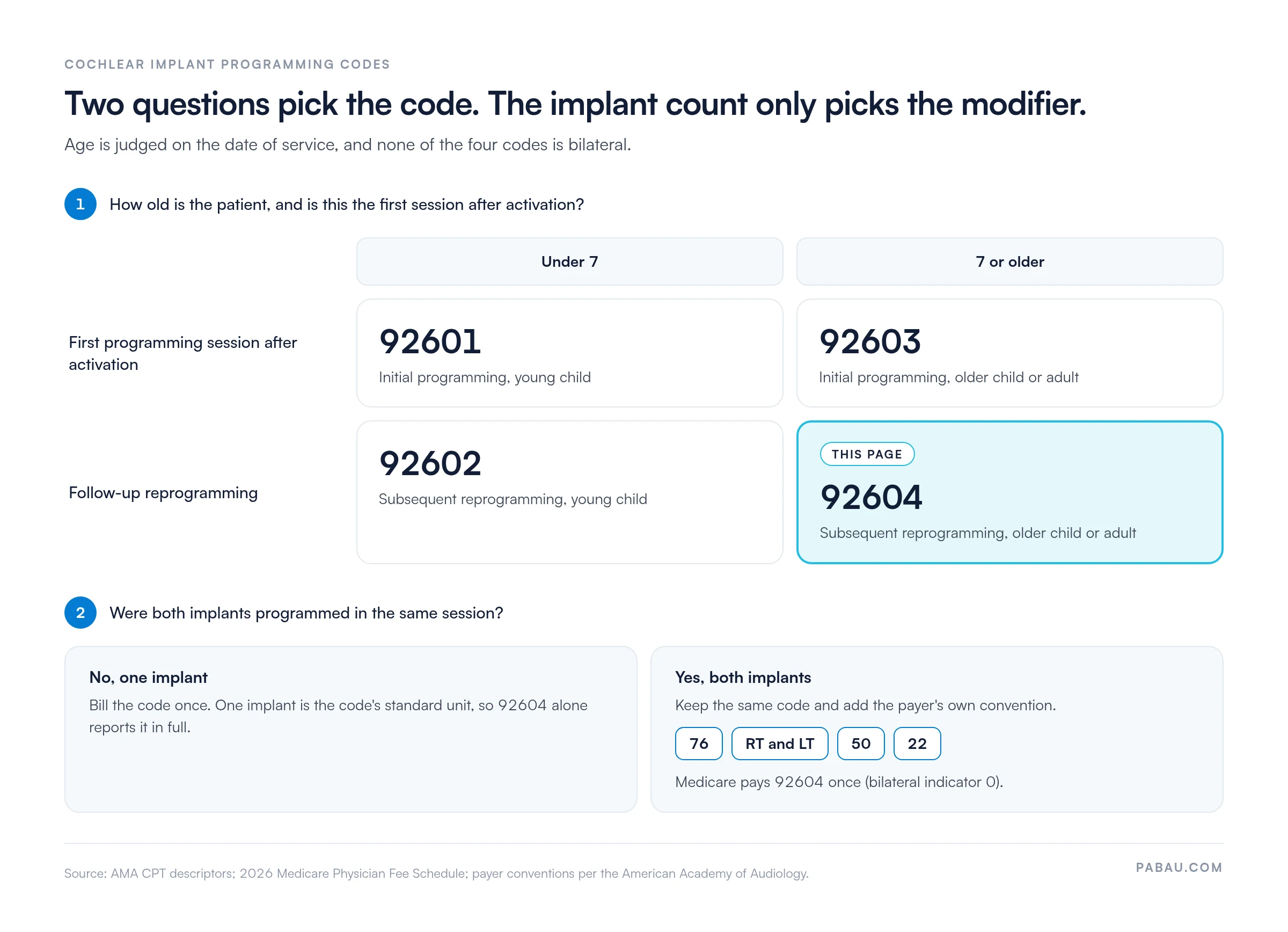
Billed alone, 92604 reflects programming of one cochlear implant, according to the American Academy of Audiology’s coding series. When both implants are programmed in one session, each payer decides how the second implant is reported.
The 2026 Medicare fee schedule gives 92604 a bilateral surgery indicator of 0. Medicare therefore pays the code once, at 100% of the fee schedule amount, even when modifier 50 or RT and LT are reported. Some commercial plans pay for the second implant, so confirm each plan’s rule before the visit.
Never use modifier 52 to show that only one of two implants was programmed. A one-implant session is the code’s standard unit, so 92604 on its own reports it in full.
A 92604 encounter follows a consistent clinical sequence. Each step maps to a line in the clinical note.
Documentation for a clean claim: The note names the date of service, the patient’s age, the audiologist, and the device make and model. It also states which ear or ears were programmed, the parameters changed, and the follow-up plan.
A note that reads “CI reprogramming performed” will not survive a payer audit. For a bilateral session, record findings for each ear separately, so the modifier on the second line has support. Understanding medical billing documentation standards helps audiology teams write notes that hold up under review.
Payers need a diagnosis that supports the programming visit. ICD-10-CM offers an encounter code for managing the cochlear device and a status code for the implant itself.
Z96.21 has no laterality, and no Z96 code identifies a right or left cochlear implant. Z96.22 is myringotomy tube status and Z96.29 covers other otological and audiological implants, so neither describes a cochlear implant.
Sequencing varies by payer. Check the payer’s policy to see whether it wants the encounter code or a hearing loss code such as H90.3 listed first.
CMS sets payment for 92604 each year through the Medicare Physician Fee Schedule (MPFS). The 2026 national CMS relative value file lists these values before any geographic adjustment.
The payment figures use the 2026 conversion factor of $33.4009, which applies to practitioners outside a qualifying alternative payment model. Your locality’s geographic practice cost index (GPCI) moves the amount up or down, and CMS updates the schedule every January.
Check the current amount in the CMS Physician Fee Schedule lookup tool. Select the year, enter 92604, and choose your locality. Commercial rates are set by contract and vary by plan.
Original Medicare generally does not require prior authorization for 92604 programming visits. The service is covered under Part B when medical necessity is documented.
Prior authorization is more likely in these situations:
When a request is needed, include the implant history, the device make and model, and the clinical reason for the visit frequency. Verify requirements for each patient’s plan before the visit.
Check prior authorization requirements per patient, not per payer. Two patients on the same commercial payer can be on plans with different auth rules depending on their employer group contract. A real-time eligibility check at the time of scheduling catches this before a claim is denied post-service.
CPT 92604 is on the Medicare telehealth services list, so remote cochlear implant programming can be billed to Medicare. Implant manufacturers offer remote fitting software that connects the audiologist to the patient’s sound processor.
According to ASHA, Congress has extended audiologists’ authority to bill Medicare for telehealth through December 31, 2027. The following conditions apply to a Medicare telehealth claim:
For remote programming, save the place of service with the appointment when it is booked. The claim then carries the right POS code without a manual fix at checkout.
Original Medicare sets no fixed annual visit limit for 92604. Each visit must be medically necessary, and a Medicare administrative contractor can apply local edits.
Programming visits cluster in the first year after activation, when maps change most. When a patient needs more visits than the plan allows, document the specific clinical reason.
Typical reasons include a change in hearing performance, a device fault, a newly deactivated electrode, or a processor upgrade. Generic notes such as “patient reports difficulty hearing” rarely support a frequency exception.
92604 claims deny for a predictable set of reasons, and most can be caught before submission. An effective denial management workflow starts with the root cause of each denial before any corrected claim is resubmitted.
When a 92604 claim is denied anyway, the remittance carries a claim adjustment reason code. Looking up denial codes tells you whether to fix the modifier, the diagnosis or the authorization before you resubmit.
Cochlear implant surgery (69930) carries a 90-day global period, while 92604 has a global indicator of XXX. Programming is an audiology service separate from the surgeon’s postoperative care, so it is not part of the surgical package.
Some commercial and Medicare Advantage plans treat early programming differently. Check the plan’s policy before the first follow-up session that falls inside the 90 days.
A structured billing workflow cuts errors on 92604 claims. These steps belong between the end of the session and claim submission.
Most 92604 errors start at charge entry, when someone keys the code, diagnosis and modifiers from memory. A bilateral session adds a step, because the second implant needs the payer’s own modifier convention.
Pabau supports cleaner claims management by letting audiology teams build a charge template for each CPT code. The diagnosis codes, modifiers and POS defaults fill in from the template, so the biller confirms them rather than retyping them.
Claims go out through Pabau’s integration with the Claim.MD clearinghouse, which supports electronic 837P submission, real-time eligibility checks, and ERA remittance. Clearinghouse edits flag POS and modifier errors before the claim reaches the payer.

Pabau connects scheduling, clinical notes, and claim submission, so each 92604 charge carries the right code, modifiers, and diagnosis pairs before it reaches the payer.

Choose 92604 by the patient’s age and the visit’s place in the programming sequence, never by the number of implants. Once that habit is set, the remaining risk is the bilateral session, and that is a payer question.
Store each payer’s bilateral convention, whether 76, RT and LT, 50 or 22, and apply it every time both implants are programmed. Pair it with Z45.321 and Z96.21, and with a note that records findings for each ear.
Book a demo to see how Pabau builds those payer rules into your audiology charge templates, so 92604 claims go out right the first time.

Need to clean up denied audiology claims? Submitting a clean claim covers the elements payers check before processing an audiology or medical billing submission.
Want to understand the clearinghouse behind 92604 submissions? How the Claim.MD clearinghouse works explains real-time eligibility, 837P transmission, and ERA remittance for practices billing Medicare and commercial payers.
Tracking ERA remittances from your 92604 claims? Electronic remittance advice (ERA) explains how 835 files return payment and denial information and how to reconcile them against submitted claims.
CPT code 92604 covers diagnostic analysis and subsequent reprogramming of a cochlear implant for a patient aged 7 or older. The session includes impedance checks, setting the electrical dynamic range, program upload, and counseling during the visit. Billed alone, it reflects programming of one implant.
CPT 92602 is for patients under 7, and CPT 92604 is for patients aged 7 or older. Both report subsequent reprogramming after the initial programming session. The patient’s age on the date of service decides which code applies.
No. The 92604 descriptor does not include the word bilateral, and billed alone the code reflects programming of one implant. For bilateral sessions, payers use modifiers such as 76, RT and LT, 50 or 22, so check each payer’s rule.
The usual pairing is Z45.321 (encounter for adjustment and management of cochlear device) with Z96.21 (cochlear implant status). Z96.21 has no laterality, so one code covers one or two implants. Add H90.3 or another hearing loss code when the payer’s policy asks for it.
Yes. Medicare Part B covers 92604 when the visit is medically necessary and billed by a qualified audiologist or physician. In 2026 the code carries 2.62 total non-facility RVUs, about $87.51 nationally before locality adjustment. Medicare Advantage plans may set stricter rules.
Yes. CPT 92604 is on the Medicare telehealth services list, and audiologists can bill Medicare for telehealth through December 31, 2027. Use POS 02 or POS 10, with modifier 95 where the payer requires it. Medicaid and commercial coverage varies, so verify each plan first.
Original Medicare sets no fixed annual limit for 92604, but each visit must be medically necessary. Medicare Advantage, Medicaid and commercial plans set their own limits. When a patient needs extra visits, document the specific clinical reason, such as a device fault or a decline in speech performance.
The top causes are billing the wrong age or visit-type code and reporting a bilateral session without the payer’s modifier convention. Others include missing prior authorization, the wrong POS on telehealth claims, missing Z45.321 or Z96.21, and thin documentation.