



CCSD code G5100: Bypass of duodenum billing guide
CCSD code G5100 bills a bypass that leaves the duodenum in place CCSD code G5100...

Last Updated: Oct 16, 2026
CPT code 76831 is the billing code for saline infusion sonohysterography (SIS). It covers the radiological supervision and interpretation of a saline-infused uterine ultrasound, including color flow Doppler when performed. Gynecology and reproductive medicine practices use this code to report the imaging component of the SIS procedure.
Companion code 58340 covers the procedural side, the catheterization and the saline introduction. Most denials on 76831 trace back to that pairing. This reference covers the 2025 Medicare fee schedule, applicable modifiers, ICD-10 diagnosis pairings, NCCI bundling rules, documentation requirements, and the most common denial triggers.

CPT code 76831 reports saline infusion sonohysterography (SIS) including color flow Doppler, when performed, for the imaging component only.
Companion code 58340 covers catheterization and saline introduction. Both codes can be billed together when a single provider performs both components.
The most common denial trigger is billing 76831 alongside 76830 on the same date without modifier 59 to establish a distinct procedural service.
Medicare paid roughly $111 nationally for 76831 in 2025, split into about $78 technical and $33 professional.
CPT code 76831 describes “Saline infusion sonohysterography (SIS), including color flow Doppler, when performed,” as defined by the American Medical Association’s CPT code set. It sits within the Diagnostic Ultrasound Procedures section of the Radiology chapter. The phrase “when performed” means color flow Doppler is optional. Document it when it is used, but its absence does not invalidate the code.
The code covers only the radiological supervision and interpretation (RS&I) component of the SIS procedure. It does not include the physical catheter placement or saline introduction, which are reported separately under CPT 58340. Billing templates should prompt for both codes whenever one provider performs both components in a single session.
Saline infusion sonohysterography distends the uterine cavity with sterile saline to improve visualization of the endometrium and intracavitary structures during transvaginal ultrasound. The process lets the sonographer or interpreting physician identify polyps, submucosal fibroids, adhesions, and septal defects that may be invisible on standard pelvic ultrasound.
The clinical steps below map onto the documentation a payer expects, so a coder can see which part of the note supports each code.
The CMS Physician Fee Schedule sets Medicare payment rates for CPT 76831 annually. Rates differ by facility type and by geographic locality. The figures below are 2025 national non-facility amounts, unadjusted for locality. Check the current fee schedule for your MAC jurisdiction before billing.
Payment amounts come from the CMS Physician Fee Schedule for 2025 and are national figures, unadjusted for locality. Geographic practice cost indices, conversion factor updates, and MAC-specific policies all move the amount a practice is actually paid.
Run the CMS Physician Fee Schedule lookup for your practice’s locality code before quoting reimbursement to a patient. National averages can sit 15-20% away from what your MAC pays. Pull the current conversion factor and locality multiplier each January, when the new fee schedule takes effect.
Three modifiers apply to CPT code 76831, depending on how the service is split between the performing and the billing provider. Incorrect modifier selection is one of the most common denial triggers on this code.
When the same physician performs and interprets the SIS in an office they own, no modifier is required. The global code covers both components. Confirm that 76831 supports a PC/TC split in the current CMS RVU file before applying either modifier.
Payers use the linked ICD-10 diagnosis code to validate medical necessity for CPT 76831. The codes below are the ones commonly paired in gynecology and fertility practices. Local Coverage Determinations govern which codes each payer accepts, and descriptors are revised every October, so confirm the current wording in the ICD-10-CM code set.
CPT 76830 describes a standard transvaginal ultrasound, non-obstetric. CPT 76831 describes a saline infusion sonohysterography. The distinction matters because 76831 already includes a transvaginal ultrasound component. Billing both codes on the same date without modifier 59 triggers an NCCI bundling edit.
The rules that govern 76830 as a standalone claim line differ once it lands on the same claim as a SIS.
Hysterosalpingography uses fluoroscopy and contrast medium to evaluate tubal patency and uterine anatomy. CPT 74740 reports the radiological supervision and interpretation for an HSG, just as 76831 reports the RS&I for a SIS. The two codes cover different imaging modalities and are not interchangeable.
The American Society for Reproductive Medicine’s coding guidance distinguishes the two procedures for billing purposes.
Reproductive medicine practices often run both studies in one workup. The SIS evaluates the uterine cavity before a cycle, and the HSG checks tubal patency on a separate date under its own code.
Yes. CPT 76831 and CPT 58340 can be billed together on the same date of service when one provider performs both components. CPT 76831 covers the imaging RS&I. CPT 58340 covers the catheterization and introduction of saline or contrast. Both AAPC and ASRM coding guidance treat them as separate components of the same procedure.
Two conditions must be met. First, both components must actually be performed, not just ordered. Second, the operative or procedure note must document the catheterization and the imaging interpretation separately to support dual billing. A combined report that does not describe catheter placement and image interpretation on their own creates audit exposure.
When two different providers split the work, each bills only the component they performed. The operating provider bills 58340. The radiologist or interpreting physician bills 76831 with modifier 26. The chart below maps each of those splits to the codes and modifiers it produces.
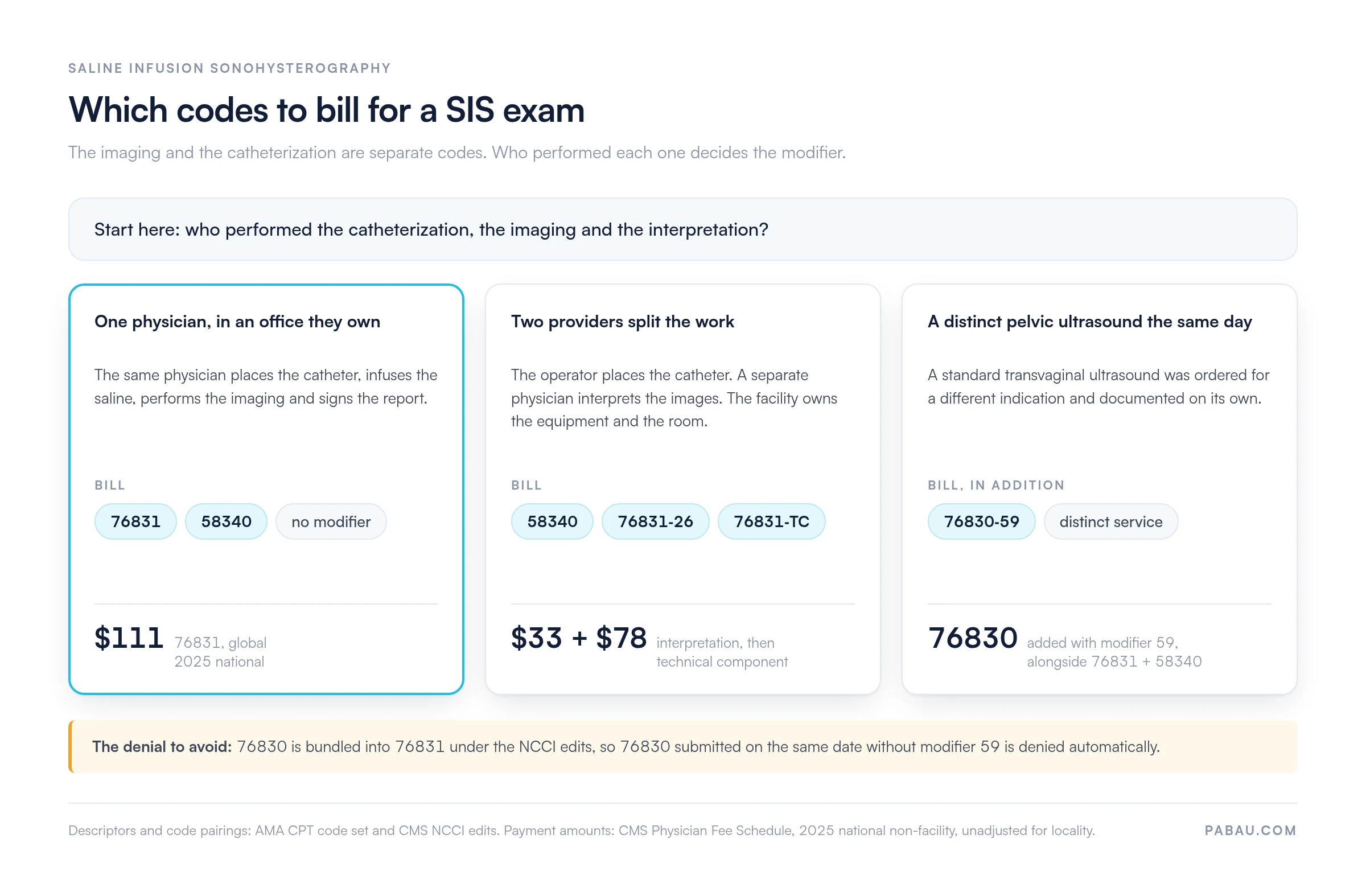
The National Correct Coding Initiative (NCCI) edits define which code pairs cannot be billed together without a modifier indicating a distinct service. For CPT 76831, the key bundling relationship is with CPT 76830. Because 76831 inherently includes the transvaginal imaging component, CMS treats 76830 as bundled into 76831.
Submitting both on the same claim without modifier 59 results in automatic denial of the lower-value code. Check the current NCCI edit table at cms.gov before billing an edge case.
A formal written interpretation is the single most important documentation element for CPT 76831. Without it, the claim does not support the RS&I component, and the line will not survive a payer audit.
A structured note template that carries every required SIS field reduces the chance of a missing Doppler notation or an incomplete impression reaching the claim.
Build a mandatory Doppler documentation checkbox into your SIS procedure note template. Doppler performed and not documented can put the whole claim in front of an auditor. Doppler documented but not performed is a false representation problem. A two-second checkbox prevents both errors at scale.
Most CPT 76831 denials trace to one of five preventable errors. All five are catchable at the point of coding, well before the remittance arrives. Running the claim through gynecology claims management software that applies NCCI logic while the coder works removes most of the rework on this code family.
Consult the AAPC’s CPT code lookup to review current code-pair edits. Cross-reference the CMS NCCI edit tables for the current policy year before making a modifier decision on an edge case.
A 76831 error usually surfaces at the remittance, weeks after the visit. The coder works from the note, the claim goes out, and the NCCI edit on 76830 comes back as a denial someone has to rework. By then the sonographer has no memory of whether Doppler was switched on.
Practice management software like Pabau moves that check to the point of charting. A SIS procedure template carries the saline volume field, the Doppler prompt, and the companion 58340 line. A missing element is visible while the chart is still open. Coding then reads from a complete note instead of reconstructing one.
Claims go out electronically through Pabau’s Claim.MD integration, which routes gynecology and reproductive medicine claims to thousands of US payers on a single clearinghouse connection. Remittances post back against the original claim, so a bundling denial on 76830 traces straight to the encounter that produced it.

Pabau helps OB-GYN and reproductive medicine practices manage procedure billing, track modifiers, and submit claims through integrated clearinghouse connections. See how it works for your practice.

Two decisions settle almost every 76831 claim, and both are made before anyone opens the billing screen. Work out who performed each component, then decide whether a separate pelvic ultrasound belongs on the same date. The modifier follows from those two answers.
That makes the note template the highest-leverage fix available. A field for saline volume, a field for Doppler, and a prompt for the 58340 line cost the sonographer a few seconds each. They also remove the three errors payers flag most often on this code.
Pabau’s claims management gives OB-GYN and reproductive medicine teams procedure templates, modifier tracking, and electronic claims submission in one system. Book a demo to see how it handles gynecology billing from the chart to the remittance.

Need the diagnosis code that carries medical necessity for a SIS? ICD-10 code N93.9, abnormal uterine bleeding covers the indication most often paired with this exam.
Want to understand how clearinghouse submission works for gynecology claims? How medical billing clearinghouses work explains the payer routing and remittance process from submission through ERA posting.
Billing the SIS as part of a fertility workup? IVF procedure codes reference guide covers companion codes and billing rules for fertility treatment cycles.
Working a bundling denial that already came back? Denial codes in medical billing maps the common remittance codes to the correction each one needs.
CPT code 76831 is the billing code for saline infusion sonohysterography (SIS). It covers radiological supervision and interpretation of a saline-infused uterine ultrasound, including color flow Doppler when performed. It is maintained by the AMA and sits within the Radiology / Diagnostic Ultrasound Procedures section of the CPT code set.
Yes. CPT 76831 covers the imaging RS&I and CPT 58340 covers the catheterization and saline introduction. They are separate components of the SIS exam, so both can be billed on the same date of service. Each must be documented separately in the procedure note to support dual billing.
CPT 76831 (SIS) uses transvaginal ultrasound with saline to evaluate the uterine cavity for intracavitary lesions. CPT 74740 (HSG) uses fluoroscopy with contrast medium to assess tubal patency. They are distinct modalities used for different clinical indications and are not interchangeable for billing purposes.
No. CPT 76830 is a standard non-obstetric transvaginal ultrasound without saline infusion. CPT 76831 adds saline distension and includes color flow Doppler when performed. Because 76831 incorporates the transvaginal imaging, billing both codes on the same date without modifier 59 triggers an NCCI bundling denial.
The report must state the clinical indication and tie it to a specific ICD-10 code. It must describe catheter placement and saline instillation, then give the imaging findings. It must also say whether color flow Doppler was performed, and carry a signed physician interpretation. A technologist worksheet alone does not meet the RS&I documentation standard.
Commonly paired ICD-10 codes include N93.8 (abnormal uterine bleeding), N84.0 (polyp of corpus uteri), and N85.00 (endometrial hyperplasia). N97.1 (female infertility of tubal origin) and Q51.3 (bicornuate uterus) are also accepted. Payer-specific LCD policies govern which codes each payer will accept as valid medical necessity indicators.



