

CCSD code G5100: Bypass of duodenum billing guide
CCSD code G5100 bills a bypass that leaves the duodenum in place CCSD code G5100...

Last Updated: Oct 16, 2026
74175 is the CPT code for computed tomographic angiography, abdomen, with contrast material(s), including noncontrast images, if performed, and image postprocessing.
Coders often confuse it with the standard CT abdomen codes 74160 and 74170, and with the combined CTA abdomen-and-pelvis code 74174. The labels look alike, but the protocol requirements differ. Reporting 74175 requires a vascular-specific contrast protocol and documented image postprocessing. Without that postprocessing note in the radiology report, a payer downcodes the claim to a lower-level CT code.
Let Pabau's smart automation suggest the right codes, reduce claim denials, and keep your practice compliant—effortlessly.
Automate repetitive tasks and focus on what matters most—your patients.
Reduce coding errors and ensure compliance with the latest regulations.
Clean claims, fewer denials, and faster reimbursements.
Powerful insights and reporting to help your practice thrive.
HIPAA compliant SOC 2 certified GDPR-compliant Trusted by 4,000+ clinics worldwide

CPT code 74175 covers CTA abdomen with contrast, noncontrast images if performed, and image postprocessing. All three elements must be documented.
Image postprocessing is a defining requirement: without it, the procedure may only support a lower-level CT abdomen code.
The 2026 national Medicare rate is $304.28, and it is the same in the facility and non-facility setting.
Common denial triggers include missing postprocessing documentation, incorrect modifier use, and selecting 74175 when the anatomy extends into the pelvis (use 74174 instead).
Pabau’s claims management software helps radiology billers track 74175 claims, attach modifier rules, and route submissions through Claim.MD for real-time eligibility checks.
The American Medical Association defines CPT code 74175 as: Computed tomographic angiography, abdomen, with contrast material(s), including noncontrast images, if performed, and image postprocessing. The code sits within the Diagnostic Radiology section of the CPT code set, under the Abdomen subheading that runs 74018-74190. CPT groups radiology codes by body area rather than by imaging modality, which is why CTA and standard CT codes share one range.
Three elements distinguish this code from a standard CT abdomen. First, contrast material is required, not optional. Second, noncontrast images are included in the global service when obtained, meaning you do not separately report a pre-contrast acquisition. Third, and most critically, image postprocessing must be performed and documented by the interpreting physician. That usually means multiplanar reconstruction or 3D vascular mapping.
Clinically, CPT code 74175 is ordered to evaluate the abdominal aorta, renal arteries, mesenteric vessels, and related vascular structures. Common indications include aortic aneurysm surveillance, renal artery stenosis workup, mesenteric ischemia evaluation, and pre-surgical vascular mapping. Renal CTA is correctly reported under this code, not under a separate renal imaging code.
RVUs determine Medicare reimbursement under the Resource-Based Relative Value Scale (RBRVS). CPT code 74175 carries the same total RVU in the facility and the non-facility setting, so the components below apply wherever the scan is performed. The CMS Physician Fee Schedule lookup tool publishes the authoritative values, updated annually.
Practice expense carries most of the weight in this code, because the service runs on scanner time, contrast, and technologist staffing. The work RVU covers the interpretation and the review of the reconstructed images, not the acquisition itself. Confirm the current values against the CMS fee schedule before using them in a fee analysis. The conversion factor and the individual weights change each year.
Medicare payment equals total RVU multiplied by the geographic practice cost index (GPCI) for the provider’s locality, then multiplied by the 2026 national conversion factor. Because both the GPCI and the conversion factor vary by region, the figure below is a national starting point. Use the CMS fee schedule tool with your locality code for the exact amount.
The national amount is identical in both settings, so the site of service does not change what Medicare pays for this code. The modifier does. A global claim carries the full amount, while a 26 or TC split divides it between the reading physician and the owner of the equipment. Commercial payer rates often exceed Medicare by 10-30%, though prior authorization requirements add claim lag that can offset the premium.
Check your MAC’s locality GPCI multiplier before quoting reimbursement amounts to your billing team. A practice in San Francisco (locality 99B) will see meaningfully different totals than one in rural Mississippi, even for identical procedures. The CMS fee schedule lookup lets you filter by locality code and year.
Modifiers clarify the circumstances of service and prevent claim denials when the standard code alone does not capture the billing scenario. The table below covers the modifiers most commonly applied to CPT code 74175 in radiology billing.
Modifier 26 and TC are mutually exclusive and should never appear together on the same claim line. When a freestanding imaging center owns both the equipment and employs the interpreting physician, bill the global service with no modifier. Payer policies on modifier 59 have tightened since CMS introduced the X-modifiers (XE, XS, XP, XU). Some MACs now require an X-modifier rather than 59 to distinguish same-day imaging services.
Medical necessity for CPT code 74175 must be supported by an appropriate ICD-10-CM diagnosis. The ordering physician’s indication drives code selection; the radiologist’s report does not independently establish it. The table below lists the ICD-10-CM codes most commonly paired with CTA abdomen. MAC Local Coverage Determinations (LCDs) vary, and not every code listed is covered by every payer.
When abdominal pain (R10.x) is the only listed diagnosis, many MACs and commercial payers want more. They require a vascular indication in the clinical notes to justify CTA over a standard CT abdomen. Always cross-reference the ordering physician’s clinical documentation before selecting the ICD-10 code for the claim.
Three codes are confused with CPT code 74175 most often. They are 74174 (CTA abdomen and pelvis), 74177 (CT abdomen and pelvis with contrast), and 74160 (CT abdomen with contrast only). The distinction rests on anatomical scope and protocol type, not simply on whether contrast was used.
The most consequential distinction is 74175 versus 74174. If the imaging acquisition included both the abdomen and the pelvis in one CTA run, 74174 is the correct code, not 74175. Billing 74175 for a combined study understates the service performed. Conversely, 74175 is correct if the order specified CTA abdomen and the scan stayed within abdominal boundaries. Incidental pelvic structures on a few slices do not change that.
Understanding where CPT code 74175 sits within the broader CT code series helps coders navigate the correct selection when the imaging protocol or anatomy changes. The codes 74150 through 74178 cover the full range of abdomen and pelvis CT variations.
Two questions settle every selection in this range. Does the acquisition stop at the abdomen, or continue into the pelvis? Was the protocol a routine contrast study, or a timed vascular run with documented reconstruction? The grid below maps both answers onto the eight codes, and crossing either boundary is the most frequent billing error on this series.
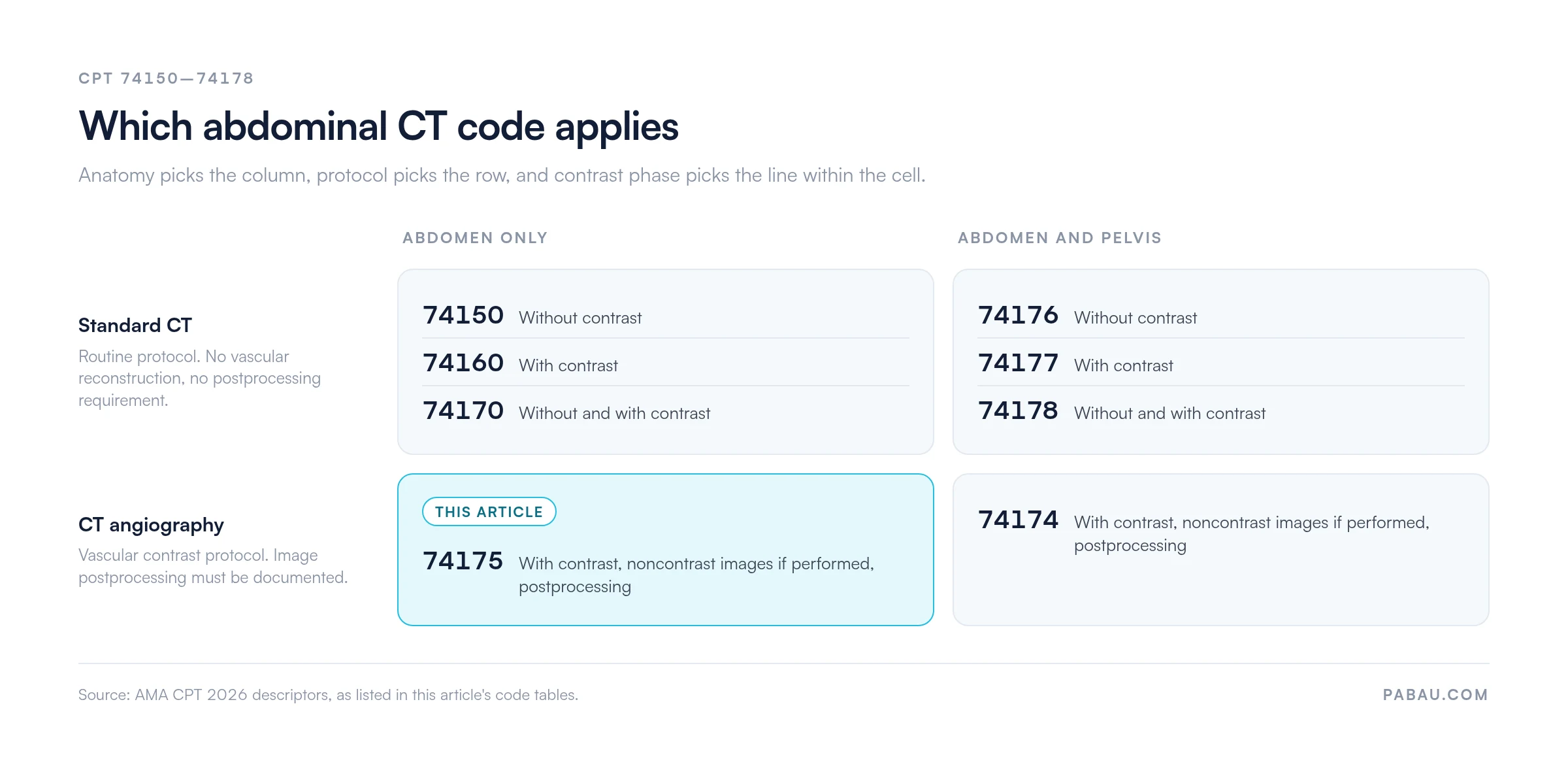
Accurate documentation prevents downcoding and supports medical necessity. For CPT code 74175, both the physician order and the radiology report carry specific requirements that differ from standard CT abdomen codes. Strong documentation makes submitting a clean claim straightforward, and missing any of the elements below is the first thing payers audit during pre-payment review.
The cheapest way to hold all six is a report template that carries each element as a required field. A postprocessing attestation line that the radiologist has to complete costs one edit to the template. It removes the single most common reason this code gets downcoded.
Claims for CPT code 74175 are denied or downcoded for a predictable set of reasons. Reading the six patterns below against your own denial log tells you which one your practice actually has, so prevention work goes where it pays.
Tracking denial patterns by code tells radiology managers whether an error is systemic or isolated. A repeated downcode points at the report template. A single one usually points at coder training. Pabau, practice management software built for healthcare providers, includes claims management software that flags modifier rules and code-level documentation requirements before submission.

Medicare coverage for CPT code 74175 is governed by MAC Local Coverage Determinations (LCDs) rather than a single national policy. A CTA abdomen that is covered under one MAC’s jurisdiction may require additional documentation or prior authorization under another. Practices serving patients across several states have to track those requirements at the MAC level, not at the Medicare level.
For commercial payers, the fastest way to confirm prior authorization requirements is to run eligibility and benefits verification at or before the point of scheduling. Pabau’s integration with Claim.MD returns eligibility in real time, so radiology teams know the patient’s coverage status before the scan takes place. Scheduled imaging appointments can be checked in batches, which keeps same-day authorization surprises off the front desk.
Before scheduling a non-emergent CTA abdomen for a commercial payer patient, run eligibility and benefits verification to confirm whether prior authorization is required. Note the authorization number and attach it to the claim. Missing authorization is one of the most preventable denial categories for high-value imaging codes.
In most radiology practices the postprocessing check happens after the fact. The report is signed, the coder reads it days later, and a missing reconstruction note surfaces only when the payer pays 74160 instead of 74175. Correcting it then costs an appeal and several weeks of aged receivable.
Pabau moves that check to the point of submission. Code-level rules sit on the claim before it leaves the practice, so a 74175 line flags when the report has no postprocessing statement attached. Modifier logic for 26 and TC follows the billing arrangement you configure once, rather than a coder’s memory of which site owns the scanner.
Eligibility runs against the payer before the scan is booked, which surfaces prior authorization cases while there is still time to obtain one. Claims transmit electronically through Claim.MD, and remittance advice posts back automatically against the original line. Your billing team spends its day on the exceptions instead of rekeying the routine claims.

Pabau integrates with Claim.MD to submit CPT 74175 claims electronically across 4,000+ US payers. Built-in modifier rules, real-time eligibility checks, and automated ERA posting keep your radiology revenue cycle moving.

CPT code 74175 pays $304.28 nationally in 2026, and that amount does not move with the site of service. Documentation decides whether the claim survives at all. Contrast, a timed vascular protocol, and a recorded postprocessing step are what hold the code in place.
The practical move is to fix the report template rather than chase the claim. A mandatory postprocessing attestation line costs one edit and removes the most common downcode on this code. Scan boundaries are the second check: if the acquisition crossed into the pelvis, 74174 is the code.
The trade-off is a slightly slower read-out workflow in exchange for a materially better paid claim. On a high-volume CTA service, that trade is worth making. Book a demo to see how Pabau catches a missing postprocessing note before a 74175 claim reaches the payer.

List Item #1
List Item #2
CPT code 74175 is the billing code for computed tomographic angiography (CTA) of the abdomen, performed with contrast material and mandatory image postprocessing. It is used to evaluate abdominal vascular structures, including the aorta, renal arteries, and mesenteric vessels. Common indications are aortic aneurysm, renal artery stenosis, and mesenteric ischemia.
CPT 74175 covers CTA of the abdomen only, using a vascular-specific contrast protocol with mandatory image postprocessing. CPT 74177 covers CT of both the abdomen and pelvis with contrast using a standard (non-vascular) protocol and does not require postprocessing. The key distinctions are anatomy covered and whether a vascular CTA protocol with reconstruction was performed.
Use CPT 74175 when the CTA acquisition covers the abdomen only. Use 74174 when the CTA acquisition covers both the abdomen and pelvis in a single study. If the scan extended into the pelvis, billing 74175 understates the service. Confirm the scan boundaries in the PACS report before selecting the code.
The most commonly used modifiers are 26, TC, and 52. Modifier 26 covers the professional component, used when the radiologist interprets but does not own the equipment. TC covers the technical component, used when the facility bills equipment and staff separately. Modifier 52 covers reduced services, used when the procedure was not completed as described. Modifier 59 may apply when 74175 is billed alongside another imaging code on the same date as a distinct service.
Yes. Image postprocessing is a defining element of CPT code 74175, not an optional add-on. The AMA code descriptor includes “image postprocessing” as a bundled component. If the interpreting physician’s report does not document that postprocessing was performed, a payer may downcode the claim. It drops to 74160, CT abdomen with contrast. The postprocessing note must appear in the body of the radiology report.
Yes. Renal CTA, when performed as a computed tomographic angiography of the abdominal vasculature including the renal arteries, is correctly reported under CPT code 74175. There is no separate CPT code for renal CTA in isolation; the renal arteries are part of the abdominal vascular territory covered by this code.
The 2026 national Medicare rate for CPT code 74175 is $304.28, and it is the same in the facility and non-facility setting. The code carries a total of 9.11 RVUs, made up of 1.77 work RVUs, 7.20 practice expense RVUs, and 0.14 malpractice RVUs. Your locality GPCI adjusts the national amount, so check the CMS Physician Fee Schedule for the exact figure.



