HCPCS code K0672: Custom fitted knee orthosis
HCPCS code K0672: Definition and code descriptor HCPCS code K0672 is the Healthc...

Last Updated: Nov 24, 2026
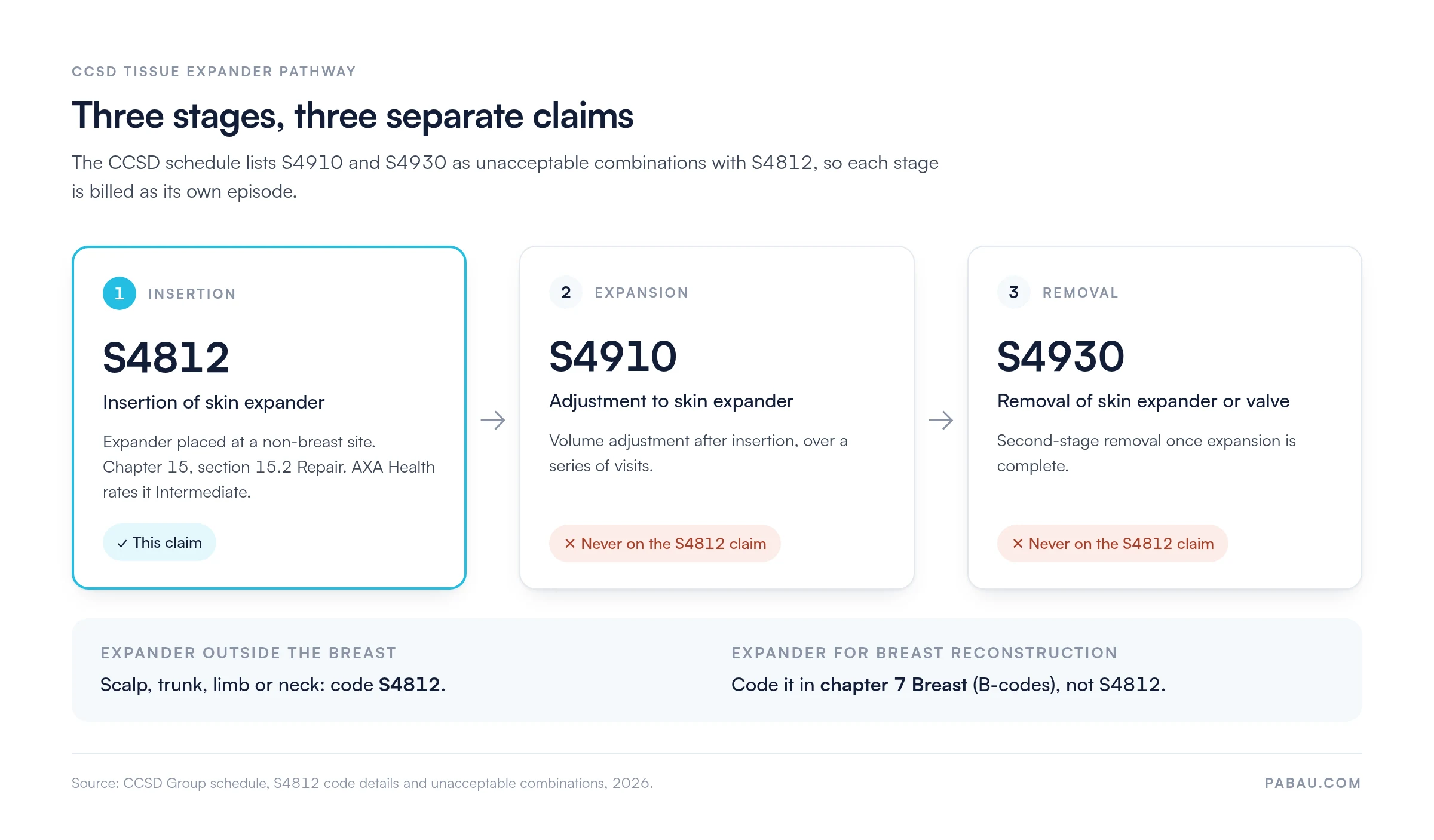
S4812 is the CCSD code for insertion of skin expander into tissue (not related to breast reconstruction). The surgeon places an inflatable expander under the skin of the scalp, trunk or a limb to grow extra tissue for reconstruction.
The code sits in chapter 15, section 15.2 Repair, and AXA Health rates it Intermediate. Expanders placed for breast reconstruction are coded in chapter 7 Breast. S4910 adjustment and S4930 removal cannot be billed on the same claim as S4812.
Let Pabau's smart automation suggest the right codes, reduce claim denials, and keep your practice compliant—effortlessly.
Automate repetitive tasks and focus on what matters most—your patients.
Reduce coding errors and ensure compliance with the latest regulations.
Clean claims, fewer denials, and faster reimbursements.
Powerful insights and reporting to help your practice thrive.
HIPAA compliant SOC 2 certified GDPR-compliant Trusted by 4,000+ clinics worldwide

CCSD Code S4812 covers insertion of a skin expander into tissue at any site other than the breast, and AXA Health’s schedule rates it Intermediate.
Expanders placed as part of breast reconstruction are coded in chapter 7 Breast, so the documented site decides which code applies.
The CCSD schedule lists S4910 (expander adjustment) and S4930 (expander removal) as unacceptable combinations with S4812.
Pair S4812 with a WHO ICD-10 diagnosis, such as L90.5 for scarring or D22 for a congenital melanocytic naevus.
Bupa, AXA Health, Aviva and Vitality each set their own fees and authorisation rules, so check the policy before booking theatre.
Pabau, a practice management platform, sends UK claims through Healthcode and Bupa, using the codes and notes already on the patient record.
CCSD Code S4812 is the UK private-healthcare code for insertion of skin expander into tissue (not related to breast reconstruction). The Clinical Coding and Schedule Development (CCSD) Group publishes the schedule, and its code page for S4812 files the procedure under chapter 15 Repair. Bupa, AXA Health, Aviva and Vitality use that schedule to identify procedures on a claim.
S4812 sits in chapter 15 (Skin and subcutaneous tissue), in section 15.2 Repair. AXA Health’s specialist schedule rates it Intermediate complexity. The CCSD Group sets the codes but not the fees, so each insurer prices S4812 on its own schedule.
The breast exclusion is a coding boundary rather than a clinical restriction. Tissue expanders placed for breast reconstruction are coded in chapter 7 Breast, which uses B-codes. Putting S4812 on a breast case, or a breast code on a scalp or limb case, invites a rejection. The site and purpose recorded in the operative note decide which code applies.
Skin expansion uses the body’s own response to stretching to generate additional soft tissue. A plastic surgeon creates a subcutaneous or subgaleal pocket beside the planned site and places an inflatable silicone expander in it. After the wound heals, saline is injected through a port over a series of visits. The overlying skin stretches until there is enough tissue for reconstruction.
The surgical steps the operative note should reflect are:
Expansion visits and the later removal are separate episodes from the S4812 insertion, each billed under its own code, as the pathway below shows.
S4812 fits when skin expansion is performed for a documented reconstructive indication, such as those below.
Record the indication in the pre-operative assessment, and carry the matching ICD-10 diagnosis onto the claim. Insurers can query or reject an S4812 claim when the diagnosis is missing or does not fit the procedure.
Insurers can ask for the operative note when they review an S4812 claim. The elements below are recommended good practice rather than a published CCSD requirement.
Digital operative note templates with these fields built in stop an incomplete record from reaching the billing stage.
UK private claims use the World Health Organization edition of ICD-10, not the US ICD-10-CM. Insurers generally expect a diagnosis that supports each CCSD procedure code on the claim. The table lists common pairings for S4812.
These pairings are illustrative. Insurers judge medical necessity on the diagnosis the surgeon documents, and no ICD-10 code guarantees approval. Check each code against the ICD-10 edition your insurer uses.
S4812 covers the insertion episode only. The CCSD schedule lists two neighbouring repair codes as unacceptable combinations with S4812, so neither belongs on the same claim.
CCSD has no separate anaesthesia code and no modifiers. The anaesthetist invoices the same procedure code, S4812, and the insurer pays an anaesthetic fee against it.
Confirm descriptors on ccsd.org.uk or your insurer’s code search before you submit. Each related procedure has its own CCSD code guide, and the Bupa CCSD codes overview explains how insurers apply the schedule.
UK private medical insurers usually ask the patient to obtain authorisation before planned surgery. Bupa, AXA Health, Aviva and Vitality each run their own process, and the rules depend on the policy. Treatment carried out without authorisation may not be covered, which can leave the fee with the patient.
A pre-authorisation request for S4812 typically includes:
Cosmetic surgery is generally excluded from UK private medical insurance, so the documented indication should show a reconstructive purpose. The Healix CCSD fee schedule shows how CCSD-coded procedures appear on a UK fee schedule.
Log the insurer authorisation number, the approved code and the approval date before you confirm the theatre slot. A procedure booked without an authorisation number is a billing risk, however complete the notes are.
Many UK private claims are submitted electronically through Healthcode, the clearing service used by the major insurers. The invoice carries the patient’s membership number, the authorisation number, S4812 and the ICD-10 diagnosis.
Fees vary by insurer and change over time. Check the current figure on the Vitality fee finder or the Bupa code search before you quote a patient. Self-pay patients are invoiced directly, using the same code for the record.
S4812 denials follow predictable patterns. The table maps the most frequent reasons to the corrective action.
The most common coding error around S4812 is swapping it with a breast expander code because the two procedures look alike. The table shows the differences that decide code selection.
Some cases sit close to the breast without being breast reconstruction. Here the purpose and site recorded in the operative note decide the code. Describe both explicitly in the authorisation request, so the insurer does not reclassify the procedure.
Practice managers and billing teams in plastic surgery units can cut S4812 errors with these workflow steps.
Reconcile S4812 claims submitted against claims paid each quarter. A rising shortfall usually traces back to documentation or authorisation problems.
An S4812 claim depends on three records agreeing: the authorisation, the operative note and the invoice. Pabau keeps all three on one patient record.
Pabau’s claims management software supports insurance billing in the UK, the US and Australia. UK claims go through Healthcode and to Bupa, built from the codes, diagnosis and membership details already recorded. Each claim’s status stays visible, so the team can answer a query before it ages.
Digital forms hold the operative note template, and the treatment record keeps each expansion visit dated. When the S4930 removal follows months later, the history is already in one place.
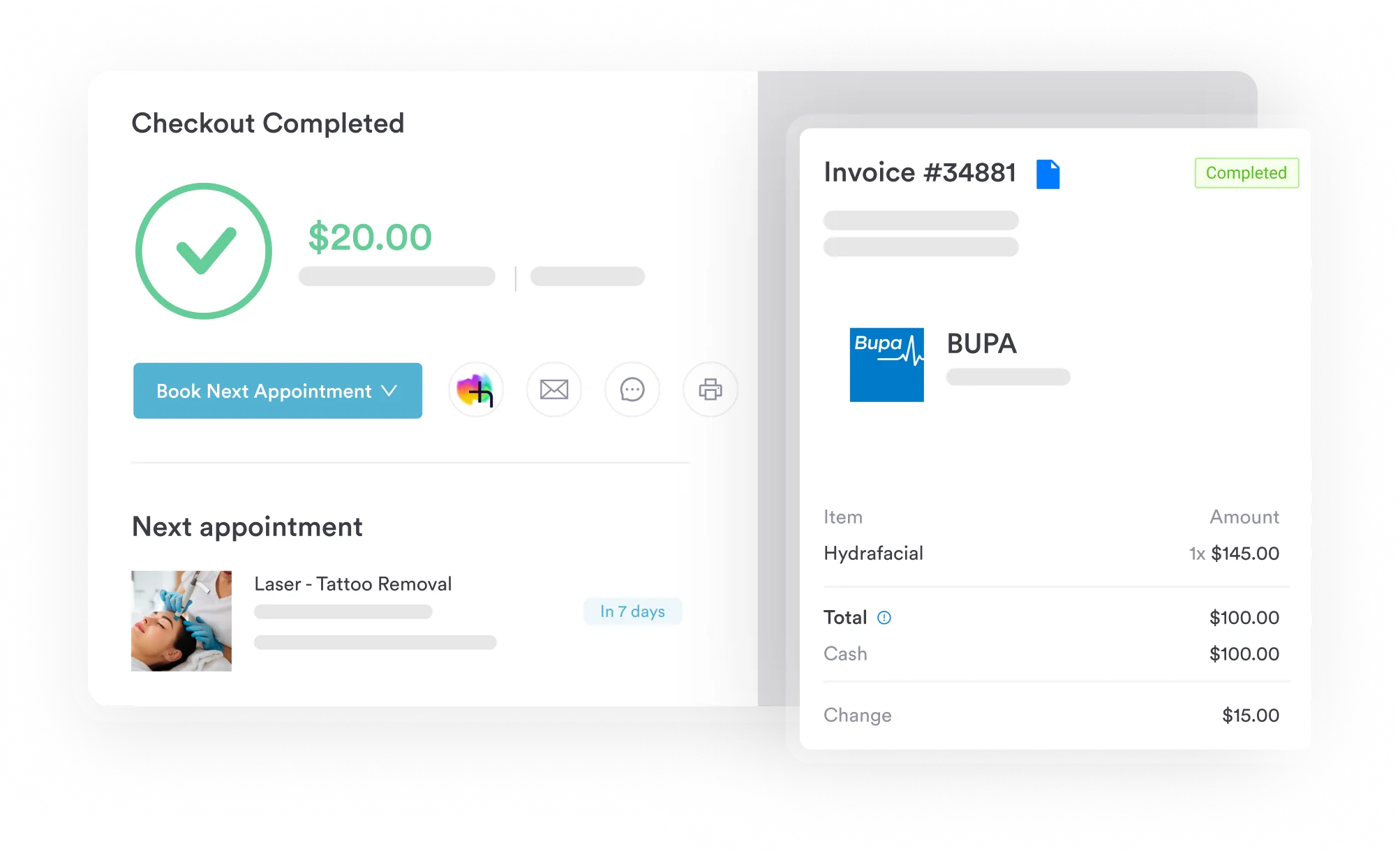

Pabau keeps the operative note, the insurer authorisation number and the Healthcode claim on one patient record. Your team spends less time chasing claims and more time with patients.

S4812 turns on one boundary and one rule. The expander must sit outside the breast, and adjustment or removal never shares its claim. With those settled, most remaining denials trace back to authorisation or documentation.
Before each case, confirm the authorisation, the WHO ICD-10 diagnosis and the operative note fields. Then plan S4910 and S4930 as separate episodes from the start. Book a demo to see how Pabau keeps the tissue expander pathway on one record, from insertion to removal.

Looking for a broader CCSD billing reference? Bupa CCSD codes explains how the CCSD schedule is structured and how UK private insurers use it.
Planning the second stage? CCSD Code S4930 covers removal of a skin expander or valve once expansion is complete.
Coding another procedure in the same episode? CCSD code guides collects Pabau’s billing references for other UK private-healthcare procedure codes.
Want to reduce claim denials across your practice? Claims management software outlines how practices submit claims, track their status and spot denial trends by procedure code.
CCSD Code S4812 covers insertion of a skin expander into tissue at a site other than the breast. Surgeons use it to grow extra skin for burn scar reconstruction, congenital naevus excision, trauma repair or scalp reconstruction. Expanders placed for breast reconstruction are coded in chapter 7 Breast instead.
Usually, yes. UK private medical insurers such as Bupa, AXA Health, Aviva and Vitality generally expect authorisation before planned surgery. Requirements depend on the insurer and the policy, so check before booking. Treatment carried out without authorisation may not be covered.
Common WHO ICD-10 pairings are L90.5 for scar conditions and T95 for the sequelae of burns. D22 covers a congenital melanocytic naevus, and Q82.5 a non-melanocytic birthmark. L66.1 or L66.9 support scalp expansion for scarring alopecia. The code must match the diagnosis in the operative record.
S4812 applies only to non-breast sites such as the scalp, trunk and limbs. Breast tissue expanders belong in chapter 7 Breast of the CCSD schedule, most often after mastectomy. Using the wrong one invites a rejection, so the site and purpose in the operative note decide the code.
No. The CCSD schedule lists S4910 (adjustment to skin expander in subcutaneous tissue) as an unacceptable combination with S4812. S4930 (removal of skin expander or valve) is listed the same way. Bill expander adjustment and removal as separate episodes, on the dates they happen.