

CCSD code G5100: Bypass of duodenum billing guide
CCSD code G5100 bills a bypass that leaves the duodenum in place CCSD code G5100...

Last Updated: Oct 16, 2026
E1350 is the CCSD code for closure of oro-antral fistula with local flap. It covers surgical repair of an established, epithelialised tract between the mouth and the maxillary sinus. The surgeon closes it with a buccal advancement, palatal rotation or buccal fat pad flap.
E1350 sits in CCSD chapter 5, Ear, nose and throat, under nasal sinuses, and Bupa bands it Intermediate 5. A repair that needs a distant flap is coded E1352 instead, or E1354 when a bone graft is added.
Let Pabau's smart automation suggest the right codes, reduce claim denials, and keep your practice compliant—effortlessly.
Automate repetitive tasks and focus on what matters most—your patients.
Reduce coding errors and ensure compliance with the latest regulations.
Clean claims, fewer denials, and faster reimbursements.
Powerful insights and reporting to help your practice thrive.
HIPAA compliant SOC 2 certified GDPR-compliant Trusted by 4,000+ clinics worldwide

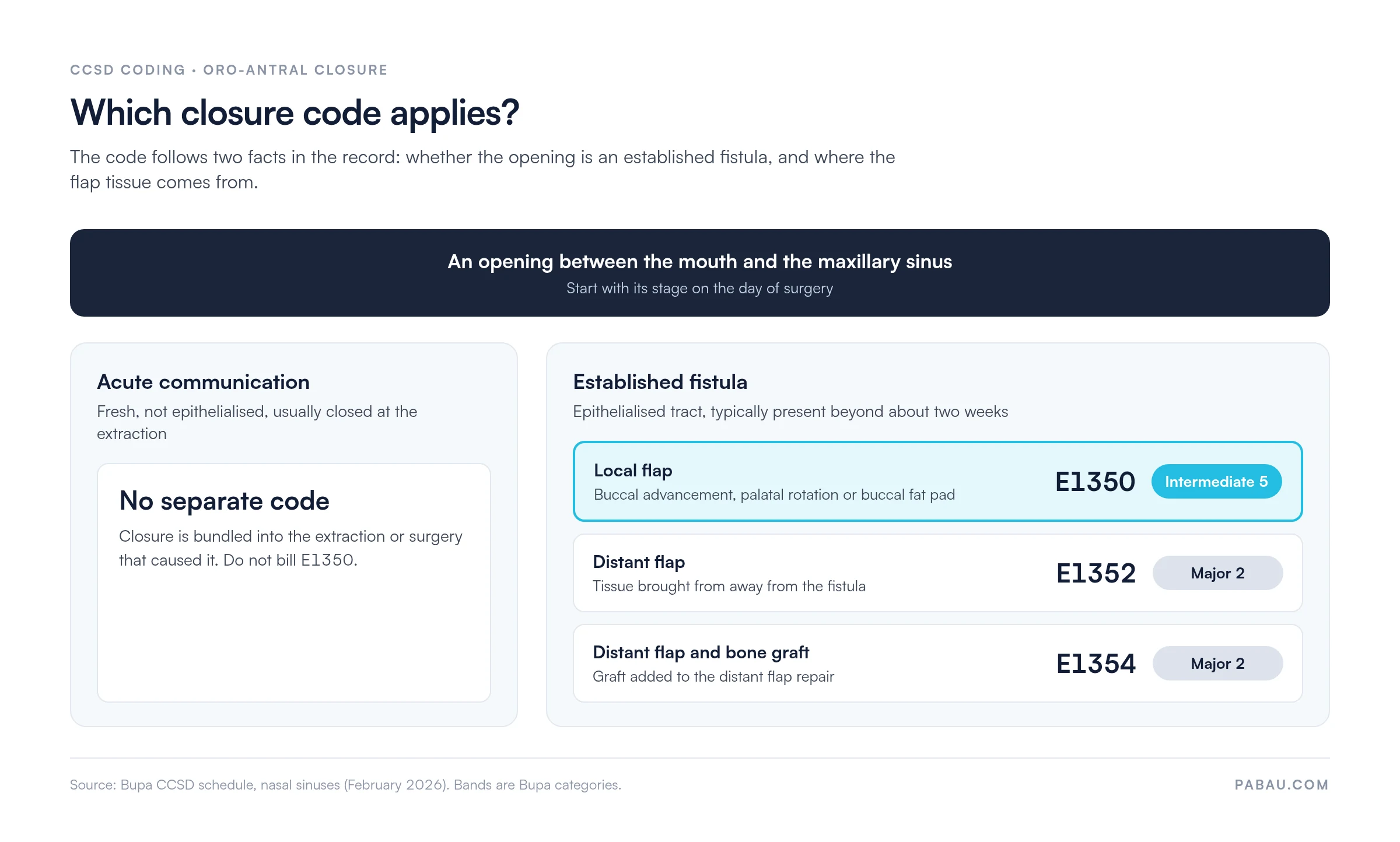
CCSD Code E1350 covers closure of an established, epithelialised oro-antral fistula with a local flap, not an acute oro-antral communication.
An acute communication has no separate code in this family, because its closure is bundled into the extraction or surgery that caused it.
A fistula closed with a distant flap is coded E1352, or E1354 when a bone graft is added, and Bupa bands both Major 2.
Most UK private medical insurers expect pre-authorisation, so UK private practices and surgeons billing medical insurers should hold an authorisation number before surgery.
Claims software such as Pabau checks that the authorisation code and membership number are present before a claim goes to Healthcode.
CCSD Code E1350 covers the surgical closure of an established oro-antral fistula (OAF) using a local mucoperiosteal advancement or rotation flap. The Clinical Coding and Schedule Development Group maintains the CCSD schedule that UK private medical insurers use. E1350 sits in chapter 5, Ear, nose and throat, under nasal sinuses.
Bupa’s schedule (February 2026) bands E1350 as Intermediate 5, with a listed fee of £405. Other nasal sinus codes, from FESS to sphenoid surgery, have their own guides in our procedure codes library.
The local flap is the defining technique. Rather than packing or a simple suture, the surgeon excises the tract’s epithelial lining and closes it with adjacent oral mucosa and periosteum. It’s a planned procedure, performed under local anaesthesia, intravenous sedation or general anaesthesia.
Three flap designs are in common clinical use:
The choice of flap is a clinical decision based on fistula size, tissue availability and surgeon preference. E1350 covers all three, and CCSD has no modifiers to tell them apart on the claim.
An oro-antral communication (OAC) is a fresh, non-epithelialised opening between the mouth and the maxillary sinus. It typically appears straight after an upper molar extraction. An oro-antral fistula (OAF) is an established, epithelialised tract that has persisted beyond about two weeks without closing on its own.
The clinical distinction drives the coding decision, and applying E1350 to an acute OAC is a common trigger for claim denial. The table below sets out the key differences.
Knowing the codes that sit alongside E1350 prevents both under-coding and unbundling errors. Bupa’s nasal sinuses list carries three oro-antral fistula closure codes, split by flap source and bone graft.
The current CCSD Technical Guide says unacceptable code combinations are listed against each code on the CCSD website. Check the list for E1350 before adding a second procedure code. The decision chart below traces the choice from the first opening to the final code.
Code descriptors are updated periodically, and the version held by your practice management system may lag behind the published schedule.
E1350 is indicated when a patient presents with a symptomatic, established oro-antral fistula that has not resolved on its own and needs surgical closure. Common causes include:
The fistula must be epithelialised and persistent before E1350 applies. The minimum record for an audit-ready claim notes the duration, the symptoms and radiographic confirmation. Typical symptoms are nasal regurgitation of fluids, one-sided sinusitis and whistling on nose-blowing.
Document fistula duration explicitly in your operative notes. Insurers reviewing CCSD Code E1350 claims frequently request evidence that the communication was present for more than two weeks before surgery was performed. A single dated entry in the patient record confirming symptomatic OAF is often the difference between a clean claim and a request for additional information.
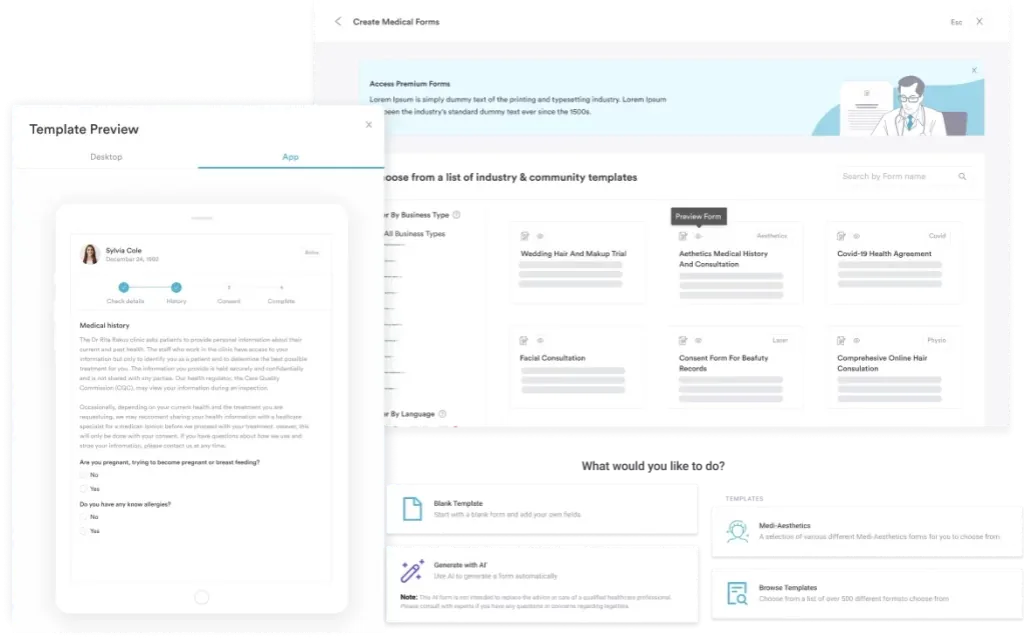
Incomplete operative notes are another frequent reason E1350 claims are queried. The following elements should be in the clinical record before the claim is submitted. A structured operative note template makes omissions less likely.
Send radiographs with the claim where the insurer’s portal accepts attachments. Sending them up front makes a further-information request, and the payment delay it brings, less likely.
CCSD is a procedure code system. UK private insurers also expect a matching ICD-10 diagnosis code on the claim to confirm medical necessity. The codes below are commonly paired with E1350. Verify them against current NHS Classifications Browser guidance and your insurer’s requirements before submitting.
These are common examples, so confirm them against the current NHS ICD-10 edition and your insurer’s requirements. The diagnosis code is the insurer’s main tool for assessing medical necessity. A mismatch between the diagnosis and procedure codes is a straightforward denial trigger.
Most UK private medical insurers treat E1350 as an intermediate-category surgical procedure and expect pre-authorisation before surgery. Operating without prior approval doesn’t guarantee non-payment. It does raise the risk, and it removes the practice’s ability to challenge a later denial on procedural grounds.
Check your insurer’s current provider guidance before each case, as requirements change without notice. The pre-authorisation request typically needs the following:
Patients usually call their insurer for the authorisation number, quoting the procedure code and fee estimate you give them. Bupa publishes its codes and fee bands on Bupa’s code search portal. AXA Health and Aviva run their own authorisation pathways, set out in each insurer’s provider pages. Our Bupa CCSD code guide covers Bupa-specific submission requirements in more detail.
E1350 claims fail for predictable reasons. Pinning down which one applies, and fixing it before resubmission, saves time and protects the practice’s payment rate.
E1350 covers the surgical procedure itself. Anaesthetic and sedation services are separately billable where the insurer’s policy permits, if they’re clinically justified and documented as a distinct service.
Insurer bundling rules vary. The Healix fee schedule and the Aviva fee schedule both publish guidance on which anaesthetic codes are reimbursed alongside surgical codes. Review the relevant schedule before adding sedation or GA codes to an E1350 claim.
Oro-antral fistula closure occasionally fails, particularly in large defects or where the patient has chronic sinusitis or poor wound healing. A revision can be billed under E1350 again. The claim then needs extra documentation showing the revision is clinically justified, not a repeat of inadequate first surgery.
For a revision E1350 claim, include:
Insurer policies on revision authorisation vary. Some insurers want a new pre-authorisation form even when the original was granted, while others accept a supplementary letter. Contact the insurer’s provider team before proceeding, and don’t assume an existing authorisation reference covers a second surgical episode.
Many surgical teams keep operative notes in one system, radiographs in another and claim forms in a third. Each E1350 claim then means chasing the duration note, the scan and the authorisation number by hand.
Pabau keeps those pieces on one patient record. Its claims management software sends claims to Healthcode with details pre-filled from that record. Validation checks confirm the membership number and authorisation code are present before the claim can go.
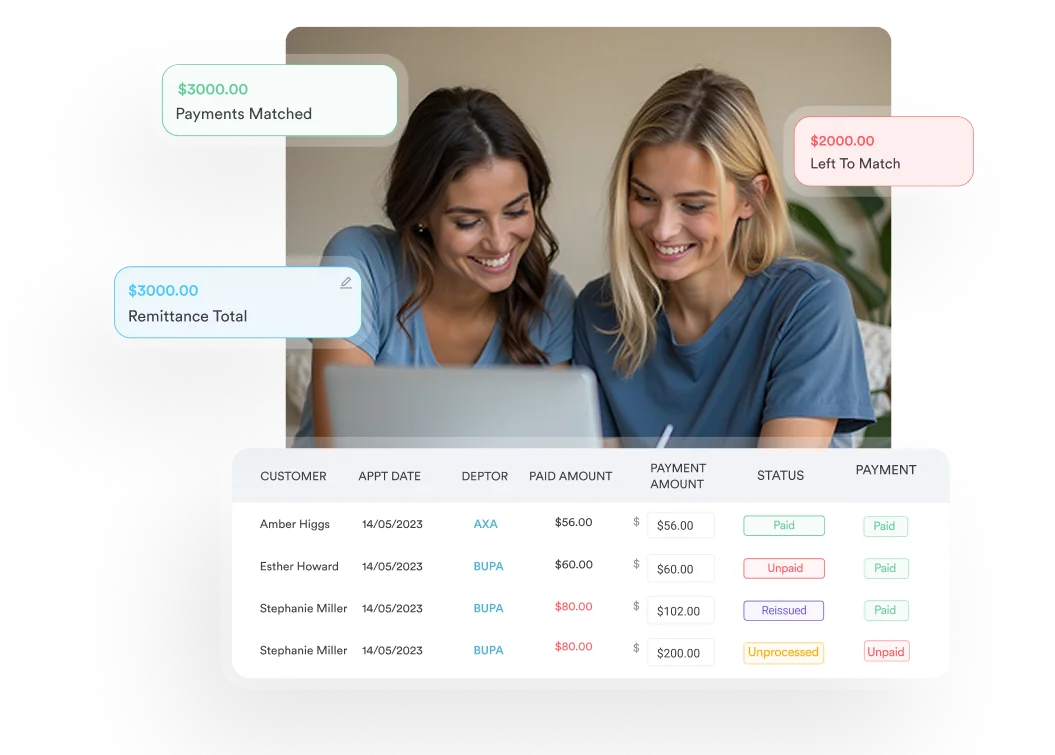
For practices billing E1350 regularly, four capabilities do most of the work:
The result is fewer E1350 claims returned for a missing number or note, and less time spent chasing insurers.

Pabau keeps operative notes, radiographs and authorisation numbers on one patient record, then sends validated CCSD claims to Healthcode.

E1350 is a narrow code. It pays for a local flap repair of an established fistula, and the claim depends on proving both parts of that description.
Before you submit, confirm three points in the record. The fistula persisted beyond about two weeks, the flap came from adjacent tissue, and the insurer authorised the case. If one is missing, fix the note or the code first. A distant flap belongs on E1352 or E1354, and an acute communication has no separate code.
Those checks take a few minutes per case, and skipping them costs a resubmission cycle and a delayed payment. Book a demo to see how Pabau keeps E1350 notes, scans and authorisation numbers together before the claim goes to Healthcode.

Need a broader guide to CCSD billing under Bupa? Bupa CCSD codes and fee schedule covers the submission process, fee chapters and insurer-specific requirements for UK private practices.
Billing endoscopic sinus surgery? CCSD code E1260 explains how image-guided endoscopic sinus surgery is coded and claimed.
Coding bilateral FESS? CCSD code E1432 walks through the bilateral FESS sinus surgery code and its billing rules.
Operating on the sphenoid sinus? CCSD code E1500 covers sphenoid sinus operations and how to claim them.
CCSD Code E1350 covers surgical closure of an established oro-antral fistula with a local flap. That includes buccal advancement, palatal rotation and buccal fat pad techniques. It applies only to a persistent, epithelialised tract. An acute oro-antral communication has no separate code in this family, because its closure is bundled into the extraction or surgery that caused it.
An oro-antral communication is a fresh, non-epithelialised opening between the mouth and the maxillary sinus, typically arising straight after tooth extraction. An oro-antral fistula is an established tract lined with epithelium that has persisted for more than about two weeks. Coding the wrong stage is a frequent cause of E1350 claim denial.
Yes, in most cases. UK private medical insurers such as Bupa, AXA Health and Aviva generally expect prior approval for E1350, an intermediate-category surgical procedure. Operating without pre-authorisation raises the risk of non-payment. Check the current requirements in your insurer’s provider guidance, as rules change without notice.
Use E1350 again for a revision procedure, but submit a new pre-authorisation request clearly labelled as revision surgery. Include the original procedure date, evidence of fistula recurrence, the reason the closure failed, updated radiographs and a clinical justification. Don’t assume the original authorisation reference covers a second surgical episode.



