HCPCS code T2043: Hospice continuous home care billing guide
HCPCS code T2043 pays for hospice crisis care by the hour HCPCS code T2043 is th...

Last Updated: Oct 7, 2026
C4810 is the CCSD code for removal of superficial corneal foreign body. It covers a foreign body confined to the corneal epithelium and removed at the slit lamp. The code sits under 4.6.0 Cornea in the UK CCSD schedule that private medical insurers use.
Insurers can change which code they accept, so confirm the code with the patient's insurer before billing.
Let Pabau's smart automation suggest the right codes, reduce claim denials, and keep your practice compliant—effortlessly.
Automate repetitive tasks and focus on what matters most—your patients.
Reduce coding errors and ensure compliance with the latest regulations.
Clean claims, fewer denials, and faster reimbursements.
Powerful insights and reporting to help your practice thrive.
HIPAA compliant SOC 2 certified GDPR-compliant Trusted by 4,000+ clinics worldwide

CCSD code C4810 describes removal of a superficial corneal foreign body in the UK CCSD schedule used by private medical insurers.
Insurers set which codes they accept, so confirm C4810 with the patient’s insurer before you bill.
The code covers foreign bodies confined to the corneal epithelium. Conjunctival, intraocular and orbital foreign bodies sit under separate CCSD codes.
CCSD defines the code, while each insurer sets its own fee, so check Bupa, AXA Health, Aviva, Vitality or Healix schedules separately.
An explicit depth statement, laterality and the anesthetic used are the record entries insurers check first on a corneal foreign body claim.
CCSD code C4810 is the code for “Removal of superficial corneal foreign body” in the schedule maintained by the Clinical Coding & Schedule Development (CCSD) Group. UK private medical insurers, including Bupa, AXA Health, Aviva, Vitality and Healix, use CCSD codes to identify the procedures they pay for.
The code applies when a clinician removes metal, glass, grit or organic matter lodged in the superficial corneal epithelium. It does not cover a foreign body on the conjunctiva, inside the eye or in the orbit. Those sites have their own CCSD codes in Chapter 4.0.0, Eye & Orbital Contents.
Before you submit a claim, search the schedule on the CCSD website, which needs a free login. Then ask the patient’s insurer which code it accepts for superficial corneal foreign body removal. Record the insurer’s answer and the date in the patient’s billing notes.
A corneal foreign body is superficial when it sits in the epithelium and has not breached Bowman’s layer. Depth is confirmed on slit-lamp biomicroscopy, and the clinical record must state it. A foreign body in the deep stroma or anterior chamber falls outside C4810.
Removal of a superficial corneal foreign body is an outpatient procedure performed at the slit lamp. Each step below creates a record entry that an insurer may ask to see.
The procedure usually takes place in outpatient rooms. A claim that describes a hospital admission for a routine superficial removal is likely to be queried by the insurer.
Insurers audit corneal foreign body claims against the clinical record. The record must show that a removal happened and that the foreign body was superficial and corneal. Digital clinical forms with set fields for laterality, depth and technique help clinicians record each element during the visit.

These are the minimum entries insurers expect in the clinical notes:
Structured patient records with an ophthalmology procedure template let the clinician complete these entries during the consultation. Nobody has to rebuild the encounter from memory at billing time.
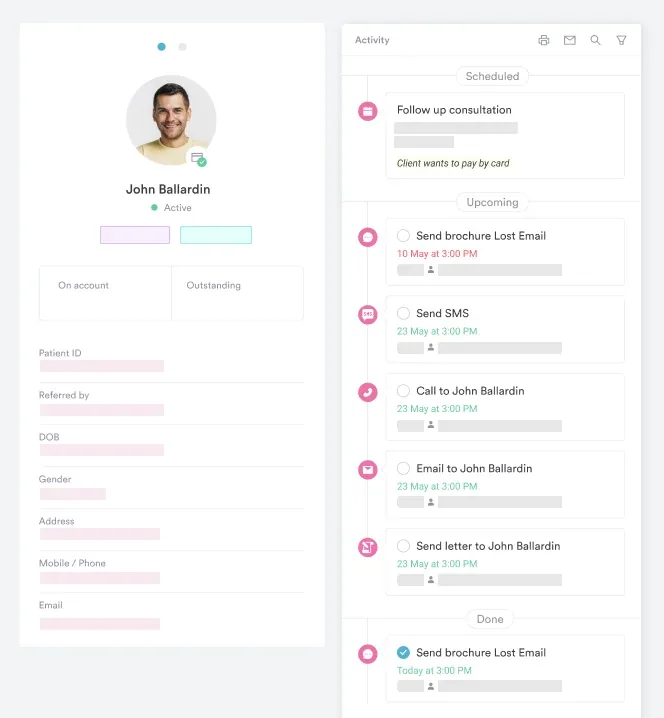
Build a corneal foreign body removal template with required fields for laterality, depth, anesthetic, instrument and rust ring status. Completing it at the slit lamp takes about two minutes and covers the entries insurers query most often.
Corneal foreign body claims go to the patient’s private medical insurer, usually through Healthcode. The first step is confirming which code the insurer will accept.
Claims management software that sends claims through Healthcode cuts down on re-keying and gives you a record of each submission.
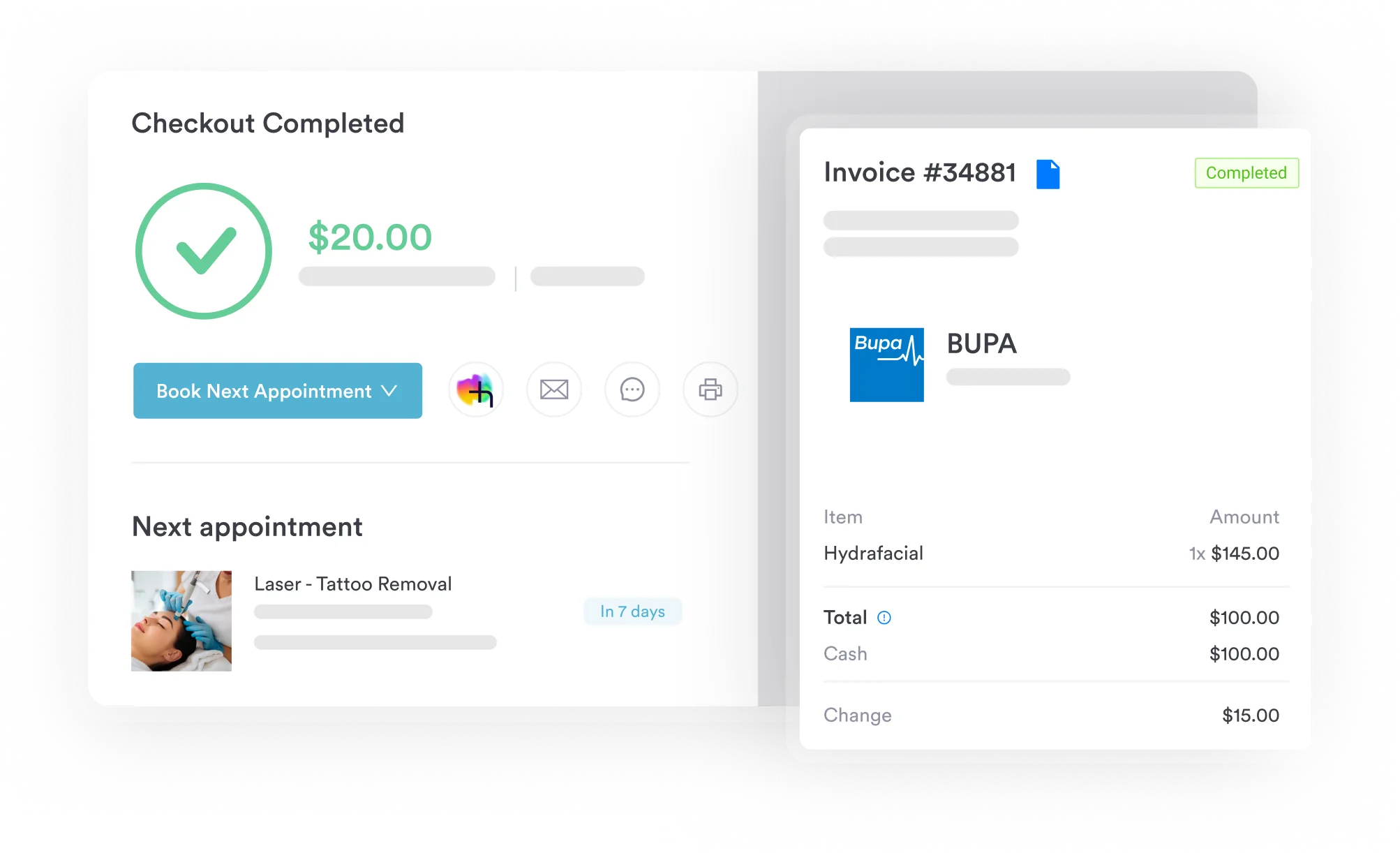
CCSD publishes code descriptors, not fees. Each insurer sets its own maximum fee for a code, and the amount can differ by insurer, policy and provider agreement. Check each schedule directly before you quote a patient.
Insurer fee schedules change during the year. A quote based on an old schedule can leave the patient with an unexpected shortfall. For Bupa specifically, our Bupa CCSD codes guide explains how CCSD codes work with Bupa claims.
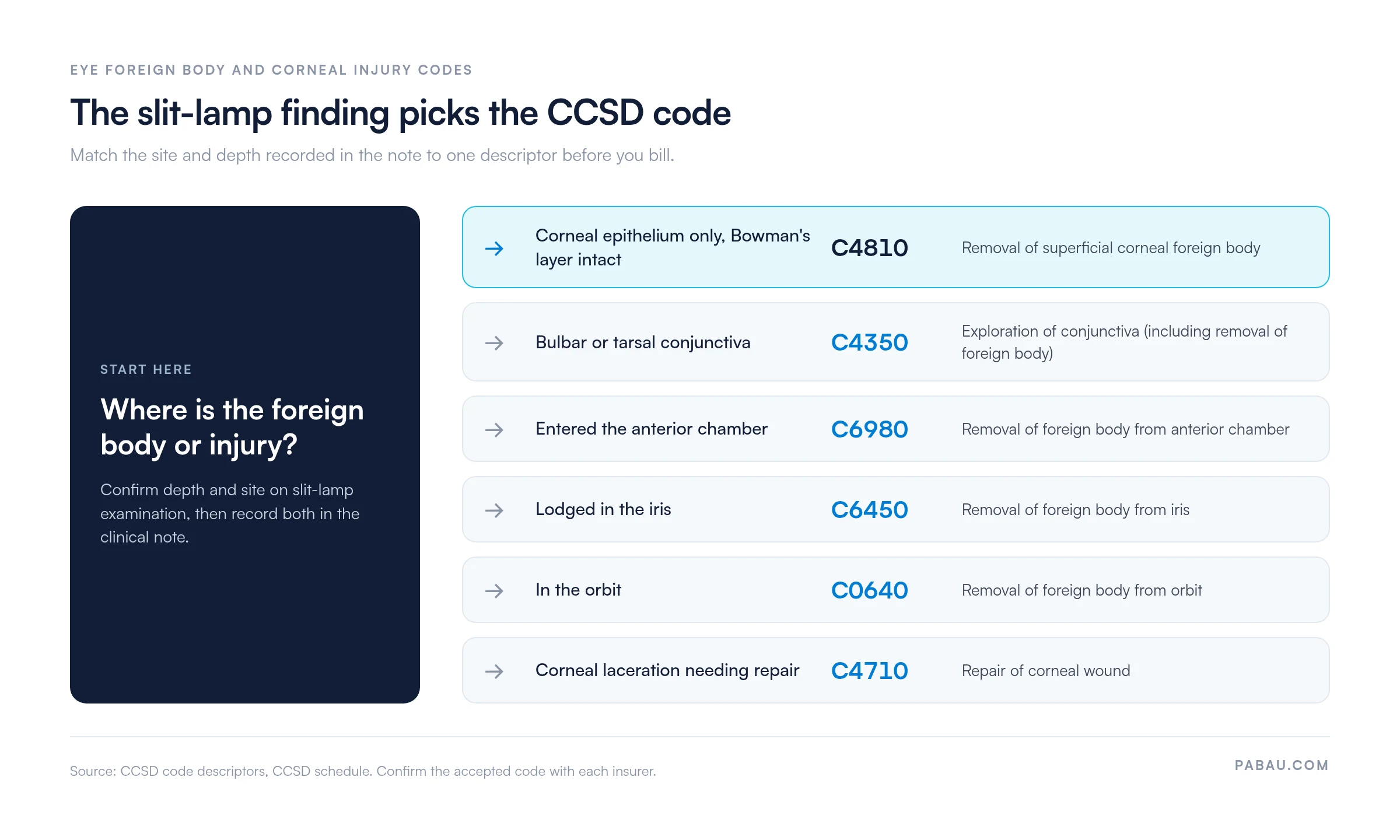
Several CCSD codes cover foreign body removal at other sites in the eye. The anatomical site recorded at the slit lamp decides which descriptor fits. A foreign body in the anterior chamber points to C6980, while a corneal laceration that needs repair points to C4710. Confirm each code with the insurer before billing.
A ferrous foreign body left in the cornea for a few hours leaves a rust ring in the surrounding epithelium. Removing it, often with a rotating burr, is a distinct step from lifting the foreign body.
The CCSD schedule does not list a separate rust ring code in the cornea sub-chapter. Insurers usually treat same-day rust ring removal as part of the foreign body procedure. If the ring is removed at a later visit, ask the insurer how to bill it and record why removal was staged.
Only when the consultation is a separate service. If the patient attends solely for the foreign body, most insurers treat the assessment as part of the procedure. A consultation fee billed alongside it is likely to be reduced or refused.
A separate service might be a planned review of another eye condition that falls on the same day. In that case, the notes must describe each service separately. Check the insurer’s rules before you bill both.
Corneal foreign body claims are usually refused for coding or documentation reasons rather than clinical ones. These are the patterns to check before submission.
Before you submit, check five entries in the notes: Laterality, depth, anesthetic, instrument and fluorescein findings. Then confirm the code the insurer accepts. Those six checks cover the most common refusals listed above.
Eligibility depends on professional registration and on each insurer’s provider recognition. Registration alone does not guarantee that an insurer will pay a specific procedure code.
An insurer will refuse a claim from an unrecognized provider before it looks at the clinical content. Keep each insurer’s recognition letter or provider number on file.
UK private medical insurers usually ask patients to get an authorization number before treatment. A corneal foreign body is often an acute injury, so the patient may arrive before calling their insurer.
In that case, ask the patient to contact the insurer as soon as possible. Record the authorization number, or the reason it was obtained after treatment. Some insurers treat urgent outpatient care differently, so check each policy.
Outpatient limits matter too. Many policies cap outpatient benefits, and a minor procedure can be paid from that allowance. Confirm the patient’s remaining outpatient cover, and tell them about any shortfall before treatment.
UK GDPR requires health records to be kept no longer than necessary and stored securely. It does not set a fixed retention period for private ophthalmology records.
Many private providers follow the retention schedule in the NHS Records Management Code of Practice as a benchmark. Your insurer agreements may also give insurers audit rights over past claims. Set a written retention policy, apply it consistently and record when records are destroyed.
Many ophthalmology practices still write foreign body notes freehand and re-enter the details into an insurer portal later. That is where depth statements and laterality go missing, and where the wrong code slips through.
Pabau keeps the clinical note, the insurer details and the invoice in one patient record. Procedure templates prompt for depth, laterality and the anesthetic used. Insurer-specific price lists hold the code and fee each insurer has confirmed.
When the invoice is ready, Pabau sends the claim to Healthcode and tracks it through each stage until payment. Your team spends less time chasing refused claims and more time with patients.

Structured procedure notes, insurer price lists and Healthcode claims help your practice send complete corneal foreign body claims the first time.

C4810 describes superficial corneal foreign body removal. Billing it without checking the insurer’s accepted code risks a refused claim and a patient left with the bill.
Confirm the accepted code with each insurer before the first claim, and record who confirmed it. Then document depth, laterality and anesthesia at the slit lamp, so the note answers an insurer query on its own.
To see how Pabau keeps notes, insurer codes and Healthcode claims in one place, book a demo.

Need a reference for other CCSD codes? Bupa CCSD codes and fee schedule guide explains how CCSD codes work with Bupa claims across specialties.
Billing a deeper foreign body? CCSD code C6980 covers removal of a foreign body from the anterior chamber.
Treating a corneal laceration? CCSD code C4710 covers repair of a corneal wound.
Looking to simplify insurer claims? Pabau’s claims management tools track each claim from the procedure note to payment.
CCSD code C4810 describes removal of a superficial corneal foreign body. It applies to a foreign body confined to the corneal epithelium and removed at the slit lamp. Deeper, conjunctival and orbital foreign bodies have separate codes.
C4810 is the CCSD descriptor for this procedure. Each insurer decides which codes it accepts, so confirm with the patient’s insurer before billing.
The Clinical Coding & Schedule Development (CCSD) Group maintains it. UK private medical insurers, including Bupa, AXA Health, Aviva, Vitality and Healix, use CCSD codes for procedure claims.
CCSD does not set fees. Each insurer publishes its own maximum for the codes it recognizes, so check each insurer’s schedule or provider services team before quoting a patient.
The cornea sub-chapter of the CCSD schedule lists no separate rust ring code. Same-day removal is usually treated as part of the procedure. For a later visit, ask the insurer how to bill it.
Record laterality, the foreign body’s material and location, a depth statement and the anesthetic used. Add the removal instrument, fluorescein findings, rust ring status and the follow-up plan.