CPT code 63081: Vertebral corpectomy, cervical spine
CPT code 63081: official descriptor and procedure overview CPT code 63081 descri...

Last Updated: Oct 6, 2026
C4690 is the CCSD code for implantation of synthetic corneal rings for keratoconus, including INTACS. It covers the surgeon's fee for inserting one or two intrastromal ring segments, such as INTACS, KeraRing or Ferrara rings, to reshape a cone-shaped cornea.
The code sits in the Cornea subsection of CCSD Chapter 4. Corneal cross-linking is billed separately under C5131 or C5132, and most UK private insurers need prior authorization before surgery.
Let Pabau's smart automation suggest the right codes, reduce claim denials, and keep your practice compliant—effortlessly.
Automate repetitive tasks and focus on what matters most—your patients.
Reduce coding errors and ensure compliance with the latest regulations.
Clean claims, fewer denials, and faster reimbursements.
Powerful insights and reporting to help your practice thrive.
HIPAA compliant SOC 2 certified GDPR-compliant Trusted by 4,000+ clinics worldwide

CCSD Code C4690 covers synthetic corneal ring implantation (INTACS, KeraRing, Ferrara) for keratoconus, and it’s separate from cross-linking codes C5131 and C5132.
Pair it with a keratoconus code from the H18.6 range, and match laterality to the operative record so the claim isn’t denied automatically.
Most UK private insurers require prior authorization first, and a missing pre-auth reference is the most common reason C4690 claims are rejected.
Pabau, the practice management platform we build, keeps topography reports, pre-auth references and diagnosis codes on the patient record before the claim goes out.
CCSD Code C4690 covers the surgical implantation of synthetic intrastromal corneal ring segments, which reshape the cornea in patients with keratoconus. The descriptor names INTACS, made by Addition Technology, as the reference device.
The code applies equally to equivalent segments such as KeraRing and Ferrara rings. All three are CE/UKCA-marked medical devices used in the UK.
C4690 sits in Chapter 4 (Eye and orbital contents) of the CCSD codes schedule, under the Cornea subsection.
The code captures the surgeon’s professional fee for the implantation itself. Whether the device cost is bundled into C4690 or needs a separate prosthesis or device code depends on each insurer’s agreement. It’s one of the most misunderstood parts of C4690 billing, so confirm it with each payer before you submit.
C4690 doesn’t cover corneal cross-linking (CXL), topography-guided laser procedures or refractive surgery. It’s a code for ring segment insertion in patients with keratoconus.
Corneal ring implantation for keratoconus follows a consistent surgical sequence. Knowing each step helps coders confirm that the operative note supports C4690 rather than an adjacent code.
The operative note must record all four stages. That means the device brand, lot number and arc length, the tunnel creation technique, and the number of segments implanted. Insurers query or defer payment when any of these details is missing.
UK private insurers accept ICD-10 keratoconus codes from the H18.6 range on C4690 claims. Laterality must be specified, because payers increasingly reject an unspecified eye when the operative record shows which eye was treated.
Progressive keratoconus codes (H18.621, H18.622) send the clearest medical necessity signal. Cone progression documented over serial topography maps gives the insurer’s clinical reviewers what they need to approve the claim. Use them whenever the clinical record supports it.
Scope confusion around C4690 causes most unbundling errors. The table below reflects standard CCSD billing practice, but confirm device cost treatment with each insurer before submission.
Confusing C4690 with adjacent CCSD corneal codes is the most consequential miscoding error in private ophthalmology billing. The procedures are clinically distinct, so the wrong code is denied however complete the documentation is.
When a surgeon performs ring implantation and cross-linking in the same session, both codes may be billed. This combined approach is sometimes used in progressive keratoconus. Each code needs its own supporting documentation and prior authorization reference, so check the insurer’s bundling rules first.
Corneal grafting is coded separately again. A lamellar graft, for example, bills under C4620 in the same Cornea subsection.
Most major UK private insurers require prior authorization for C4690. A missing pre-auth reference is the highest-volume denial trigger across ophthalmology billing teams.
The table below summarizes the general position of the main UK payers. Coverage criteria and pre-auth processes change every year, so check current policy documents before you proceed.
For Bupa, check C4690 coverage and pre-auth rules in our Bupa CCSD procedure codes reference alongside Bupa’s own portal. NICE interventional procedures guidance on intrastromal corneal ring segments informs many insurers’ coverage policies. Citing it in the supporting letter strengthens the medical necessity case.
An incomplete operative note can turn a legitimate C4690 claim into a long appeals process. Every document in the list below should be in the patient record and attached to the claim before submission.
Digital consent and clinical forms capture device details, implant lot numbers and the clinical indication at the point of care. That cuts transcription errors between the operative record and the claim. Practices still relying on paper surgical notes see this mismatch most often.

Denial patterns for C4690 are consistent across UK private payers. Practices that track which denial reason appears most often on their remittances can usually remove the root cause within one billing cycle.
Each of these denials starts at a specific point in the claim, from booking through to the invoice, as the map below shows.
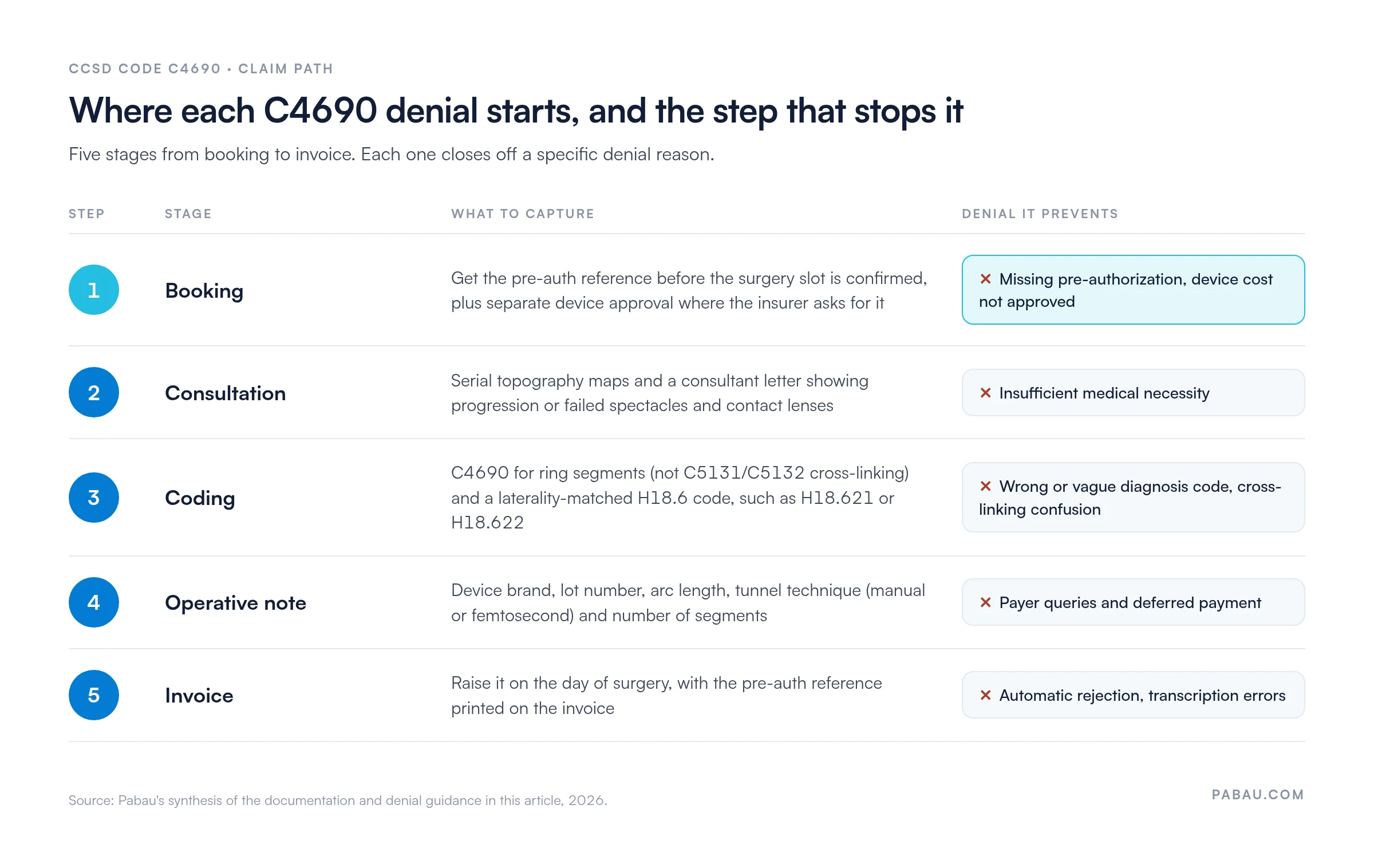
Appeals against C4690 denials succeed most often with the full topography series, the consultant’s rationale letter and the NICE guidance supporting the procedure. A pre-submission check that flags missing documents stops most of these denials before they reach the insurer.
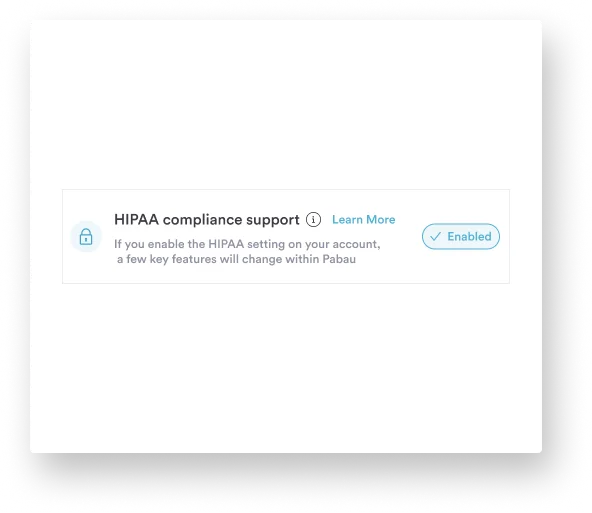
Accurate billing starts before the surgery date. Practices that set up C4690 correctly in their practice management system rarely see first-pass denial rates above single figures. The setup comes down to diagnosis code mapping and a document attachment workflow.
Run a monthly audit of every C4690 invoice raised without a pre-authorization reference attached. If the number is above zero, the pre-auth step is happening too late in the workflow. Move the authorization request to the booking stage, before the surgery slot is confirmed. First-pass payment rates typically improve within the next billing cycle.
Many ophthalmology practices still chase C4690 paperwork across a booking diary, a scanned topography folder and a separate billing spreadsheet. The pre-auth reference lives in an email, and the lot number sits in a paper surgical note.
Pabau’s claims management software keeps those pieces on one patient record. Imaging, the consultant’s letter, consent forms and the pre-auth reference attach to the patient timeline. The invoice is then raised from the same record the surgeon documented.
The result is a claim that leaves the practice with the right H18.6 code, the right procedure code and the attachments the insurer asks for. Your billing team spends less time on rejected remittances and appeals.
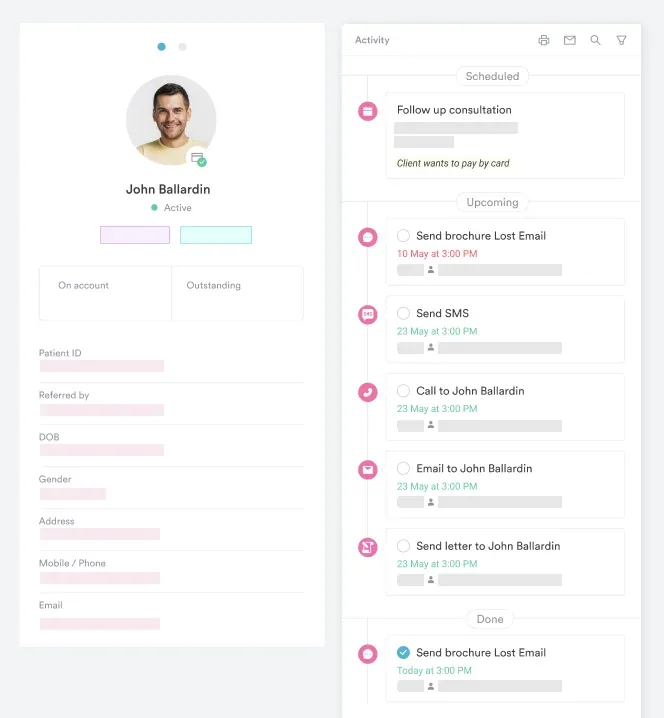

Pabau helps private ophthalmology practices track pre-auth references, attach topography reports to patient records, and submit CCSD claims with the right diagnosis codes.

C4690 claims rarely fail on clinical grounds. They fail on admin, which means the fix sits with your workflow rather than your surgeons.
Move pre-authorization to the booking stage, default to laterality-specific H18.6 codes and keep cross-linking on C5131 or C5132. Those three habits remove the denial triggers this guide sees most often. The trade-off is a few extra minutes at booking, which costs far less than a single appeal.
Book a demo to see how Pabau keeps pre-auth references, topography reports and diagnosis codes together for every CCSD claim your practice submits.

Billing other eye surgery? CCSD Code C5480 explains how to code the removal of silicone oil from the eye.
Treating the conjunctiva too? CCSD Code C4010 covers mucosal grafts to the conjunctiva.
CCSD Code C4690 covers the surgical implantation of synthetic intrastromal corneal ring segments for keratoconus, including INTACS, KeraRing and Ferrara rings. It captures the surgeon’s professional fee for the implantation. The device cost, femtosecond laser use, anesthetic and post-operative consultations are billed separately or follow insurer-specific bundling agreements.
Coverage varies by insurer and individual policy. Most major UK private insurers, including Bupa, AXA Health and Aviva, include keratoconus ring implantation in their ophthalmology benefits. Prior authorization is typically required, and coverage criteria such as documented cone progression and failed conservative management must be met. Always verify current policy terms before booking surgery time.
C4690 covers mechanical insertion of a polymer ring segment into the corneal stroma. Corneal cross-linking (CXL) codes C5131 and C5132 cover a different procedure, using riboflavin drops and UV light to stiffen corneal collagen with no implant. The two procedures treat keratoconus by different mechanisms, and their codes can’t be substituted for each other on a claim.
The most common reason is a missing prior authorization reference. Another frequent trigger is an unspecified-eye ICD-10 code (H18.609) where a right- or left-eye code applies. A device cost billed without pre-approval for the implant is denied too. A clinical letter that states the diagnosis without showing progression or failed conservative management is also often denied.
Most UK private insurers require a pre-authorization reference before C4690 is performed. Practices typically submit a topography report showing cone progression and a consultant’s letter confirming the diagnosis and clinical indication. They also show that spectacles or rigid contact lenses have been tried. The pre-auth reference number must appear on the invoice, or the claim is rejected automatically.
Yes. The anesthetic fee isn’t included in C4690 and is billed separately under the appropriate CCSD anesthetic code. Post-operative consultations and corneal topography imaging are also billed as separate line items. The surgeon’s operative fee is the only element C4690 captures directly.