CPT code 93503: Swan-Ganz catheter billing and modifiers
CPT code 93503: Official descriptor and procedure overview In the AMA CPT code s...

Last Updated: Oct 23, 2026
C1010 is the CCSD code for excision of lesion of eyebrow. It covers surgical removal of a discrete lesion from eyebrow tissue, with simple direct wound closure included. UK private medical insurers such as Bupa, AXA Health, Aviva and Vitality pay it when the excision is medically necessary.
The code sits in chapter 4 of the CCSD schedule, Eye and orbital contents, under eyebrow and lid. Lesions on the eyelid, inside the orbit, or on forehead skin take separate codes. The site recorded in the operative note decides whether C1010 applies.
Let Pabau's smart automation suggest the right codes, reduce claim denials, and keep your practice compliant—effortlessly.
Automate repetitive tasks and focus on what matters most—your patients.
Reduce coding errors and ensure compliance with the latest regulations.
Clean claims, fewer denials, and faster reimbursements.
Powerful insights and reporting to help your practice thrive.
HIPAA compliant SOC 2 certified GDPR-compliant Trusted by 4,000+ clinics worldwide

CCSD Code C1010 covers surgical removal of a lesion at the eyebrow, distinct from the eyelid and orbit codes.
PMI coverage depends on medical necessity, and purely cosmetic requests are excluded under all major UK insurer policies.
Simple wound closure is bundled within C1010, while flap or graft repair may need an additional code.
Most UK PMIs require pre-authorization before an elective eyebrow lesion excision goes ahead.
Pabau’s claims management software handles CCSD code entry, document attachment, and electronic PMI submission in one workflow.
CCSD Code C1010 describes the surgical excision of a lesion located at the eyebrow. It is published in the Clinical Coding and Schedule Development (CCSD) schedule, maintained jointly by the major UK private medical insurers. The code sits in chapter 4, Eye and orbital contents, under eyebrow and lid procedures.
C1010 applies when a clinician removes a discrete lesion from eyebrow tissue by surgical excision. Shave removal, laser ablation, and curettage are different techniques and do not qualify.
Anatomical precision matters here, because C1010 is specific to the eyebrow. Lesions involving the upper or lower eyelid, the orbital rim, or the adjacent forehead skin fall under separate CCSD codes. Confirm the documented site in the operative note before selecting C1010. A mismatch between that site and the billed code is a leading cause of claim rejection.
Neighboring facial sites can fall in a different CCSD chapter entirely. A lesion on the external nose bills as E0910, in chapter 5, Ear, nose and throat.
For a wider map of the schedule, our Bupa CCSD codes guide covers lookup and submission rules for Bupa claims. The full library of CCSD codes for clinicians lists every neighboring eye and orbit code.
An eyebrow lesion excision under CCSD Code C1010 typically follows a defined surgical sequence. The steps below reflect standard practice; individual technique varies by clinician and lesion type.
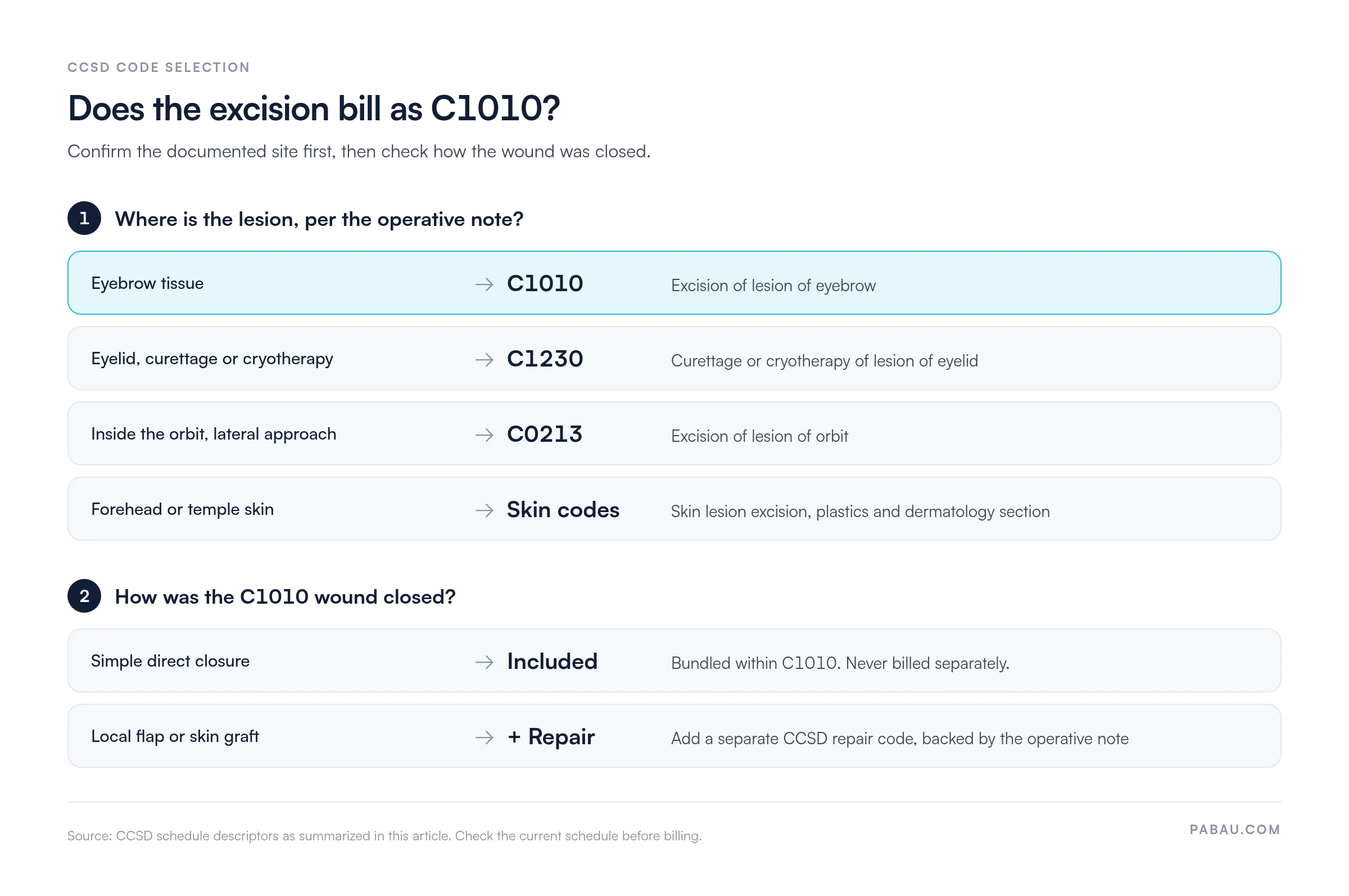
Simple direct closure of the wound is bundled within C1010. Complex closure with a local rotation flap, advancement flap, or skin graft is not. When the defect needs reconstruction beyond direct closure, consider an additional CCSD repair code, supported by the operative note.
UK PMIs cover eyebrow lesion excision under C1010 when the procedure is medically necessary. Purely cosmetic removal of an asymptomatic benign lesion with no functional impact is excluded across all major insurer policies. The following diagnoses and clinical presentations are commonly accepted as supporting medical necessity.
NICE guidance on suspected skin cancer (NG12) sets the clinical threshold for suspected malignancy that supports urgent excision. Referencing NG12 in the clinical record strengthens the medical necessity argument in a PMI submission. A structured patient record captures the clinical detail PMIs ask for at pre-authorization.
The cosmetic-vs-medical boundary is where most C1010 claims succeed or fail. UK PMI policies uniformly exclude cosmetic procedures, but the classification of a specific request is not always obvious. The table below summarizes how major payers approach the distinction.
The framing of the pre-authorization request shapes how payers classify the procedure. Clinicians should state the functional or diagnostic reason for excision in the referral and pre-auth submission. Avoid language that frames the request mainly in aesthetic terms.
Submitting a complete documentation package reduces the chance of a C1010 claim being queried or rejected. The required elements vary by payer; the list below represents the consensus across Bupa, AXA Health, Aviva, and Vitality.
Capturing operative notes and post-operative records in digital forms keeps them structured, timestamped, and easy to retrieve at claim submission. Payers increasingly expect records on request within days of a claim query, so accessibility matters as much as completeness.
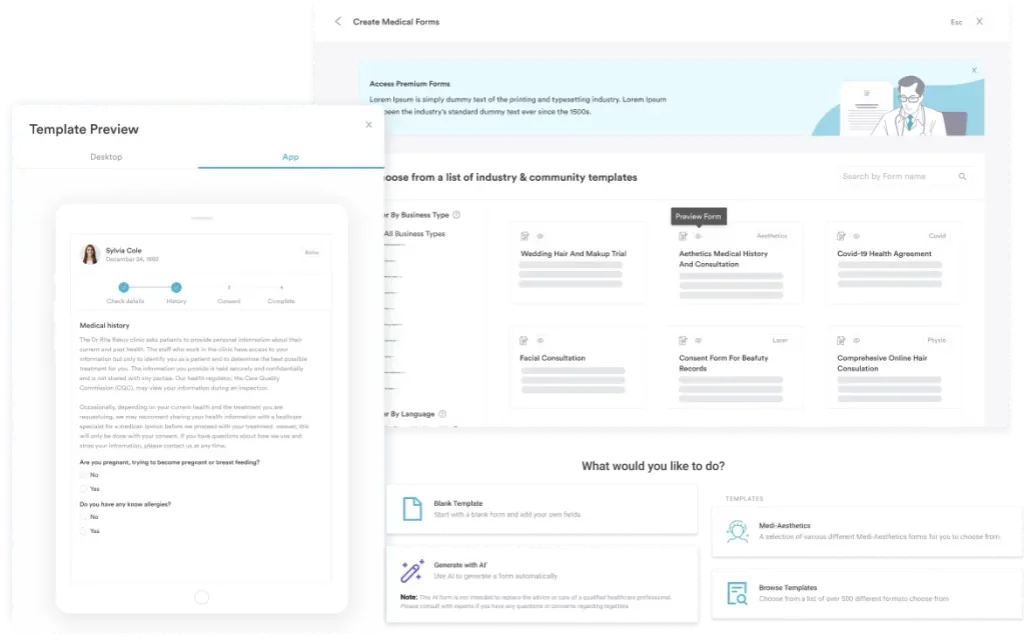
Document lesion dimensions in two planes (length x width) and record the excision margin in millimeters. This detail satisfies both histopathology request requirements and payer queries about whether the procedure was proportionate. Vague descriptions such as ‘small lesion removed’ are a common trigger for medical necessity reviews.
Several CCSD codes sit close to C1010 in the periorbital and dermatology sections. Selecting the wrong code because of an anatomical or procedural mismatch is a common billing error. The table below maps the key adjacent codes and their differentiators.
Two neighbors come up most often. An eyelid lesion treated by curettage or cryotherapy bills as C1230, not C1010. A lesion inside the orbit, removed through a lateral approach, bills as C0213.
The canthus is a third site worth checking. A lesion at the inner or outer canthal angle bills as C1110, not C1010.
Technique splits the eyelid codes too. A lid lesion excised rather than curetted bills as C1210, not C1230.
Always verify adjacent codes against the current CCSD schedule, because descriptors and chapter assignments are revised annually. When the lesion spans the eyebrow into the eyelid margin, consult your payer’s medical reviewer before coding. The Bupa code search tool lets clinicians and billing staff look up current CCSD descriptors and Bupa fee information by code.
The two checks run in a fixed order, site first and closure second, as the diagram below shows.
Most UK PMIs require pre-authorization before elective surgical procedures, including eyebrow lesion excision under CCSD Code C1010. Proceeding without authorization usually means the claim is declined automatically, whatever the clinical justification. The steps below reflect the standard pre-auth workflow. Policies differ, so confirm requirements with each insurer before submission.
AXA Health manages procedure authorization through its specialist procedure codes portal, which allows clinicians to check approved CCSD codes and submit procedure requests. Aviva publishes its CCSD fee schedule and invoicing requirements for providers, including guidance on when pre-authorization applies.
C1010 claim denials follow predictable patterns. The table below maps the most frequent denial reasons to the specific prevention action.
Run a pre-submission check before every C1010 claim. Confirm the pre-auth number and an operative note with site and dimensions. Attach histopathology if required, and record the closure as simple or complex. Five minutes checking the file prevents weeks of appeals.
Entering CCSD Code C1010 in a practice management system involves more than typing the code number. A well-configured workflow links the code to the patient record, attaches supporting clinical documents, and routes the claim to the correct PMI portal. The steps below describe current best practice.
Most practices still assemble a C1010 claim by hand, pulling the operative note from one system and the invoice from another. Pabau, the practice management platform we build, keeps both in one place. Its private practice claims software handles CCSD code entry, clinical note attachment, and insurer-specific claim formatting.
Operative notes and histopathology reports attach directly to the invoice, so a payer query gets answered the same day. That cuts the back-and-forth that delays payment when documents have to be sent separately.
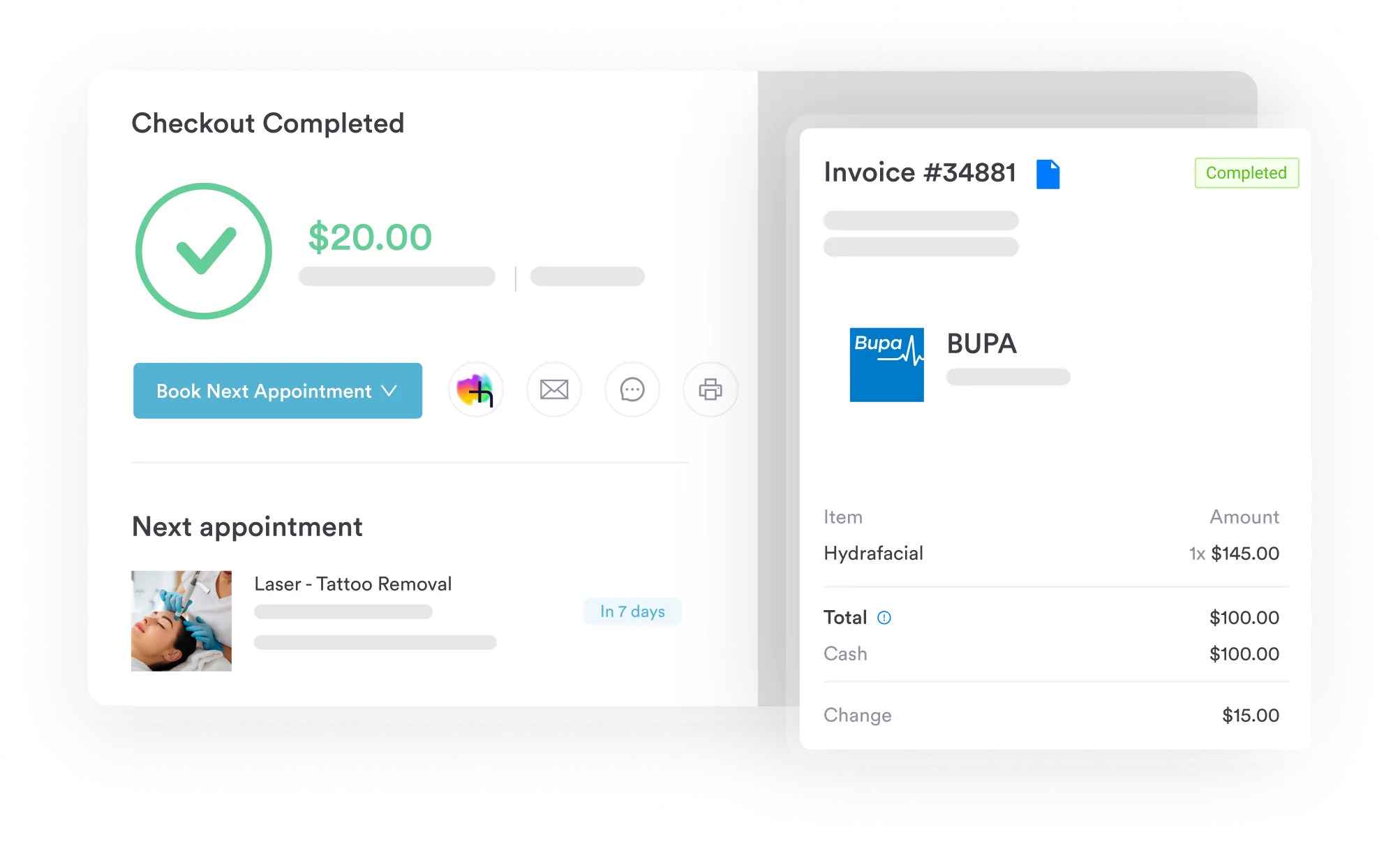

Pabau lets private practices enter CCSD codes, attach operative notes, and submit claims to PMIs from one place. No chasing documents at the end of the week.

C1010 claims are won or lost before the patient reaches theater. Lock the site, the clinical reason, and the authorization number into the record first, and the claim itself becomes routine.
The trade-off is a few extra minutes at consultation. Skip them, and you risk weeks of appeals over a code that should have paid first time.
Pabau’s claims management tools build document attachment, code entry, and PMI submission into the same workflow as your clinical records. Book a demo to see how Pabau gets eyebrow lesion claims to insurers complete the first time.

Coding a lid procedure in the same chapter? CCSD code C1640 walks through tarsorrhaphy billing, from the operative note to the PMI claim.
CCSD Code C1010 covers the surgical excision of a lesion located at the eyebrow, including simple direct wound closure. It applies when the lesion is removed surgically in a private practice setting. Practices use it to bill UK private medical insurers, including Bupa, AXA Health, Aviva, and Vitality.
Yes, when the procedure is medically necessary. UK PMIs cover eyebrow lesion excision under C1010 for diagnoses such as sebaceous cyst, dermoid cyst, BCC, SCC, or lipoma with functional impact. Purely cosmetic removal of an asymptomatic benign lesion is excluded under all major UK insurer policies.
Simple direct wound closure is generally included within C1010 and should not be billed separately. Complex closure with a local rotation flap, advancement flap, or skin graft may be billed with an additional CCSD code. The operative note must document the complexity and why a simple closure was insufficient.
The standard set starts with a GP referral letter and the insurer’s pre-authorization reference number. Add a consultation note with the diagnosis, a detailed operative note, and a follow-up record. Some payers also require the histopathology report to be submitted with the claim; check each insurer’s requirements before submission.
The most common reasons are cosmetic classification, a missing pre-authorization number, and an incomplete operative note. An incorrect site code and missing histopathology, where the payer requires it, also trigger denials. Using the wrong code because a lesion is on the eyelid rather than the eyebrow is also a frequent cause of rejection.
No. C1010 is specific to the eyebrow. Eyelid lesions use separate CCSD codes that reflect the different anatomical site and procedural complexity. Using C1010 for an eyelid procedure is a coding error that typically results in claim rejection. Confirm the anatomical site in the operative note before selecting the code.