HCPCS Code E0215: Electric heating pad (non-moist) billing guide
HCPCS Code E0215: Official description and device definition HCPCS Code E0215 is...

Last Updated: Nov 16, 2026
C0514 is the CCSD code for reconstruction of socket with implant and graft. It covers rebuilding an anophthalmic socket when the surgeon places an orbital implant and a graft in the same operation. An anophthalmic socket is the orbit left after the eye is removed.
Both components must appear in the operative note. A socket rebuilt with only one of them bills as C0513, and an implant placed while the eye is removed bills as C0122. UK private medical insurers assess the code through the CCSD schedule.
Let Pabau's smart automation suggest the right codes, reduce claim denials, and keep your practice compliant—effortlessly.
Automate repetitive tasks and focus on what matters most—your patients.
Reduce coding errors and ensure compliance with the latest regulations.
Clean claims, fewer denials, and faster reimbursements.
Powerful insights and reporting to help your practice thrive.
HIPAA compliant SOC 2 certified GDPR-compliant Trusted by 4,000+ clinics worldwide

C0514 requires both an implant and a graft in the same operation, and a socket rebuilt with only one of them bills as C0513.
Contracted socket, implant extrusion, and volume loss after enucleation or evisceration are the main clinical indications for the code.
UK private medical insurers usually expect pre-authorization before surgery, with a supporting letter detailing the implant type, graft source, and clinical indication.
Practice software such as Pabau helps oculoplastic practices capture the operative detail insurers need before a claim goes out.
CCSD code C0514 covers reconstruction of the anophthalmic socket when the surgeon places an orbital implant and a graft in the same operation. Bupa, AXA Health, Aviva and Vitality share the CCSD procedure schedule as a common coding language for private healthcare. The “and” in the official descriptor matters. A socket rebuilt with only an implant or only a graft bills as C0513, not C0514.
The procedure belongs to oculoplastic surgery, a subspecialty of ophthalmology, and an ophthalmic plastic surgeon performs it. UK private medical insurers assess C0514 claims against the CCSD schedule, and each insurer applies its own fee and pre-authorization rules. Our CCSD code library lists the neighboring codes in chapter 4, Eye and orbital contents.
Socket reconstruction under C0514 treats the anophthalmic socket, the orbital cavity left after the globe is removed by enucleation or evisceration. The procedure has two distinct operative components, and the note must document both.
Implant component: The surgeon places an orbital implant into the posterior socket to restore orbital volume. The implant is sized to the socket, sutured to the extraocular muscle stumps where present, and covered with conjunctiva or a graft.
Graft component: The surgeon takes a graft from a donor site. Dermis fat comes from the abdomen or buttock, and mucous membrane from the inner cheek or hard palate. Processed amniotic membrane is another option. The graft rebuilds the conjunctival lining, deepens the fornices, or covers the implant surface. It is what separates C0514 from C0513, which covers an implant or a graft alone.
The operative note must record each of these steps explicitly. A note that leaves out either the implant placement or the graft harvest is a common reason insurers query or reject a C0514 claim.
C0514 fits when the socket needs both orbital volume restoration and tissue reconstruction in the same procedure. The following indications commonly justify the code.
State the clinical indication explicitly in the supporting letter sent with the pre-authorization request. Insurer reviewers look for the documented reason the graft was necessary, as well as the fact that it was performed.
The implant material does not change the code. What matters is that an implant was placed and a graft was performed. The operative note should still record the implant material, size, and manufacturer, because some insurers restrict cover for specific materials.
Confirm with the patient’s insurer whether an implant material needs separate approval. Some UK insurers may apply benefit restrictions to non-standard implant materials, separately from approving C0514 itself.
The graft is what separates C0514 from C0513 on the claim. Record the graft source and type in the operative note, because insurer reviewers use it to confirm a graft was performed alongside the implant.
The operative note must state the graft type, donor site, dimensions harvested, and how the graft was secured. For a dermis fat graft, also document the abdominal or buttock donor-site closure as part of the same operation.
A frequent coding error in socket billing is choosing C0513 when both an implant and a graft were placed. The reverse error is billing C0514 for a socket repair that needed neither. The chart below shows which code each eye socket operation takes.
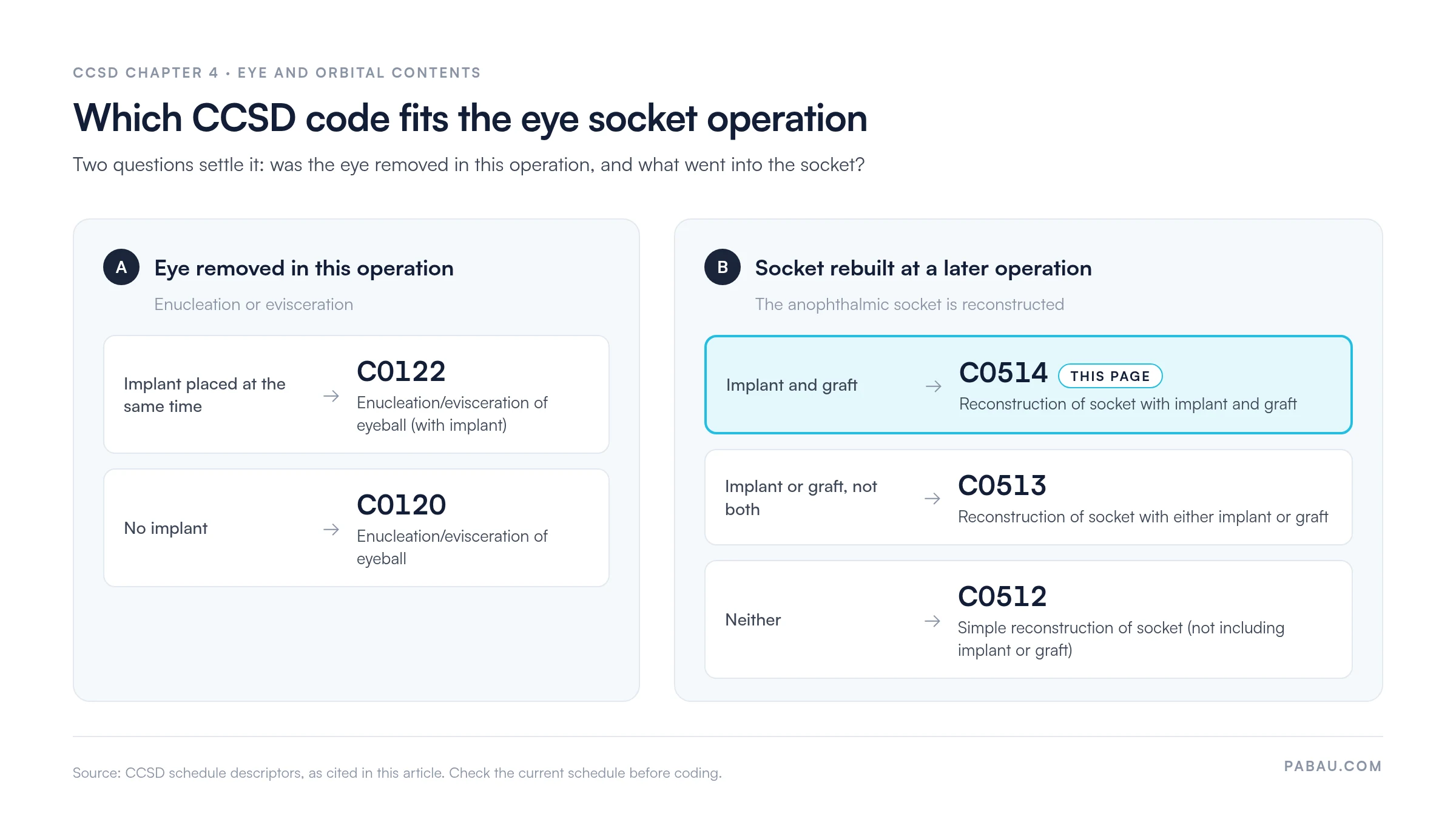
The table sets out what separates each neighbor from C0514. Our Bupa CCSD codes guide explains how the wider schedule is organized.
Two neighbors sit in the globe and orbit codes rather than the socket codes. C0122 covers removal of the eye with an implant placed in the same operation, and C0120 covers removal without one. Verify every descriptor against the current CCSD schedule before coding, because CCSD updates it on a regular publication cycle.
UK private medical insurers may ask for the operative note when they assess a C0514 claim. Structured clinical records that capture both the implant and the graft reduce the risk of a documentation-based rejection. Check that the following elements are present before submission.
Draft a standard operative note template for C0514 with fields for implant size, graft source, and donor site closure. Use it for every case, and your clinical team will capture each element the insurer needs without relying on memory at the time of coding.
The claims management software the practice uses should flag incomplete notes before the claim leaves the practice. A note that records “socket reconstruction performed” without naming both components will not satisfy an insurer audit.
C0514 is a surgical procedure that involves an implant. Most UK private medical insurers, such as Bupa, AXA Health, Aviva and Vitality, expect pre-authorization before the procedure. Surgery done without an authorization number risks non-payment, whatever the clinical need.
The pre-authorization request for C0514 typically includes:
Turnaround varies by insurer, so send the request as soon as the surgery date is set. Some insurers offer an urgent route, but elective C0514 cases should not rely on it. If authorization is declined, ask the insurer for its reasons in writing, because they form the basis of an appeal.
C0514 claims tend to fail for the same handful of reasons, and each one is cheaper to prevent than to appeal. A coding check that flags missing fields before submission stops most of them from reaching the insurer.
CCSD publishes principles for each code, which set out what the code includes and what can be billed alongside it. Check the CCSD schedule’s principles for C0514 before you code an unusual case.
Laterality: Socket reconstruction is unilateral in almost every case. Record the operated eye (left or right) on the claim, and check the CCSD schedule’s principles for C0514 for how laterality is reported.
Assistant surgeon: Where a second surgeon assists with C0514, check the CCSD schedule’s principles for C0514 and the insurer’s rules on assistant fees before billing.
What is bundled into C0514: The graft harvest is part of the C0514 procedure. It should not be billed as a separate graft code on the same date. The implant insertion is bundled in the same way. Together, these components account for C0514 sitting above the simpler socket codes.
What can be billed alongside it: The anesthetist bills anesthesia separately under their own codes. An unrelated procedure at a different site may be billed alongside C0514, subject to the CCSD principles and the insurer’s rules. The ocularist fits the prosthesis at a separate appointment, and that fitting cannot be added to the C0514 surgical claim.
For edge cases, confirm the bundling rules with the insurer’s provider support team before you submit the claim.
Many oculoplastic practices assemble a C0514 claim by hand from the operative note, the authorization letter and the surgery list. Each handover is a chance for the implant size, graft site or eye side to drift between documents.
Pabau, the practice management platform we build, keeps those pieces on one patient record. A note template carries fields for the implant and the graft, and the claim goes to the insurer through Healthcode from the same record. The code, laterality and authorization number therefore match across every document.
The result is fewer insurer queries and less time spent rebuilding a claim after surgery.

Pabau helps ophthalmology and oculoplastic practices capture the operative detail insurers need, track authorization status, and submit cleaner C0514 claims. Your team spends less time on queries and more time in surgery.

Code C0514 only when the operative note shows both an implant and a graft. If the note names just one, the claim is not ready, whatever happened in surgery. Fix the note first, then the code.
The authorization request, the operative note and the claim should tell the same story about the implant, the graft and the eye. Book a demo to see how Pabau keeps surgical notes and insurer claims in step for oculoplastic practices.

Need a broader CCSD billing reference? Pabau’s Bupa CCSD codes guide covers how the CCSD schedule is structured and how UK private insurers assess claims across specialties.
Billing eye removal with an implant instead? CCSD code C0122 covers enucleation or evisceration with an orbital implant placed in the same operation.
Looking for the neighboring eye codes? The CCSD code library lists every Pabau guide to a CCSD code, including the rest of chapter 4.
Want cleaner claims across all procedure codes? Pabau’s claims management software tracks submission status and flags incomplete documentation before claims leave the practice.
CCSD code C0514 covers reconstruction of the anophthalmic socket when the surgeon places an orbital implant and a graft in the same operation. Both components are required. A socket rebuilt with an implant alone or a graft alone bills as C0513. The graft may be dermis fat, buccal mucosa, hard palate mucosa, or amniotic membrane, depending on the clinical indication.
C0514 requires both an implant and a graft, while C0513 covers reconstruction of the socket with either an implant or a graft. If both were placed and C0513 is billed, the claim is undercoded and may be queried on audit. If only one was placed, C0514 overstates the procedure.
The CCSD descriptor for C0514 does not limit the graft to one tissue type. Dermis fat, buccal mucosa, hard palate mucosa, and amniotic membrane grafts are all used in clinical practice and documented under C0514. Record the graft source and donor site in the operative note. The choice of graft material does not change the code.
Usually, yes. Most UK private medical insurers, such as Bupa, AXA Health, Aviva and Vitality, expect it. C0514 is a surgical procedure that involves an implant. Send the CCSD code, a supporting letter with the clinical indication, the implant type, laterality, and the planned surgery date. Turnaround varies by insurer, so check the patient’s policy before booking the procedure.
No. C0514 is a later reconstruction code for the anophthalmic socket, not a code for the operation that removes the eye. If the eye is removed and an implant placed in the same operation, the correct code is C0122, enucleation/evisceration of eyeball (with implant). C0514 applies to a separate, later reconstructive operation.
Common denial reasons include billing C0513 when both an implant and a graft were placed, and missing pre-authorization. Others are an operative note that documents only one component, or a laterality mismatch between the claim and the notes. An implant material the insurer’s policy excludes causes denials too. Checking the documentation list before submission prevents each of them.