CPT Code 27425: Lateral retinacular release billing guide
CPT Code 27425: Official descriptor and procedure overview CPT code 27425 is def...

Last Updated: Nov 16, 2026
C0120 is the CCSD code for enucleation/evisceration of eyeball (without implant). It covers removing the whole eye, or only its contents, when no orbital implant goes in. The code sits in chapter 4 of the CCSD Schedule, Eye and orbital contents, under Globe and orbit.
Surgery with an orbital implant placed in the same operation bills as C0122. Removing the eye with the rest of the orbit's contents is exenteration, billed as C0110. UK insurers such as Bupa, AXA Health, Aviva and Vitality pay against the code.
Let Pabau's smart automation suggest the right codes, reduce claim denials, and keep your practice compliant—effortlessly.
Automate repetitive tasks and focus on what matters most—your patients.
Reduce coding errors and ensure compliance with the latest regulations.
Clean claims, fewer denials, and faster reimbursements.
Powerful insights and reporting to help your practice thrive.
HIPAA compliant SOC 2 certified GDPR-compliant Trusted by 4,000+ clinics worldwide

C0120 covers enucleation or evisceration of the eyeball when no orbital implant goes in during the operation.
If the surgeon places an implant in the same operation, the claim bills as C0122, not as C0120 plus a separate implant code.
Removing the eye together with the rest of the orbit’s contents is exenteration, which bills as C0110.
UK insurers such as Bupa ask for treatment to be pre-authorized, so confirm cover and put the reference on the claim.
The anesthetist claims separately, on their own fee line, while the surgeon’s claim covers the operation itself.
CCSD code C0120 is the UK private healthcare code for enucleation/evisceration of eyeball (without implant). It sits in the CCSD Schedule of procedure codes, the standard code set for UK private healthcare. The CCSD Group maintains the schedule, and its members represent four insurers: Bupa, AXA Health, Aviva and Vitality.
The code applies when the surgeon removes the whole eye, or only its contents, and leaves the socket without an orbital implant. If an implant goes in during the same operation, the claim bills as C0122 instead.
C0120 is one of many CCSD codes used on private claims. Each insurer sets its own fee against it, in pounds sterling, in its own fee schedule.
NHS hospitals record the same surgery in OPCS-4, which is a different classification. A private claim needs the CCSD code instead, so a consultant who operates in both sectors keeps the two references apart.
Enucleation removes the entire eyeball, including the sclera. The surgeon cuts the optic nerve and detaches the eye muscles from the globe. Evisceration removes only the contents of the eye, such as the lens, vitreous and retina, and leaves the scleral shell in place.
Both techniques fall under C0120 when the socket is left without an implant. The operative note still has to say which one happened, because the insurer’s reviewer reads it against the descriptor.
The choice between the two is a clinical decision, based on the pathology and the patient. For coding, the distinction matters most in the operative note and in the supporting diagnosis code. Prevention of sympathetic ophthalmia calls for enucleation, because the uveal tissue has to come out entirely.
Insurers look closely at the clinical case for C0120, because the surgery is irreversible. Each indication has its own supporting ICD-10 code, and a diagnosis that doesn’t match the clinical picture is a common reason for a query.
C0120 covers the surgeon’s operation: the enucleation or evisceration and the closure of the socket. The implant question is settled by the descriptor itself. C0120 is the without-implant code, so an implant placed in the same operation moves the whole claim to C0122.
So there is no bundling question to settle with the insurer. A note that records an implant placed during the operation belongs on a C0122 claim. Adding a separate implant code to a C0120 claim for the same session will be queried.
Give the implant its own yes or no field on your operative note template. The surgeon answers it on every eye removal, and your billing team picks C0120 or C0122 from that one answer.
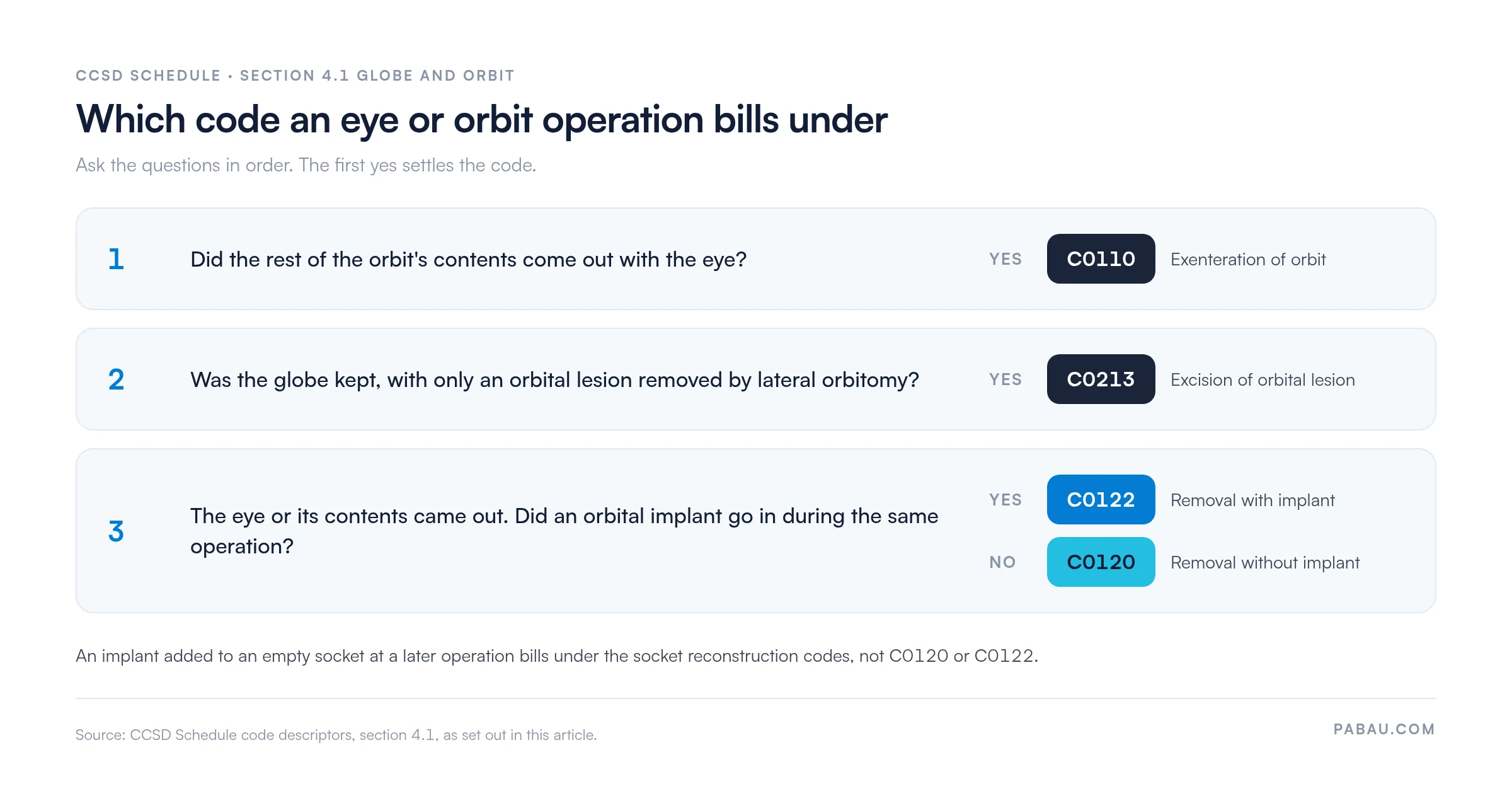
Section 4.1 groups C0120 with a few close neighbors. Two questions separate them: how much tissue came out, and whether an implant went in.
If the surgeon clears the orbit rather than the globe alone, the claim moves to C0110 for exenteration of orbit. If the globe stays and only an orbital lesion comes out by lateral orbitomy, the operation bills as C0213.
Ask the orbit question first and the implant question last, and each eye or orbit operation lands on a single code.
The pre-authorization request and the claim both need the diagnosis behind the surgery. Recording it as an ICD-10 code keeps the note, the authorization and the claim consistent. These codes are the ones most often paired with eye removal.
Suspected malignancy: Uveal melanoma is often treated by enucleation without a prior biopsy. In that case, record the clinical basis for the diagnosis in the operative note. Then update the record once the histopathology report confirms it.
Insurers audit an eye removal claim by comparing the note with the descriptor. Compile the full file before the claim goes out, rather than after a query comes back.
A structured note template makes this list far easier to meet. Accurate patient records also support the claim if complications later need further surgery.
UK private insurers expect planned surgery to be authorized before it happens. Bupa, for example, asks members to contact it before arranging treatment and issues a pre-authorization code once cover is confirmed. The patient usually makes that call, then passes the code to the consultant.
Before booking a C0120 operation, confirm these points with the patient and the insurer:
Each insurer publishes its own fee and authorization rules for the code. The table shows where to look them up.
Bupa’s rules differ from the other insurers in places. If Bupa covers a large share of your patients, our guide to Bupa CCSD codes covers those differences.
Emergency cases: Severe trauma or panophthalmitis can mean operating before authorization is possible. Contact the insurer as soon as you can afterward, and ask how it handles cover for emergency surgery under that policy.
The anesthetist bills separately from the surgeon. Insurer fee schedules list an anesthetist fee against the procedure code itself, so the anesthetist claims against C0120 as well, on their own fee line.
How that fee is set differs from insurer to insurer, so check the anesthetist fee in each insurer’s schedule. The surgeon’s part is to make sure the theater record shows the correct procedure and code.
For an assistant surgeon, check with the insurer before the operation whether it pays an assistant fee for this code. Record the assistant’s part in the operative note either way.
Most queries on an eye removal claim are administrative rather than clinical, so they can be fixed. The table covers the usual reasons and the fix for each.
Log every C0120 query by insurer and by reason. When one insurer keeps raising the same query, the cause is usually a single step in your booking process, such as a missed pre-authorization call.
C0120 is only the first billing event in the patient’s care. Follow-up and rehabilitation each carry their own rules.
In many practices, the operative note lives in one system, the invoice in another, and the claim in a third. Each hand-off is a chance for the implant detail or the authorization reference to fall off the claim.
Pabau keeps those steps on one patient record. Its claims management software sends CCSD-coded claims to Healthcode straight from that record, with checks before submission. You can then follow each claim’s status and reconcile the payment in the same place.
The result is fewer queried claims, and less time spent chasing a missing reference after the patient has gone home.
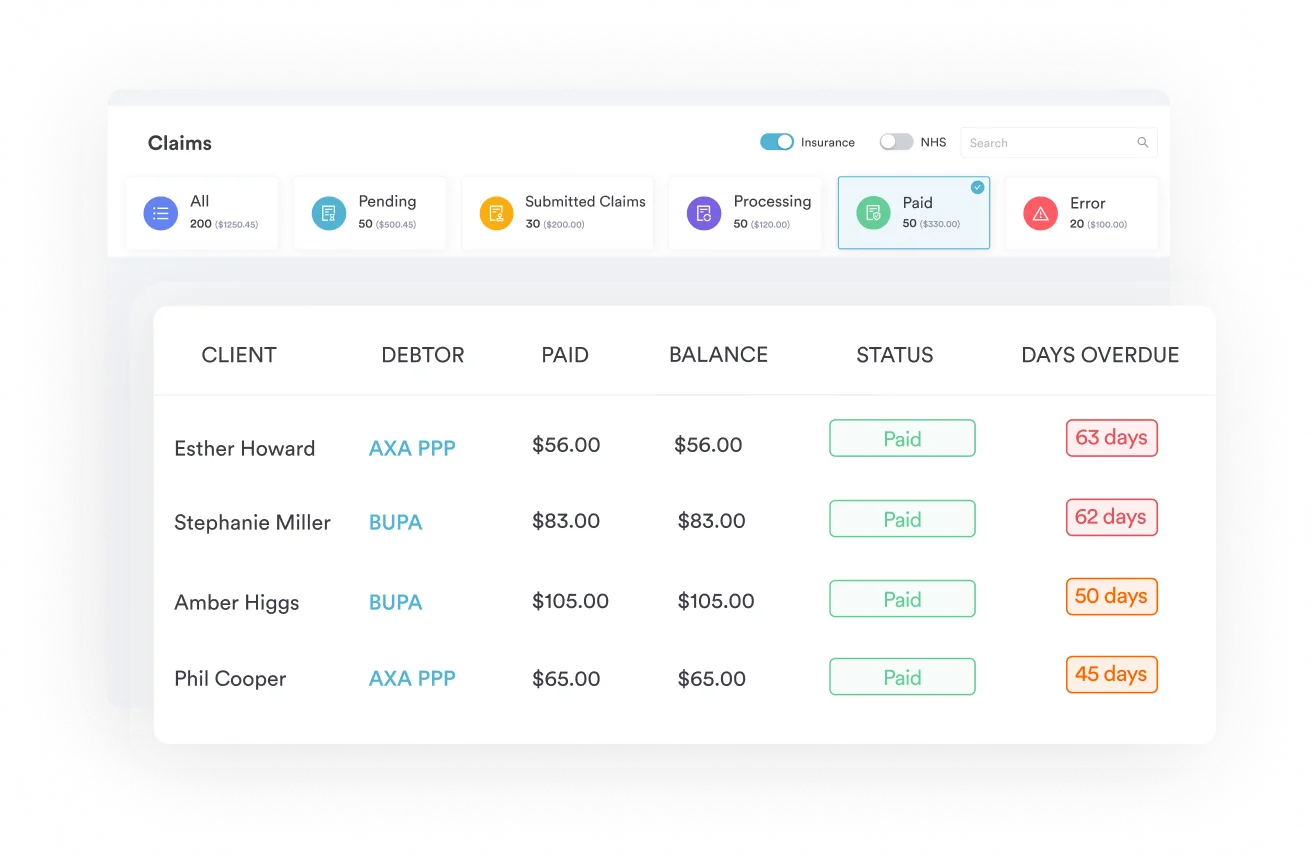

Pabau keeps the operative note, the pre-authorization reference and the Healthcode claim on one patient record. That way, each C0120 claim carries the detail insurers check.

C0120 is a narrow code. It fits only when the eye, or its contents, comes out and no implant goes in. The implant is the fact the claim rests on, so make the note say it plainly either way.
Get that right, confirm pre-authorization before the surgery date, and most C0120 claims go through without a query. A few minutes of checks at booking cost far less than a resubmission.
Want your notes, invoices and Healthcode claims on one record? Book a demo and we’ll walk you through a private surgical claim from start to finish.

Surgeon placed an implant? CCSD code C0122 covers eye removal with an orbital implant in the same operation.
Was the whole orbit cleared? CCSD code C0110 explains how to bill exenteration of orbit.
Billing across several private insurers? Bupa CCSD codes explains how Bupa applies the schedule, and where its rules differ from other insurers.
Need the full schedule? CCSD codes covers how the schedule is organized and used on UK private claims.
CCSD code C0120 is the UK private healthcare code for enucleation/evisceration of eyeball (without implant). It covers removing the whole eye, or only its contents, when no orbital implant is placed. The CCSD Group, made up of Bupa, AXA Health, Aviva and Vitality, maintains the schedule.
Enucleation removes the entire eyeball, including the sclera. Evisceration removes only the contents of the eye and leaves the scleral shell in place. Both bill as C0120 when no implant is placed, but the operative note must say which one happened.
Common choices are C69.2 for retinoblastoma, C69.3 for uveal melanoma, and H44.5 for a degenerated, blind eye such as end-stage glaucoma. S05.7 covers traumatic avulsion of the eye, and H44.0 covers purulent endophthalmitis. The code must match the indication documented in the note.
No. C0120 is the without-implant code. If the surgeon places an orbital implant during the same operation, bill C0122 for the whole operation instead. An implant added at a later operation bills under the socket reconstruction codes.
Yes. The anesthetist claims separately, on their own fee line against the same procedure code. Insurer fee schedules list the anesthetist fee for each code, so check the figure for C0120 with each insurer.
The usual reasons are a missing pre-authorization reference, a diagnosis that doesn’t support removing the eye, or a note that records an implant. Fix the code or the note, attach the missing document, and resubmit.