CPT Code 69610: Tympanic membrane patch repair (myringoplasty)
CPT code 69610: official descriptor and procedure overview CPT code 69610 descri...

Last Updated: Oct 19, 2026
A4500 is the CCSD code for open operations on spinal cord, used when a surgeon opens the dura and operates directly on cord tissue. It covers procedures such as intramedullary tumour resection, syrinx drainage, myelotomy and tethered cord release.
The code sits in CCSD Chapter 3 (spine, spinal cord and peripheral nerves), in the spinal cord category, and is rated a complex procedure. Spinal column surgery that leaves the dura closed, and percutaneous or endoscopic approaches, are coded separately.
Let Pabau's smart automation suggest the right codes, reduce claim denials, and keep your practice compliant—effortlessly.
Automate repetitive tasks and focus on what matters most—your patients.
Reduce coding errors and ensure compliance with the latest regulations.
Clean claims, fewer denials, and faster reimbursements.
Powerful insights and reporting to help your practice thrive.
HIPAA compliant SOC 2 certified GDPR-compliant Trusted by 4,000+ clinics worldwide

CCSD code A4500 covers open operations on the spinal cord in UK private healthcare. It is unrelated to HCPCS A4500, a US surgical stocking code.
The code applies only when a surgeon opens the dura and performs a named procedure on cord tissue, such as tumour resection or myelotomy.
Chapter 3 assigns separate codes to percutaneous and endoscopic approaches, and to spinal column surgery that leaves the cord untouched.
Bupa, AXA Health and Freedom Health Insurance expect prior authorisation before open spinal cord surgery, and the operative note must confirm cord exposure.
Anaesthetic fees go on the anaesthetist’s own claim, and whether a practice can bill IONM separately depends on the insurer.
CCSD Code A4500 is the UK private healthcare procedure code for open operations on spinal cord. The Clinical Coding and Schedule Development (CCSD) Group maintains the code. UK private medical insurers use it to reimburse neurosurgery that opens the dura and operates on the cord. It sits in CCSD Chapter 3 (spine, spinal cord and peripheral nerves), alongside the other codes in our CCSD code directory.
CCSD A4500 is also unrelated to HCPCS A4500, the US code for surgical stockings. Teams that bill in both countries should confirm they are working from the CCSD schedule before submitting an open spinal cord claim.
The code applies when a neurosurgeon operates directly on the cord itself, not merely on the surrounding spinal column. Cord exposure, confirmed in the operative note, separates A4500 from the many spinal column codes that never breach the dura.
A4500 captures any open surgical procedure in which a surgeon directly operates on the spinal cord itself. So the following procedure types fall within scope:
The unifying requirement is direct open access to the spinal cord, with the procedure performed on cord tissue. A standard discectomy or laminectomy for radiculopathy does not qualify when the dura stays closed and the surgeon does not operate on the cord. Three questions, answered from the operative note, then settle whether an operation codes to A4500.
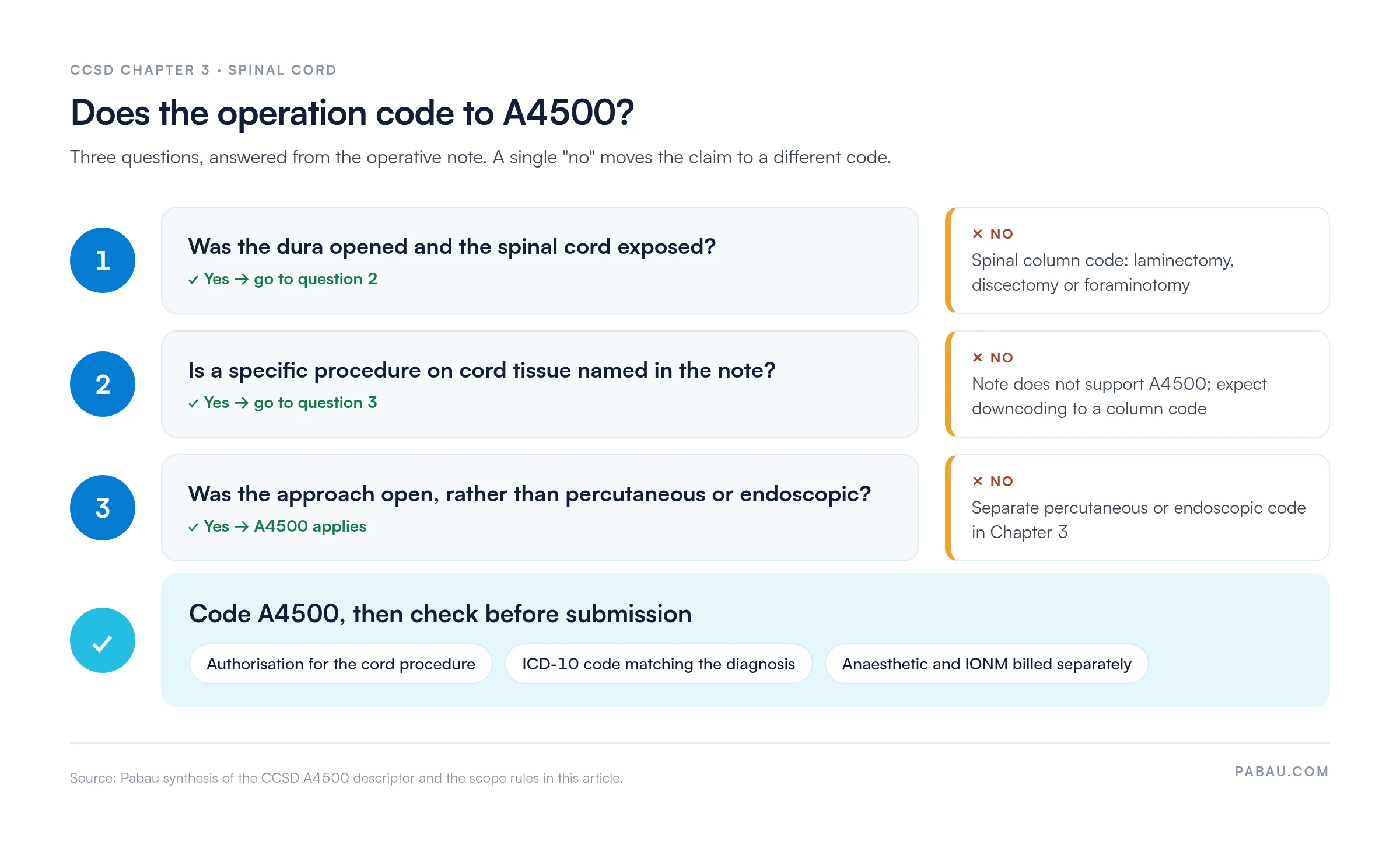
Coders frequently confuse A4500 with adjacent Chapter 3 codes for spinal column surgery. The most common misassignment occurs when a surgeon performs a laminectomy or discectomy for radiculopathy or canal stenosis without direct cord surgery. So A4500 does not include the following procedures, which need their own codes:
Percutaneous cordotomy, used mainly for one-sided cancer pain, is one of those excluded interventions. A consultant reaches the spinothalamic tract with a needle electrode under image guidance. The cord is never opened, which places the procedure under A4730.
Billing teams often query intraoperative neurophysiology monitoring (IONM) for separate billing. Some UK PMIs include it in the surgical fee, while others accept a separate IONM code, so check with each insurer before billing it.
Chapter 3 of the CCSD schedule groups spine, spinal cord and peripheral nerve procedures. The codes around A4500 cover related but distinct interventions, and picking the wrong one is a frequent cause of rejected spinal claims. So the table below shows the Chapter 3 code groups most often confused with or billed alongside A4500.
For the exact code numbers of adjacent procedures, consult the CCSD Technical Guide (October 2025) or each insurer’s published Chapter 3 fee schedule. Also, our Bupa CCSD billing guide explains how to check a code through Bupa’s code search portal.
Open spinal cord surgery follows a defined sequence that the operative note must reflect to support a valid A4500 claim. Understanding the surgical steps helps billing teams identify the key documentation elements needed before submission.
The operative note must clearly state that the surgeon exposed and operated on the spinal cord. A note that describes a laminectomy and dural decompression without naming the cord procedure is insufficient for A4500. So insurers commonly downcode that claim to a spinal column procedure code. Secretaries can check for these elements at the point of dictation, before the surgeon signs off the note.
The same documentation failure shows up elsewhere in the CCSD schedule. Claims for CCSD Code B3590 are rejected when the operative note describes a breast operation without naming the duct procedure.
Every CCSD A4500 claim must carry one or more ICD-10 diagnosis codes that reflect the documented condition. UK private insurers expect ICD-10 codes as published in the NHS Classifications Browser. So a non-specific or incorrect code is a common cause of rejection, and the table below lists the diagnoses most often paired with A4500.
Verify all ICD-10 codes against the NHS Classifications Browser before submission. The code must reflect the diagnosis documented in the operative and clinical notes. Selecting a more specific code than the documentation supports is miscoding. Where the diagnosis falls under a broader G95.x or D33.x category, instead use the most specific available subcode.
Open spinal cord surgery almost always requires prior authorisation from UK private medical insurers. Insurers will reject a claim submitted without a valid authorisation reference, however strong the clinical documentation. Requirements vary by payer, but the pattern below is consistent across the major UK PMIs.
Insurers update prior authorisation policies regularly. The requirements above reflect standard PMI practice for complex surgical procedures, so billing teams should verify them against each insurer’s current provider guidance before submission. Authorisation is procedure-specific, and an authorisation granted for a spinal column procedure does not extend to an open cord operation under A4500.
Insurer fee schedules rate A4500 as a complex neurosurgical procedure. We do not reproduce fee amounts here because insurers update schedules regularly, so check current rates in each insurer’s published fee schedule. The following billing conventions apply.
Open cord surgery carries high documentation expectations, and most A4500 rejections trace back to one of six triggers.
Billing teams can catch each of these triggers before the claim leaves the practice. So a pre-submission check of the operative note, the authorisation letter and the ICD-10 code resolves most of them.
Before submitting a CCSD A4500 claim, run a four-point check. Confirm the prior authorisation reference covers this cord procedure. Confirm the operative note states cord exposure and names the procedure. Match the ICD-10 code to the documented diagnosis. Bill anaesthetic and IONM codes separately where they apply.
Neurosurgical practices handling open cord surgery run a billing workflow that spans authorisation, operative documentation, code selection and claims to several insurers. Each stage is a potential rejection point. So Claims management software like Pabau keeps those stages inside the patient record.
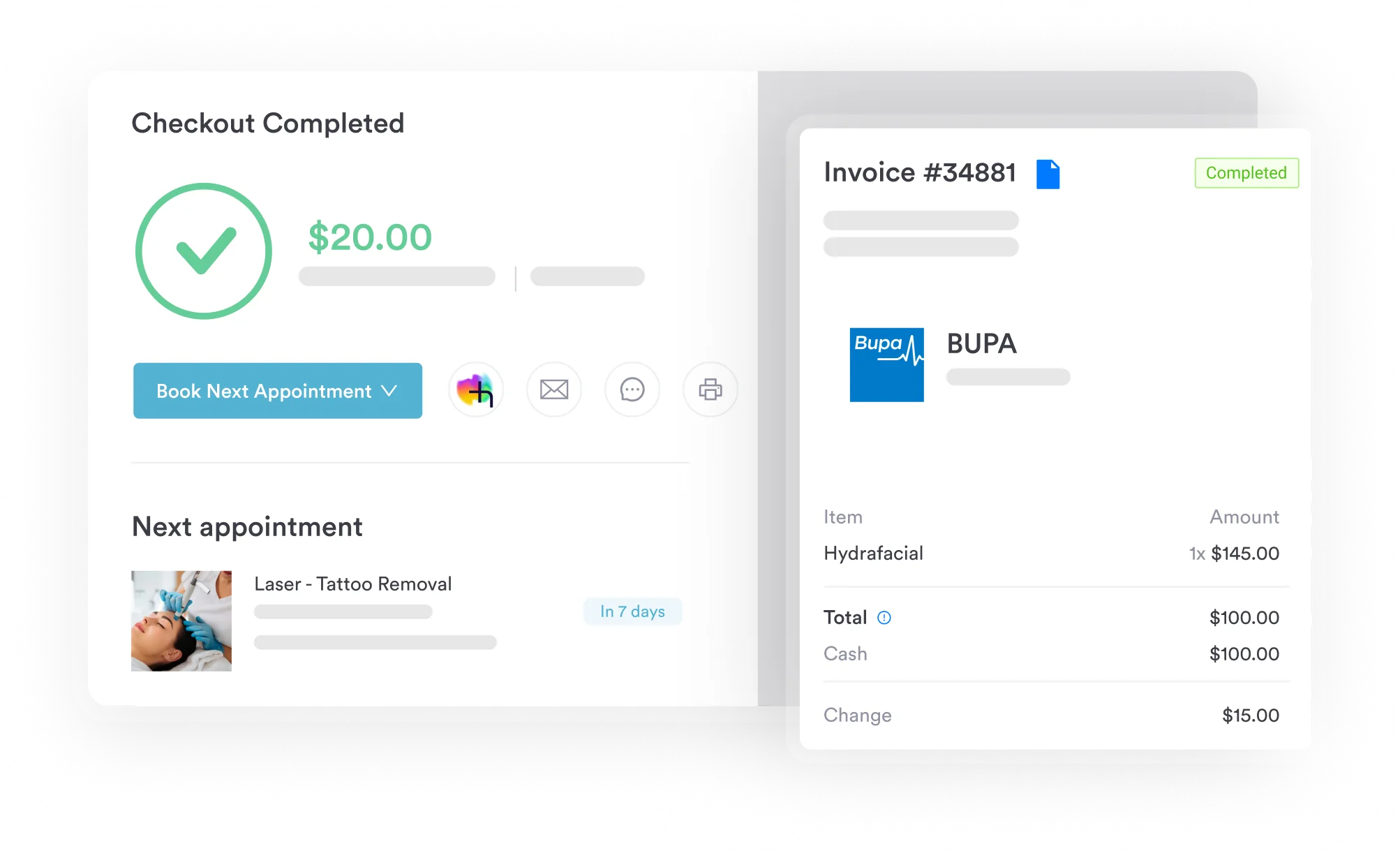
Pabau stores each patient’s insurer membership number and authorisation code on their record. Every time the practice sends a claim, Pabau checks in the background that those details are in place. So Pabau catches a claim missing its authorisation code before it reaches the insurer, which removes the most common A4500 rejection cause.
Invoice details pre-fill the Healthcode submission, so the billing team does not re-enter the A4500 fee for each insurer. Meanwhile, each consultant’s claims stay tied to their own patients, while practice managers see the whole list in one place.
The operative note, referral letter and imaging sit in the same patient record. So a secretary can confirm that the note documents cord exposure and the specific cord procedure before the practice dispatches the claim.
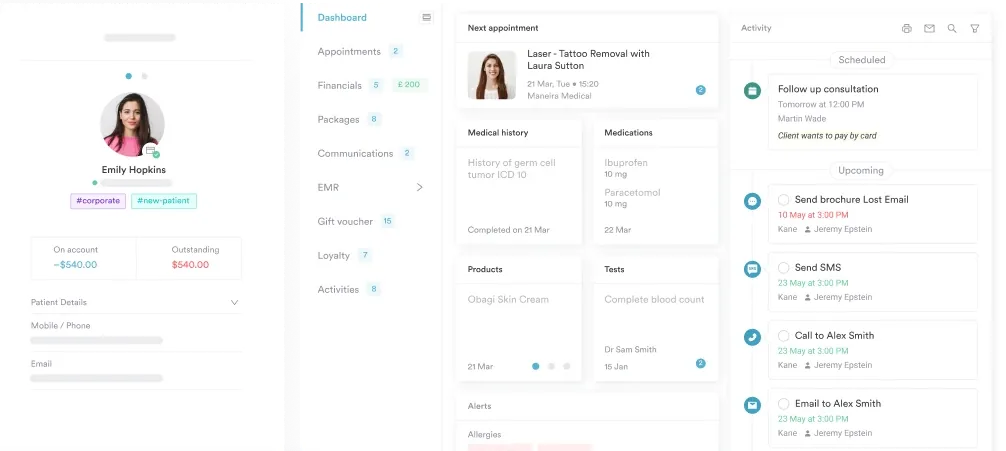

Pabau checks that membership numbers and authorisation codes are in place before each claim is sent, then pre-fills the Healthcode submission from the invoice. See how it works for your neurosurgical practice.

A4500 claims succeed or fail on the operative note. When the note confirms the dural opening and names the cord procedure, the coding question answers itself. The insurer then has little to dispute.
The trade-off is time before surgery. Securing authorisation for the exact cord procedure and matching the ICD-10 code to the diagnosis takes longer up front. But it spares the practice a resubmission cycle on a complex claim.
Book a demo to see how Pabau checks authorisation details before each A4500 claim goes to Healthcode.

Need a complete reference for Bupa’s CCSD codes? Bupa CCSD codes covers the full Bupa procedure code set and how to verify codes before submitting claims.
Want to understand the Bupa fee schedule in detail? Bupa procedure codes fee schedule breaks down how Bupa prices surgical and non-surgical procedures across specialties.
Coding a partial excision rather than an open cord operation? CCSD code A4400 covers partial excision of spinal cord, the neighbouring Chapter 3 code.
Choosing a billing system for a UK private practice? Best medical billing software in the UK compares the platforms UK practices use to send claims to private insurers.
CCSD Code A4500 covers open operations on the spinal cord, including decompression, intramedullary tumour resection, syrinx drainage, arteriovenous malformation excision, myelotomy, and tethered cord release. The defining criterion is direct open surgical access to the spinal cord itself, confirmed by dural opening and cord exposure in the operative note. Coders assign spinal column procedures that do not access the cord to separate codes.
The operative note must state the surgical access route and the spinal levels involved. It must also confirm dural opening and cord exposure, and name the exact cord procedure, such as tumour resection or syrinx shunting. A note that describes a laminectomy without naming the cord procedure is insufficient. A valid prior authorisation reference and paired ICD-10 code must also accompany the claim.
The ICD-10 code must match the documented diagnosis. Common pairings include D33.4 (benign neoplasm of spinal cord), G95.0 (syringomyelia and syringobulbia) and G95.1 (vascular myelopathies including AVM). G95.2 (cord compression), C72.0 (malignant neoplasm of spinal cord) and G06.1 (intraspinal abscess) are also frequent. Verify each code against the NHS Classifications Browser and ensure the operative note clearly documents the diagnosis before selection.
No. The anaesthetist always submits anaesthetic fees on a separate claim, using the relevant CCSD anaesthesia codes. Bundling anaesthetic fees within the A4500 surgical claim constitutes an unbundling error and will result in rejection. Whether a practice can bill intraoperative neurophysiology monitoring separately depends on the insurer. Confirm with the relevant PMI before adding a monitoring code to the claim.