

ICD-10 Code S42.444P: Medial epicondyle fracture, right humerus
ICD-10 Code S42.444P: full descriptor and code validity ICD-10 Code S42.444P car...

Last Updated: Oct 13, 2026
Billable Code Specific Code
Z91.B is the billable ICD-10-CM code for personal risk factor of exposure to diethylstilbestrol.
DES exposure carries long-term health risks for people exposed in utero, including rare gynecologic cancers and reproductive tract anomalies. Having a dedicated code allows clinicians to document this risk factor consistently, supporting appropriate surveillance and risk stratification across a patient's care history.
Let Pabau's smart automation suggest the right codes, reduce claim denials, and keep your practice compliant—effortlessly.
Automate repetitive tasks and focus on what matters most—your patients.
Reduce coding errors and ensure compliance with the latest regulations.
Clean claims, fewer denials, and faster reimbursements.
Powerful insights and reporting to help your practice thrive.
HIPAA compliant SOC 2 certified GDPR-compliant Trusted by 4,000+ clinics worldwide

ICD-10 Code Z91.B is a billable, specific diagnosis code for personal risk factor of exposure to DES, valid in the FY2026 ICD-10-CM code set.
The code took effect on October 1, 2025 with the FY2026 update, and it has no earlier introduction date.
The tabular list gives four Applicable To terms, including DES daughter or son and second generation DES exposure.
Z91.B is an additional code rather than a primary diagnosis, because it documents a risk factor and not an active disease.
Pabau’s patient records and claims management tools help clinicians capture and submit Z91.B alongside primary diagnosis codes.
ICD-10 Code Z91.B is a billable, specific ICD-10-CM code that documents personal risk factor of exposure to diethylstilbestrol. “Billable” means the code is granular enough to be used for reimbursement on a claim. It will not generate an insufficient specificity edit from a payer. Coders and clinicians can apply it without a more specific sub-code.
The CMS ICD-10 codes page maintains the official FY2026 code files where Z91.B appears in the tabular list under the Z91 category. Coders should confirm the code against the current-year release when billing for dates of service after October 1, 2025.
The Applicable To notes in the ICD-10-CM tabular list define which patient presentations this code is designed to capture. For ICD-10 Code Z91.B, four inclusion terms apply.
All four terms resolve to the same code, Z91.B. If the clinical record contains any of these phrases, the code applies. Coders do not need a separate sub-code to distinguish between them, because the CDC/NCHS ICD-10-CM tabular list treats them as equivalent for classification purposes.
Understanding where Z91.B sits in the code tree helps coders confirm they are in the right chapter and category before assigning it. The full hierarchy, verified against the ICD-10-CM tabular list, runs as follows.
Z91 is a broad personal risk factor category. It covers personal and family history items not classified elsewhere in ICD-10-CM, from allergy status to prior radiation exposure. Z91.B is one of the newer additions, and you can see how it sits against its neighbors in the ICD-10-CM code directory.
Diethylstilbestrol is a synthetic estrogen that was prescribed to pregnant women between roughly 1940 and 1971 to prevent miscarriage and other pregnancy complications. Exposure histories that carry long-term health risks earn dedicated codes, so providers can document and act on them consistently.
DES was withdrawn from clinical use after research linked it to a rare cancer. Clear cell adenocarcinoma of the vagina and cervix appeared in daughters of women who took the drug. That cancer turns up in young women with no other obvious risk factors. Research also documented reproductive tract anomalies in DES-exposed offspring, along with potential effects on DES sons.
Before ICD-10 Code Z91.B existed, clinicians documenting DES exposure history had no specific code to use. The risk sat in free-text notes with no structured ICD-10 marker. That kept it invisible to clinical decision support, quality measure reporting, and population health screening programs. A dedicated code makes this at-risk population identifiable in every system that reads coded data.
Apply Z91.B when the patient’s record or their own report confirms DES exposure. The encounter must also be for something other than an active DES-related disease. The code documents a risk factor, not an active condition.
That sequencing rule holds in every setting where Z91.B turns up, and three scenarios cover almost all of them.
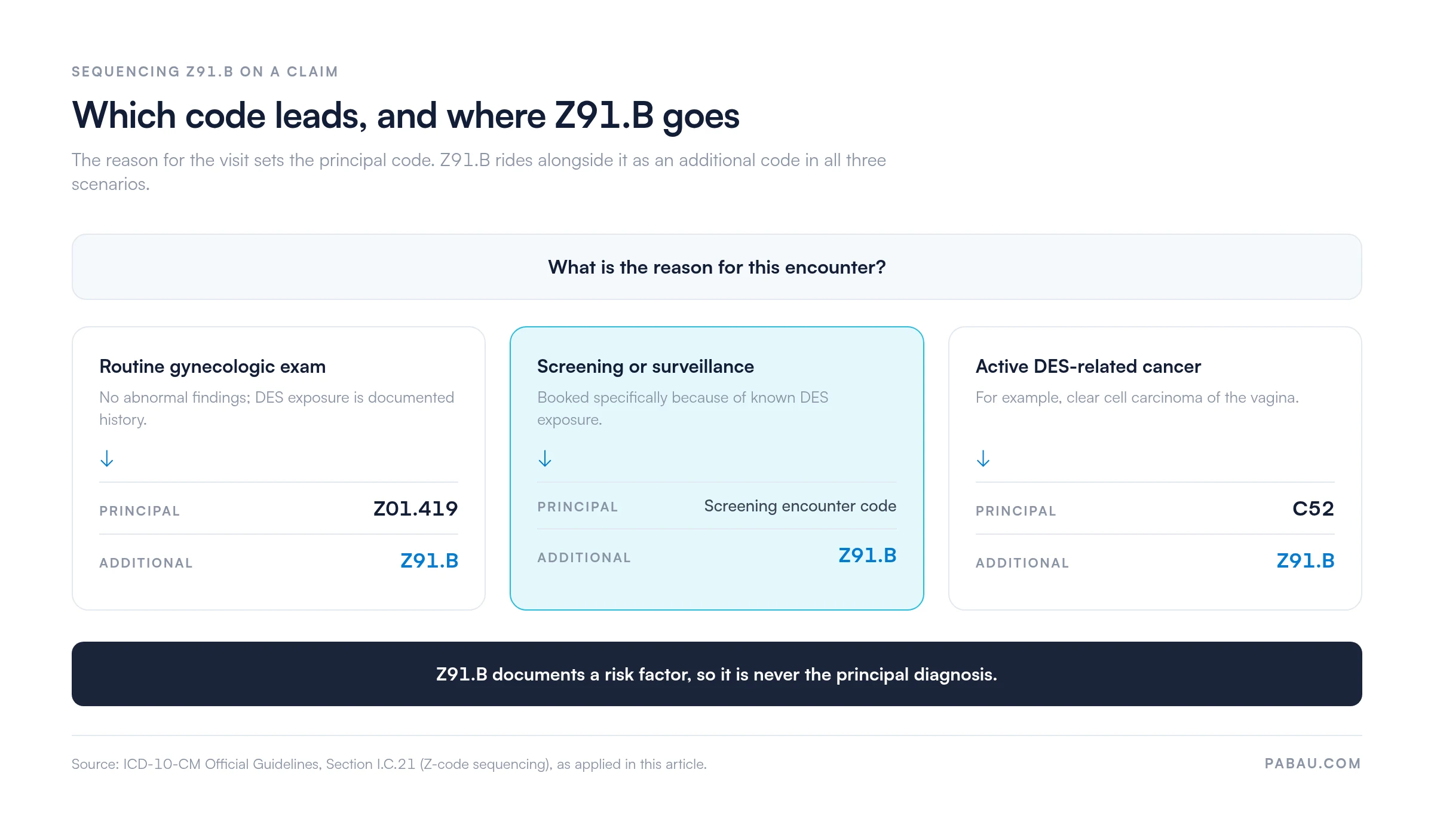
Documenting DES exposure history consistently across visits matters because payers and quality programs increasingly look for structured data. A free-text note does not fire a clinical decision support alert or populate a risk registry. A coded Z91.B entry does both.
Coders frequently assign Z91.B together with other ICD-10-CM codes that reflect the clinical picture of a DES-exposed patient. The table below shows the most commonly paired codes, drawn from standard reference sources including the AAPC ICD-10-CM code lookup.
For coders working in oncology or gynecologic practices, pairing Z91.B with cancer history codes is the most common multi-code scenario. One patient file may carry several Z-code history entries covering different risk factors documented over time. Each code stands independently and is sequenced according to the encounter’s primary reason.
When reviewing a DES-exposed patient’s record, check whether Z85.3 (personal history of breast neoplasm) is already coded. If it is, Z91.B adds a distinct dimension: the mechanism of risk. Payers and quality programs distinguish between a general cancer history and a specific environmental exposure, so documenting both gives the clearest clinical picture.
Z91.B is a new code for fiscal year 2026, effective October 1, 2025. It has no earlier introduction date. The April 1, 2025 ICD-10-CM release carried guideline and typographical revisions only, so no new diagnosis codes took effect that day.
Practices that updated their EHR code tables after the FY2026 annual release will find Z91.B in their diagnosis code library. A claim carrying the code for a date of service before October 1, 2025 will be rejected. The code did not exist in the tabular list then, so there is no earlier billing window to fall back on.
Clinical documentation often uses informal or variant language that differs from the official ICD-10-CM description. The phrases below all point to ICD-10 Code Z91.B and are acceptable in source records for code assignment.
When auditing documentation, coders should treat any of these phrases as sufficient to assign Z91.B, provided the rest of the record supports the entry. There is no need to query the provider to change terminology, because the existing clinical phrasing is adequate for code assignment.
Capturing Z91.B in the billing workflow asks three things of a practice’s software.
Generic EHR systems often make multi-code entry awkward, particularly for Z-codes that mark a risk factor rather than the reason for the visit.
Practice management software like Pabau handles this through its claims tools for coders, which support multi-code claim entry. Clinicians attach a secondary diagnosis code such as Z91.B to an encounter without overriding the primary code. Exposure histories stay in the structured patient record, so nobody re-documents them at the next visit.

For electronic claims, Pabau routes ICD-10-CM coded claims through Claim.MD, its US clearinghouse partner, which reaches thousands of US payers. A claim carrying Z91.B as a secondary code goes through the same EDI submission and eligibility checks as any other coded claim.
Practices that see DES-exposed patients can also report on who carries Z91.B in their records. Gynecology, oncology, and primary care practices with older female patients are the usual candidates. That turns a coded risk factor into a recall and screening list, rather than a line on an old claim.

Track personal risk factors like Z91.B alongside primary diagnosis codes, link them to patient records, and submit clean claims through your existing workflow.

ICD-10 Code Z91.B gives coders a billable, specific code for an exposure history that spent more than fifty years in free-text notes. Gynecology, oncology, and primary care all see the patients it applies to.
Assign it as an additional code and sequence the encounter reason first. The claim then carries the risk factor without inviting a specificity edit. The patient’s screening history also stays readable to the next clinician who opens the chart.
Pabau’s claims management and patient record tools make it straightforward to add Z91.B as a secondary diagnosis code and submit it through Claim.MD. To see how Pabau handles multi-code claim workflows for risk factor documentation, book a demo with the team.

Need to keep Z-code documentation audit-ready? Medical billing compliance covers the documentation payers expect to sit behind a secondary diagnosis code.
Wondering how electronic claim submission works for secondary codes? Pabau’s Claim.MD clearinghouse guide explains how ICD-10-CM coded claims route through the clearinghouse to thousands of US payers.
Looking to reduce ICD-10 claim denials? Denial codes in medical billing breaks down the most common denial reasons and how to appeal them effectively.
ICD-10 Code Z91.B documents personal risk factor of exposure to diethylstilbestrol (DES), a synthetic estrogen prescribed to pregnant women between the 1940s and 1971. Four Applicable To terms map to the code. Two name the patient: DES daughter or son, and second generation DES exposure. The other two name the exposure: personal risk factor of exposure to DES, and the in utero version of that term. Clinicians assign it as an additional code when no active DES-related disease is the reason for the encounter.
Yes, Z91.B is a billable and specific ICD-10-CM code valid for reimbursement purposes. It carries no insufficient specificity edit, so coders can assign it directly without a more granular sub-code. It has been billable since October 1, 2025, when it took effect with the FY2026 code set.
Z91.B is a new code for FY2026, effective October 1, 2025, and it has no earlier introduction date. Claims with dates of service before that day cannot use it, because the code did not exist in the tabular list then.
For coding purposes, DES exposure means the patient was exposed to diethylstilbestrol, most commonly in utero when their mother took the drug during pregnancy. The exposure creates a documented health risk, particularly for gynecologic cancers and reproductive tract anomalies. Clinicians record that risk as a structured entry rather than relying on free-text notes, and ICD-10 Code Z91.B is the designated code for it.
The parent code is Z91, which covers personal risk factors not elsewhere classified. Z91 sits within the Z77-Z99 block, for persons with potential health hazards related to personal history. That block belongs to Chapter 21 (Z00-Z99), covering factors influencing health status and contact with health services.




