Professional development record
A professional development record is a structured log of a healthcare practition...

3
Last Updated: Oct 8, 2026
Practice Fusion pricing starts at $199 per provider per month, billed monthly under a required annual commitment. That figure comes from Practice Fusion’s own pricing page, and it covers the core EHR only. Billing services and sales tax are charged on top. A two-provider practice pays $4,776 a year before either one is added.
This guide breaks down what the subscription includes, where the add-on fees start, and how the total compares with other EHR platforms. If you run an aesthetic practice, a med spa, or a wellness practice, one section covers why Practice Fusion rarely fits.

Practice Fusion charges $199 per provider per month, billed monthly under a required annual commitment.
Sales tax and billing services sit outside that rate, so the listed price is never the full monthly spend.
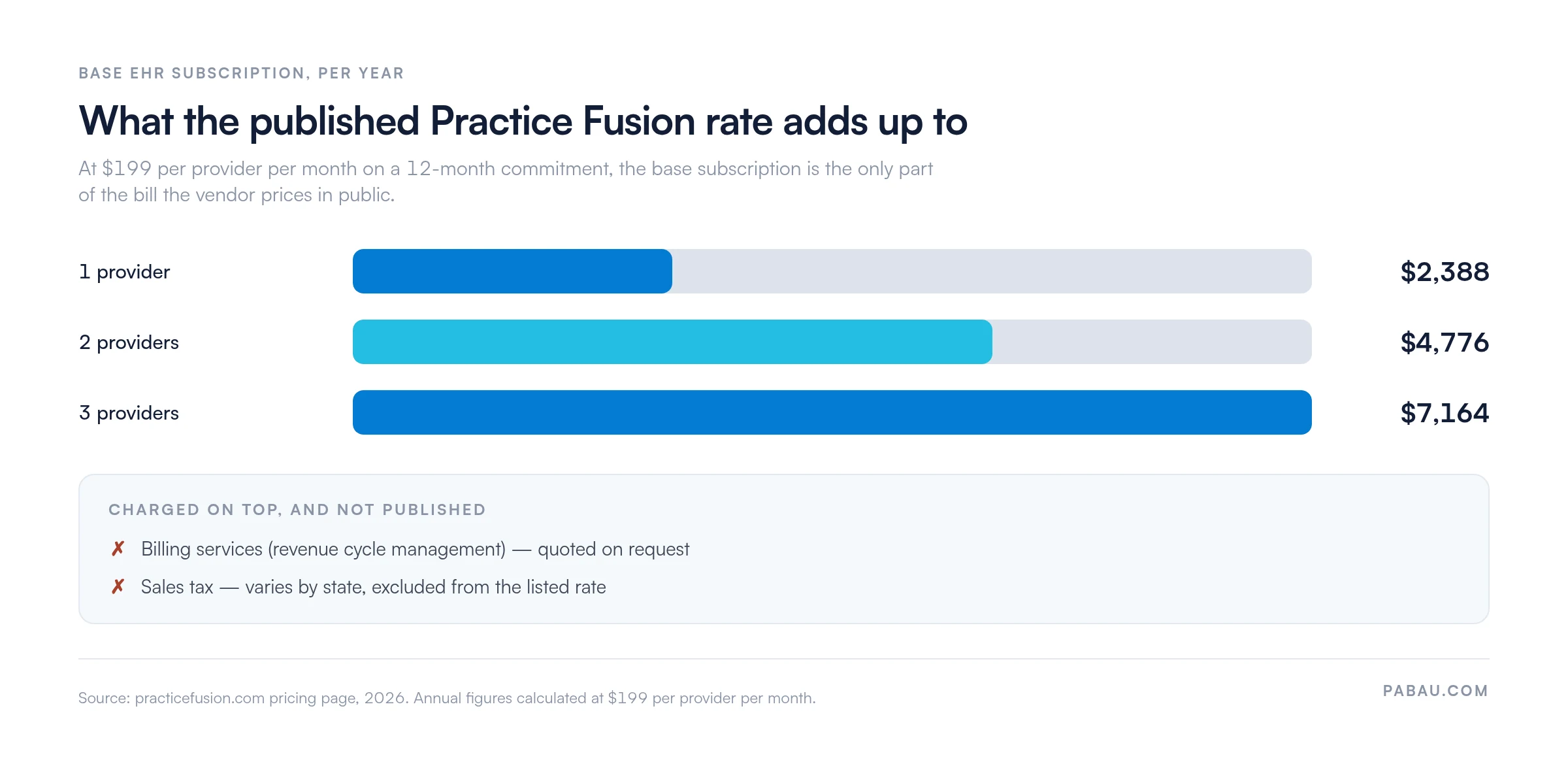
A two-provider practice pays $4,776 a year for the base subscription alone, before tax and billing services.
Practice Fusion publishes no cost for its billing add-on, so ask for a written quote before signing.
The platform is built for US ambulatory and primary care, while aesthetic, med spa, and wellness practices need a purpose-built alternative.
Practice Fusion sells a single subscription tier, with no starter, professional, or enterprise levels to compare. Instead, its pricing page lists $199 per provider per month. Billing runs monthly, but the contract runs for a year, so the monthly invoice does not buy monthly flexibility.
Check the rate on Practice Fusion’s own site before you sign. Software pricing moves, and the commitment fixes whatever number you agree to for a full year.
The base subscription covers the core EHR toolset, which is a reasonable feature set for a primary care or family medicine practice. Here is what Practice Fusion lists under the $199 per provider per month plan:
Third-party integrations extend that list, including Updox for patient communication and faxing. However, each one may carry its own charge, depending on how your practice configures it.
However, the total gets harder to pin down here. Claims submission, denial management, and revenue cycle management sit outside the $199 subscription. Practice Fusion sells them as a separate commercial arrangement.
Notably, the cost of that arrangement is not published. Practices usually pay either a flat monthly fee or a percentage of collections, depending on the model on offer when they sign. Before committing, ask Practice Fusion directly for:
As a result, for a practice that bills insurance, the billing add-on is close to mandatory, which pushes the total well past the listed subscription. Practice management software like Pabau keeps claims and billing inside one platform, so aesthetic and wellness practices avoid a second contract.

Before signing any EHR contract, ask the vendor for a 12-month total cost estimate in writing. It should cover the base subscription, billing services, sales tax, and any integration charges. The listed price and the 12-month invoice total rarely match.
Practice Fusion requires a 12-month commitment, and no month-to-month plan is published. That creates two practical risks for smaller and growing practices, plus a set of charges worth confirming in writing:
In addition, sales tax is excluded from the listed rate. A two-provider practice pays $4,776 a year for the base subscription alone, before tax and before billing services. Specifically, the chart below shows how that base cost scales with each provider you add.
Reviewers on Capterra and G2 return to the same two complaints: the inflexible annual term and the opaque billing add-on. Practice Fusion holds 3.7/5 on Capterra and 3.5/5 on G2.
Overall, Practice Fusion suits a specific type of practice well. In short, whether the price is justified depends on how closely that profile matches yours.
Practice Fusion is built for US ambulatory and primary care practices. It is a reasonable fit when your practice matches all of the following:
It is a weaker choice where specialty-specific workflows drive the day, and it was never designed for aesthetic medicine, med spas, dermatology, or wellness practices. Those settings need treatment photo management, consent form workflows, injection plotting, loyalty programs, and membership billing.
Comparatively, Practice Fusion sits in the mid-range for US ambulatory EHR platforms. The table below uses each vendor’s own published figures, and two of the five publish none at all.
For comparison, two models sit side by side here. Practice Fusion splits the EHR and the billing into separate cost centers, while athenahealth folds billing into a percentage of collections. A high-volume insurance biller often pays less under the percentage model. A practice with few insurance claims usually does better on a platform that includes billing workflows.
If DrChrono is on your shortlist, DrChrono vs Practice Fusion weighs the two on features and contract terms. SimplePractice pricing covers the tiers behind that $49 starting figure.
Similarly, Pabau publishes its rate the same way Practice Fusion does, which makes the two straightforward to line up. Our side-by-side platform comparisons set out where each one earns its price.
Practice Fusion was built for ambulatory primary care, which is a design decision rather than a flaw. MIPS reporting, controlled substance e-prescribing, and lab result management matter in family medicine. However, they are not what an aesthetic practice runs on day to day.
Those practices need before-and-after photo management, consent workflows for fillers and laser treatments, membership and loyalty billing, and stock control for retail and injectables. Practice Fusion’s core feature set covers none of that.
Pabau handles that list in one subscription, alongside scheduling, digital intake forms, and billing. By contrast, pricing starts at $62 per month for one user, with no annual lock-in. Every subscription includes every feature, so the billing add-on question never arises.
Practices weighing med spa software can run that evaluation in parallel with a Practice Fusion quote, since the two are priced on different logic.

On Capterra, Pabau holds a 4.5/5 rating from verified reviewers, who single out appointment booking, client management, and treatment records.

Aesthetic and wellness practices use Pabau instead of an EHR plus a separate billing arrangement. One price, no annual lock-in, and every feature included.

Practice Fusion publishes one number, and that number is honest as far as it goes. What sits around it decides the total: the billing add-on it does not price, the sales tax it excludes, and the 12-month term it requires. Budget for all three, or the first invoice will surprise you.
For US primary care practices that need ONC-certified functionality and MIPS reporting, Practice Fusion earns a place on the shortlist. For aesthetic, med spa, and wellness practices, the fit is wrong at any price. Book a demo to see how Pabau covers booking, records, and billing for those practices in one subscription.

Comparing the two head to head? DrChrono vs Practice Fusion weighs both platforms on features, contract terms, and the workflows each one handles best.
Need DrChrono’s numbers before you decide? DrChrono pricing explains what the vendor quotes on request and which costs sit outside the core plan.
Looking at a behavioral health platform instead? SimplePractice pricing breaks down the tiers, the per-practitioner charges, and what each plan includes.
Building a wider shortlist? Pabau competitors and alternatives sets out where each platform fits and which practice type it was designed for.
Practice Fusion pricing is $199 per provider per month on a single subscription plan. Billing runs monthly, but the contract runs for a year. The rate covers core EHR access, e-prescribing, scheduling, a patient portal, training, and support. Billing services and sales tax are charged separately on top.
$199 per provider per month, under a required 12-month commitment. A two-provider practice pays $4,776 a year for the base subscription, before billing services and sales tax. Practice Fusion publishes no month-to-month plan.
Yes. Practice Fusion sells billing services as a separate revenue cycle management add-on. The cost is not published, so you have to request it directly. The add-on covers claims submission and RCM work that the $199 subscription excludes.
Yes. Practice Fusion requires a 12-month commitment, with no month-to-month option. Review the auto-renewal and cancellation terms before signing, especially if your provider headcount or specialty mix may change during the term.
The costs beyond the listed rate are billing services, sales tax, and potentially implementation or data export charges, depending on your contract. The $199 rate covers core EHR functionality only. Ask for a written 12-month total before you sign.
Pabau is built for aesthetic, med spa, and wellness practices, with scheduling, billing, before-and-after photos, consent forms, and loyalty programs from $62 per month. SimplePractice suits behavioral health practices. athenahealth and DrChrono target general ambulatory care on different pricing models.