Free model waiver form + what it is and when your practice needs one
A model waiver form is a signed document that lets a healthcare practice use a p...

7
Last Updated: Sep 29, 2026

Portrait Care is a full medspa EMR and practice management platform. RepeatMD is a membership and loyalty add-on, so the two solve different problems.
RepeatMD needs a separate EMR or practice management system to run. Portrait Care works on its own.
Neither vendor publishes prices, and practitioner communities report that RepeatMD’s model may include a revenue share tied to membership income.
No native integration between the two is documented publicly, so running both can mean reconciling patient data by hand.
Pabau covers both layers in one platform, with memberships, loyalty, EMR, and marketing from $62 per month.
Portrait Care and RepeatMD are not really competitors. Portrait Care runs the operational side of a medspa, and RepeatMD layers memberships and loyalty on top of a system like it. So the question to answer first is which layer your practice is missing.
That framing changes the shortlist. If you have no EMR, RepeatMD on its own will not run your practice. If your calendar is already full but your revenue is flat, a second EMR will not fix that either.
This guide compares both platforms on features, pricing, reviews, and fit. It also covers what happens when a practice runs the two together, which neither vendor documents publicly.
The distinction here is platform category, not feature quality. Portrait Care is a practice management system built to run the operational side of a medspa. It covers appointments, clinical charting, billing, and patient records.
RepeatMD sits on top of a practice management system and drives recurring revenue. It sells memberships, runs loyalty programs, and gives patients a branded app to buy through. It does not schedule appointments and it does not hold clinical notes.
Seeing the two as floors of one stack makes the shortlist much easier to build. The diagram below maps what each platform covers, and where a two-vendor setup leaves a seam.
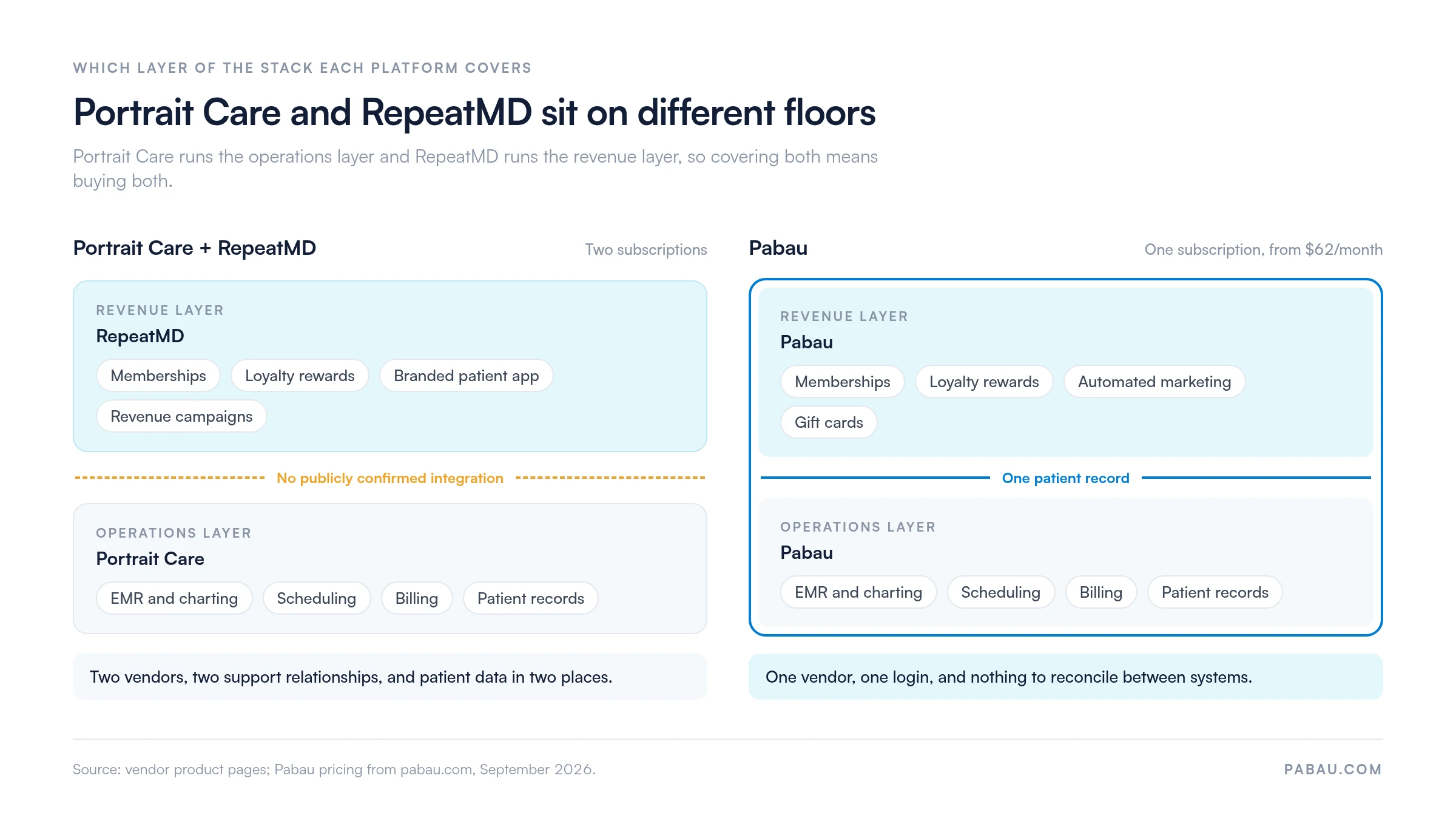
So a straight feature-for-feature winner does not exist here. The useful questions are which layer you need first, whether RepeatMD connects to the system you already run, and whether two subscriptions earn their cost.
Because the two platforms serve different jobs, a plain feature matrix only tells half the story. The sections below take each functional area in turn. You can see where each platform is strong, and where your practice would still have a hole to fill.
Portrait Care is the clear winner in this category. It was built for the day-to-day demands of a medical spa software environment. Appointment scheduling, patient intake, clinical charting, and billing all sit in one system. Owners can manage the full provider calendar, document treatment notes in an aesthetics-specific EMR, and reconcile payments without leaving the platform.
RepeatMD offers neither scheduling nor EMR charting, and it was never designed to. Practices using it still need a primary practice management system to run operations. That is worth pricing in when you compare total software cost, because RepeatMD is always a second line item rather than the only one.
RepeatMD is the stronger platform for memberships and loyalty, and this is where most medspas buy it. Practices can sell membership tiers, packages, and gift cards through a branded patient app. Patients enroll and manage plans without calling the front desk, which cuts admin time out of the renewal cycle.
Portrait Care has some membership capability, but it is not the platform’s primary focus. If you want built-in membership management with automated billing and patient self-service, Portrait Care’s tools are narrower than RepeatMD’s. Practices built around recurring revenue tend to need RepeatMD’s depth here, while still running Portrait Care or something like it underneath.
Loyalty follows the same pattern. RepeatMD’s loyalty rewards system is built to drive repeat visits and upsells without staff prompting. Portrait Care’s loyalty tools are comparatively limited.
RepeatMD ties its marketing automation to revenue triggers. Membership renewals, loyalty redemptions, and in-app purchases all fire outreach to patients. The branded app is central to that, because it gives the practice a channel to patient phones instead of relying on email alone.
Portrait Care includes patient communication tools, but its automated workflows are more basic than RepeatMD’s revenue-trigger model. For appointment reminders and post-treatment follow-ups, Portrait Care covers the essentials. For campaigns that react to what a patient just bought, RepeatMD is the more capable tool.

Each platform reports on what it manages. Portrait Care’s analytics cover clinical and operational metrics, including appointment volume, provider utilization, billing performance, and patient history. Those are the numbers a practice manager needs to run the week.
RepeatMD reports on revenue and engagement instead: membership take-up, loyalty redemptions, in-app purchase revenue, and campaign performance. Neither one is weak, they simply measure different parts of the business. Practices running both have to reconcile two dashboards to see how the practice is performing overall.
RepeatMD is designed to integrate with practice management systems rather than replace them. Its product pages say the platform connects with several EMR and scheduling systems used in the medspa market. Ask RepeatMD for the current list before you buy, because integration availability changes.
Portrait Care has its own native integrations for payments, labs, and other adjacent services. Whether Portrait Care and RepeatMD have a verified direct integration is not confirmed in public documentation. That matters if you plan to run both, because without a data sync your patient records and revenue data have no automatic connection.
The table below pulls the whole comparison together, with Pabau included as the single-platform option.
Neither Portrait Care nor RepeatMD publishes prices. Both want a demo or a sales call before they quote a number. That is common in medspa software, and it makes budgeting hard until you have engaged with two sales teams.
Practitioner communities report that RepeatMD’s pricing may include a revenue-share component tied to membership and in-app transaction volume. RepeatMD has not confirmed that on its own pages. If memberships are a large share of your revenue, ask exactly how the fee scales before you sign.
Portrait Care is equally opaque. Ask their sales team for a quote based on your provider count, your location count, and the modules you would actually turn on.
For contrast, practice management software like Pabau publishes its full price list, which starts at $104 per month for one user. There is no revenue-share component, so the cost stays predictable as membership volume grows.
Both platforms have a thin public review record. As of writing, neither carries a confirmed rating on Capterra, G2, or Trustpilot. Comments from medspa owner forums and Reddit give some signal, but they are not verified review data.
The thin review record is itself useful information. It reflects how niche both products still are within the wider medspa software market. Ask each vendor for direct customer references, and insist on speaking to a practice about your size.
Before you sign with any medspa software vendor, ask for a live walkthrough of the workflows your team runs most often. Membership enrollment, loyalty redemptions, and clinical charting are the three to insist on. A platform that only looks smooth in a scripted demo will cost your team time every day.
Possibly, but no native integration between the two is documented publicly. Plenty of medspas want Portrait Care’s operational depth alongside RepeatMD’s membership tools, so the pairing comes up often. The deciding factor is whether the two can share data without someone retyping it.
RepeatMD integrates with several EMR and scheduling systems. Whether Portrait Care is on that list needs confirming with RepeatMD directly. Without a sync, patient records, membership status, and purchase history sit in separate systems, and staff reconcile them by hand.
Practices that run both successfully treat them as parallel systems. Portrait Care holds the clinical and operational record. RepeatMD owns the patient-facing revenue experience. That arrangement works as long as one system is clearly the source of truth for billing and patient communication.
The answer comes down to what is missing from your setup today, and how far along your practice is operationally.
Choose Portrait Care if you need a primary practice management and EMR platform. Opening a medspa or replacing an aging system both point here, because you get scheduling, charting, billing, and patient management in one place. It is worth reading our Portrait Care vs PatientNow comparison too, since PatientNow is the platform it comes up against most often.
Choose RepeatMD if your practice management system already works and your problem is repeat revenue. RepeatMD adds memberships and loyalty on top of an existing stack. It suits practices with solid appointment volume that want to convert that traffic into predictable membership income.
Consider both if you already run Portrait Care and want more membership and loyalty depth than it offers natively. The dual-stack route does work. Confirm the integration story in writing first, and price the pair as one line item.
Neither name may end up on your shortlist. Our guide to Pabau alternatives and competitors lines the main medspa platforms up side by side. Use it to place each one in a category before you book any demos.
The Portrait Care plus RepeatMD route costs you two subscriptions, two support relationships, and two systems for staff to learn. Pabau covers both layers itself, so aesthetic and wellness practices run operations and recurring revenue from one place.
Membership tiers, package sales, loyalty rewards, and automated recall campaigns sit in the same system as your calendar, your clinical notes, and your payments. Because they share one patient record, there is nothing to reconcile between platforms at the end of the month.
That shows up at the front desk. When a membership patient calls, your team sees the plan, the sessions left on it, and the treatment history on one screen. Nobody has to open a second app before they can rebook or take payment.
Pabau holds a 4.7/5 rating from more than 600 verified reviews on Capterra, with consistent feedback on ease of use and support. Every subscription includes every feature, so the membership and loyalty tools come with the base plan.

Pabau combines EMR, scheduling, memberships, loyalty rewards, and automated marketing in a single platform built for medspas and aesthetic practices. One patient record means no second system to integrate.

This is really a sequencing decision rather than a head-to-head. Get the operational layer right first, because memberships sold through an app still need a calendar, a chart, and an invoice behind them.
If that layer already works and your problem is repeat revenue, RepeatMD earns its line item. If you are buying both at once, price the pair as one number and get the integration answer in writing before either contract is signed.
The third option is not buying two systems at all. To see how memberships, loyalty, charting, and marketing behave inside one patient record, book a demo with our team.

Wondering how Pabau stacks up against Portrait Care directly? Pabau vs Portrait Care compares the two platforms on features, pricing, and the kind of practice each one suits.
Still weighing up EMR options for your medspa? PatientNow alternatives reviews the platforms aesthetic practices move to, and what each one costs.
Comparing Portrait Care with the other big aesthetics EMR? AestheticsPro alternatives covers the systems medspas shortlist when charting and billing have to live together.
Looking at the medical-director model too? Pabau vs Moxie breaks down where a software-plus-services package fits and where it gets expensive.
Portrait Care is a full practice management and EMR platform for medspas, covering scheduling, clinical charting, billing, and patient records. RepeatMD is a revenue add-on that layers memberships, loyalty rewards, and a branded patient app on top of an existing system. Portrait Care can run on its own, and RepeatMD cannot.
RepeatMD does not publish prices, so a sales conversation is required for a quote. Community sources suggest the model may include a revenue-share component tied to membership volume, though RepeatMD has not confirmed this on its own pages. Ask the vendor directly before you sign.
Portrait Care includes basic membership functionality, but memberships are not the platform’s primary focus. Practices that want deeper membership tooling, patient self-service enrollment, and automated loyalty rewards usually add a dedicated tool like RepeatMD. The other route is an all-in-one platform such as Pabau.
Possibly, but no confirmed native integration between the two is documented publicly. Running both without a data sync means patient records and membership data live separately, so someone has to reconcile them by hand. Check integration availability with RepeatMD’s team before committing to both.
Pabau is an all-in-one alternative that combines EMR, scheduling, memberships, loyalty rewards, and automated marketing in one platform. Medspas that would rather not manage a Portrait Care plus RepeatMD dual stack get the same coverage from $62/month. Pricing is published, and there is no revenue-share model.