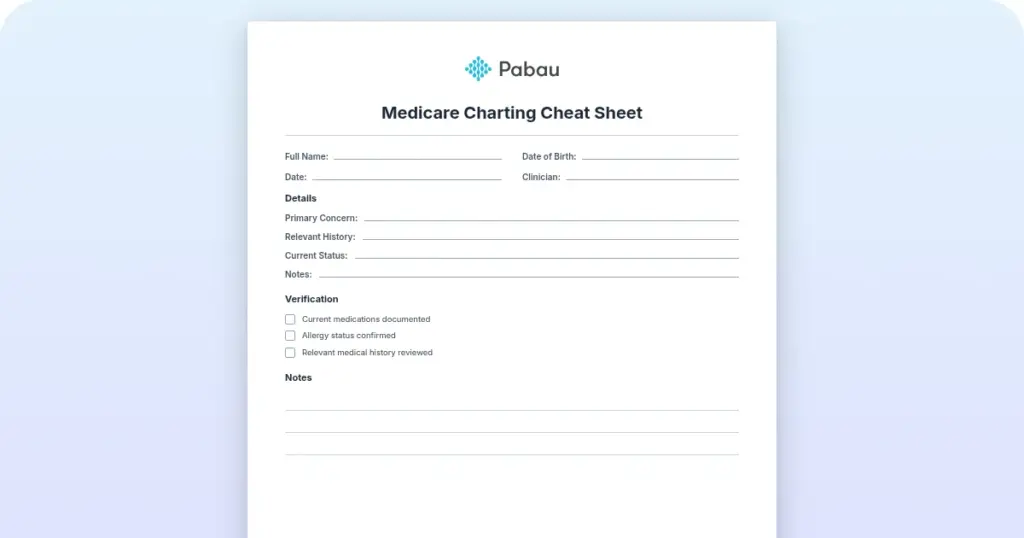
Medicare charting cheat sheet
A Medicare charting cheat sheet is a one-page reference that lists what Medicare...

4
Last Updated: Oct 21, 2026

Hint Health publishes starting prices for three of its four plans: Launch at $290 a month, Pro at $320, and Scale at $770.
Only the Enterprise tier is quote-based, and the cost surprise sits in the per-clinician and per-member add-ons rather than in hidden pricing.
A three-clinician practice with 600 members pays roughly $870 on Launch, $1,144 on Pro, and $1,374 on Scale.
Core features cover DPC membership billing, a patient portal, and select EHR integrations, though reviewers report limited integration depth.
Practice management software like Pabau publishes per-location pricing from $104 a month, with membership management, automated billing, and clinical documentation in one system.
Hint Health pricing starts at $290 a month, and unlike most direct primary care (DPC) software, that number is published. Transparency helps, though the figure only describes a single-clinician practice. Hint meters clinicians and members separately, so the plan you price today can double the month a second physician joins.
Below is what each tier costs, what moves the bill as your panel and payroll grow, and how the figures compare with other DPC platforms.
Hint Health lists a starting monthly price for Launch, Pro, and Scale, and keeps custom pricing for Enterprise alone. That already puts it ahead of most DPC platforms, which park every number behind a contact form.
The figures below come from the pricing page on Hint Health’s own site, checked in September 2026.
Every published tier includes exactly one clinician. Growth is what moves the number, and on Pro and Scale it moves from two directions at once.
Hint also runs a billing-only track on those two plans, for practices that want to keep their existing EMR. That track scales by member count alone, at $45 per month per 50 members on Pro and $175 per month per 250 members on Scale.
Launch is the entry plan, and the only one that does not meter members. The $290 monthly fee covers one clinician and an unlimited panel, plus the EMR, charting, scheduling, communications, and membership billing.
Each additional clinician adds another $290 a month, so a three-physician practice starts at $870. Card payments carry 3.00% plus $0.30, and ACH runs 1.00% plus $0.25 with a $5 cap.
Pro starts at $320 a month and covers one clinician and 100 members. On top of Launch it adds Hint AI, employer management and billing, one eligibility autosync, sales tax handling, and advanced membership pricing.
Past the included allowance, each clinician costs $232 a month and every extra 50 members costs $36. Transaction fees drop to 2.75% plus $0.30 on cards and 0.75% plus $0.25 on ACH.
Scale starts at $770 a month for one clinician and 500 members. It adds affiliate management, commission tracking, engagement tracking, and three eligibility autosyncs. Extra clinicians cost $232 a month, and every additional 250 members costs $140.
Scale also requires paid onboarding, which Hint does not price on its site. Card fees fall to 2.60% plus $0.30 and ACH to 0.60% plus $0.25.
Enterprise is the only plan Hint does not price publicly. It targets multi-site organizations and DPC networks that need single sign-on, advanced security, and dedicated support.
Cost is negotiated directly with Hint’s team, and so are the contract terms. At this tier you cannot benchmark against another vendor without a call.
Roughly triple, on two of the three published plans. The clearest way to see it is to price one practice on all three tiers at the same time. Take a practice with three clinicians and a panel of 600 members.
On Launch, the arithmetic is short. Three clinicians at $290 each comes to $870 a month, and the panel size makes no difference, because Launch does not meter members.
Pro looks cheaper on the pricing page and lands higher here. The $320 base covers one clinician and 100 members. Two more clinicians add $464, and the remaining 500 members add $360 in $36 blocks. Total: $1,144 a month.
Scale absorbs the panel better than either. Its $770 base already includes 500 members, so the extra 100 cost a single $140 block. Add $464 for two more clinicians and the bill reaches $1,374 a month.
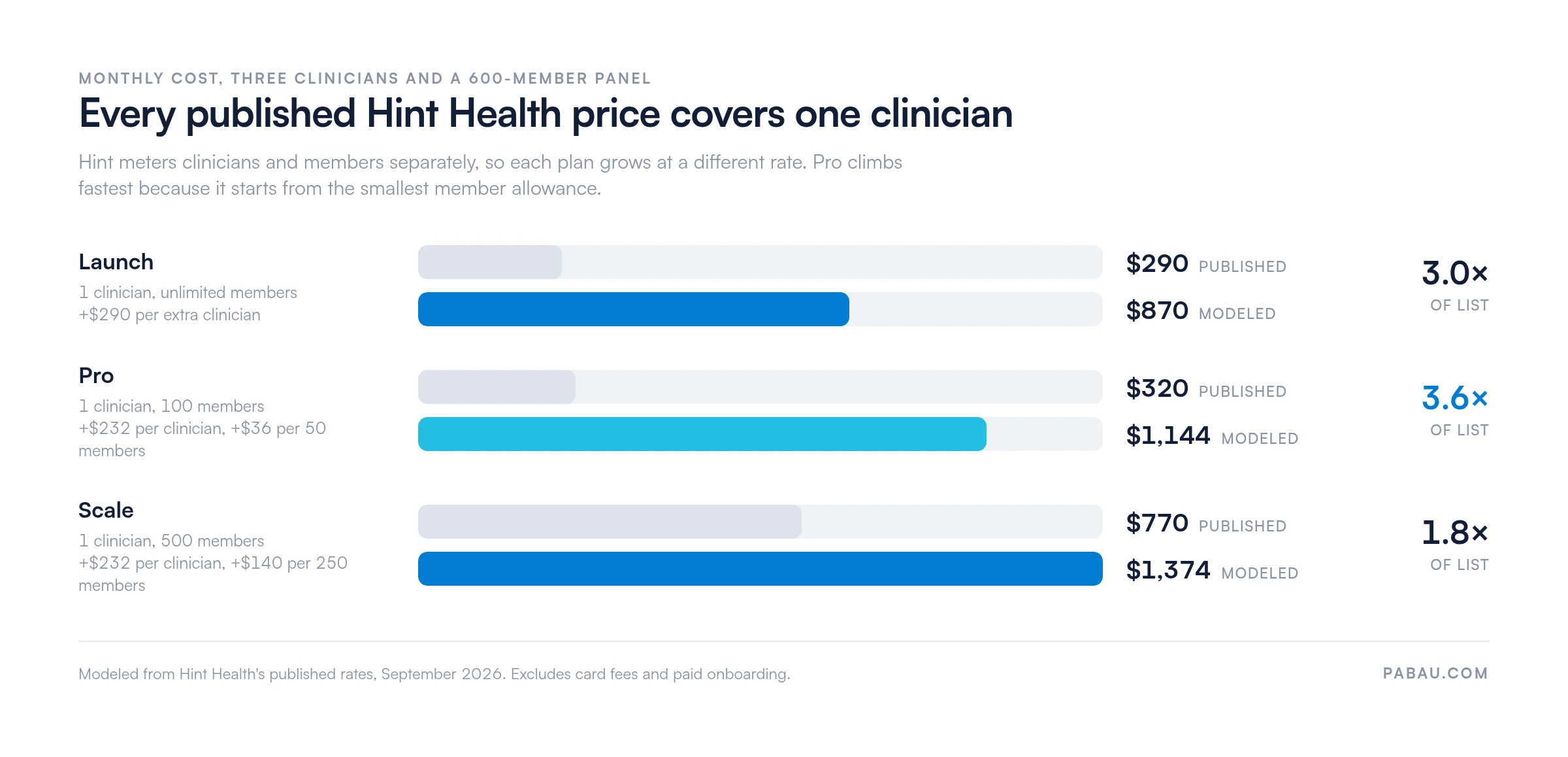
Pro climbs fastest because it meters both variables from the smallest allowance. Scale costs the most on day one and grows the slowest.
Launch stays cheapest at this size purely because the panel is free, which reverses the moment you need employer billing or Hint AI. So model your own headcount and panel first, then pick the tier.
If you already run an EMR you like, ask Hint to price the billing-only track alongside the whole platform. That track scales by member count alone, so adding a physician does not move the bill. For a practice hiring faster than it is growing its panel, the difference over a year is worth the extra quote.
What you get per dollar matters as much as the dollar itself. Hint Health is built specifically for the DPC model, so its feature set is narrow by design and deepest where membership practices spend their day.
Prices and inclusions come from Hint Health’s published pricing page, checked in September 2026. Plans change, so confirm current figures with Hint before you sign.
Five variables sit outside the published rates, and each can move a monthly bill by a few hundred dollars. None of them appear in the plan comparison, so they are easy to miss until the first invoice lands.
Work through these before the sales call rather than after it. Each one turns a number on the pricing page into a number for your practice, which is the only version that matters.
Doing the arithmetic first turns the call into a negotiation instead of a reveal. It also surfaces the questions that separate one DPC platform from another.
Four patterns turn up whenever a practice benchmarks one DPC platform against another. Each is avoidable in an afternoon with a spreadsheet.
Reviewers rate the membership billing workflow highly and the integrations far lower. That split runs consistently through G2 and TrustRadius, and it is a fair guide to where the money goes. Automating recurring monthly charges without insurance processing saves a solo DPC physician genuine hours.
Friction starts when a practice grows past a solo setup or needs deeper links to outside systems. Multiple G2 reviewers flag integration depth as a recurring complaint.
One noted that the platform works well inside its DPC niche but becomes limiting once workflows widen past membership management.
On cost, the published figure is only the starting point. What a practice pays depends on clinician count, member count, and card volume together. Model the base fee alone and you will understate the bill for any practice that is growing.
Hint sits at the transparent end of a market where most vendors quote privately. Elation Health, Atlas MD, Cerbo, and Spruce Health each serve overlapping slices of the same audience. Their pricing models differ more than their feature lists do.
The Direct Primary Care Coalition notes that DPC practices run on subscription revenue from patients rather than insurance reimbursement. Software is therefore a direct operating expense with no billing recovery behind it.
Every dollar spent on the platform comes out of membership revenue. That is why the growth curve above matters more here than in an insurance-billing practice. For contrast, our CareCloud pricing guide covers an insurance-billing EHR sold by quote, with outsourced billing reportedly priced as a share of collections.
Four names come up most often when Hint Health is not the fit. Which one suits you depends on whether you need a pure DPC membership tool or a full practice management system underneath it.
Shortlists get shorter faster once you can compare practice software directly on features and price in one place. For a wider sweep of the market, read our roundup of Carepatron alternatives.
It covers platforms that reach past membership billing into clinical documentation, scheduling, and patient engagement.
Plenty of DPC practices widen out over time, adding weight management, hormone therapy, or aesthetics alongside the membership panel. At that point a DPC-only tool starts leaking work into spreadsheets.
Practice management software like Pabau is built for that broader surface. It runs membership management, automated billing, clinical documentation, scheduling, digital intake forms, and recurring payment processing in one system.
Pricing works differently too. Pabau charges per location rather than per clinician, publishes its rates from $104 a month, and includes every feature in every subscription. Hiring a second physician does not double your software bill, and no capability sits behind a higher tier.
Pabau holds a 4.7/5 rating on Capterra from approximately 645 reviews, with users highlighting automated workflows and billing efficiency.
Tiered membership plans, automated renewal billing, and patient communication all connect in the same place. A growing panel therefore does not mean a growing admin list.

Pabau publishes its pricing and every subscription includes every feature: membership management, automated billing, clinical documentation, and scheduling. Book a demo to see how the numbers work for your practice.

Hint Health earns credit for publishing its rates, and for a solo DPC physician the entry cost is easy to work out. The complexity arrives with growth. Clinicians, members, and card volume each move the bill on their own, and only Enterprise buyers negotiate around that.
So the decision is less about the $290 and more about the slope after it. Price your 12-month practice on all three tiers, then judge whether the plan that wins today still wins then. For pure DPC membership billing, Hint does its core job well, with integration depth the limitation you are most likely to hit.
If predictable per-location pricing and broader clinical workflows matter more to you than DPC specialization, Pabau is worth a look. Book a demo to see what your membership billing and clinical notes look like in one system.

Weighing a quote-only vendor against a published price? Tebra pricing breaks down the modules and add-ons that sit behind a custom quote.
Comparing platforms built for small health practices? Carepatron pricing sets out the tiers and what each one includes for a growing team.
Looking at EHR-first options for an independent practice? DrChrono pricing explains the per-provider model and the fees that are easy to miss.
Running memberships and packages outside pure primary care? Practice Better pricing shows how add-on billing changes the monthly total.
No. Hint Health does not advertise a free trial, and prospective customers go through a demo instead. Startup practices pay no subscription until they launch, so you can build your plan and finish onboarding before billing starts.
Hint publishes four tiers, so moving up is straightforward. Moving down is the part to check. The pricing page does not state whether a mid-term downgrade is allowed, so get that answer in writing before you sign.
Pro and Scale bill in member blocks, at $36 per 50 members and $140 per 250. Hint does not publish how quickly a cancelled member drops out of that count. Ask when the count is taken, because a monthly snapshot and a rolling total produce different bills.
Not on its own. Hint Health is built for cash-pay membership revenue and does not process insurance claims. Hybrid practices usually keep a separate EHR and clearinghouse, then run the membership side through Hint’s billing-only track.
Not much, on the three published plans. Enterprise is the tier where cost and contract terms are agreed directly with Hint’s team. On the published plans, your leverage sits in what Hint does not publish, such as onboarding and contract length.