GLP-1 diet plan
A GLP-1 diet plan is a structured eating framework for patients taking semagluti...

2
Last Updated: Oct 13, 2026
The Gustilo-Anderson classification is the grading system trauma teams use to sort open fractures into five levels: Type I, II, IIIA, IIIB, and IIIC. It scores wound size, soft tissue damage, contamination, and whether an artery needs repair.
The grade decides what happens next. It sets the antibiotic regimen, the urgency of debridement, whether the wound needs flap coverage, and how realistic limb salvage is. Ramon Gustilo and John Anderson published the original three-type system in 1976, and the 1984 modification split Type III into its three subtypes.
One practical point runs through all of it. Grade the fracture at the initial assessment, then grade it again after the first debridement. What the surgeon finds in theatre can move a IIIA to a IIIB.

The Gustilo-Anderson classification grades open fractures into Types I, II, IIIA, IIIB, and IIIC based on wound size, soft tissue damage, and contamination level.
Type IIIC is the highest-severity grade, defined by vascular injury requiring repair, and carries the greatest risk of amputation and limb loss.
Antibiotic selection, debridement urgency, and fixation strategy all vary by grade, which makes accurate grading a direct driver of clinical decisions.
The system has known interobserver variability, particularly between Type II and Type IIIA, which teams should account for in documentation and handovers.
Grade the fracture at initial assessment and again after the first debridement, and record both assessments separately.
Ramon Gustilo and John Anderson published their original classification in the Journal of Bone and Joint Surgery in 1976. It drew on a study of 1,025 open fractures, most of them tibial. They described three grades differentiated by wound size, soft tissue injury, and contamination, which gave trauma teams a shared language where none existed before.
That three-type framework held until 1984, when Gustilo and colleagues recognized that Type III fractures were too varied to guide consistent treatment. The 1984 modification split Type III into IIIA, IIIB, and IIIC. Each subtype carries distinct implications for coverage and vascular management, and this six-grade version is what clinicians use today.
One caveat is worth carrying forward. Both the original and modified studies ran almost entirely on tibial fractures. Applying the system to femoral, humeral, or forearm injuries is widespread practice, but the validation dataset behind it was narrow.
The classification grades open fractures across five levels. The table below summarizes the defining criteria for each grade, followed by clinical detail on each subtype.
A wound of 1 cm or less, clean, with minimal soft tissue damage and no crush component. The bone injury is typically a simple transverse or short oblique pattern. Infection risk is low, generally cited across studies as 0-2%.
Wound length between 1 and 10 cm with moderate soft tissue damage and moderate contamination, but no periosteal stripping. There is no severe comminution. Infection risk rises, with published ranges broadly between 2% and 5%, though figures vary by bone, patient population, and era.
All Type III fractures involve high-energy mechanisms. That includes high-velocity gunshot injuries, farm injuries with gross contamination, segmental fractures regardless of wound size, and any open fracture with traumatic amputation. The 1984 modification then differentiates by coverage and vascular status.
The practical value of the classification is what the grade maps to. It sets an antibiotic regimen, a debridement urgency, a fixation strategy, and a coverage plan. Getting the grade right at initial assessment shapes the whole management pathway. The matrix below sets those four decisions side by side.
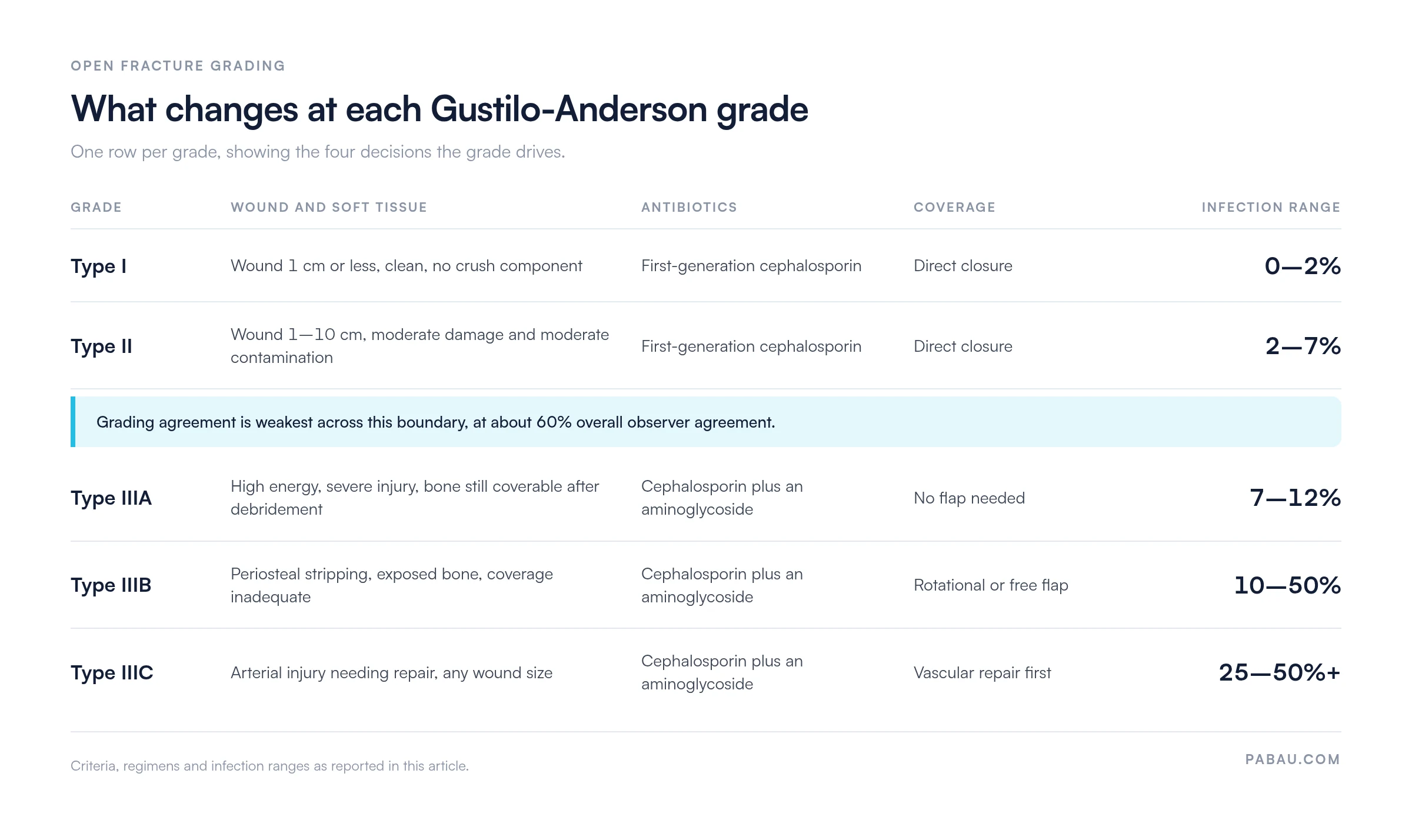
Antibiotic selection is one of the most direct clinical outputs of grading. Regimens, dosing, and durations vary by institution and should be cross-referenced against current AAOS, IDSA, or EAST guidelines, since protocols evolve. The table below reflects the general framework most commonly described in the orthopedic trauma literature.
Farm injuries and heavily contaminated wounds involving soil or fecal matter usually prompt the addition of penicillin G for anaerobic and clostridial coverage. Verify your institutional protocol and the current EAST practice management guidelines before finalizing a regimen. Recommendations have moved considerably since the 1980s publications that first set this framework.
The historical “6-hour rule” is no longer supported as a universal threshold. Current guidance from multiple prospective studies points to prompt, properly resourced debridement rather than adherence to an arbitrary window. High-grade fractures stay urgent because of contamination load and soft tissue compromise, but the driver is clinical status rather than the clock alone.
Stabilization strategy scales with grade. Type I and II fractures can usually be managed with intramedullary nailing or plate fixation once the wound is clean. Type IIIA fractures are often nailed after adequate debridement.
Type IIIB fractures frequently need temporary external fixation as a bridge to definitive fixation and flap coverage. That sequence requires close coordination between orthopedic and plastic surgery. Type IIIC injuries need emergent vascular repair before or alongside skeletal stabilization. Temporary shunting or external fixation restores perfusion while the definitive plan is settled.
The detail that gets lost between the ED, theatres, and the ward is rarely the fixation plan. It is the grade, the time of debridement, and the antibiotic already given. Capturing those three as structured fields rather than free text is what keeps the record usable downstream.

Document the Gustilo-Anderson grade at initial assessment and again after the first debridement. Grade can change intraoperatively once the full extent of soft tissue damage is visible. A pre-operative IIIA becomes a IIIB once periosteal stripping is confirmed in theatre. Record both assessments separately.
Infection risk increases with grade. That dose-response relationship holds across prospective and retrospective studies. Reported rates still vary by fracture site, patient population, era, and how infection is defined. The figures below are representative ranges from the literature rather than single-study benchmarks.
Compartment syndrome is an additional risk with high-energy Type III injuries, particularly in the tibia. Early recognition and fasciotomy where indicated can change the limb outcome. Recovery then runs into months of rehabilitation, where software for rehab teams keeps union milestones and weight-bearing status on one record.
For Type IIIC fractures, limb salvage versus primary amputation remains one of the hardest decisions in orthopedic trauma. The mangled extremity severity score, ischemia duration, patient age, and comorbidities all feed into it.
No fixed amputation rate should be quoted without naming the study cohort behind it, because outcomes have improved with modern vascular and microvascular technique. Prolonged intravenous antibiotic courses bring their own monitoring burden, and line complications belong in the same recovery plan as the fracture itself.
The system is widely used, and its limitations matter in practice. Knowing where it breaks down helps teams apply it thoughtfully instead of treating the grade as a fixed objective measure.
Consistency improves when the grading fields live in the record itself rather than in a free-text note. Our comparison of sports medicine software covers which systems let you define structured assessment fields of that kind.
Gustilo-Anderson is not the only open fracture grading system. Two alternatives appear regularly in the orthopedic literature, and knowing where each fits helps clinicians and researchers pick the right tool for the context.
The AO/OTA system grades integument injury, muscle and tendon injury, and neurovascular structures on separate subscales. That gives more granular tissue-specific data for research, at the cost of extra complexity at the bedside. The Tscherne system is common in European trauma centers and covers soft tissue damage in closed fractures, which Gustilo-Anderson does not address at all.
Other systems are anatomy-specific rather than general. The Danis-Weber classification, for instance, grades ankle fractures by the level of the fibular fracture relative to the syndesmosis. It answers a narrower question than Gustilo-Anderson and sits alongside it rather than replacing it.
In clinical settings Gustilo-Anderson predominates, because it is simple and familiar to every team in the corridor. The AO classification is more common in research publications that need standardized, reproducible tissue-damage scoring. Teams working across both contexts sometimes record both grades to bridge clinical and research documentation.
The system was not developed or validated for pediatric patients. Open fractures in children behave differently. Periosteum is thicker and more biologically active, healing is faster, and infection risk is lower at an equivalent grade. Applying adult criteria and adult infection benchmarks directly can lead to overtreatment or mismatched prognostic expectations.
The University of Texas Medical Branch modification has been proposed to account for pediatric anatomy and healing potential, though it has not been universally adopted. Most pediatric trauma centers still use Gustilo-Anderson as the baseline and apply grade-specific management. They do so knowing that outcomes in children are generally better than adult data suggests.
Anyone quoting infection rates or outcome benchmarks for pediatric open fractures should check the source cohort. Adult study data should not be carried across. Multi-stage wound review over several months is the norm, and the follow-up schedule needs to be booked accordingly.
In most practices the Gustilo grade lands in a free-text note. The re-grade after the first debridement lands somewhere else, usually the operative note. By the time the rehabilitation team picks the patient up, nobody can say which grade the plan was built on.
Practice management software like Pabau stores that detail as structured fields on the patient record instead of as prose. You capture the grade at initial assessment, the grade confirmed in theatre, and the reasoning behind each. The same record carries the antibiotic regimen and the debridement dates.
Follow-up for a high-grade open fracture runs over months and across several teams. Pabau ties every appointment, note, and document to one patient timeline, so the rehabilitation team opens the case and sees what was done and when. That removes most of the phone calls between departments.

Pabau helps orthopedic and surgical teams document clinical grades, coordinate multi-stage debridement schedules, and track post-operative recovery milestones, all in one place.

Open fractures demand fast, coordinated decisions, and the Gustilo-Anderson grade is the shortest route to a shared plan. It links the antibiotic choice made in the ED to the coverage plan made in theatre.
Its weaknesses are worth holding in mind. Agreement between surgeons is imperfect at the II to IIIA boundary, and the grade can move after debridement. The validation data also came almost entirely from adult tibial fractures.
So grade twice, write down why, and treat the number as an opening position rather than a verdict. The teams whose handovers hold up are the ones that documented their reasoning next to the grade.
Book a demo to see how Pabau keeps trauma grading, debridement notes, and rehabilitation milestones on a single patient record.

Grading an ankle fracture instead? Danis-Weber classification explains how the level of the fibular fracture guides ankle management decisions.
Need to tell two forearm fracture patterns apart? Galeazzi fracture vs Monteggia sets out the radiographic differences and what each one means for fixation.
Deciding whether an ankle needs imaging? Ottawa ankle rules calculator shows how a structured decision rule cuts unnecessary radiographs.
Suspecting an occult wrist fracture? Scaphoid fracture test covers the examination findings that justify immobilizing before imaging confirms it.
The Gustilo-Anderson classification is a grading system for open fractures. It sorts injuries into Types I, II, IIIA, IIIB, and IIIC by wound size, soft tissue injury, contamination, and vascular damage. Ramon Gustilo and John Anderson described it in 1976, and the 1984 modification added the three Type III subtypes. It remains the most widely used open fracture classification in orthopedic trauma.
Type IIIA has severe soft tissue injury but enough soft tissue left to cover bone after debridement, so no flap is needed. Type IIIB has periosteal stripping with exposed bone and inadequate coverage, so it needs a rotational or free flap. Type IIIC is defined by an arterial injury requiring vascular repair to restore limb perfusion, whatever the wound size. It carries the highest risk of amputation.
The original 1976 system described three types, I, II and III, without subdividing Type III. The 1984 modification by Gustilo and colleagues recognized that Type III fractures were too varied. It split them into IIIA, which has adequate soft tissue coverage, and IIIB, which needs flap coverage after periosteal stripping. IIIC carries a vascular injury requiring repair. This turned a three-point scale into the five-grade framework used today.
Interobserver reliability is limited. A frequently cited 1994 study by Brumback and Jones reported overall observer agreement of about 60%. Agreement was weakest at the boundary between Type II and Type IIIA. The same fracture can therefore be graded differently by different surgeons. That matters whenever the grade drives antibiotic duration or coverage decisions.
The AO/OTA classification grades soft tissue injury on three separate subscales, covering integument, muscle and tendon, and neurovascular structures. That gives more granular data than the single combined Gustilo-Anderson grade. Gustilo-Anderson remains the dominant clinical tool because of its simplicity and familiarity. The AO system is more common in research that needs reproducible, detailed tissue-damage documentation.
The classification was developed and validated on adult, predominantly tibial fractures, and was not designed for children. Children typically heal faster, have more active periosteum, and show lower infection rates for an equivalent grade. The UTMB modification has been proposed for pediatric use but is not universally adopted. Adult infection benchmarks should not be applied directly to pediatric cases without pediatric-specific study data.