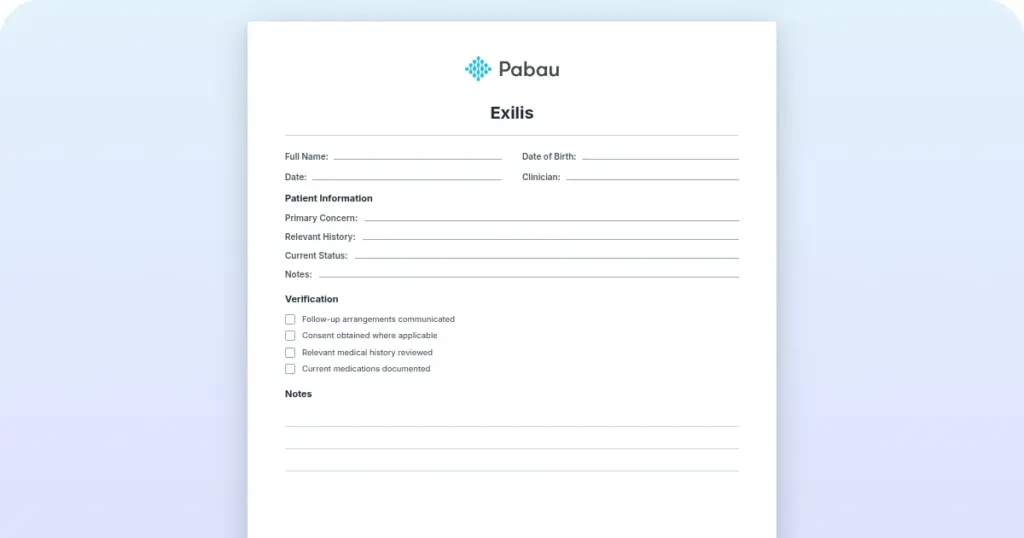
Exilis patient treatment record: Free PDF for RF sessions
An Exilis patient treatment record is the session log for BTL’s radiofrequ...

1
Last Updated: Oct 23, 2026

A facial intake form collects a client’s personal details, medical history, skin type, current routine, and goals before a facial treatment.
The must-have sections are personal info, medical history, skin type and concerns, skincare routine, previous treatments, consent, emergency contact, treatment goals, and a signed acknowledgment.
A facial intake form, a facial consultation form, and a facial consent form overlap but do different jobs — you usually want all three, or one form that covers them.
Digital intake forms cut front-desk admin, pull answers straight into the client record, and give you a signed, timestamped record if a reaction is ever disputed.
Grab the free facial intake form template below and customize it to the treatments you offer.
A facial intake form is the questionnaire a client fills in before a facial so you know their skin type, medical history, allergies, and goals before you touch their skin. It is your first safety check and your first legal record in one document.
Skip it and you are treating blind. Poor documentation can compromise client safety and leave you unable to defend your practice if a treatment goes wrong.
Below you will find every section a facial intake form should include, the exact questions to ask in each one, and why each field protects you. You can grab the free template now and read the rest when you have a minute.
Skip building one from scratch. Our free facial intake form template covers every section below, and you can edit it to match the facials you offer. It works as a printable PDF or as a digital form your clients complete before they arrive.
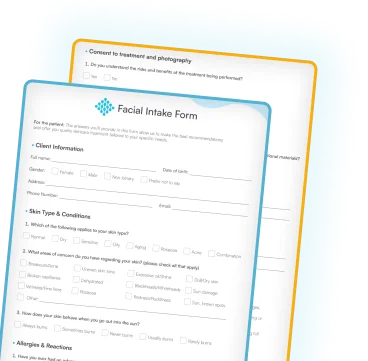
A facial intake form is a short questionnaire a client completes before their first facial that captures their contact details, medical history, skin type, current skincare routine, and treatment goals. You review it before every appointment and update it as the client’s skin or health changes.
The same document goes by several names. Depending on who you ask, it is a facial client intake form, a client consultation form for facial treatments, a skin care consultation form, or simply a facial form. Plenty of estheticians just call the whole set their facial forms.
Search for any of those and clients usually mean the same thing: the form they fill in before the treatment starts. The wording matters less than what the form actually captures.
Where people do get tripped up is the difference between an intake form, a consultation form, and a consent form. They overlap, and plenty of practices roll all three into one document, but each has a distinct job.
| Form | What it captures | When you use it |
|---|---|---|
| Facial intake form (a.k.a. facial client intake form) | The full client profile: personal details, medical history, skin type, current routine, and goals | Before the first facial, then reviewed at return visits |
| Facial consultation form | The record of your consultation: concerns discussed, the treatment plan, and the expectations you agree on together | During the consultation, before treatment |
| Facial consent form | Informed consent, a liability release, and photography permission | Signed before treatment, and again whenever consent or the treatment changes |
One more distinction worth clearing up: an esthetician provides cosmetic skincare like facials, exfoliation, and hair removal, while a medical esthetician usually works in a clinical setting on treatments such as skin resurfacing or post-procedure care. The intake form looks similar for both, but the medical version leans harder on medications and past procedures.
A well-built facial intake form is your practice’s first step toward safe, personalized treatments. Here is every section it should include, with the exact questions to ask and why each one earns its place.
| Section | What it captures | Why it matters |
|---|---|---|
| Personal information | Name, date of birth, contact details | Reach the client and confirm who you are treating |
| Medical history | Allergies, medications, conditions, surgeries | Screens for contraindications before you treat |
| Skin type and concerns | Skin type, current concerns, sensitivities | Matches products and technique to the skin |
| Current skincare routine | Home products and active ingredients | Prevents reactions between home actives and your treatment |
| Lifestyle factors | Smoking, diet, hydration, exercise | Sets realistic results and aftercare advice |
| Previous treatments | Past facials or peels and how the skin reacted | Flags tolerance issues and past reactions |
| Consent and photography | Treatment consent, photo and marketing permission | Documents permission and protects privacy |
| Emergency contact | Name and number of someone to call | Covers you if a client becomes unwell |
| Treatment goals | Desired outcome and motivation | Aligns on realistic, achievable results |
| Acknowledgment and signature | Signed declaration plus a liability release | Your record that the client disclosed everything |
Start with the client’s contact and identity details. Keep this section accurate and complete, and include:
You need a client’s medical history to treat safely. Collect allergies, skin conditions, medications, and past surgeries so you can avoid complications and personalize care. For clients with more complex health backgrounds, a medical review of systems captures more detail than a standard facial intake form. Ask:
Once you have the basics, move on to the skin itself. Every skin type needs a different approach, and concerns like acne, hyperpigmentation, or sensitivity shape the products and methods you use. Ask:
A skin analysis form can help you document these details consistently at every visit. If acne is a main concern, pair your intake notes with an acne treatment consent form so flare-up zones and treatment plans stay documented over time.
Gather what the client uses at home before you treat, so your facial is compatible with their existing products. Cover cleansers, moisturizers, exfoliants, serums, sunscreen, and any active ingredients like retinoids or acids. Ask:
Diet, hydration, stress, and habits like smoking or drinking all affect skin health and aging. A study of women aged 18 to 75 found that non-smokers and those who avoid heavy drinking tend to show fewer signs of facial aging. Capturing this helps you set realistic expectations and give better aftercare advice. Ask about:
You take on risk if you do not know a client’s history of facials and how their skin reacted. Say a client books a chemical peel: if you never checked how they responded last time, and they react badly because of their skin type or an allergy to AHAs or BHAs, you could be in serious trouble.
Documenting past treatments lets you tailor each session to their tolerance. Ask:
Your consent form is where the client agrees to the treatment and to how their photos are handled. In practice, images track progress, jog the practitioner’s memory, and support marketing, so permission has to be explicit.
Not everyone is comfortable being photographed, and even those who are may not want their images seen beyond their practitioner. One dermatology patient survey found that 99.5% of patients wanted their images accessible only to their treating provider. Keep treatment consent and marketing consent as separate opt-ins, the same way you would with a standalone medical release form. Ask:

Facials are low-risk, but reactions do happen, so capture someone you can reach if a client becomes unwell. Ask:
Clients arrive with different goals, so get aligned on what they want before you start. A few questions here surface whether their expectations are realistic, and if they are not, you can have that conversation early. Ask:
Close the form with a signed acknowledgment. This is the section every generic template skips, and it is the one that protects you: a dated signature confirming the client disclosed everything, understood the treatment, and accepts responsibility for the information they gave.
As one esthetician put it on a community thread about intake forms, the point of the form is that once the client fills it out, you are no longer carrying sole liability for a contraindication they never told you about. Include:
Whether you offer one facial or twenty, a good form flexes to your services. Our free esthetician client intake form template includes every section above, so you can hand it over as a printable esthetician intake form or send it digitally before the appointment.
Download it as an esthetician client intake form PDF, or search for a facial consultation form PDF free download and you will find the same fields under a different name. Some estheticians even label it an esthetician client consultation form, but the sections are identical.
Then customize it: add the questions that matter for your treatments, and drop the ones that do not apply.
The intake form is your first touchpoint with a client, so it is worth getting right. A few habits keep the process smooth, safe, and easy on your front desk.
A digital consent form beats paper on almost every count, and it is the single biggest upgrade you can make to your intake process. Clients complete it at home instead of hunched over a clipboard, and the answers land in their record automatically. Here is how digital wins:
With practice management software like Pabau, you can build digital forms for every facial you offer, whether you run a skin clinic or a medical spa, choosing from over 40 ready-made templates or creating your own from scratch.

Practice management software like Pabau lets you send digital intake forms before every facial, collect signatures online, and pull each client’s answers straight into their record, so your front desk stops chasing paperwork.

Keep forms current so you always know what has changed with a client’s skin. It matters because:
Informed consent is necessary for every aesthetic treatment, facials included. Cover it during the consultation, where you walk the client through the risks, side effects, and alternatives so nothing is a surprise. Make sure you have:
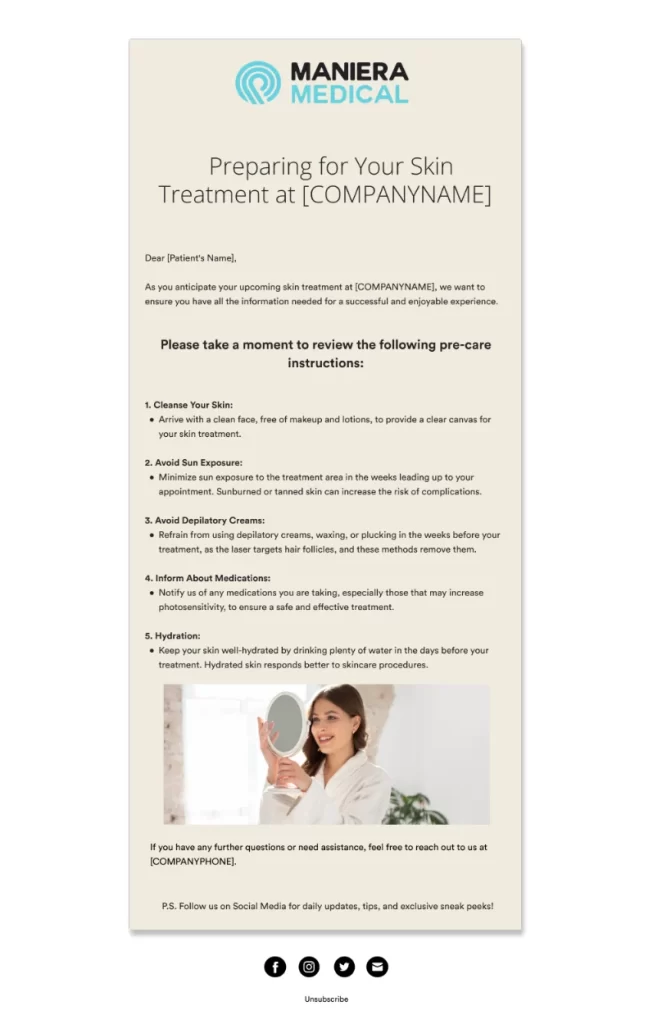
Good results depend on clients following pre- and post-treatment care. Automated pre- and aftercare emails let you send the right instructions at the right time. Cover:
Clients come to you for the treatment, not the paperwork, so the less friction your intake form adds, the better their visit feels. That is where practice management software like Pabau comes in: it turns the facial intake form from a clipboard chore into an automated step that runs before the client even walks in.
Pabau automates the whole intake process for you. You build a digital form once, and the system sends it out automatically ahead of each appointment, collects the client’s answers and e-signature, and files everything straight into their record. Here is what that means day to day:
The payoff is a smoother check-in, a complete client record every time, and a front desk that spends its time on clients instead of paperwork. If you want to see exactly how Pabau automates your facial intake forms, book a demo and we will walk you through it.

Building out the rest of your client paperwork? Our skin analysis form template pairs with your intake form to document skin type, concerns, and treatment zones in one place.
Offering peels or other higher-risk facials? Add a treatment-specific acne treatment consent form so consent matches the exact service you’re providing.
Need a consistent way to score eczema severity? EASI score calculator guide explains the validated tool for scoring atopic dermatitis.
A facial intake form should include personal and contact details, medical history, skin type and concerns, current skincare routine, lifestyle factors, previous treatments and reactions, consent and photography permissions, an emergency contact, treatment goals, and a signed acknowledgment with a liability release.
They overlap but are not identical. The intake form captures the client’s full profile before treatment, while a client consultation form for facial treatments records the concerns and plan you agree on during the consultation. A skin care consultation form often blends the two, and many practices use one document that covers both.
They can be, as long as the software stores and transmits client data securely and you handle it correctly. A digital consent form kept in secure practice management software is easier to keep HIPAA-compliant than paper sitting in an unlocked drawer.
Yes. With digital forms, clients complete and sign an esthetician intake form from their phone before they arrive, and the signed, timestamped form flows straight into their client record.