

Yocum test: How to perform it and what a positive means

The Yocum test is one of the fastest ways to load the subacromial space and hear what the shoulder says. With a hand resting on the opposite shoulder, your patient lifts that elbow against steady downward pressure. Pain at the front or side of the shoulder counts as a positive result. All of it takes […]
Tight hip flexors test: How to do the Thomas test
Front-of-hip tightness is easy to feel and hard to pin down. You stretch, it eases for an hour, then the pull creeps back by mid-afternoon. The tight hip flexors test, better known as the Thomas Test, settles the question in about two minutes. You lie back on a firm table, hug one knee to your […]
QuickDASH Outcome Measure
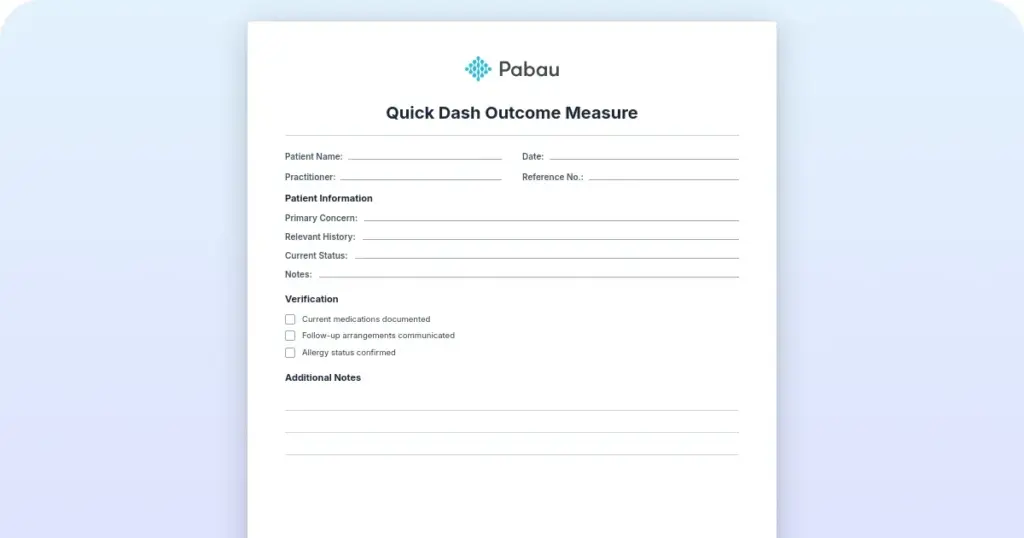
Download your free QuickDASH score record sheet A one-page charting form for filing each QuickDASH result, with fields for patient name, assessment date, the calculated score, and clinical notes. The questionnaire itself is published separately by the Institute for Work & Health, which owns the copyright. Download template The QuickDASH turns a vague complaint about […]
Belly press test: How to perform and interpret results

Subscapularis tears are easy to miss. They slip past a routine shoulder exam, and MRI misses plenty of them too. Weakness in internal rotation is the clue, and one bedside test brings it out. The belly press test takes about a minute and needs no equipment. Ask the patient to press a flat palm into […]
Motor Assessment Scale: Items, scoring, and how to administer it
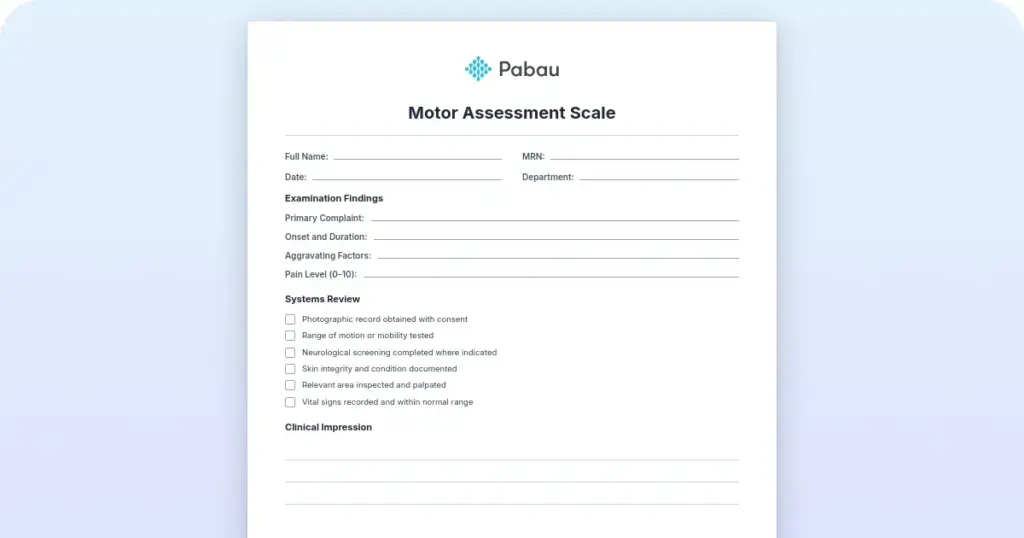
Download Your Free Motor Assessment Scale Motor Assessment Scale A standardised 8-item motor function assessment tool for post-stroke patients and neurological populations, including scoring criteria, administration instructions, and general muscle tone evaluation. Download template The Motor Assessment Scale (MAS) is one of the most widely used standardised assessment tools in neurological rehabilitation. If you work […]
ICD-10 Code S96.922A: left foot tendon laceration, FY2026

ICD-10 Code S96.922A: definition, billable status, and effective date ICD-10 Code S96.922A describes laceration of unspecified muscle and tendon at ankle and foot level, left foot, initial encounter. It sits in the S96 category under Chapter 19 of ICD-10-CM, which covers injury and poisoning. The code became effective October 1, 2025 under the FY2026 edition. […]
HCPCS code E0239: Hydrocollator unit, portable billing guide

E0239 code details at a glance Field Detail HCPCS code E0239 Full description Hydrocollator unit, portable Code type HCPCS Level II (DME) Code range E0200-E0239, heat, cold, and light therapies Benefit category Medicare Part B, durable medical equipment Maintained by CMS HCPCS National Panel Status (2026) Active Medicare coverage and eligibility for E0239 Medicare Part […]
Hoffa’s fat pad test
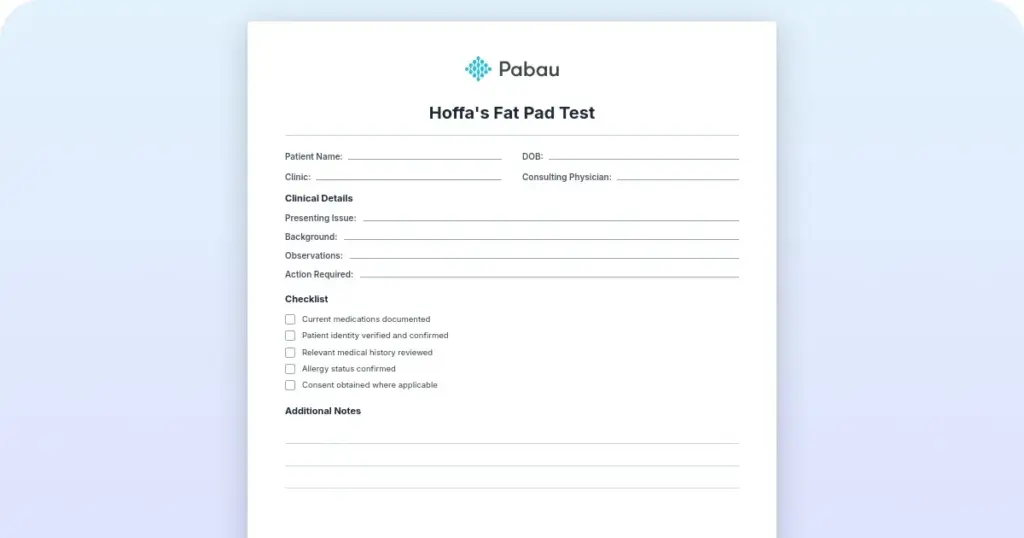
Download your free Hoffa’s fat pad test template A structured assessment form covering patient positioning, examiner technique, and how you read the result. It also captures infrapatellar fat pad findings, other special tests performed, and the follow-up action agreed with the patient. Download template Hoffa’s fat pad test is a hands-on knee examination that reproduces […]
Cuboid syndrome test: How to perform and interpret it
Six weeks after an ankle sprain, the patient is still limping. The X-ray came back clear. The ligaments feel stable on stress testing. Yet every step on the outer edge of the foot still hurts. That pattern often points at the cuboid. A small shift at the calcaneocuboid joint keeps producing lateral midfoot pain long […]
Coleman block test: technique, interpretation, and variants
The Coleman block test is one of orthopedics’ most practical bedside tools, yet clinicians apply it inconsistently and misread what it shows. It takes under two minutes to perform. What it settles is whether a patient with cavovarus deformity needs a soft-tissue release or a bony osteotomy. This guide covers how to perform the test, […]