Botox reconstitution chart
A Botox reconstitution chart shows how much saline to add to a vial and how many...

1
Last Updated: Oct 6, 2026
Affirm vs Cherry comes down to where the financing conversation actually happens in your practice. Cherry is the better default for most elective healthcare practices. It was built only for providers, and it keeps the credit check soft at every stage of the application. Affirm is the better fit when patients pay online before they arrive.
Both are buy-now-pay-later (BNPL) lenders, so the headline pitch reads much the same. What separates them is the credit check, the merchant fee model, and how much work it takes to run financing from a consultation room. This guide compares them on each of those.

Cherry is healthcare-exclusive and runs a soft credit check at every stage, so applying never affects the patient’s credit score.
Affirm prequalifies on a soft check, but it may run a hard inquiry to finalize a larger loan.
Neither company publishes its merchant fee percentages, so ask both for a written rate sheet before you sign.
Cherry’s merchant fee rises as the patient’s APR falls, which lets you price each plan before you offer it.
Practice management software like Pabau keeps deposits, invoices, and treatment records in one system, whichever financing partner you use.
Here is how the two platforms compare on the factors that decide the choice for a healthcare practice.
Cherry is a patient financing platform built exclusively for healthcare providers. It serves aesthetic practices, dental offices, med spas, dermatology practices, and similar elective care settings. Cherry operates as a lender in all 50 US states and does not sign retail or general consumer merchants.
The pitch is a high-approval, low-friction application. Patients apply by text message, by scanning a QR code, or through the provider’s portal, and most finish in under two minutes. Because the credit check stays soft throughout, nobody is penalized for applying. That removes the main reason patients stall when treatment cost comes up.
One thing to know before you go looking for reviews. Cherry is a lender rather than a software product, so it carries no verified profile on the main software review sites. Provider feedback mostly arrives through Cherry’s own case studies and through word of mouth in practice owner groups.
Affirm is a general consumer BNPL platform founded in 2012 and headquartered in San Francisco. Its core market is retail e-commerce, with merchant partnerships across travel, electronics, home goods, and fashion. Some healthcare providers use Affirm, but it has no healthcare-specific onboarding or support team.
Affirm’s strength is brand recognition. Plenty of patients already hold an Affirm account from consumer purchases, which cuts friction on an online booking that checks out like a retail cart. For a financing conversation that happens in the treatment room, the infrastructure is far less tailored.
Affirm’s G2 rating sits at 4.3 out of 5 from 48 reviews. Its Trustpilot score tells a different story at 1.7 out of 5 from 7,722 consumer reviews, driven largely by customer service complaints from retail borrowers. Weigh that sentiment against your own patient base before you put the brand in front of them.
Approval rate is the difference practice owners feel first. Cherry reports rates of up to 85% or higher in its marketing materials. Treat that as a marketing claim rather than a benchmark, because results move with patient demographics and procedure cost.
The structural reason Cherry tends to outperform in healthcare is its credit check method. Cherry runs a soft inquiry at every stage of the application, so the patient’s credit score is untouched whether they are approved or declined.
Affirm prequalifies on a soft check, but may apply a hard credit inquiry when the loan is finalized, particularly on larger amounts. The Consumer Financial Protection Bureau notes that BNPL lenders generally avoid hard inquiries at application. It flags larger installment loans as the exception, which is exactly the band a $4,000 treatment plan falls into.
For aesthetic and elective procedures, soft-check-only matters because these patients often carry thinner credit files than retail borrowers. Someone hesitating over a $2,000 injectable treatment is far more likely to finish the application once they know a decline costs them nothing.
Stage by stage, the two applications look identical until the final decision. The comparison below maps where they part company.
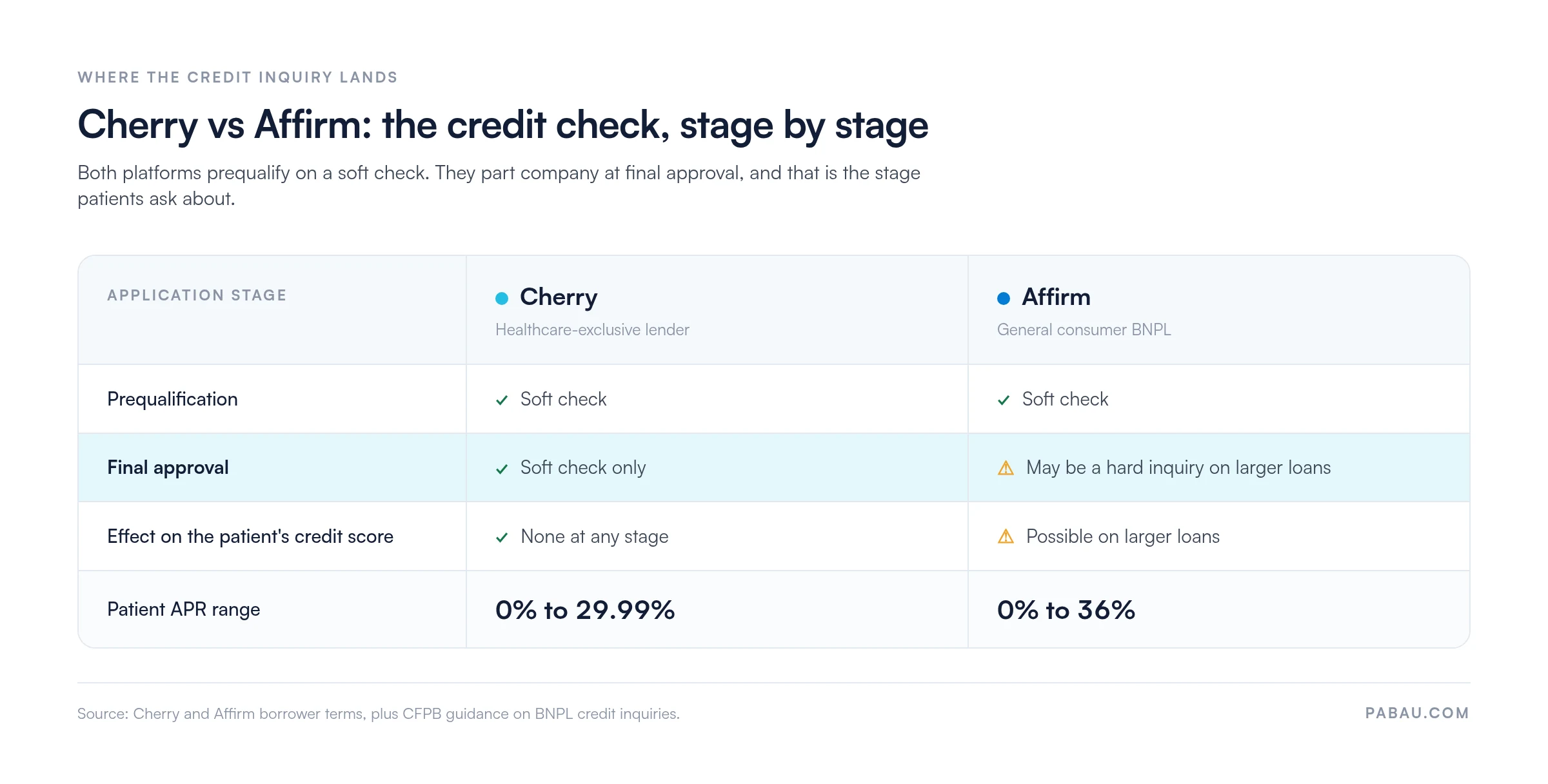
Both platforms offer 0% APR promotional financing, and the mechanics differ in ways that change how you talk about treatment price.
Cherry’s APR range runs from 0% to 29.99%. The 0% option opens up when the practice absorbs a higher merchant fee and effectively pays the patient’s interest. Longer plans usually carry a higher patient APR and a lower merchant fee. That gives you a lever for splitting the cost between the practice and the patient.
Affirm’s range is wider at 0% to 36%, and its 0% tier is merchant-subsidized in the same way. On healthcare purchases the top of Affirm’s range can sit well above Cherry’s. That gap shows up in the rate disclosure a patient reads right before they commit.
Affirm also runs no deferred interest plans. Patients see the full cost of credit upfront, which is good for trust. It does mean you lose the promotional pay-in-full-by-month-six structure that some dental and aesthetic practices build their offers around.
Here is the part both companies are quiet about. Neither Cherry nor Affirm publishes its merchant fee percentages, so any figure you find in a round-up came from somewhere other than the lender. Ask both for a written rate sheet before you commit to either.
Cherry’s fee is quoted per plan rather than as one flat rate. When a practice offers a longer plan at a lower APR, the practice pays a higher merchant discount rate. Cherry does not publish the exact percentages, so request a rate quote and model your own numbers from it.
Affirm’s fee is set through an individual merchant agreement. Rates vary by merchant category, average transaction size, and volume. Comparison sites quote figures around 5.99% plus a per-transaction charge, but Affirm confirms nothing publicly. Read the full agreement rather than a rate sheet summary, because the effective rate can land either side of those benchmarks.
Either fee stacks on top of what you already pay to take a card in the room. Price the financing against your current clinic POS terminal rate, not against zero, or the comparison flatters the financing every time.
Ask both lenders for the same thing in writing: the merchant discount rate at every plan length they will offer you, plus any per-transaction charge. A summary rate sheet hides the spread between a 6-month plan and a 60-month one, and that spread is where your margin goes.
This is where the two platforms separate most clearly. It is also the dimension that matters most to a practice owner running appointment-based care rather than an online store.
Cherry was designed from the ground up for in-clinic financing conversations. Its provider portal lets front desk staff start a patient application from the point-of-sale screen. They can also send a text-to-apply link during the consultation, or display a QR code in the waiting room.
Cherry has also built direct integrations with some practice management systems. Coverage varies by system, so confirm your own is supported before you assume it works.
Affirm’s integration architecture is built for e-commerce. Its API documentation, developer resources, and checkout flows are tuned for Shopify, WooCommerce, BigCommerce, and similar retail platforms. Embedding Affirm into an in-person checkout or a practice management system usually means paying for custom API work.
Affirm does work for online bookings where patients pay at the point of scheduling. The in-clinic experience simply takes more setup than Cherry’s out-of-the-box provider tools.
How a patient experiences the application decides case acceptance. Long forms, unclear terms, or a hard credit pull warning all push an interested patient back toward thinking about it.
Cherry’s patient experience is tailored for the treatment room. A patient who gets a text-to-apply link during a consultation can finish on their phone in under two minutes. They see their approval amount immediately and pick a plan before they leave. Cherry’s patient app then lets them track the balance and pay without calling the front desk.
Affirm’s flow is familiar to retail shoppers and less suited to a clinical setting. Patients who book online and pay at checkout will find it intuitive if they have used Affirm before. For an in-person conversation, staff have to send them to Affirm’s web application instead, and there is no text-to-apply equivalent. Affirm also offers no dedicated in-clinic patient app.
For most aesthetic practices and med spas, Cherry is the more practical choice. Aesthetic procedures are elective, almost always self-pay, and usually priced between $500 and $5,000. That is the exact band where a high-approval, soft-check model earns its keep.
Practices offering injectables, laser treatments, body contouring, or skin resurfacing gain the most. Cherry’s approval criteria are calibrated for this patient profile rather than a retail borrower’s. Financing is only one workflow, though. Software for med spas keeps the plan, the consent form, and the treatment note on the same patient file.
Affirm earns its place under two conditions. The first is a strong online booking presence where patients pay before they arrive. The second is a patient base that already uses Affirm for retail. Where most financing conversations happen during consultations, which covers most med spas, Cherry’s in-clinic tools win.
For the majority of elective healthcare practices in the US, Cherry is the stronger choice. Its healthcare-exclusive design, soft-check-only approvals, and in-clinic application tools are built for what happens in an aesthetic, dental, or med spa setting.
Affirm makes sense in a narrower set of conditions. Your practice sells mainly through an online store. Your patients already hold Affirm accounts. Or you are adding BNPL to an e-commerce checkout rather than a consultation. In those cases Affirm’s retail infrastructure gives it an edge Cherry cannot match.
The comparison sites stop at fees and approval rates. The question they skip is the one you live with daily, which is what happens to the record after the plan is approved.
A financing portal that sits outside your booking and charting workflow leaves the payment story in a second system. Staff log the plan twice. Reconciliation turns into a monthly export-and-match exercise, and a patient’s payment history stops lining up with their treatment history.
Pabau handles the other side of that transaction. Its built-in payment processing covers deposits, invoicing, and transaction tracking in the same platform that holds consultations, consent forms, and clinical notes. Patients who prefer to spread a cost can also pay through the native Klarna integration at checkout, with no separate portal or custom API work.
The point is what it saves you. The total cost of a financing setup includes staff time across two systems and reconciliation errors. It also includes the awkward moment when a patient asks about a balance nobody at the front desk can see. Practices selling memberships and packages feel that most, since a recurring plan needs the payment record and the treatment record to agree.

Pabau brings scheduling, clinical notes, consent forms, and payment processing into one workflow. See how the full patient journey works, from first booking to final payment, without stitching together separate financing portals.

Pick the platform that matches where your patients say yes. If that moment happens in the consultation room, Cherry’s soft check and text-to-apply link remove the friction that kills case acceptance. If it happens on your website at 11pm, Affirm’s retail checkout is the smoother path.
Whichever you sign, get the merchant rate in writing at every plan length first. Neither company publishes those numbers. The spread between a short plan and a long one decides whether financing grows your margin or quietly eats it.
The financing partner is only half the workflow, though. The other half is whether the payment ends up attached to the patient record or stranded in someone else’s portal. Book a demo to see how Pabau keeps deposits, invoices, and treatment notes on the same patient file.

Wondering what handles the payment once the plan is approved? Best integrated payment processing tools compares the platforms that take the card and reconcile the balance.
Thinking about offering memberships alongside financing? How to build a med spa membership program walks through pricing, retention, and payment models.
How does BNPL fit into a broader pricing strategy? How to choose a med spa pricing strategy covers the trade-offs between financing, packages, and upfront pricing.
Cherry is a patient financing platform built exclusively for healthcare providers. It uses a soft credit check throughout and ships a dedicated in-clinic provider portal. Affirm is a general consumer BNPL platform optimized for e-commerce and retail checkout, with some healthcare merchant acceptance. Cherry is purpose-built for elective medical and aesthetic practices. Affirm is a retail lending platform that providers can access, but it was never designed for clinical workflows.
Cherry uses a soft credit check only, at every stage of the application. The patient’s credit score is not affected by applying or by being approved. This is one of Cherry’s primary differences from Affirm, which may use a hard credit inquiry to finalize approval on larger loan amounts.
Cherry reports approval rates of up to 85% or higher in its marketing materials. Treat that as a marketing claim, since results vary by patient demographics and procedure cost. Affirm publishes no healthcare-specific approval benchmarks. Cherry’s soft-check-only model and healthcare-calibrated underwriting generally make it more likely to approve patients with thin credit files, which is common in elective care.
Neither lender publishes its merchant fee percentages. Cherry quotes a merchant discount rate per plan, and a lower patient APR carries a higher merchant fee because the practice is subsidizing the interest. Affirm sets rates through individual merchant agreements that vary by category, volume, and transaction size. Ask both for a written rate sheet covering every plan length before you sign anything.
Yes. Aesthetic practices and med spas can apply to become Affirm merchants. Affirm is not healthcare-exclusive, though, and its tools are optimized for e-commerce rather than in-clinic workflows. Cherry is generally a better fit for aesthetic practices because of its soft-check model, text-to-apply link, and healthcare-specific provider portal. Affirm suits practices that take online pre-payment before the appointment.
Both offer 0% APR plans that the practice subsidizes, paying a higher merchant fee so the patient pays no interest. For Cherry, the 0% option sits at its highest merchant fee tier, though the company does not publish the percentage. Affirm offers 0% promotional terms on the same principle. Factor the merchant fee into your procedure pricing before you advertise a 0% plan.