Impaired skin integrity nursing care plan
An impaired skin integrity nursing care plan is a structured document that recor...

2
Last Updated: Oct 16, 2026

The template covers seven dinners, breakfast and lunch ideas, a grocery list sorted by store section, and a Sunday prep routine.
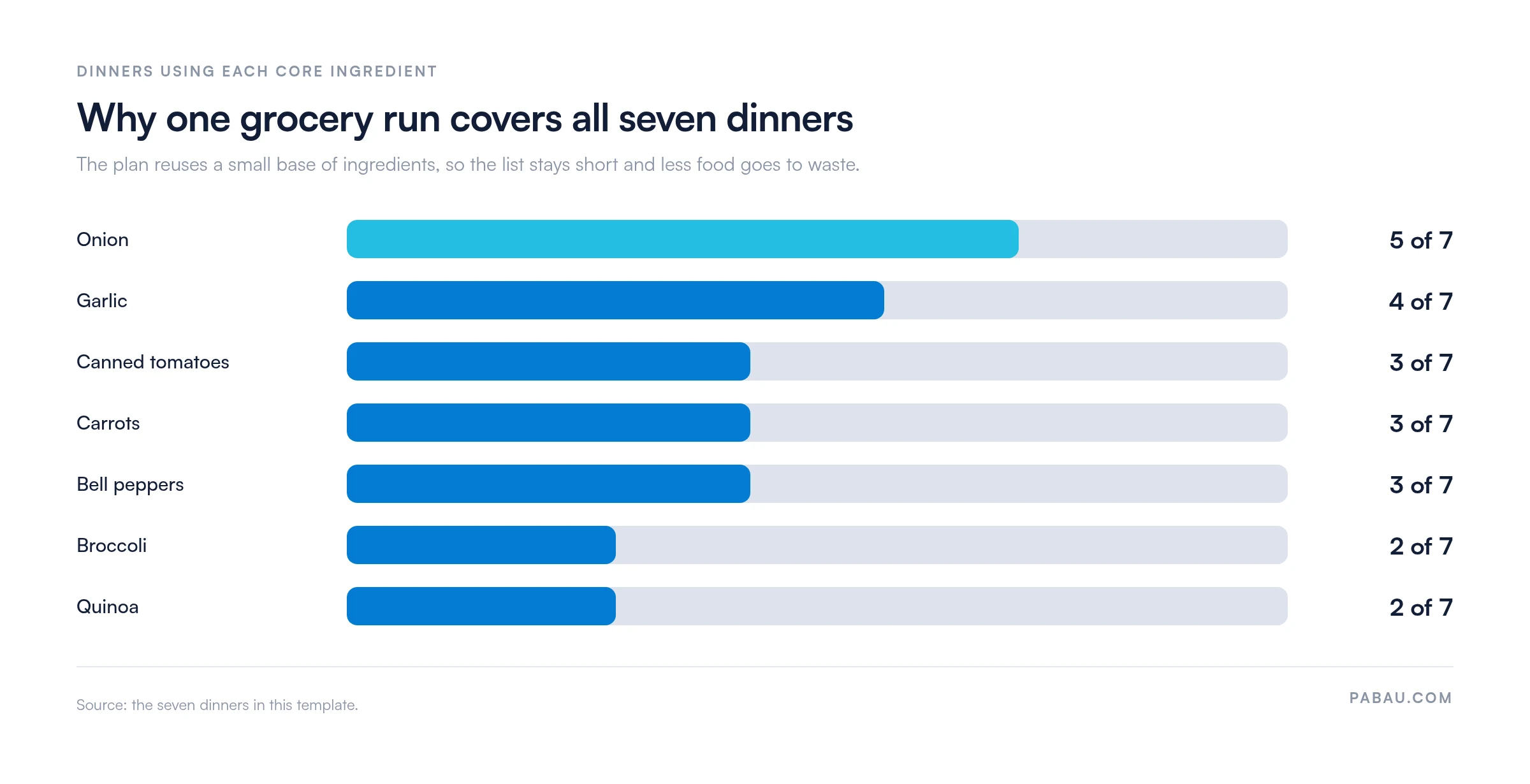
The dinners share a small ingredient base, so onion turns up in five of the seven and garlic in four.
A household of four can run the week for roughly $60 to $80 using the budget swaps included.
One prep session of two to three hours covers most of the cooking for the following five weeknights.
Practice management software like Pabau stores the plan once, so a practice can send the current version to every client from their record.
Two printable pages. Page one carries the seven dinners with their ingredients, breakfast and lunch ideas, and a grocery list by store section. Page two has the Sunday prep order, storage times, budget swaps, and blank fields for your household.
Download templateWeekly meal plan recipes work best when they share a shopping list. That’s the idea behind this free template. Seven dinners are built on the same small base of ingredients, so one grocery run covers the week.
Plans usually collapse on Wednesday, when the fridge holds five half-used bags and no obvious dinner. Overlapping ingredients fix that. For a household of four, the week lands around $60 to $80, and the prep takes one Sunday session.
Below you’ll find the seven dinners, the grocery list by store section, and that prep routine. The last sections cover the edits that fit the plan to your household, and how a practice shares it with clients.
Print it once and the decisions are made for the week. Here is what sits on the two pages:
Households print it and stick it on the fridge. Nutrition, wellness and weight management practices tend to edit the blank fields first, then hand the adapted version to clients.
Each night uses ingredients that show up again later in the week. That is what keeps the list short and the leftovers usable.
Count the repeats and the shopping logic becomes obvious. Onion appears in five of the seven dinners, garlic in four, and canned tomatoes, carrots and bell peppers in three each.
Swap any dinner you like. Just check that the replacement uses two or three ingredients already on the list, or the shopping grows.
Dinner is the easy meal to plan. Breakfast and lunch are where most weeks quietly fall apart, usually around 11am on a Tuesday.
Notice that none of these need a separate shop. The eggs, yogurt, quinoa and vegetables are already on the list for dinner, so lunch costs you container space rather than money.
Sorting the list by store section is the fastest change you can make to a shop. You walk one loop instead of doubling back, and the impulse buys drop.
Practices sharing the list with clients get more out of it digitally than on paper. A client portal lets people tick items off, flag a substitution, and bring questions to the next appointment.
That figure is for the whole household of four, for the full week, using the swaps below. Prices move by region and by store, so treat it as a target rather than a promise.
These swaps matter most for practitioners working with clients on tight budgets. A plan that ignores the grocery bill gets abandoned in week two, whatever the nutrition looks like on paper.
Order matters more than speed here. Start the oven first, then work through everything else while it runs.
Labeling sounds fussy until Thursday, when a container of unmarked beige food gets thrown out. Write on the lid and the week holds together.
Cooking for two rather than four? Halve every quantity. Two pounds of chicken becomes one, and the prep time barely changes. If you would rather batch cook, run one recipe at full size and freeze half. Pick one of those two approaches for the week, not both.
Feeding six or more? Multiply every quantity by 1.5 and cook the sheet pan meals in two trays. One tray crowds, steams the vegetables, and loses the roast.
Someone avoids gluten or dairy? Four of the seven dinners already work without either. Swap the pasta for rice, the tortillas for corn, and the cheddar for a dairy-free version.
Need a longer runway than one week? A 30-day meal plan spreads the same structure across a month, with more variety before the recipes repeat.
Training hard or protecting muscle? Keep the shopping structure and raise the protein at each meal. A high-protein meal plan shows what those portions look like across a week.
The federal reference point moved recently, so it is worth knowing which one you are planning against. In January 2026 the USDA retired MyPlate.gov and replaced it with RealFood.gov.
That site presents the 2025-2030 Dietary Guidelines for Americans as an inverted pyramid rather than the old divided plate. If you have been checking plans against the plate graphic, check them against the current guidelines instead.
The seven dinners here already follow the same shape: a protein, a vegetable, and a whole grain or legume on every plate.
A nutrition or weight management practice hands out a plan like this every week. Emailed as an attachment, it lives in a sent folder rather than in the client record.
Nobody can see which version a client received, or whether they opened it. Purpose-built weight loss practice software closes that loop.
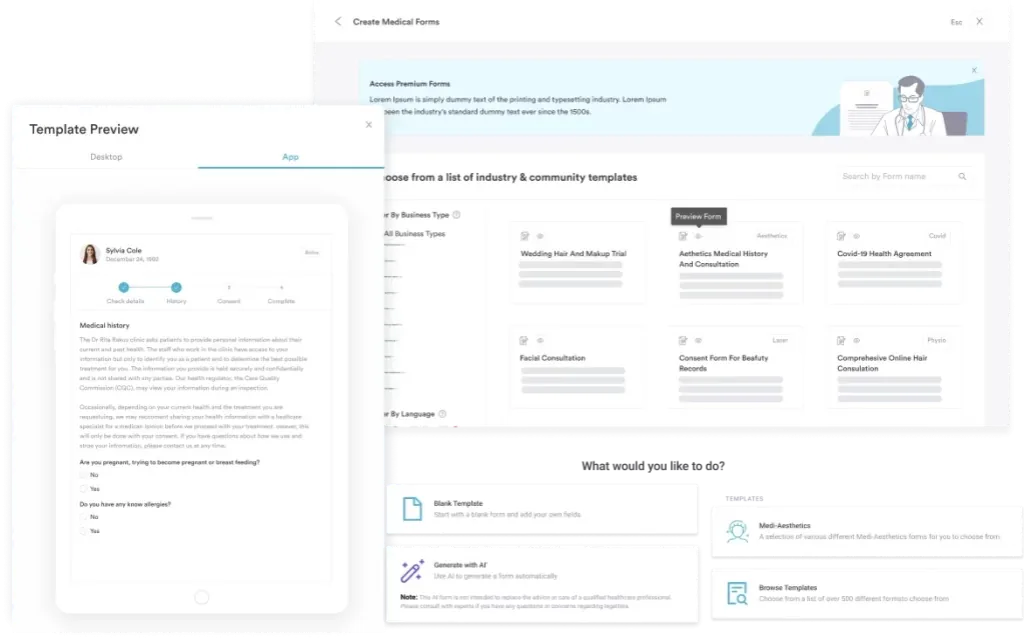
Practice management software like Pabau stores the template once and attaches it to the client record. Any practitioner on the team can send the current version, and the record shows when it went out.
Dietary preferences and allergies collected through digital intake forms land in the same file. That way the plan gets adjusted before it goes anywhere near a printer.
The follow-up matters more than the file. Send a reminder the day before prep day, a check-in on Thursday, and a short questionnaire at week’s end.
Those three touchpoints turn a download into a habit. Pabau sends all three automatically from the same client record.


Pabau stores your nutrition templates once, sends them to clients from their own record, and tracks the follow-up. Your team stops hunting through sent folders for the current version.

A meal plan is only as good as the shopping and the prep behind it. That is why the grocery list and the Sunday routine carry more weight than the recipes themselves. Change any dinner you want, but keep the shared ingredient base and the week still works.
Print the template, fill in the customization fields, and run it once before you change anything. Note what got eaten and what did not. The second week is where a plan either sticks or quietly dies.
Practices handing this out at scale hit a different problem. They need to know who got which version, and what happened next. Book a demo to see how Pabau keeps every meal plan, note and follow-up in one client record.

Need a plan that runs longer than seven days? 30-day meal plan for weight loss stretches the same structure across a month, so the recipes repeat less often.
Working with clients who need more protein? High-protein meal plan shows what those portions look like at every meal of the day.
Managing inflammation through diet? Anti-inflammatory meal plan template swaps the ingredient base while keeping the same weekly format.
Getting asked about keto? 7-day keto meal plan covers a full week of recipes with the carb counts included.
Want a shorter commitment to start with? 2 week diet plan for weight loss runs the same shopping logic over two weeks.
Yes, and most households should. Repeating it for two or three weeks makes the shopping faster, because you stop rereading the list. Swap two dinners each round to keep it interesting.
Cook the grains and roast the vegetables on Monday evening instead. That alone covers about 20 minutes of every weeknight. Then move the slow cooker meal to the weekend, since it needs the least attention.
No. Portions are controlled by the recipe yields, not by counting. If you do track intake, log each recipe once and reuse that entry rather than weighing ingredients every night.
Cook Sunday’s bowl last and build it from what is left. Roasted vegetables, cooked grains and any remaining protein all go in. Freeze whatever is still untouched on Sunday night.
Yes. It is free to download, print and pass on. Most practitioners edit the customization fields to match their own intake questions first, then send the adapted version from the client’s record.