Monika Lazarevska

HCPCS code J7170: Hemlibra (emicizumab-kxwh) billing guide
HCPCS code J7170: Descriptor and drug details HCPCS code J7170 is the Level II c...

Last Updated: Nov 20, 2026
Free PDF 3 pages, print-ready Clinician-reviewed
A health care directives form puts your treatment wishes and your chosen decision-maker in writing. Your care team then knows what you want when you cannot speak for yourself.
Our free PDF is a planning worksheet that records your agent, eight treatment choices, comfort and organ donation wishes, and a signature and witness block. You choose whether your agent's authority starts immediately or only after a physician finds you lack capacity. Use the worksheet to prepare, then complete your state's official form, because state witness and notary rules decide whether a directive is honored.
A printable three-page worksheet that names your health care agent and an alternate, then records want or do-not-want choices for eight treatments. It also covers comfort care, organ donation, your signature, two witnesses and an optional notary line.
Start from scratch, or upload this PDF or any form you already use, and Pabau's AI Form rebuilds it with tick boxes, text fields and a signature. Attach it to the treatment once, and every patient gets it on time.
AI Form rebuilds the consent, history and aftercare forms you already use. You review each one, then publish.
Patients complete forms on their phone before they arrive, so the front desk stops retyping paper.
Every signed form is versioned and attached to the treatment record, ready when you need it.
Set how long a consent stays valid. Returning patients skip forms they have already signed.
Supports HIPAA and GDPR compliance AES-256 encryption 4.8 on G2 4.7 on Capterra Trusted by 4,000+ practices worldwide

A health care directives form names your health care agent and records your treatment wishes for a time you cannot decide.
Our PDF is a worksheet to prepare with, so complete your state’s official form before anyone signs.
You choose on the form whether your agent’s authority starts immediately or only after a physician finds you lack capacity.
Witness and notary rules vary by state, so confirm them before the patient signs.
A living will is one part of the directive, while DNR orders and POLST forms are separate physician orders.
For a practice, the hard part is retrieval: a complete, current copy on the patient record that staff can find in minutes.
Most health care directives forms combine two documents. The first is a health care power of attorney, which names your agent, the same job a health care proxy form does on its own. The second is a living will, which records your treatment choices. Our template follows that pattern across three pages and four numbered parts.
The PDF at a glance. Counts come from the worksheet itself.
The “Only if / notes” option lets a patient attach a condition to a treatment, such as accepting ventilation only if recovery looks likely. The form has no separate time-limited trial box, so conditions go in the notes space. That middle ground is often closer to what patients mean than a plain yes or no.
Any adult can complete one, usually from age 18, whether they are healthy or managing a chronic condition. The treatment wishes guide care when the patient can no longer make or voice decisions.
The agent’s authority works differently. Part 1 lets the patient tick “Only when my physician determines I cannot make my own decisions” or “Immediately”. Many directives take effect only after a physician finds the patient lacks capacity, so explain the immediate option before the patient chooses.
People use “advance directive”, “living will” and “health care directive” as if they meant the same thing. They overlap, but each document does a different job. The table compares them by who completes them, when they apply, what they are for, and whether our PDF covers them.
A DNR order and a POLST form sit outside the directive. Both are physician orders for seriously ill patients, and both apply straight away. The directive guides future decisions, while the order tells EMS and hospital staff what to do now. Our DNR form template records that order on its own page.
Names also shift between states. Minnesota, for example, calls its combined form a health care directive, while most states say advance directive. Hospitals, nursing homes, home health agencies and hospices that take Medicare or Medicaid must ask about it at admission. That duty comes from the federal Patient Self-Determination Act.
Filling in the worksheet is quick, but the order of the steps matters. The signature only counts once your state’s witness rules are met.
Then put a review date in the calendar. The PDF has no review field, so keep the date in your own calendar or patient record. Review the directive after a new diagnosis, a divorce, a death in the family or a move.
Most states ask for two adult witnesses, some accept a notary instead, and a few require both. Check the current rule with your state health department or attorney general before the patient signs, not after.
Who witnesses matters as much as how many. States commonly bar the named agent, and many also exclude relatives, heirs and staff of the patient’s health care provider. Our worksheet’s witness note lists the agent, your attending physician, an employee of your health care provider and anyone entitled to part of your estate.
The PDF’s witness block is easy to misread. Both signature lines sit side by side, but the names and addresses below them stagger across the two columns. “Witness 1 address” lands under “Witness 2 signature”.
Colors show whose detail each box holds. Layout follows page three of the PDF.
Tell patients to match each printed name and address to the right witness. Ask each witness to fill in their own details while you read the block back.
Two questions come up at the front desk again and again.
Our PDF calls itself a worksheet that helps you think through and record your wishes. Its own note says to use it to prepare, then complete your state’s official form or have an attorney draft one. Many states publish a statutory form, which the PDF calls the safest to use.
That fits the worksheet’s best use. Fill it in first, talk it through with your agent, and carry the answers onto the state form. The footer is blunt that it is not legal advice.
Two small quirks are worth a heads-up. The date fields read dd / mm / yyyy, so US patients should read them twice. The wording also uses UK spellings, such as “honoured” and “notarised”, on a US form. Neither affects the worksheet’s use, and your state’s form will use its own wording.
These are the places to look first:
A handful of states also run an advance directive registry. A registered directive lets a hospital look it up when the paper copy is missing.
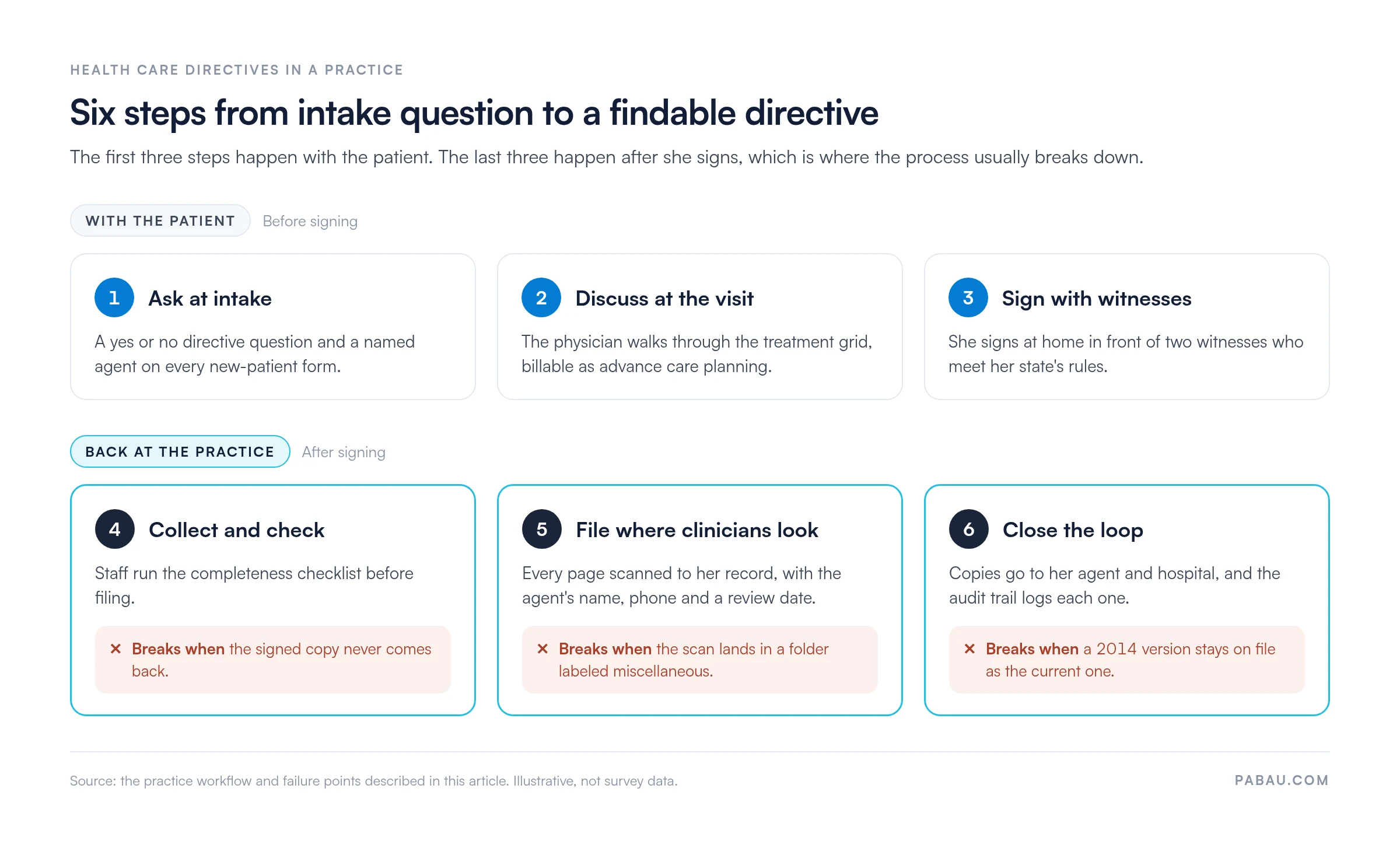
A directive helps only if the right person can find it on a bad day. Take a 74-year-old patient who mentions at her Annual Wellness Visit that she signed one years ago. She isn’t sure where it is, or whom she named.
Here is the path a well-run practice gives her directive:
The process usually breaks down after signing, in the last three steps of the diagram. Copies never come back, a 2014 version stays on file, or the scan lands in a folder labeled miscellaneous.
Audit your directives once a year. Check that each signed copy names the current agent and a working phone number. Replace any copy that predates a change of agent or a move to another state, since an outdated version causes confusion at the bedside.
Five minutes at the front desk saves a scramble later. Before a returned directive goes on the record, confirm each point below.
A directive can be signed correctly and still fail at the bedside. The usual cause is how it was written, or where it was stored.
In many practices, the directive question sits on a paper intake form, and the signed copy waits in a scanning pile. Weeks later, nobody is sure which version is current.
Pabau, the practice software we build for clinical teams, moves that work onto the patient’s record. You can add directive questions to your patient intake software forms, so the answer is on file before the first visit. The signed directive is then stored with the patient’s treatment notes and consent history.
The outcome is a directive your clinicians can find in seconds, and a clear record of which version is current. With medical records management in the same system, staff file each scanned page against the patient rather than in a shared drive.

Pabau collects directive answers through digital intake forms and stores the signed copy on the patient’s record. Your team finds the current version in seconds.

A health care directives form is only as useful as the conversation behind it and the copy you can find later. Encourage patients to name an agent they’ve briefed, prepare with the worksheet, complete their state’s official form, and return a complete copy.
For your practice, the payoff comes from routine rather than paperwork. Ask at intake, check every page before filing, and set a review date.
Book a demo to see how Pabau keeps directives and intake forms on the patient record, ready when your team needs them.

Want a form that only names the decision-maker? Health care proxy form covers agent designation on its own, without treatment preferences.
Need someone to handle records and insurance instead? Authorized representative form names the person who can speak to your practice about records and appeals.
What if a patient with capacity refuses care? Against medical advice form documents an informed refusal and protects the practice.
Planning the estate side as well? Will worksheet gathers what an attorney needs before drafting a last will.
Yes. Medicare Part B covers voluntary advance care planning, billed with CPT 99497 for the first 30 minutes and 99498 for each extra 30. When it is done during the Annual Wellness Visit, the patient pays no deductible or coinsurance.
No. Most states let any competent adult complete and sign one without a lawyer, as long as the witness or notary rules are met. An attorney helps when the directive is part of wider estate planning, or when family disagreement seems likely.
Often, but not everywhere. Most states honor a directive that was valid where it was signed, though the rules differ. Patients who move, or who spend months each year in another state, should complete that state’s form as well.
A patient with capacity can revoke it at any time, in most states by telling their physician or destroying the signed copy. To change it, sign a new form and replace every old copy, including the one in your practice’s records.
In many states a clinician may decline on grounds of conscience. They must then tell the patient or agent and help transfer care. Vague instructions also leave room for interpretation, which is why a well-briefed agent matters.