Trauma response test: Free template for clinicians
A trauma response test is a structured screening questionnaire that helps clinic...

3
Last Updated: Oct 15, 2026

A gratitude in recovery worksheet is a structured tool that helps clients name and record what they are grateful for.
Research links gratitude practice to lower substance use, fewer depressive symptoms, and better sleep, which are all protective factors against relapse.
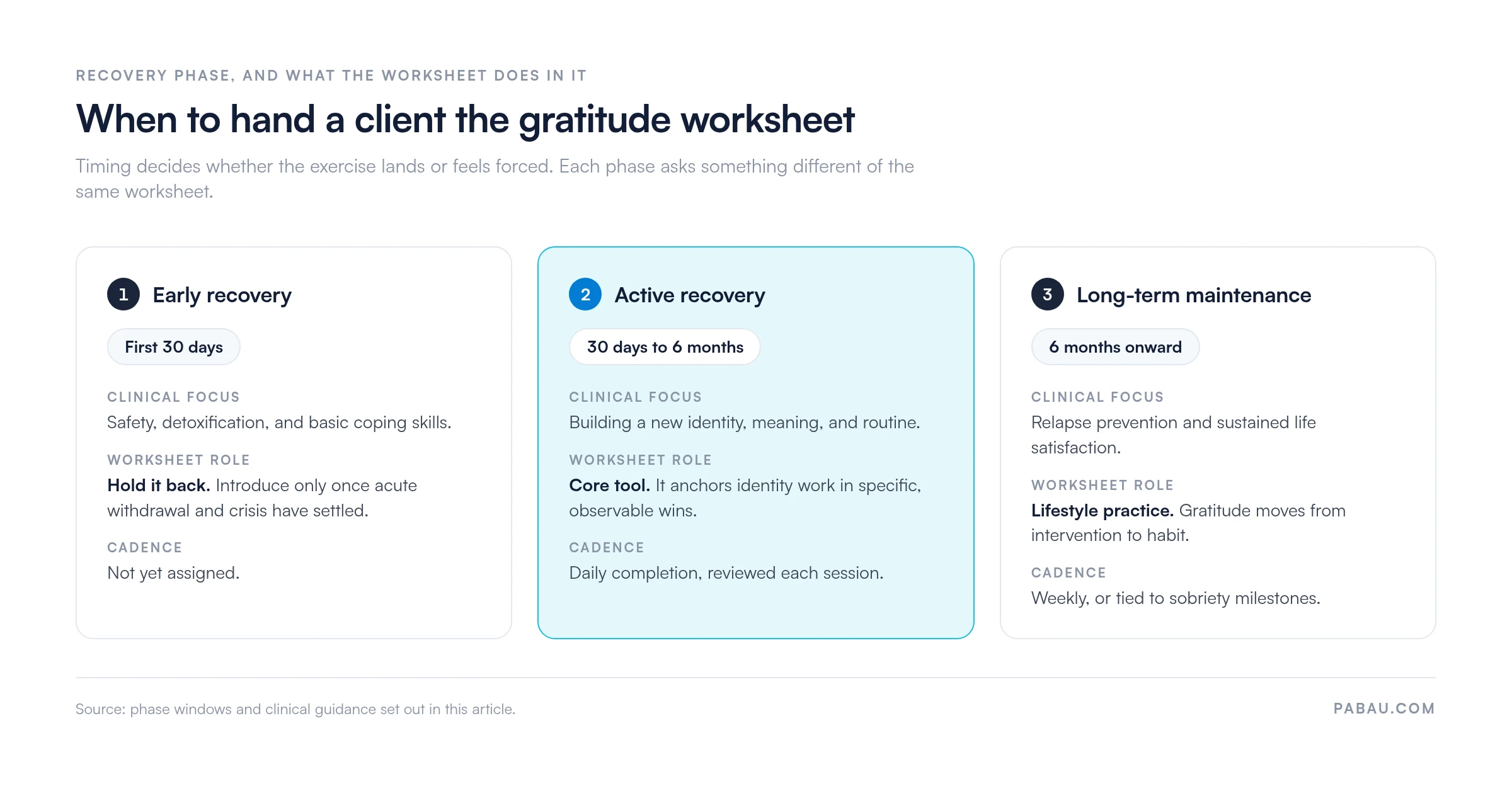
Timing decides the result. Hold the worksheet back in the first 30 days, then use it daily through the first six months.
Pair the worksheet with gratitude letters, jars, and group sharing so the practice keeps working between sessions.
Pabau’s digital forms and client portal let therapists send, track, and store completed worksheets inside the client record.
Five guided sections take a client through recovery milestones, supportive people, daily gratitudes, spiritual or meaning-based reflection, and barriers they have overcome. Print it or send it digitally before the next session.
Download templateA gratitude in recovery worksheet moves a client’s attention from what recovery has cost them to what it has already given back. Counselors, psychologists, and therapists use it in individual sessions, group work, and aftercare programs.
The structure is what makes it clinical rather than casual. Open-ended journaling lets a client write “I’m grateful for my family” and stop there. Guided prompts push for the specific detail that anchors a recovery win in something observable.
This guide covers what the worksheet contains and when to introduce it across the phases of treatment. It also pairs the worksheet with exercises that keep the practice going between sessions.
A gratitude in recovery worksheet is a structured template that prompts clients to identify, document, and reflect on what they are grateful for. Unlike informal journaling, it supplies guided prompts, separate sections for different categories of gratitude, and space to connect that reflection to recovery goals.
The worksheet does four jobs at once:
Gratitude practice has a research base behind it, not just a slogan. American Psychological Association research on gratitude found that more grateful teenagers were less likely to abuse drugs and alcohol. The same work linked rising gratitude to greater life satisfaction and hope over four years. Other studies associate regular gratitude exercises with fewer depressive symptoms and better sleep quality.
In 12-step recovery, gratitude sits close to the daily practice the program already asks for. The 10th step’s continued personal inventory is where many clients notice what went well. Meetings often close with expressions of gratitude for sobriety and community.
The free template is organized into five sections that walk a client through gratitude reflection in order:
Clinical deployment varies by setting. In individual therapy, introduce the worksheet early in the session, while the client is grounded rather than in acute distress. Walk through the first section together, then assign the rest as homework and review the responses at the next visit.
Filing matters more than it sounds. A worksheet that lives in a folder on someone’s desk cannot inform the next session. Store completed responses in your mental health EMR alongside the clinical note.
In group settings, allow 10 to 15 minutes for silent completion, then invite one or two people to share. Never mandate it. Group dynamics amplify the benefit, because hearing a peer’s gratitude makes hope feel available rather than theoretical.
The worksheet works harder when it is not the only gratitude exercise a client has. These five pair well with it and need no extra materials.
Gratitude runs through 12-step philosophy without being a formal step of its own. The 10th step’s daily personal inventory is where it usually shows up, since noticing what went well is part of taking stock. Sponsorship rests partly on gratitude for guidance, and many groups open or close on the phrase “attitude of gratitude.”
Clients already working the tenth step can run the two exercises together. Our 10 step inventory worksheets cover the inventory side, and the gratitude worksheet handles what that inventory turns up on the credit side.
Groups and recovery ministries can hand the worksheet out after meetings, share it electronically with a sponsor, or fold it into formal step work.
Timing decides whether the exercise lands or feels like being told to cheer up. The three phases below each ask something different of the same worksheet.
Contraindications are rare. Hold the worksheet if a client is actively suicidal, severely dissociated, or in an acute trauma response, and stabilize first. Some clients with trauma histories read gratitude work as invalidating their pain, so reframe it as something that coexists with grief and anger.
In long-term maintenance the worksheet pairs naturally with a relapse prevention plan worksheet. One records what is worth protecting, the other records what to do when it is threatened.
Clients often stall on the first entry, so give them examples before asking for their own. These come from recovery communities and treatment settings:
Share these in the first session, then ask clients to write their own. Specificity is what makes an entry useful. “I’m grateful for sobriety” is true but abstract, while “I’m grateful I didn’t reach for a drink when my ex texted” records a choice.
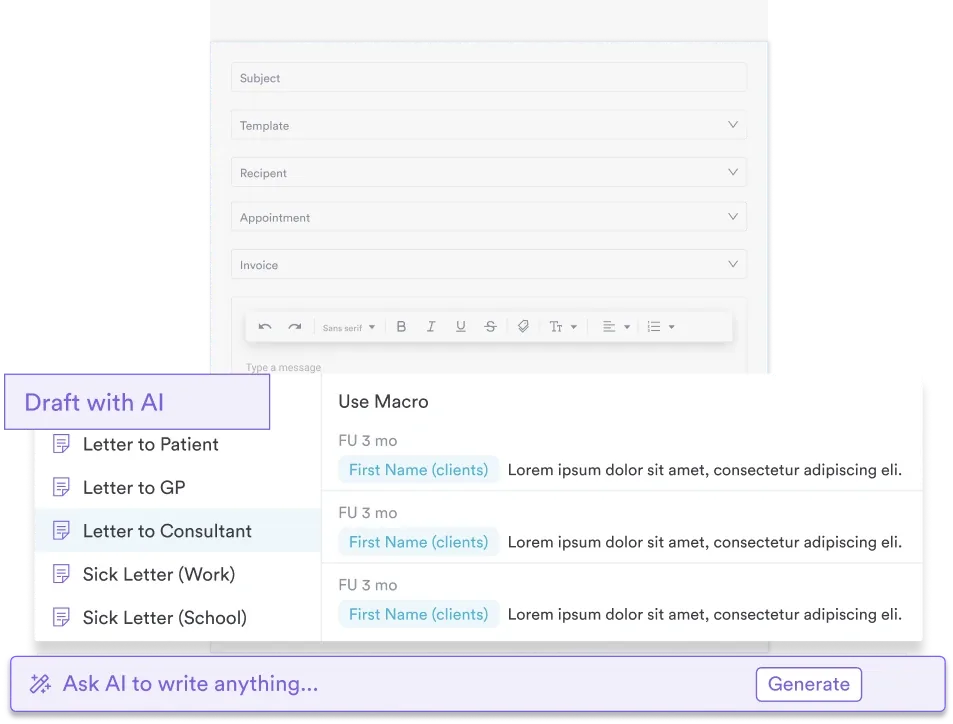
A paper worksheet gets handed out at the end of a session and often never comes back. Practice management software like Pabau turns the same exercise into a tracked part of the treatment plan.
Send the worksheet from the client record, and the completed response files itself back against that record. Pabau’s patient intake software handles both the delivery and the return, so no completed form waits in a tray to be scanned.
Automated reminders chase the clients who have not completed it, and reporting shows who is engaging with the exercise. That turns gratitude work into something you can review in supervision. The worksheet, the note, and the reminder all live in one therapy practice management system.
Practice managers can also use the engagement data to spot clients who take to gratitude work. Those are often the people ready for a peer mentoring role or group facilitation.

See how Pabau helps therapists, addiction counselors, and recovery practices deliver, track, and store gratitude worksheets and other therapeutic tools in one secure platform.

The worksheet is easy to hand out and easy to waste. Timing and follow-through decide which one you get. Introduce it when the client is stable enough to mean it, then review what comes back in the next session.
Gratitude work is slow, and that is the trade-off worth remembering. It will not carry a client through a crisis. Over months it makes progress visible, which matters most in the stretch of recovery where motivation runs thin.
Download the template, decide which phase each client is in, and set the cadence from there. To deliver and track it across a full caseload, book a demo and see how Pabau fits recovery-focused care.

Need a companion exercise for step work? 10 step inventory worksheets give clients the inventory side of the same daily practice.
Looking for a lighter group activity? Gratitude jar worksheet comes with 30 prompts you can run in a single session.
Want a daily version clients keep at home? Daily gratitude journal template is a printable PDF built for between-session practice.
Are clients struggling with empty time in recovery? Boredom in recovery worksheet template tackles one of the most common relapse triggers.
Building a longer-term plan with a client? Wellness recovery action plan worksheet maps daily maintenance, triggers, and crisis steps.
Gratitude in recovery is the deliberate practice of noticing and appreciating what is going well in your recovery. That covers people, moments, milestones, and growth. It builds resilience, works against depression, and strengthens motivation for sustained sobriety.
Daily completion is ideal through early and active recovery, the first 6 months. Weekly or milestone-based completion works well in long-term maintenance, after therapy breakthroughs or sobriety anniversaries. Start daily, then adjust to the client’s engagement and capacity.
Yes. Allow 10 to 15 minutes for silent completion, then invite voluntary sharing. Group settings amplify the benefit by normalizing the practice and deepening connection among peers.
Reframe gratitude as something that coexists with grief, anger, and pain rather than replacing them. Start small, with one genuine gratitude per session. Resistance often softens once clients see that acknowledging progress does not erase the struggle.
The 10th step asks for a continued personal inventory. Gratitude is a practice commonly built around that step rather than part of its text. It underpins step work, sponsor relationships, and meeting culture. A structured worksheet formalizes something that is otherwise informal.
Yes. Studies link gratitude practice to lower depression, better sleep, stronger social bonds, and higher life satisfaction. Those are all protective factors against relapse. The National Library of Medicine archives peer-reviewed research on gratitude interventions in recovery populations.