Exilis patient treatment record: Free PDF for RF sessions
An Exilis patient treatment record is the session log for BTL’s radiofrequ...

1
Last Updated: Oct 23, 2026
The Godin leisure-time exercise questionnaire is a four-item self-report form that measures how often a patient exercises in their free time. You score it with the Leisure Score Index: (9 × strenuous) + (5 × moderate) + (3 × mild), using weekly session counts. A total of 24 or above classifies the patient as Active, 14 to 23 as Moderately Active, and 13 or below as Insufficiently Active.
Godin and Shephard published the form in 1985, and a patient fills it in inside two minutes. Physical therapists, sports medicine teams, wellness practices and primary care use it to set a baseline, guide exercise prescriptions, and find sedentary patients. Download the questionnaire below, then read on for scoring, thresholds, and the limits worth knowing.

The Godin leisure-time exercise questionnaire is a validated four-item form covering strenuous, moderate and mild activity across a typical seven-day week.
The Leisure Score Index is (9 × strenuous) + (5 × moderate) + (3 × mild), calculated from weekly session counts.
A score of 24 or above is Active, 14 to 23 is Moderately Active, and 13 or below is Insufficiently Active.
Scores correlate with accelerometer data and VO₂ max, so a two-minute self-report still gives you defensible baseline data.
Practice management software like Pabau can collect the form before the visit and file the score in the client record.
The full four-item form covering strenuous, moderate and mild leisure-time activity. It comes with the Leisure Score Index scoring guidance and the Active, Moderately Active and Insufficiently Active thresholds.
Download templateThe Godin leisure-time exercise questionnaire, also called the Godin-Shephard questionnaire, measures leisure-time physical activity across a typical seven-day week. It splits exercise into strenuous, moderate and mild intensity categories. Those weekly counts feed the Leisure Score Index, which sorts patients into three activity levels.
Length is the point. Four core items plus one subjective rating take about two minutes, so it fits into an intake pack without crowding out other forms. That matters when you need comparable activity data on every patient, not just the ones with time to spare.
The questionnaire opens with a single stem question. It asks how many times, in a typical seven-day week, the patient does each kind of exercise in their free time. Only sessions longer than 15 minutes count.
Each frequency item is left blank so the patient writes in a number. That shows you which intensity tier dominates. An athlete’s score is built on strenuous sessions, while an older patient’s may be almost entirely mild.
The Leisure Score Index turns weekly exercise frequencies into one number using metabolic equivalent (MET) weightings. A MET is a unit of energy expenditure, so strenuous sessions carry a higher multiplier than mild ones.
The formula: (9 × strenuous) + (5 × moderate) + (3 × mild).
Worked example. A patient reports two strenuous sessions, three moderate and two mild in a week. The index comes to (9 × 2) + (5 × 3) + (3 × 2), or 39. The chart below traces that arithmetic through to the band the score lands in.
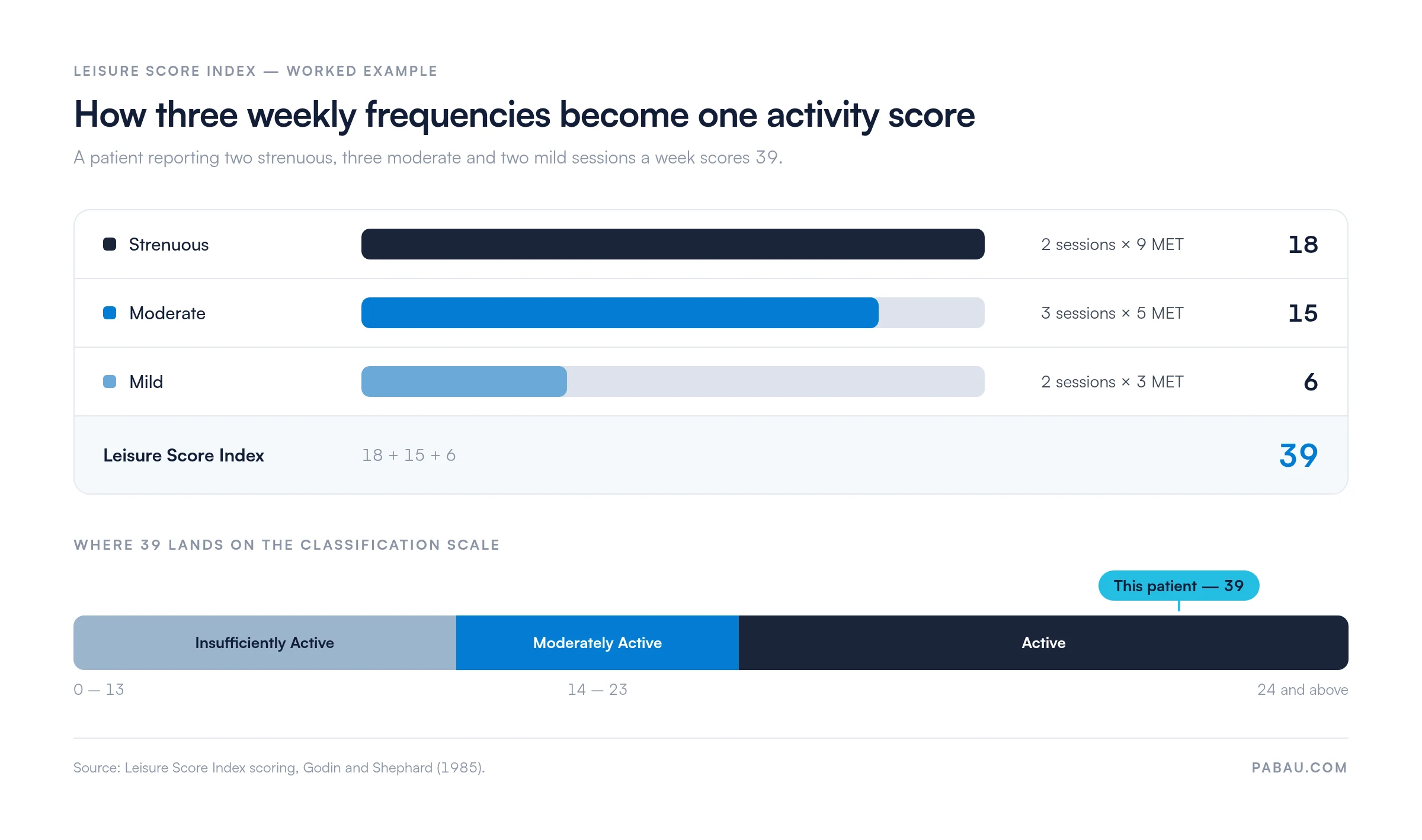
The Leisure Score Index maps onto three classifications. Record the band alongside the raw score, because the band is what drives the next clinical decision.
These bands line up with WHO and CDC physical activity guidance for adults. The Insufficiently Active group is the one worth flagging, because those patients gain the most from a structured prescription and a follow-up review.
Read the stem question closely and three blind spots appear. Each one changes how you interpret a low score, so they are worth naming before you act on one.
None of that makes the score less useful, but it does change what you do with a low one. Treat it as a prompt to ask a follow-up question rather than a finished picture.
The questionnaire has been studied since 1985. Peer-reviewed work supports its reliability and its agreement with objective measures across a range of populations.
The practical read is that a two-minute form holds up against instruments that take much longer. You do not need an hour-long evaluation to get usable activity data.
Administration. Hand it out at intake or at a follow-up visit. Patients complete it themselves in under two minutes, and no clinician training is needed. The seven-day recall window is wide enough to catch a typical pattern without straining memory.
Scoring and documentation. Calculate the index and write the classification into the patient record. That becomes the functional baseline you measure the next visit against.
Clinical decisions. Insufficiently Active patients are the ones to act on first, usually with a structured home exercise program or a referral. Active patients still benefit from a periodic re-check to confirm the habit is holding.
Screen for readiness before you prescribe exercise. A physical activity readiness questionnaire covers the safety questions the Leisure Score Index never asks.
Tracking over time. Re-administer every three to six months and watch the band, not just the number. A patient moving from Insufficiently Active to Moderately Active is evidence your intervention worked.
The Godin is one of several validated self-report options. Pick the one that fits the appointment time you have and the population you see.
Why pick the Godin? It is the shortest of the three at four items, which keeps completion rates high in a busy schedule. The IPAQ collects more detail on duration, so reach for it when duration is what you need to measure.
Track the band, not just the score. Re-administer every three to six months and record whether the patient moved from Insufficiently Active to Moderately Active. A band change is easier to show a patient than a jump from 11 to 19. It also reads clearly in a case review.
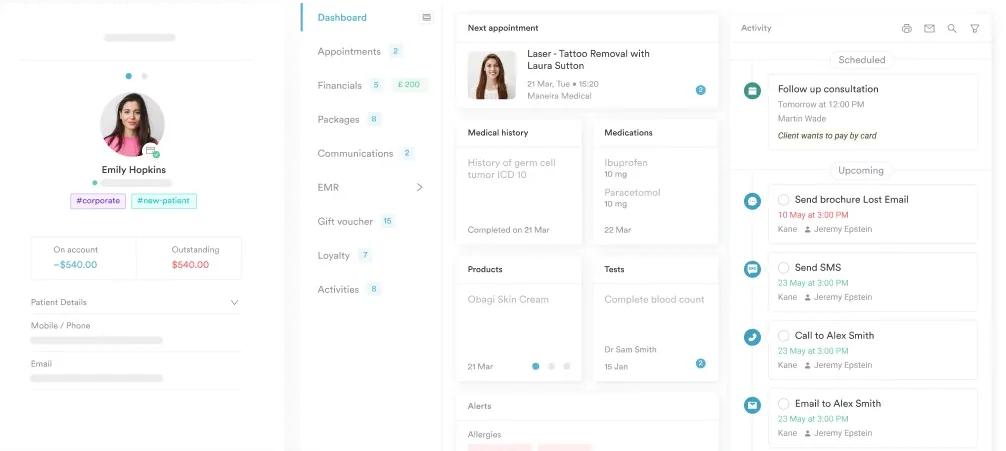
Handing out paper questionnaires means someone has to scan them, key in the score, and file the result. Practice management software like Pabau replaces that with digital intake forms the patient completes before they arrive.
Answers flow straight into the client record, so the Leisure Score Index and the band sit with the treatment notes instead of in a folder. Every clinician who opens the file sees the same baseline.

Automated follow-ups then do the chasing. Trigger a reminder for a patient who scored Insufficiently Active, schedule the three-month re-screen, or send the questionnaire out ahead of the next appointment.
Across a caseload, the pattern is what you report on. A physical therapy EMR that stores scores as structured data lets you show which interventions move patients up a band.

Pabau’s digital forms, client records and automated follow-ups keep the Godin questionnaire in your routine. Scores land in the patient file, and re-screens schedule themselves.

Two minutes of patient time buys you a number you can defend and repeat. That is the whole argument for the Godin questionnaire, and it holds whether you work in physical therapy, sports medicine, or primary care.
Use it more than once. A single Leisure Score Index tells you where a patient stands today, while a series tells you whether your treatment is changing behavior. The second is the one that shows up in an outcome review.
Collect the form digitally and the second part stops being extra work. Book a demo to see how Pabau collects, files and re-sends activity questionnaires for you.

Need to screen before you prescribe exercise? Physical activity readiness questionnaire (PAR-Q) template covers the safety questions the Godin score leaves out.
Want an objective measure alongside the self-report? 2-minute step test gives you an aerobic capacity number you observe rather than one the patient reports.
Building a broader baseline? Fitness assessment form collects strength, flexibility and cardiovascular measures in one intake document.
Ready to prescribe? Home exercise program template turns an Insufficiently Active classification into a plan the patient can follow at home.
It is a validated four-item self-report form measuring leisure-time physical activity at three intensities over a typical seven-day week. Scoring produces a Leisure Score Index that classifies the patient as Active, Moderately Active, or Insufficiently Active.
Multiply the weekly session counts by their MET weights: (9 × strenuous) + (5 × moderate) + (3 × mild). Two strenuous, three moderate and two mild sessions give 18 + 15 + 6, which is 39.
A score of 24 or above is Active. Scores of 14 to 23 are Moderately Active, and 13 or below is Insufficiently Active. The bands align with WHO physical activity guidance for adults.
Published validation studies report test-retest reliability between 0.60 and 0.94. Scores show moderate to strong agreement with accelerometry and VO₂ max, and more than 1,000 peer-reviewed papers cite the instrument.
The Godin has four items and takes about two minutes. The IPAQ short form has seven items and takes five minutes. The long form runs to 27 items and 15 minutes. Choose the Godin when appointment time is tight.
No. The stem question asks about free time only, so occupational and household activity is excluded. A physically demanding job can still produce a low Leisure Score Index.
Yes. Physical therapy, sports medicine, primary care and wellness practices use it to set a baseline, guide exercise prescriptions, and find sedentary patients. Patients complete it themselves, so no clinician training is needed.