Despina Petrushevska
What state has the most plastic surgery per capita? America’s cosmetic map in 20 numbers
What state has the most plastic surgery per capita? Florida is America’s p...

Last Updated: Oct 16, 2026
Free PDF 1 page, print-ready Clinician-reviewed
Download your free dimple surgery aftercare template Dimple surgery aftercare instructions A ready-to-use post-operative care sheet covering recovery protocols, wound management, activity restrictions, medication guidance, and complication warning signs for dimpleplasty patients. Download template Dimple surgery, or dimpleplasty, is one of the simpler cosmetic procedures a practice can add, but its permanence and complication risk […]
Upload this PDF, or any form you already use, and Pabau's AI Form rebuilds it with tick boxes, text fields and a signature. Attach it to the treatment once, and every patient gets it on time.
AI Form rebuilds the consent, history and aftercare forms you already use. You review each one, then publish.
Patients complete forms on their phone before they arrive, so the front desk stops retyping paper.
Every signed form is versioned and attached to the treatment record, ready when you need it.
Set how long a consent stays valid. Returning patients skip forms they have already signed.
Supports HIPAA and GDPR compliance AES-256 encryption 4.8 on G2 4.7 on Capterra Trusted by 4,000+ practices worldwide

Dimple surgery (dimpleplasty) is a short cosmetic procedure that creates a permanent cheek or chin dimple by forming a small adhesion between the skin and the buccinator muscle.
It takes about 30 minutes under local anesthetic through an incision inside the mouth, leaves no external scar, and most patients are back to normal activity within a week.
Because the result is permanent and carries risks such as asymmetry and infection, clear informed consent and structured aftercare are essential, both clinically and medico-legally.
Practice management software like Pabau captures intake, consent, and procedure notes in one patient record, so nothing gets missed between consultation and follow-up.
Dimple surgery, or dimpleplasty, is one of the simpler cosmetic procedures a practice can add, but its permanence and complication risk make careful patient communication and documentation non-negotiable.
This guide covers what the procedure involves, how recovery goes, the main risks, what it costs, and how to document it properly, plus a free aftercare template you can adapt for your own practice.
Dimple surgery, formally called dimpleplasty or dimple creation surgery, is a cosmetic procedure that creates a permanent indentation on the cheeks or chin. It works by forming an adhesion between the dermis and the underlying buccinator muscle, so that when the patient smiles, the muscle pulls the skin inward and a natural-looking dimple appears.
The procedure takes roughly 30 minutes under local anesthesia. It involves a small incision inside the mouth and non-absorbable sutures that anchor the skin to the muscle, with no external scar and minimal downtime. According to the American Society of Plastic Surgeons (ASPS), it is one of the more straightforward cosmetic procedures available.
Surgeons typically mark the Stensen (parotid) duct before making the incision so suture placement avoids it. Your procedure note should record that this landmark was identified.
Dimple surgery recovery is short. Most patients return to normal activities within two to five days and back to work in about a week. Swelling and bruising peak on day two or three and settle over two to three weeks. The dimples themselves look deep at first and soften into a natural crease over four to six weeks.
Set expectations for the first days after surgery with clear aftercare instructions:
The main risks and side effects of dimple surgery are asymmetry, infection, scarring, temporary nerve dysesthesia, and visible sutures. Most are uncommon and resolve as the tissue heals, but patients need to understand them before they consent.
Poor outcomes usually trace back to patient selection or technique rather than the procedure itself, which is why a thorough intake and a clear consent conversation matter so much. Because the dimple is permanent, the consent form should also make clear that weight change and aging can alter its appearance over time.
Medical records software keeps every version of a completed form audit-ready.
Yes. Dimpleplasty forms a lasting adhesion between the dermis and the buccinator muscle, so the indentation stays in place once the tissue settles. Reversal is theoretically possible but rarely requested. State the permanence clearly on the consent form, and note that aging and weight fluctuation may change how the dimple looks over the years.
Dimpleplasty is an elective, self-pay cosmetic procedure, so there is no insurance code and no single price. What a patient pays depends on the provider, the region, and whether the procedure is done under local anesthesia alone or with sedation.
The regional spread on comparable cosmetic procedures is wide. Our breakdown of cosmetic prices by state shows a nose job averaging 2.3 times more in New York than Arkansas.
From a documentation standpoint, record the quoted fee and exactly what it covers on the consultation intake form. That way the patient’s financial consent is captured alongside their clinical consent, and there is no dispute later about what was agreed.
Standardized documentation turns dimple surgery from an ad hoc procedure into a repeatable clinical process. Follow these five steps:
Dimple creation sits within several aesthetic and surgical specialties, and the documentation needs are similar across all of them:
When adapting dimple surgery consent templates for your practice, audit your practitioner credentials and scope of practice. Board-certified plastic surgeons, dermatologists, and appropriately credentialed nurse practitioners may perform dimpleplasty; however, scope varies by jurisdiction. Ensure your consent form reflects your actual practice setting (private surgical center, med spa, dermatology clinic), anesthesia type (local only vs. local with sedation), and practitioner credentials. Have your legal and compliance team review templates before use — templates are educational starting points, never substitutes for professional legal advice.
Good documentation supports the whole patient journey, not just the operating day.
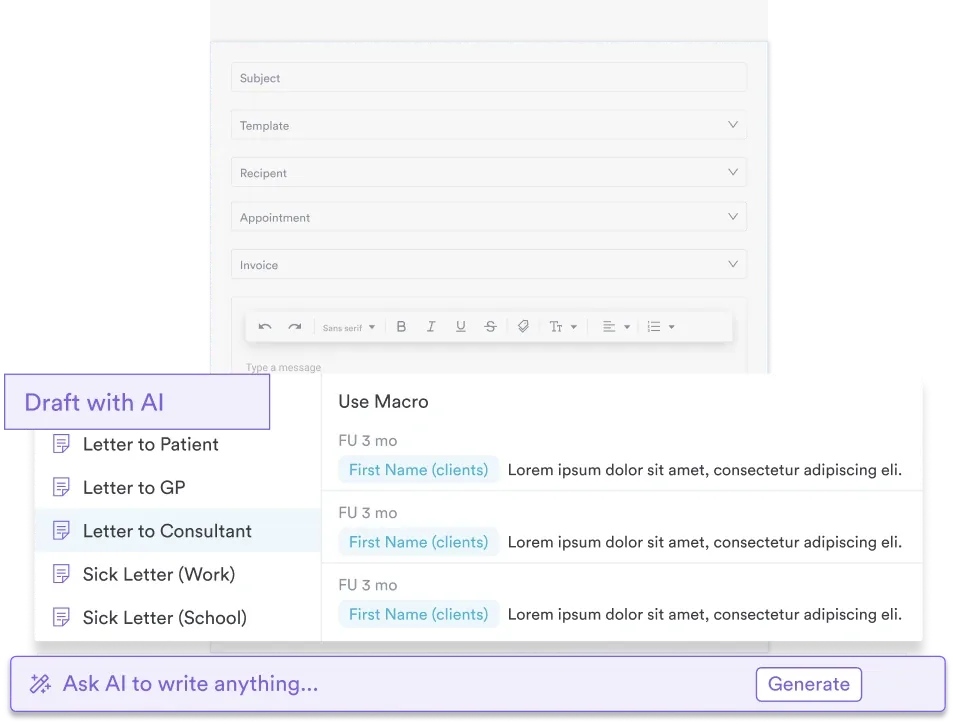
Follow-up matters just as much. Automated aftercare reminders by SMS or email reinforce wound care and flag concerning symptoms early. Practices that also offer dermal filler treatments can adapt a Teoxane consent form for contraindication screening and risk disclosure.

From intake to post-operative care, Pabau’s digital forms, clinical notes, and patient communication tools keep dimple surgery workflows organized, compliant, and outcome-focused.

Dimple surgery is elective, but it carries complication risk, so regulators expect it to be documented thoroughly.
In the UK, aesthetic clinics offering it must meet CQC registration standards, which require documented informed consent, clear complication disclosures, and safe post-operative monitoring.
In the US, state licensing boards and accreditation bodies such as The Joint Commission expect thorough documentation of patient understanding and practitioner competency.
Peer-reviewed literature on dimpleplasty technique shows that the procedure’s safety record rests on appropriate patient selection, clear consent, and rigorous follow-up. Templates that build those principles into routine workflow reduce deviation and support better outcomes.
Dimple surgery is a straightforward procedure, but its safety rests on meticulous documentation and honest patient communication. Standardized templates for intake, consent, procedure notes, and aftercare protect patients, reduce practitioner liability, and create an auditable record of every clinical decision.
Whether you are launching a dimple creation service or refining an existing one, structured documentation turns isolated procedures into a compliant, repeatable service. Book a demo to see how Pabau’s digital forms and clinical documentation tools simplify dimple surgery workflows.

Looking to grow patient volume for your practice? aesthetic practice marketing strategies lists eight strategies covering local SEO, paid ads, Instagram, and patient retention, plus useful benchmarks.
Want to streamline patient intake? Plastic surgery practice management software integrates consent capture, intake forms, and clinical notes into one unified patient record system.
Looking for additional procedure templates? Facial consultation form templates provide reusable frameworks for other aesthetic procedures beyond dimple creation.
A consent form must describe the procedure, confirm permanence with caveats, and list complication risks including infection, asymmetry, scarring, and nerve dysesthesia. Specify the anesthesia type and outline recovery expectations. Always have your legal team review templates before use.
Dimple surgery recovery time is short. Most patients return to normal activities within 2-5 days and to work in about a week. Full resolution of swelling and bruising takes 2-3 weeks, and the dimples themselves soften over 4-6 weeks. Strenuous exercise should be avoided for 3-7 days.
Common risks and side effects of dimple surgery include asymmetry, infection, scarring, temporary nerve dysesthesia, and visible sutures. Consent forms must disclose each risk and explain how your practice mitigates them. ASPS guidance emphasizes clear patient education before surgery.
Dimpleplasty creates a permanent dermal-muscle adhesion designed to last indefinitely. Reversal is theoretically possible but rarely requested. Consent forms should emphasize permanence while noting that aging and weight fluctuation may alter appearance over time.
Yes. The procedure forms a lasting adhesion between the dermis and the buccinator muscle, so the indentation stays even after the tissue settles. It reads as deep at first and looks natural once it softens over the following weeks. State this clearly on the consent form so the patient understands the result is designed to be lifelong.
Dimpleplasty is an elective, self-pay cosmetic procedure, so pricing varies by provider, region, and whether local anesthesia or sedation is used. Record the quoted fee and what it covers on the consultation intake form, so the patient’s financial consent is documented alongside their clinical consent.
In the US, store electronic forms securely, use encrypted transmission, and maintain audit trails. In the UK, follow CQC standards requiring documented informed consent and safe post-operative monitoring. Have your compliance officer review all templates before clinical use.
Suitable candidates are healthy adults with realistic expectations and enough cheek tissue to hold a natural-looking dimple. Screen for bleeding disorders, a tendency to form keloid scars, and active infection at the site. Anyone who wants a reversible result is not a good fit, since the adhesion is designed to be permanent.