HCPCS code V5259: Digital binaural ITC hearing aid billing
HCPCS code V5259 reports a digital ITC hearing aid pair HCPCS code V5259 reports...

Last Updated: Oct 22, 2026
HCPCS code V5242 is the Level II code for a hearing aid that is analog, monaural and completely in the ear canal (CIC). It covers one non-programmable analog CIC aid for a single ear.
The aid must be analog with no software programming, sit fully in the canal and serve one ear. Change any one and the code changes. Most aids dispensed today are digital, so check the spec sheet first. Traditional Medicare excludes hearing aids, so the claim goes to Medicaid, Medicare Advantage or a commercial plan.
Let Pabau's smart automation suggest the right codes, reduce claim denials, and keep your practice compliant—effortlessly.
Automate repetitive tasks and focus on what matters most—your patients.
Reduce coding errors and ensure compliance with the latest regulations.
Clean claims, fewer denials, and faster reimbursements.
Powerful insights and reporting to help your practice thrive.
HIPAA compliant SOC 2 certified GDPR-compliant Trusted by 4,000+ clinics worldwide

HCPCS code V5242 bills one analog, non-programmable hearing aid that sits completely in the ear canal (CIC) of a single ear.
A programmable analog CIC aid is V5244 and a digital CIC aid is V5254, so the spec sheet decides the code.
A pair of analog CIC aids bills once as V5248, the binaural code, not as two lines of V5242.
Traditional Medicare excludes hearing aids, so V5242 claims go to Medicaid, Medicare Advantage or commercial plans.
Add RT or LT where the payer asks for it, and make sure the diagnosis names the same ear.
HCPCS code V5242 is the supply code for a hearing aid that is analog, monaural and completely in the ear canal (CIC). The official descriptor reads “Hearing aid, analog, monaural, CIC (completely in the ear canal)”. All three parts must apply at once.
Analog here means a conventional aid with no software programming. Its sound is shaped by the circuit and any manual trim controls. A CIC aid is custom-made from an ear impression and sits deep in the canal, so it is barely visible.
V5242 sits in the hearing services range of the CMS HCPCS Level II code set, which CMS updates every year. For the wider code family, start from our HCPCS code guide.
V5242 pays for the device and nothing else. The visits and supplies around it carry their own codes, and each payer decides which of them it covers.
A CIC shell is molded to the canal, so a separate ear mold is rarely dispensed. Some plans bundle the fitting and dispensing fee into the device payment. Check the state Medicaid manual or the plan contract before you split the lines.
Ask them in this order. How does the aid process sound? How many ears were fitted? Where does it sit? The path below shows where each answer sends the claim, and the table after it lists every neighbor.
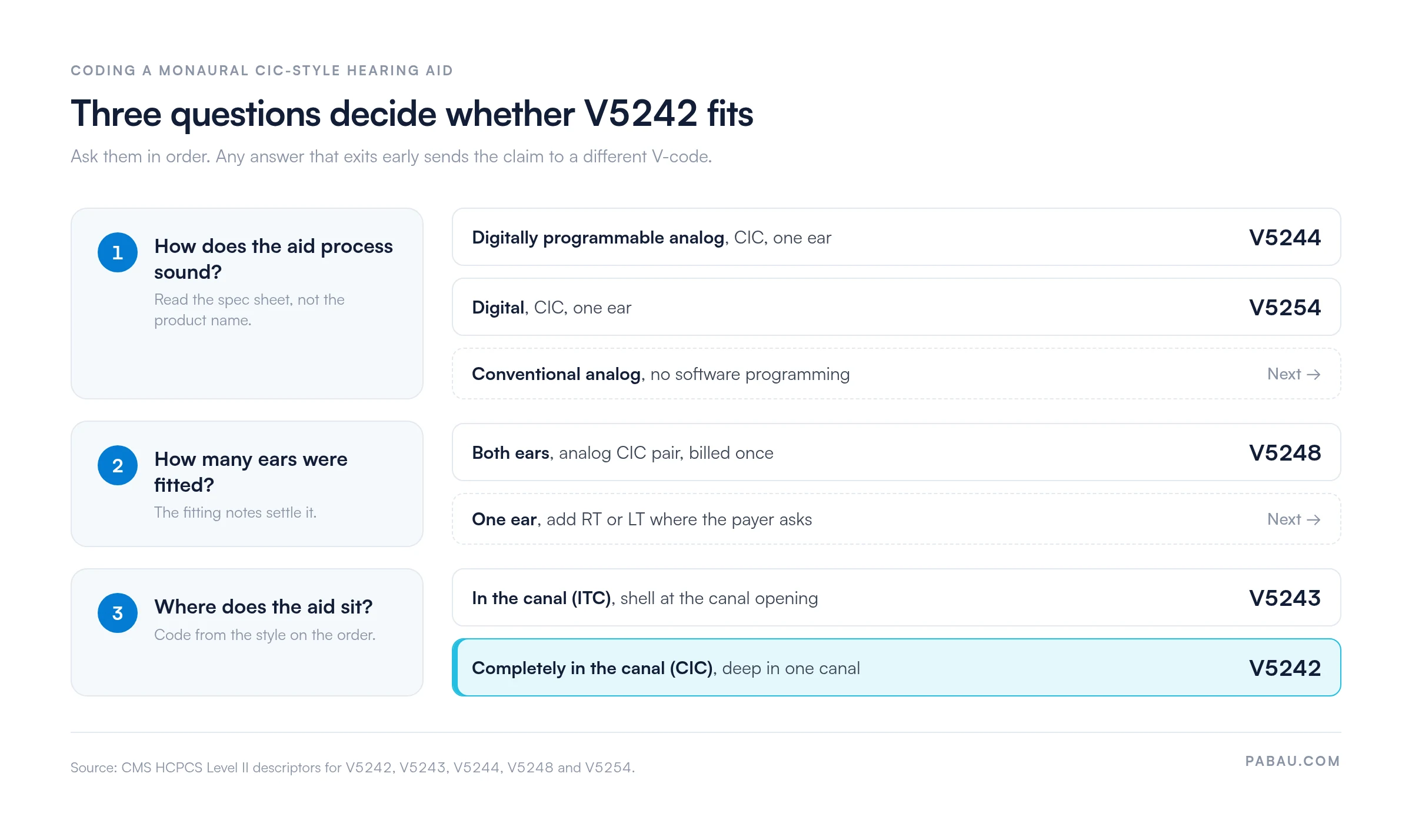
The processing question trips up most V5242 claims. Most aids dispensed today are digital or programmable, so a CIC claim usually belongs on V5244 or V5254. Read the manufacturer’s spec sheet, not the product name, before you settle on V5242.
V5242 is for one ear. When the patient gets analog CIC aids in both ears, the pair bills once as V5248. Two lines of V5242 for the same date usually read as a duplicate and deny.
For a single aid, add RT or LT to show which ear was fitted. Some Medicaid plans require it, and others only prefer it. Check the payer’s billing guide, and keep the ear in the fitting notes either way.
Watch the second-ear visit. If the patient comes back for the other ear soon after, ask the payer first. Some plans expect the binaural code for the episode, and others accept two monaural claims on different dates.
Hearing aid claims get audited, and a thin file is the usual reason they fail. Gather these records before the fitting, not after a denial.
The diagnosis must match the type of hearing loss and, where it can, the ear fitted. A laterality mismatch is a common reason for a denial.
You can check any code on this page with the NLM Clinical Tables HCPCS search, which draws on the CMS file.
Traditional Medicare excludes hearing aids under Section 1862(a)(7) of the Social Security Act. So Part B does not pay for V5242. An Advance Beneficiary Notice is not required for a statutory exclusion. A voluntary notice is still recommended, so the patient knows they will pay.
Supplier rules vary in the same way. Some payers ask hearing aid dispensers to enroll as a DME supplier, while others contract with audiologists directly. Confirm your enrollment per payer before the first claim.
Here is a clean claim for a typical Medicaid patient, from coverage check to payment.
Most V5242 denials trace back to a handful of causes. Good denial management in healthcare starts by naming the cause before you touch the claim.
Hearing aid claims usually stall on a missing authorization number or a record that sits in a paper file. Pabau, the practice management software we build, keeps the audiogram, the order and the signed forms in one patient record.
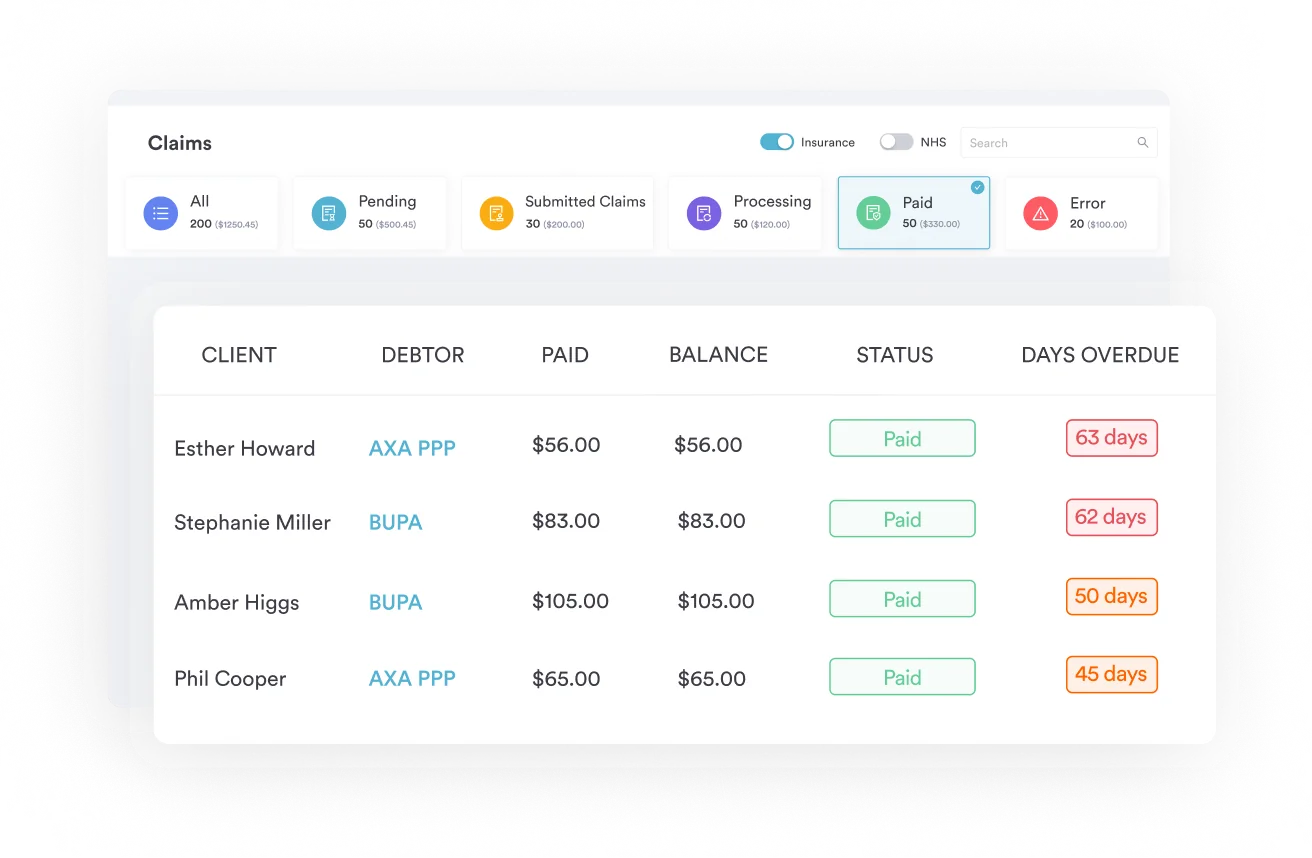
From there, Pabau’s claims management pre-fills the claim from the record and checks that required fields are filled in. US practices can submit claims and follow their status from the same screen.

Pabau keeps the audiogram, order and signed forms in one record, then pre-fills and submits the claim.

V5242 is a narrow code, and that is its main risk. It fits only a conventional analog aid, in the CIC style, for one ear. Settle those three facts from the spec sheet and the fitting notes, and the code chooses itself.
If any one of them changes, the code changes too. Then put your effort into the authorization and the audiogram, because that is where these claims stall. Book a demo to see how Pabau helps audiology practices send complete hearing aid claims.

Fitting a slightly larger shell? HCPCS code V5243 covers the analog in-the-canal aid for one ear.
Fitting both ears? HCPCS code V5248 covers the analog binaural CIC pair on a single line.
Is the CIC aid digital? HCPCS code V5254 covers the digital monaural CIC hearing aid.
Struggling with repeat rejections? Denial management in healthcare shows how to sort, appeal and prevent payer denials.
Want claims that pay first time? What makes a clean claim lists the fields and records that decide whether a claim pays.
CIC stands for completely in the canal. The aid is custom-made from an ear impression and sits deep inside the ear canal, so it is barely visible.
Both are monaural CIC aids. V5242 is a conventional analog aid with no software programming. V5244 is a digitally programmable analog aid, tuned with fitting software.
Yes, V5242 is an active HCPCS Level II code. Analog CIC aids are uncommon now, though, so confirm the device type before you use it.
Yes, where the payer pays it separately. The monaural dispensing fee is V5241. Some plans bundle it into the device payment, so check the contract first.
No, because hearing aids are a statutory Medicare exclusion. A voluntary notice is still recommended, so the patient knows they will pay.
Each payer sets its own limit. Many plans allow one aid per ear every few years, unless the hearing changes or the aid is lost.