HCPCS code J3471: Hyaluronidase ovine injection billing guide
HCPCS code J3471: Descriptor, code type, and quick-reference data HCPCS code J34...

Last Updated: Oct 14, 2026
L3760 is the HCPCS Level II code for elbow orthosis (eo), with adjustable position locking joint(s), prefabricated, item that has been trimmed, bent, molded, assembled, or otherwise customized to fit a specific patient by an individual with expertise.
The device is prefabricated, then customized to fit a specific patient. It is one half of a code pair. Its twin, L3761, describes the same class of brace dispensed off the shelf. The product on the shelf does not settle which code you bill. The fitting work you perform and record at dispensing does.
Many suppliers arrive here searching for L3700. That code was deleted from the HCPCS code set on January 1, 2010 and crosswalked to A4466. For a hinged elbow brace fitted to a patient today, L3760 is usually the code that replaces it.
Let Pabau's smart automation suggest the right codes, reduce claim denials, and keep your practice compliant—effortlessly.
Automate repetitive tasks and focus on what matters most—your patients.
Reduce coding errors and ensure compliance with the latest regulations.
Clean claims, fewer denials, and faster reimbursements.
Powerful insights and reporting to help your practice thrive.
HIPAA compliant SOC 2 certified GDPR-compliant Trusted by 4,000+ clinics worldwide

HCPCS code L3760 covers a prefabricated elbow orthosis with adjustable position locking joints, customized to fit one patient by someone with expertise.
L3760 and L3761 can describe the same physical brace. The fitting work recorded at dispensing is what separates them.
HCPCS code L3700 was deleted on January 1, 2010 and crosswalked to A4466, so it cannot be billed today.
From October 28, 2026, L3761 sits on the CMS face-to-face and written-order-prior-to-delivery list. L3760 does not.
Practice management software like Pabau helps suppliers capture the fitting note and modifiers before the claim is submitted.
HCPCS code L3760 sits in the L-code series that the Centers for Medicare and Medicaid Services maintains for orthotic and prosthetic devices. Its official descriptor comes in two halves.
The first half names the device. It reads elbow orthosis (EO), with adjustable position locking joint(s), prefabricated. The second half names the fitting. It reads item that has been trimmed, bent, molded, assembled, or otherwise customized to fit a specific patient by an individual with expertise.
Two clauses in that descriptor carry the whole code. The device must have adjustable position locking joints, so a static brace without joints does not qualify. The device must also be customized at dispensing by a person with the training to do it. Coding guidance from the Pricing, Data Analysis and Coding (PDAC) contractor describes the qualifying device in structural terms. It is a prefabricated orthosis with rigid or semi-rigid cuffs and single or double uprights. It extends from the forearm to mid-humerus and its joints offer at least 15 degrees of adjustability.
Typical clinical uses include controlled mobilization after elbow surgery, ligament repair protocols, and post-fracture management. In each case the physician wants elbow motion held inside a set arc.
L3700 was deleted from the HCPCS code set effective January 1, 2010. Its old descriptor read elbow orthosis, elastic with stays, prefabricated, includes fitting and adjustment. The PDAC code update for that year discontinued it with no grace period and crosswalked it to A4466.
A4466 describes a garment, belt, sleeve or other covering made of elastic or similar stretchable material. It is not an elbow brace code, and Medicare treats it as non-covered. Some product catalogs and internal fee tables still list L3700 as an active elbow orthosis code. That listing is more than fifteen years out of date.
Pick the replacement by what the device is and how it was fitted. A hinged brace with adjustable locking joints, customized at dispensing, is L3760. The same brace handed over in its manufactured size is L3761. An elastic sleeve with metal joints is L3710, and a rigid brace without joints is L3762.
CMS split the original L3760 into two codes effective January 1, 2018. Transmittal R3931CP records what happened. The existing code was revised to cover only devices customized for a specific patient, and a new code took the off-the-shelf items. The same transmittal applied L3760’s fee schedule amount to the new L3761. Both codes therefore started life at the same allowed amount.
One detail trips suppliers up. A single product can hold PDAC coding verification under both codes at once. A December 2020 PDAC letter for a functional elbow brace assigns the same model number to L3760 and to L3761. Pulling the product up on the classification list will not answer the question for you.
Ask instead what your fitter actually did. Was the brace trimmed, bent, molded or assembled to suit this patient’s arm? Then bill L3760 and write down what was changed. Was it selected in a stock size and strapped on? Then bill L3761. A note that says only “fitted to patient” supports neither code under review.
Write the fitting note while the patient is still in the room. Record the model and size, the person who fitted it and their credentials, and each modification made to the device. Two lines written at dispensing outperform any reconstruction attempted months later during an audit.
Medicare Part B pays for L3760 under the brace benefit, administered through the DMEPOS program. Coverage is never automatic. Four conditions govern almost every elbow orthosis claim.
Elbow orthoses differ from knee, ankle-foot and spinal braces in one respect worth knowing. Those categories each have a dedicated Local Coverage Determination that spells out clinical criteria. Upper limb orthoses have no equivalent policy. Medical necessity for L3760 is judged against the brace benefit and the supplier manual instead, so the treating practitioner’s notes carry more weight than usual.
Payment comes from the CMS DMEPOS fee schedule, which is republished each January and varies by jurisdiction. Pull the current file rather than reusing last year’s figure. Put that refresh on the billing calendar. Otherwise an underpayment is what tells you the amount moved.
Post-payment review decides most L3760 claims. Checking eligibility before delivery confirms Part B enrollment and flags any secondary coverage. The supplier file then needs each of the following.
Assemble that file before the claim goes out. Rebuilding it once a denial arrives costs far more staff time and rarely recovers the payment.
Laterality is the modifier that matters most on an elbow orthosis line. Claims submitted without RT or LT are commonly returned as unprocessable, which means no appeal rights and a full resubmission. Getting those two characters right is the cheapest denial prevention this code offers.
Bilateral dispensing is billed as two lines, one carrying RT and one carrying LT, each with a unit of one. Do not combine them on a single line or use a bilateral modifier. Building that rule into claims management software catches the omission before submission rather than after a rejection.
L3760 appears in CMS RAC approved topic 0155, which targets upper limb orthoses billed inside the reasonable useful lifetime. Under that topic, a claim is denied when an identical code was already paid for the same beneficiary and site inside that window.
Medicare regulation sets the reasonable useful lifetime for equipment of this type at no less than five years. The clock starts on the date of service of the paid claim. Replacement inside that window is payable only in defined circumstances. Loss, theft and irreparable damage qualify, as does a change in the patient’s condition that the old device can no longer accommodate. Ordinary wear does not.
Check the beneficiary’s claim history for the same or a similar device before dispensing a replacement. Practices that track dispensing dates by patient and by side rarely meet this denial at all.
The elbow orthosis family runs from L3702 to L3762. Three questions separate them. Does the device have joints, was it prefabricated or built from a model of the limb, and was it customized at dispensing? Answered in that order, they land on a single code.
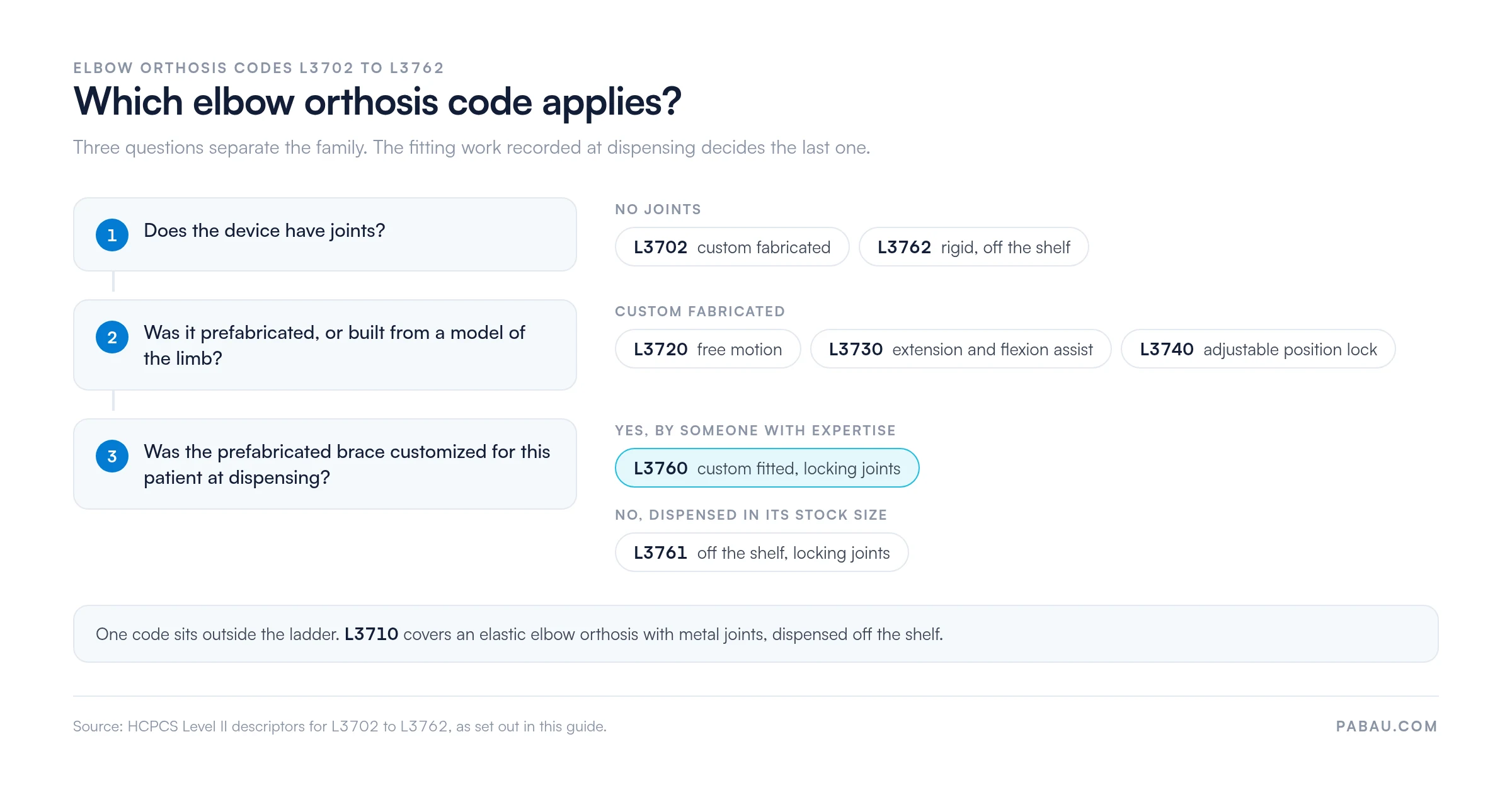
Each code’s full descriptor is below, alongside the detail that separates it from L3760.
Anatomy matters as much as construction. Codes L3702 to L3762 describe elbow-only devices. Codes L3763 onwards cover elbow-wrist-hand and elbow-wrist-hand-finger orthoses, which span further down the limb. Billing an elbow code for a device that reaches the metacarpals is a category error that leads to recoupment.
The off-the-shelf twin has a reference of its own. Read HCPCS code L3761 before October 28, 2026, when its encounter and order requirements take effect.
Denials on this code cluster around a short list. Reading your own remittance data against the standard denial codes shows which of them is costing the practice most.
Treat each of these as a workflow fix rather than a one-off appeal. Three denials sharing a cause point to a step missing from the dispensing process.
Review every L3760 denial from the past sixty days and sort them by reason code. Where one cause appears three times or more, change the dispensing or billing step that produced it. Fixing the process retires the whole group of denials instead of one claim.
Most practices dispensing elbow orthoses keep the pieces of an L3760 claim in different places. The order arrives by fax, the fitting note lives in a paper chart, and the delivery receipt sits in a folder behind the front desk. Assembling that file takes a biller several minutes per claim, and a missing piece is often discovered only after the denial.
Practice management software like Pabau keeps those records against the patient rather than in separate systems. Digital forms capture the fitting details at the point of dispensing, including the model, the size and the modifications made. The signed delivery receipt is stored with the same appointment, so the file is complete before anyone opens the claim.
Claims management then applies your modifier rules before submission and tracks what each payer does with the line. Billers spend their time on the claims that need judgment, and fewer denials reach the appeals queue at all.

Pabau helps DMEPOS suppliers and orthotic teams capture fitting records, apply the right modifiers, and track denials in one place.

HCPCS code L3760 turns on one question that no product catalog can answer for you. The brace must have adjustable position locking joints, and someone with expertise must have customized it for this patient at dispensing. Record that work and the code holds up. Leave it vague and a reviewer will read the claim as L3761.
The surrounding rules are equally mechanical. A complete standard written order, laterality on the line and a signed delivery receipt prevent most denials on this code. Checking the replacement window prevents most of the rest. To see how Pabau keeps those records together for DMEPOS and orthotic billing, book a demo.

Billing the off-the-shelf version instead? HCPCS code L3761 billing guide covers the off-the-shelf elbow orthosis and its documentation rules.
Dispensing a rigid brace without joints? HCPCS code L3762 billing guide explains when a static elbow orthosis is the correct code.
Want fewer rejections at first pass? Clean claim submission walks through the checks that catch errors before a claim is sent.
HCPCS code L3760 is the Level II code for an elbow orthosis with adjustable position locking joints. The device is prefabricated, then trimmed, bent, molded, assembled or otherwise customized to fit a specific patient by an individual with expertise. It is billed by DMEPOS suppliers and orthotists to Medicare Part B and commercial payers.
No. L3700 was deleted from the HCPCS code set effective January 1, 2010 and crosswalked to A4466, a garment and covering code. It has not been a billable elbow orthosis code for more than fifteen years. For a hinged elbow brace fitted to a patient today, L3760 or L3761 applies instead.
Both codes describe a prefabricated elbow orthosis with adjustable position locking joints. L3760 applies when the device is trimmed, bent, molded or assembled for one patient by someone with expertise. L3761 applies when it is dispensed in its manufactured size with only sizing and strap adjustment. The documented fitting work decides the code.
Medicare Part B covers L3760 under the brace benefit. Medical necessity must be documented, a standard written order must be on file, and the supplier must hold active DMEPOS enrollment. Elbow orthoses have no dedicated Local Coverage Determination, so the treating practitioner’s clinical notes carry the case for medical necessity.
An L3760 claim needs a complete standard written order and clinical records linking a diagnosis to the need for controlled elbow motion. It also needs a signed proof of delivery and product identification for the model dispensed. The element unique to this code is a fitting record naming the modifications made and the person who made them.
Yes, when both elbows are treated and each device is separately justified. Bill two lines, one with the RT modifier and one with the LT modifier, each at a quantity of one. Do not combine them on a single line or use a bilateral modifier, since that usually causes a rejection.