L1904 is the HCPCS Level II code for ankle orthosis, ankle gauntlet or similar, with or without joints, custom fabricated. The device is built for one patient from a cast, mold or scan, and an off-the-shelf gauntlet bills under L1902 instead.
LCD L33686 governs Medicare coverage, and CMS Policy Article A52457 sets the documentation and billing rules for the code.
L1904Ankle gauntlet orthosis, custom fabricatedHigh match
Confidence score
98%
Why this code?
Matches patient diagnosis
Supported by clinical notes
Commonly used for this condition
Why practices choose Pabau
Save hours every week
Automate repetitive tasks and focus on what matters most—your patients.
Improve accuracy
Reduce coding errors and ensure compliance with the latest regulations.
Get paid faster
Clean claims, fewer denials, and faster reimbursements.
Grow with confidence
Powerful insights and reporting to help your practice thrive.
HIPAA compliant•SOC 2 certified•GDPR-compliant•Trusted by 4,000+ clinics worldwide
Key takeaways
L1904 is the custom-fabricated ankle gauntlet code, built for one patient from a cast, mold or scan.
An off-the-shelf gauntlet that is only trimmed or adjusted at dispensing bills under L1902 instead.
Medicare coverage requires a written order, a face-to-face examination, and a covered diagnosis under LCD L33686.
The KX modifier is required when billing L1904 to Medicare to attest that documentation supports medical necessity.
Pabau’s claims management software tracks modifier requirements and coverage criteria to reduce L1904 denials.
HCPCS Code L1904: Code descriptor and device specifications
HCPCS Code L1904 describes an ankle orthosis, ankle gauntlet or similar, with or without joints, custom fabricated. It sits within the HCPCS Level II L-series, which CMS maintains for orthotic and prosthetic devices.
L1904 has always been the custom code. Before 2016 its descriptor read “Ankle orthosis, ankle gauntlet, custom fabricated”. The 2016 HCPCS update added “or similar, with or without joints” to give the current wording.
Field
Detail
HCPCS Code
L1904
Official descriptor
Ankle orthosis, ankle gauntlet or similar, with or without joints, custom fabricated
Code series
HCPCS Level II, L-series (orthotics)
Device category
Custom-fabricated ankle orthosis, made for one patient from a cast, mold or scan
Governing LCD
LCD L33686 (Ankle-Foot/Knee-Ankle-Foot Orthosis)
CMS Policy Article
A52457 (Ankle-Foot/Knee-Ankle-Foot Orthoses)
Descriptor history
Earlier wording was “Ankle orthosis, ankle gauntlet, custom fabricated”. The January 1, 2016 HCPCS update added “or similar, with or without joints”.
Off-the-shelf counterpart
L1902 (ankle gauntlet or similar, prefabricated, off-the-shelf)
The device must be an ankle gauntlet or structurally similar design built for one patient. The orthotist takes a cast, mold or digital scan of the ankle and fabricates the orthosis over that model.
Rigid and semi-rigid constructions both qualify, with or without joints. A stock-size gauntlet that is only trimmed or adjusted at dispensing bills under L1902 instead.
Medicare coverage criteria for L1904
LCD L33686 sets the medical necessity thresholds that determine whether a Medicare claim for L1904 pays. Physical therapy practices and orthotics suppliers that bill Medicare Part B as a DME benefit must satisfy all of the following before supplying the device.
Written order: A prescribing physician, nurse practitioner, or other qualified ordering clinician must provide a written order before the device is dispensed.
Face-to-face examination: The ordering clinician must have seen the patient and documented clinical findings that support the medical necessity of an ankle orthosis.
Covered diagnosis: The patient’s diagnosis must appear on the LCD L33686 covered-diagnosis list. Non-covered diagnoses result in automatic denial regardless of clinical documentation quality.
Functional limitation: Documentation must describe the functional limitation the orthosis is meant to address. Examples include ankle instability, foot drop, post-surgical weakness, or deformity.
Custom-fabrication criterion: Because L1904 is a custom code, the record must also meet one of the LCD’s custom criteria. Examples include a failed prefabricated fitting, a condition expected to last more than six months, or a healing fracture.
DMEPOS supplier enrollment: The supplier must hold an active Medicare DMEPOS supplier number. Physicians and practices that are not enrolled as DMEPOS suppliers cannot bill L1904 directly.
Covered and non-covered indications
LCD L33686 distinguishes between conditions that support coverage and those that do not. The table below summarizes the key distinctions. Always cross-check against the current LCD text on the CMS Medicare Coverage Database, as covered-diagnosis lists are updated periodically.
Covered indications
Non-covered indications
Ankle instability with documented weakness
Routine ankle pain without functional deficit
Foot drop (peroneal nerve palsy)
Prophylactic use in athletes
Post-fracture rehabilitation with residual instability
Acute sprain without neurological or musculoskeletal weakness
Post-surgical ankle instability
Convenience or comfort use
Diabetic neuropathy with ankle instability
Diagnoses not on LCD L33686 covered list
Supported ICD-10 diagnosis codes for L1904
Payers cross-check the ICD-10-CM code on the claim against the covered-diagnosis list in LCD L33686. A diagnosis that does not appear on that list triggers an automatic non-covered denial.
The ICD-10 codes below are among the most commonly used to support medical necessity for L1904. The list is not exhaustive, so verify each code against the current LCD.
ICD-10-CM Code
Description
Clinical context
M25.371
Other instability, right ankle
Primary covered diagnosis for ankle instability
M25.372
Other instability, left ankle
Primary covered diagnosis for ankle instability
G57.01
Lesion of sciatic nerve, right lower limb
Foot drop from sciatic or peroneal nerve involvement
G83.10
Monoplegia of lower limb affecting unspecified side
Foot drop / lower limb weakness
E11.40
Type 2 diabetes mellitus with diabetic neuropathy, unspecified
Diabetic neuropathy causing ankle instability
M96.671
Fracture of tibia or fibula following insertion of orthopedic implant, joint prosthesis, or bone plate, right leg
Leg fracture after implant or plate surgery, where the orthosis supports the healing limb
How L1904 differs from adjacent ankle orthosis codes
The most consequential billing error with L1904 is using it for a prefabricated gauntlet fitted from stock. L1902 is the off-the-shelf version of the same design.
Billing L1904 for a stock device is upcoding, and billing L1902 for a custom device understates the claim. The comparison table below clarifies the distinctions within the AAPC’s HCPCS Level II code database.
Code
Descriptor summary
Fabrication type
Key distinction
L1902
Ankle orthosis, ankle gauntlet or similar, with or without joints, prefabricated, off-the-shelf
OTS prefabricated
Stock size selected and trimmed or adjusted at dispensing; the off-the-shelf counterpart to L1904
L1904
Ankle orthosis, ankle gauntlet or similar, with or without joints, custom fabricated
Custom fabricated
Fabricated for one patient from a cast, mold or scan; this code
Multiligamentous support from stock sizes; a different design from the L1904 gauntlet
L1907
Ankle orthosis, supramalleolar with straps, with or without interface/pads, custom fabricated
Custom fabricated
Supramalleolar design extending above the malleoli; custom, like L1904
L1910
Ankle foot orthosis, posterior, single bar, clasp attachment to shoe counter, prefabricated, includes fitting and adjustment
Prefabricated, fitted
Posterior single-bar design; different mechanical function to L1904
L1930
Ankle foot orthosis, plastic or other material, prefabricated, includes fitting and adjustment
Prefabricated, fitted
Full AFO extending to the foot plate; distinguishable from the ankle gauntlet design of L1904
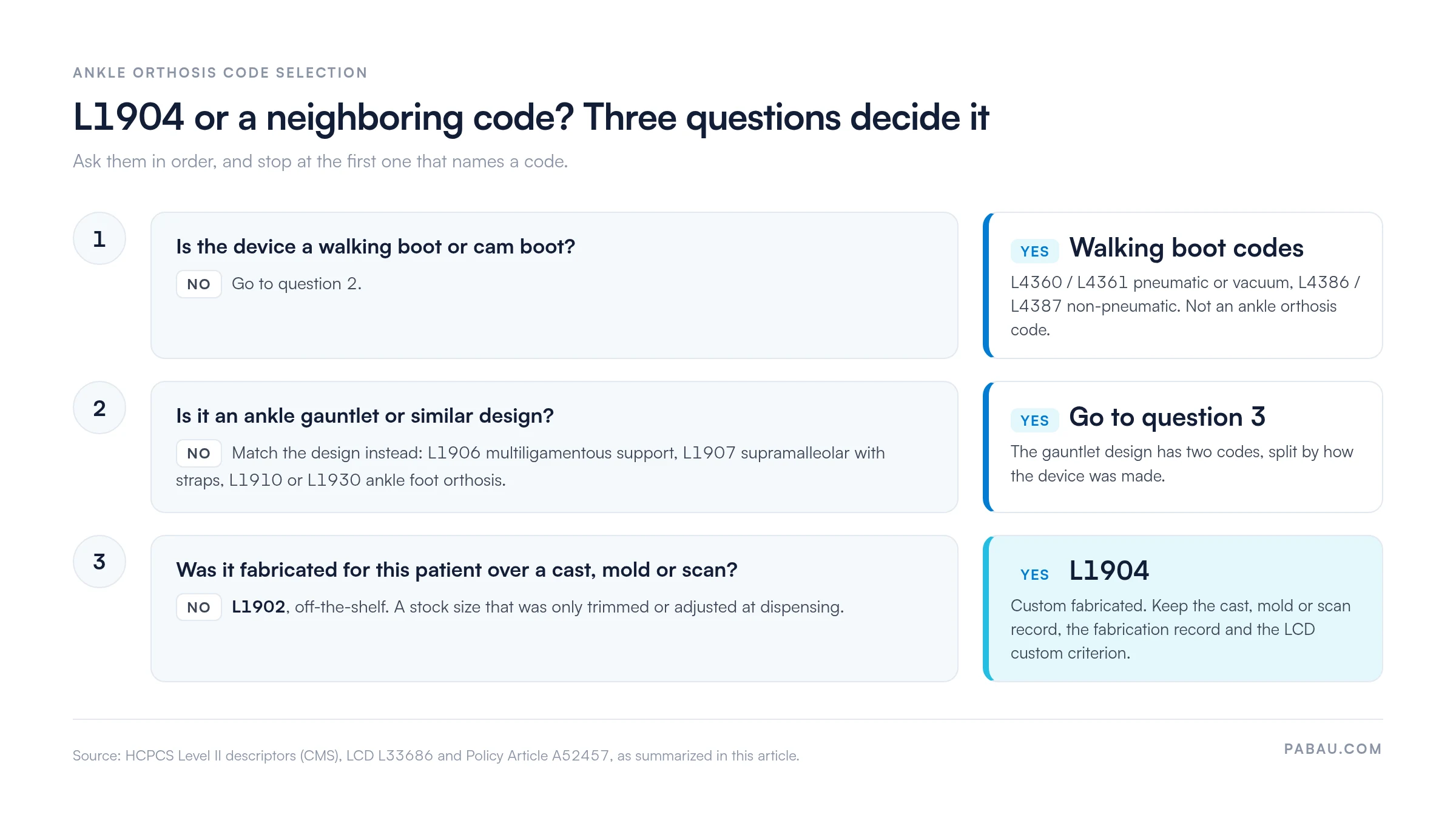
Three questions settle which code a dispensed ankle device belongs to. Their order matters, because a walking boot or a non-gauntlet design never reaches the custom-or-stock question.
Once walking boots and other designs drop out, L1904 versus L1902 turns on one document: the cast, mold or scan record. Descriptors follow CMS HCPCS Level II and LCD L33686.
Pro Tip
When the dispensed device is a walking boot or cam boot, neither L1904 nor the related ankle codes L1902 and L1906 apply. Pneumatic or vacuum walking boots bill under L4360 or L4361, and non-pneumatic boots under L4386 or L4387. Confirm device design against the official descriptor before selecting the L-code.
Documentation requirements for L1904 claims
CMS Policy Article A52457 specifies what must be in the medical record before an L1904 claim is billed. Solid medical billing documentation is the single most effective defense against a post-payment audit. Every item below must be present and legible in the record on the date of service.
Detailed written order: Signed and dated by the ordering clinician before delivery, and ideally before fabrication starts. It names the beneficiary, the order date, the custom-fabricated ankle orthosis, and the ordering clinician.
Face-to-face clinical findings: The ordering clinician’s notes must document the examination findings that establish medical necessity. Examples include range of motion deficits, muscle strength grade, or neurological findings.
Diagnosis with functional context: The ICD-10-CM code on the claim must match a covered diagnosis in LCD L33686. The notes must explain how the diagnosis produces the functional limitation the orthosis addresses.
Delivery confirmation: A signed delivery receipt or proof of delivery from the beneficiary (or caregiver) confirming receipt of the device.
Cast, mold or scan record: Note how and when the ankle was captured, such as by plaster cast, foam impression or 3D scan. This is the evidence that the device was custom fabricated.
Fabrication records: Keep the fabrication order, materials, design specifications and fitting notes. An auditor uses them to confirm the orthosis was built for this patient and not taken from stock.
Custom-fabrication justification: The notes must name the LCD L33686 criterion that makes a custom device necessary, rather than a prefabricated L1902 gauntlet.
Advance Beneficiary Notice (ABN): If coverage is not certain, issue and obtain a signed ABN before dispensing. Without it, the supplier absorbs the cost if the claim is denied as non-covered.
Prior authorization and pre-claim review requirements
Medicare does not impose a universal prior authorization requirement for L1904 across all DME MAC jurisdictions. However, commercial payers frequently require PA, and some DME MACs have conducted pre-claim review initiatives for orthotics claims.
Check the current requirements with the relevant DME MAC before submitting. For commercial plans, review the payer’s orthotics benefit policy or call the payer’s provider line before dispensing the device.
Medicare fee schedule and reimbursement for L1904
The Medicare allowable amount for L1904 is set by the CMS DMEPOS fee schedule, which is updated every January and varies by state. The table below shows how payment works rather than quoting one figure.
Look up the current allowable for your state before you quote the patient their share. Medicaid and commercial payer rates are set by contract and may differ substantially.
Item
Detail
Billing basis
Purchase (NU modifier); rental (RR modifier) rarely applies to a custom-fabricated device made for one patient
2026 fee schedule
Verify current allowable at the CMS DMEPOS fee schedule lookup; amounts change each January 1
Geographic adjustment
Orthotic fee schedule amounts are set by state, within national floor and ceiling limits
Medicare cost share
Medicare pays 80% of allowable; beneficiary responsible for 20% after deductible
Medicaid and commercial
Rates set by individual payer contract; verify before dispensing
The billing section below covers the full modifier stack for L1904. Confirm it against the payer’s orthotics policy before submission.
Common claim denial reasons for L1904 and how to avoid them
Most L1904 denials are preventable. Effective denial management workflows start with understanding which errors occur most often and building checklist controls to catch them before submission.
Denial reason
Root cause
Corrective action
Non-covered ICD-10 code
Diagnosis not on LCD L33686 covered list
Cross-check the diagnosis against the current LCD before billing; obtain a covered supporting diagnosis if one exists clinically
Missing KX modifier
KX not appended to L1904 when billing Medicare
Append KX to every L1904 line billed to Medicare to attest that documentation supports medical necessity; without KX the claim edits out at the MAC
Prefabricated device billed as custom
L1904 billed for a stock-size gauntlet that was only trimmed or adjusted at dispensing
Confirm a cast, mold or scan record and a fabrication record exist before billing L1904; bill an off-the-shelf gauntlet under L1902
Insufficient documentation
Medical record lacks face-to-face exam findings or written order
Use a pre-billing documentation checklist; do not submit until all A52457 required elements are in the record
Custom fabrication not justified
Record does not show the LCD L33686 criterion that makes a custom device necessary
Document which custom criterion applies before fabrication starts, such as a condition expected to last more than six months
Duplicate billing
L1904 billed on a date when a procedure code for fitting or adjustment was also billed incorrectly
Review bundling edits; separate the orthosis supply claim from any associated fitting evaluation on the same date where payer policy requires it
Billing L1904 alongside CPT and other HCPCS codes
Most reference pages describe L1904 in isolation. In practice, the orthosis code is often billed with a fitting evaluation or adjustment code on the same date of service. Getting the modifier stack right is where practices either submit a clean claim or trigger a claim edit.
KX modifier (attestation of medical necessity): Required on every L1904 line billed to Medicare. Without it, the DME MAC’s claim editing system will reject or deny the line. This is the single most common fixable error.
NU modifier (new, not rental): Append NU when billing L1904 as a purchase. This is the standard billing scenario for ankle orthoses.
RR modifier (rental): Used when the payer requires rental rather than purchase. This rarely applies to a device custom fabricated for one patient, but verify with individual commercial payers.
Bundling with CPT procedure codes: L1904 is an HCPCS supply code, not a procedure code. If the ordering clinician also performs an evaluation on the same date, that evaluation bills under the appropriate CPT E&M or physical therapy code. The two do not automatically bundle, but payers may apply edits if the combination appears unusual. Document the distinct clinical purposes of each service.
The CGS Medicare PDAC coding verification guidance addresses product-to-code alignment for DMEPOS items. It helps when a prefabricated gauntlet is marketed in terms that suggest the custom L1904 code.
Pro Tip
Audit your L1904 claims quarterly. Pull every L1904 claim missing the KX modifier, and every L1904 claim with no cast, mold or scan record on file. Both patterns appear in DME MAC targeted review lists.
How claims management software keeps L1904 claims clean
Without one system, an L1904 claim lives in three places. The order and exam notes sit in the chart, the modifiers in a spreadsheet, and the cast or scan record in a shared folder. An auditor’s request then means rebuilding the file by hand.
Pabau, the practice management platform we build, keeps those pieces on one patient record. Its claims management software tracks payer-specific modifier requirements and pre-submission documentation checklists, so KX and a covered diagnosis are confirmed before the claim leaves.
The outcome is fewer L1904 lines returned for a missing modifier, and a record that already holds the fabrication evidence when a post-payment review arrives.
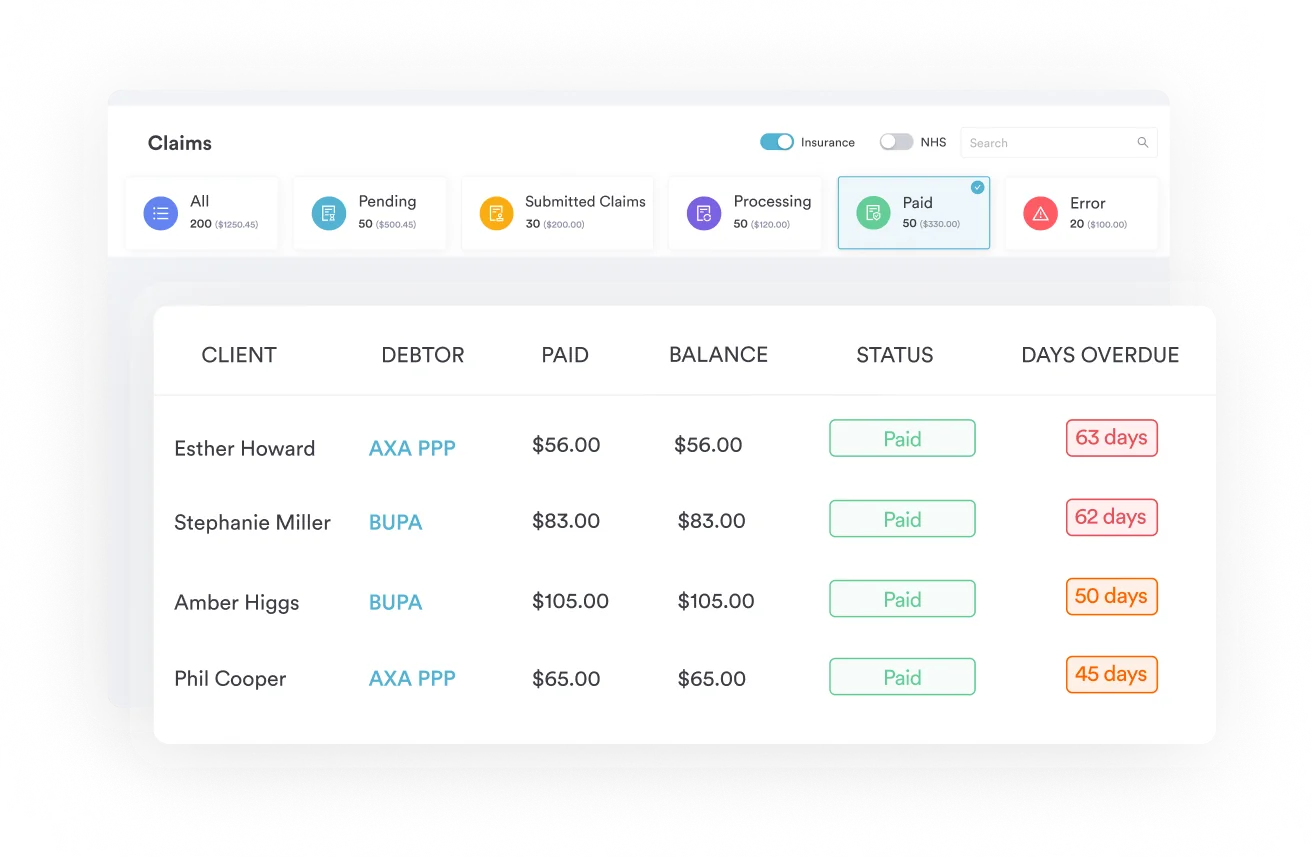
Pabau’s claims dashboard sorts claims by status, from pending to paid or error, so a rejected L1904 line shows up the day it comes back.
Reduce L1904 claim denials with Pabau
Pabau’s claims management tools track modifier requirements, coverage criteria, and documentation checklists so your DME and orthotics claims go out clean the first time.
Treat the cast, mold or scan record as the document that decides the code. If it exists and names this patient, bill L1904 with KX and a covered diagnosis. If the device came from stock, bill L1902, even when it was trimmed to fit.
The trade-off is a few minutes at intake. Recording the custom criterion before fabrication starts is far cheaper than defending an upcoding finding after the payment has been recouped.
Book a demo to see how Pabau keeps orthotics orders, fabrication records and claims on the same patient file.
Continue your research
Need to understand the full medical billing cycle?What is medical billing walks through the end-to-end process from claim creation to payment posting.
Looking for the complete billing software overview?Pabau claims management software handles modifier tracking, payer rules, and clean-claim submission for DME and orthotics practices.
Fitting a multiligamentous ankle support?HCPCS code L1906 explains coverage and billing for that off-the-shelf design.
Frequently asked questions
What is HCPCS Code L1904?
HCPCS Code L1904 is the billing code for an ankle orthosis, ankle gauntlet or similar, with or without joints, custom fabricated. DME suppliers and orthotists use it to bill Medicare Part B and commercial payers for a gauntlet built from a cast, mold or scan.
Is L1904 a prefabricated or custom orthosis code?
L1904 is a custom-fabricated code. A device billed under L1904 must be fabricated for one patient from a cast, mold or scan, and the record must show it. A prefabricated, off-the-shelf ankle gauntlet bills under L1902 instead.
What ICD-10 diagnosis codes support L1904 medical necessity?
Commonly accepted ICD-10-CM codes include M25.371 and M25.372 (ankle instability) and G57.01 and G83.10 (foot drop and lower limb weakness). E11.40 (type 2 diabetes with neuropathy) is also common. LCD L33686 defines the covered-diagnosis list, and payers deny claims whose ICD-10 code is not on it.
Does Medicare require prior authorization for L1904?
Medicare does not impose a universal prior authorization requirement for L1904 across DME MAC jurisdictions. Some MACs have run pre-claim review programs for orthotics. Commercial payers frequently require PA. Confirm requirements with the relevant DME MAC and individual commercial plans before dispensing the device.
How does L1904 differ from L1902?
L1902 is the prefabricated, off-the-shelf version of the same ankle gauntlet design, selected from a stock size and adjusted at dispensing. L1904 is custom fabricated from a patient-specific cast, mold or scan. Billing L1904 for a stock device is upcoding, and billing L1902 for a custom device understates the claim.
Which LCD governs Medicare coverage for L1904?
LCD L33686 (Ankle-Foot/Knee-Ankle-Foot Orthosis) governs Medicare coverage for L1904. CMS Policy Article A52457 provides supplementary billing and documentation guidance. Both documents are available on the CMS Medicare Coverage Database.