CCSD code H4430: Examination of rectum under anaesthetic
CCSD code H4430 pays for the examination alone CCSD code H4430 is the UK private...

Last Updated: Oct 20, 2026
J3520 is the HCPCS Level II code for edetate disodium, per 150 mg.
Providers running IV therapy and infusion services will encounter J3520 wherever edetate disodium is part of the protocol. The code covers the drug itself. Administration is billed separately using the appropriate infusion CPT code, which depends on how long the drip runs.
Let Pabau's smart automation suggest the right codes, reduce claim denials, and keep your practice compliant—effortlessly.
Automate repetitive tasks and focus on what matters most—your patients.
Reduce coding errors and ensure compliance with the latest regulations.
Clean claims, fewer denials, and faster reimbursements.
Powerful insights and reporting to help your practice thrive.
HIPAA compliant SOC 2 certified GDPR-compliant Trusted by 4,000+ clinics worldwide

HCPCS code J3520 describes edetate disodium, per 150 mg, the chelating agent billed as a Level II J-code for heavy metal toxicity.
Medicare covers J3520 only for documented heavy metal toxicity, primarily lead poisoning. Chelation for cardiovascular or wellness indications is not covered.
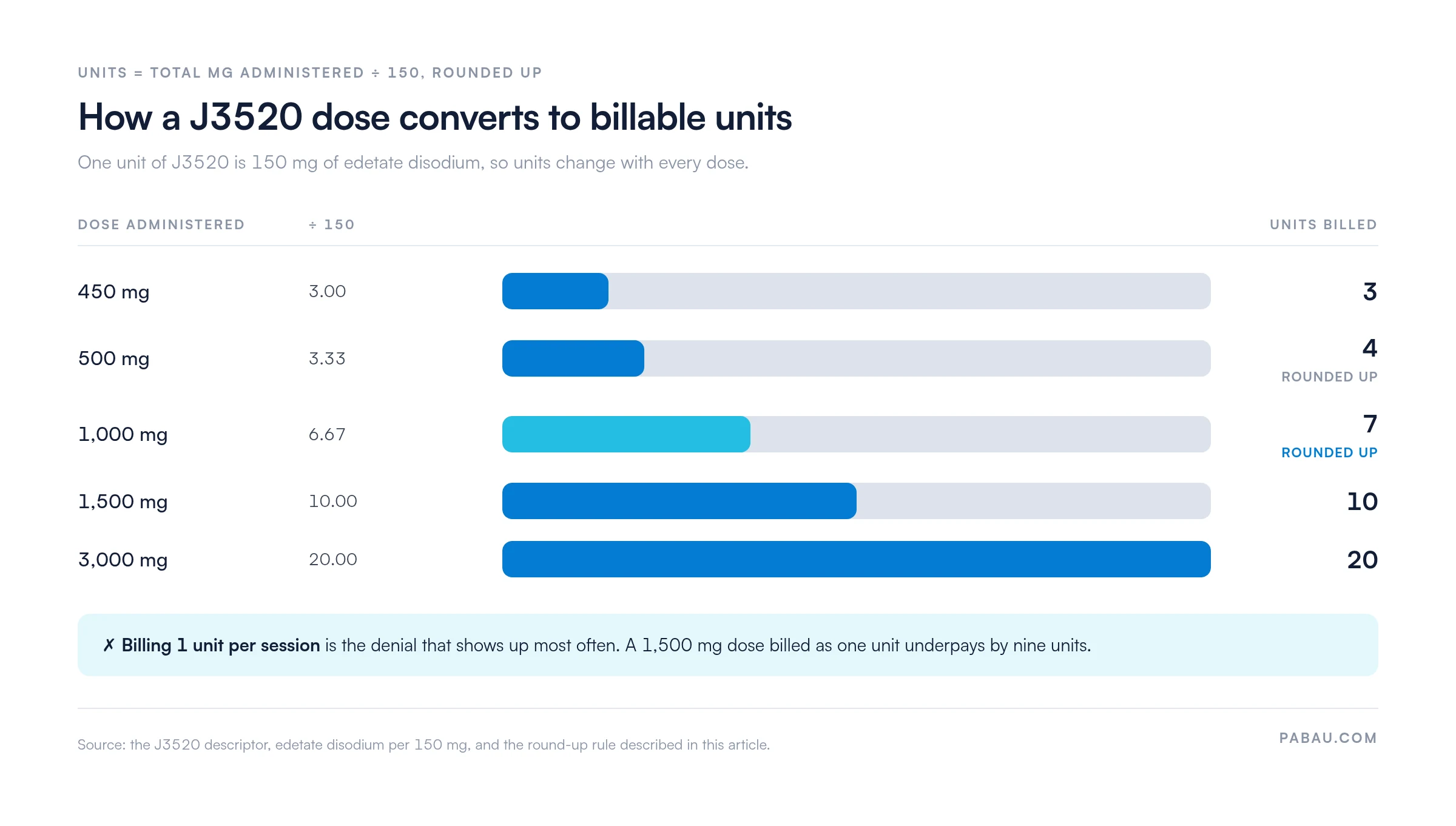
Bill units by dividing the total dose administered by 150 mg and rounding up. Missing this calculation is the leading cause of J3520 rejections.
Edetate disodium ships in single-dose ampules, so every J3520 line sent to Medicare carries either the JW or the JZ modifier.
Claims management software like Pabau’s automates the unit math, attaches the JW or JZ modifier, and checks coverage before submission.
Edetate disodium (EDTA) is a chelating agent. It binds heavy metal ions in the bloodstream so the body can excrete them through the kidneys. Clinically, it carries three labeled indications, though only one drives most claims.
Route of administration is intravenous infusion, typically delivered over several hours in an outpatient or infusion suite setting. Document the infusion start and stop times in the clinical record. Administration CPT codes are time-dependent, and auditors cross-reference those times against the J3520 units billed.
Chelation therapy describes the intravenous administration of a chelating agent to remove heavy metals from the body. J3520 covers the drug cost only. A complete chelation therapy claim also carries an administration code for the infusion service, and for a first hour that is 96365. Providers billing the drug without the administration code, or the reverse, face routine edits from Medicare and commercial payers alike.
Scope-of-practice rules also decide which provider types can bill the administration component alongside J3520, and they vary by state. A physician or mid-level provider must typically supervise or perform the service for Medicare reimbursement.
Medicare Part B reimburses J3520 based on the drug pricing methodology applied to single-source and multi-source drugs. Rates reflect the Average Sales Price (ASP) plus a 6% add-on for separately payable drugs. Because edetate disodium is available from multiple manufacturers and is not a high-volume drug, Medicare payment amounts are modest and subject to annual revision.
The figures below reflect 2026 CMS-published rates. Verify current amounts using the CMS Physician Fee Schedule lookup tool for your specific MAC jurisdiction.
Commercial payers typically set their J3520 reimbursement rates independently, often as a percentage of AWP (average wholesale price) rather than ASP. Always verify rates in your payer contracts before using CMS figures as a proxy.
Medicare’s coverage of chelation therapy is narrow. CMS does not recognize chelation as a covered benefit for cardiovascular disease, general wellness, autism, or anti-aging indications. Coverage applies specifically when documented heavy metal toxicity is the diagnosis, supported by laboratory evidence of elevated serum or urine metal levels.
Practices offering chelation services should confirm their documentation meets payer requirements before billing J3520 to Medicare. A claim for chelation therapy without supporting documentation of heavy metal toxicity is both a denial risk and an audit trigger.
Major commercial payers largely mirror Medicare’s restrictive stance on chelation therapy. Blue Cross Blue Shield and UnitedHealthcare have published medical coverage guidelines that limit J3520 reimbursement to documented heavy metal toxicity indications. Coverage for alternative or integrative chelation protocols (heart disease, heavy metal “detox”) is broadly excluded.
Run eligibility verification before every chelation session, not just at intake. Payer policies on chelation change annually. A plan that covered it last year may now require prior authorization, or may have reclassified it as experimental. Verify benefits fresh for each treatment course.
CMS mandates the use of JW and JZ modifiers on single-dose containers to account for drug waste. Edetate disodium (Endrate) is supplied in single-dose ampules, so the JW and JZ rules apply to every J3520 claim line. Waste from a multi-dose vial is never billable, and neither modifier applies to one. Failure to append the correct modifier is among the most common J3520 billing errors flagged during MAC audits.
Under CMS policy, one of these two modifiers must appear on every claim line for J3520 submitted to Medicare. Claims missing both modifiers will be rejected on edit. Document the amount administered and the amount discarded in the clinical record. Those figures support the modifier chosen and must be available for auditor review.
The ICD-10-CM codes below are the diagnoses that support medical necessity for J3520 claims. Without a covered diagnosis on the claim, payers will deny J3520 as not medically necessary. Select the most specific code available, and check the wider ICD-10-CM code index when the toxicity involves a metal other than lead. Verify the clinical record supports whichever code you choose.
The CDC/NCHS ICD-10-CM web tool provides searchable access to the full tabular list. Coders should also check the seventh character on the code. A means initial encounter, D subsequent, and S sequela, and it must match the visit type in the record.
Several payers, including many Medicaid programs, require the National Drug Code (NDC) on claims for separately payable drugs. The NDC identifies the manufacturer, product, and package size of the edetate disodium administered. Report the NDC that matches the ampule actually used, never a generic or placeholder number.
Do not fabricate or estimate NDC numbers. The FDA’s NDC Directory is the authoritative source. Verify the NDC against the product dispensed, since generic edetate disodium from different manufacturers carries different 11-digit codes. Where a practice draws from more than one supply run, record the NDC at the point of care, since lot and manufacturer can vary.
Coders billing chelation therapy or related infusion drug services will encounter the codes below alongside J3520. Knowing when each applies prevents duplicate billing and stops an unclassified code being used where a specific one exists. Confirm your billing system supports J-series drug code lookup and crosswalks each J-code to its companion administration code.
The most important distinction here is between J3520 and J0600. Edetate disodium (J3520) and edetate calcium disodium (J0600) are pharmacologically distinct molecules with different safety profiles. Using the wrong one is a billing error and a clinical documentation error, and it can trigger post-payment review.
Getting J3520 right takes more than picking the correct code. Each step below is a distinct failure point where claims get rejected. Pabau’s medical claims management tools automate the unit math and the modifier choice, which removes manual entry errors at steps 3 and 4. Start with the unit conversion, since that is where most J3520 lines go wrong.
J3520 denials cluster around a predictable set of errors. The table below maps each common denial reason to its root cause and fix. Reviewing your remittance advice for these patterns after the first few claims catches systemic issues before they accumulate.
Practices that get J3520 right on the first pass avoid the cascading delays that come from working denials retroactively. A clean J3520 claim needs a documentation workflow, a pre-submission check, and staff who know the per-150-mg unit rule.
Set a standing order template in your notes system that prompts the administering nurse to record three numbers every session. The three numbers are total mg drawn, total mg administered, and total mg wasted. They map straight onto your J3520 units, your JW quantity, and your JZ decision, and auditors look for them first.
In most infusion practices the J3520 line gets built twice. A nurse writes the dose into the treatment note. A coder converts it to units days later, working from whatever that note captured.
Pabau, our practice management software, keeps the claim attached to the record it came from. The patient’s insurer and policy sit on the patient record, so an invoice routes to the right payer without re-keying. When the invoice is ready, Pabau pulls the patient, treatment, and insurer details into a pre-filled submission you review and send.
In the US that submission goes to Claim.MD from inside Pabau. Every claim then carries a visible status, from submitted through to paid or error. So a rejected J3520 line stays traceable. You can see which insurer holds the claim and which treatment note the units came from, without opening a second system.
The result is fewer trips back through the chart to answer a denial, and a chelation claim your coder can reconcile in one place.

Pabau handles J-series drug code billing, unit calculation, modifier attachment, and coverage checks in one workflow. Your J3520 claims go out clean the first time.

J3520 is a narrow code that generates a wide share of avoidable denials, and almost always for the same reason. The unit count on the line does not match the milligrams in the note.
So the fix sits upstream, in the chart. Record the dose, the waste, and the diagnosis properly at the chair. The units, the modifier, and the NDC then follow without a second review. Chelation claims will still get scrutinized, but they will survive it.
Pabau builds those checks into the submission workflow rather than leaving them to a manual coder review. Book a demo to see how J-code units, modifiers, and payer rules are handled in one place.

Want a J3520 claim to pass on the first submission? What makes a clean claim sets out the fields payers check before a claim reaches adjudication.
Not sure what an auditor will ask for? Medical billing compliance covers the documentation, retention, and audit-response duties that come with drug billing.
Want to understand how modern claims tools work end-to-end? What is revenue cycle management explains the full billing lifecycle from charge capture to payment posting.
Looking for guidance on handling denied J-code claims? Denial codes in medical billing maps common CARC denial reasons to corrective actions you can take before refiling.
HCPCS code J3520 is used to bill edetate disodium (EDTA) administered during chelation therapy, primarily for lead poisoning and heavy metal toxicity. It is a Level II HCPCS J-code covering the drug component only. The infusion administration is billed separately using a CPT code such as 96365.
Medicare covers J3520 only for documented heavy metal toxicity, most commonly lead poisoning confirmed by laboratory testing. Chelation for cardiovascular disease, general wellness, or anti-aging purposes is not a Medicare-covered benefit, and claims submitted with those diagnoses will be denied.
Edetate disodium comes in single-dose ampules, so CMS requires either JW or JZ on every J3520 claim line sent to Medicare. JW reports drug discarded from the ampule, and JZ certifies that no drug was wasted. Claims missing both are subject to rejection. Document the amount administered and the amount wasted to support whichever modifier you apply.
Units are calculated by dividing the total milligrams of edetate disodium administered by 150. For example, a 1,500 mg dose equals 10 units. Never bill a flat one unit per session. Unit miscalculation is the most common denial trigger for J3520 claims.
J3520 describes edetate disodium, the sodium salt of EDTA. J0600 describes edetate calcium disodium, a calcium-chelated form used in lead poisoning treatment. The two are pharmacologically distinct drugs with different NDCs, dosing, and clinical applications. Using the wrong one is a billing error and a documentation error.
Yes, HCPCS code J3520 is active and valid for billing in 2026. No deletion, revision, or replacement has been announced in the current CMS annual HCPCS Level II update. Verify current-year status annually using the CMS HCPCS overview page before submitting claims.