CCSD code H4430: Examination of rectum under anaesthetic
CCSD code H4430 pays for the examination alone CCSD code H4430 is the UK private...

Last Updated: Oct 20, 2026
J1810 is the HCPCS Level II code for injection, droperidol and fentanyl citrate, up to 2 ml ampule. CMS terminated it with effect from 31 March 2025, so it is no longer valid for claims after that date.
Let Pabau's smart automation suggest the right codes, reduce claim denials, and keep your practice compliant—effortlessly.
Automate repetitive tasks and focus on what matters most—your patients.
Reduce coding errors and ensure compliance with the latest regulations.
Clean claims, fewer denials, and faster reimbursements.
Powerful insights and reporting to help your practice thrive.
HIPAA compliant SOC 2 certified GDPR-compliant Trusted by 4,000+ clinics worldwide

HCPCS Code J1810 described the injection of droperidol and fentanyl citrate, up to 2 ml ampule. The combination agent was used for procedural sedation and anesthesia induction.
CMS deleted J1810 effective March 31, 2025, so any claim carrying the code today will be denied by Medicare and most commercial payers.
There is no single replacement code. Report droperidol and fentanyl citrate separately, and confirm each code against the CMS HCPCS file for the year of service.
Practice management software like Pabau validates the fields each insurer requires before a claim goes out, then tracks its status through to payment.
HCPCS Code J1810 described the injection of droperidol and fentanyl citrate, up to 2 ml ampule. It sat in the HCPCS Level II J-code series. That series covers drugs administered in a clinical setting and billed to Medicare Part B or a commercial payer. CMS deleted the code effective March 31, 2025. Any claim submitted with J1810 after that date is rejected as an invalid code. That holds whether it surfaced on an old remittance, in an audit, or in a resubmission queue.
The table below captures the essential metadata for HCPCS Code J1810.
CMS maintains the HCPCS Level II code set and revises the drug and biological J-codes quarterly. Per CMS’s HCPCS overview, a deleted code drops out of the active file on its termination date. Payers stop honoring it from that date, and it does not return in a later release.
CMS deletes a HCPCS code when the product behind it leaves the market, when more specific codes replace it, or when reporting practice changes. J1810 went for the first of those reasons.
Innovar, the fixed-ratio droperidol and fentanyl citrate ampule, is listed as discontinued from marketing in the FDA Orange Book. With no marketed product left to report, CMS retired the code in its fourth-quarter 2024 HCPCS update, with a termination date of March 31, 2025. Providers who still administer either drug report it under that drug’s own active J-code.
Providers who keep submitting a deleted code collect automatic rejections, and a repeating pattern can draw an audit. Sorting those rejections by cause is the first step in denial management.
Droperidol and fentanyl citrate together produced a clinical state called neuroleptanalgesia. Patients became sedated and analgesic while remaining conscious enough to cooperate with simple commands. This made the combination useful for minor surgical procedures, diagnostic imaging requiring patient cooperation, and anesthesia induction prior to general anesthesia.
The combination product, sold as Innovar, contained 0.05 mg of fentanyl and 2.5 mg of droperidol per mL. Billing under J1810 covered up to 2 ml of that ampule. The code appeared most often in outpatient surgical and anesthesia billing while it was active.
Billing staff reviewing old records should read J1810 as a description of the service, not as a data-entry mistake. The injection happened as documented. Only the code used to report it has expired.
There is no single direct replacement for HCPCS Code J1810. Because J1810 was a combination code, billers now need to report each drug component separately. The correct approach is to verify the currently active J-code for each drug in the CMS HCPCS annual file before submitting any claim.
The table below shows the typical crosswalk approach based on available HCPCS data. Descriptors and statuses change with each release. Verify these codes against the current HCPCS code set via AAPC Codify or the CMS release before submitting any claim.
The codes above are commonly cited alternatives, not formally CMS-designated replacements for J1810. Confirm each one is active in the year of service before submitting. Where neither specific code applies, J3490 (injection, drug, unclassified) can work as a payer-specific fallback.
Kanamycin claims rely on J3490 entirely, since CMS deleted HCPCS Code J1840 in 2024 without naming a replacement. Many payers require prior authorization or supporting documentation when J3490 is used.
The chart below sets out which code to reach for, and the filing window that decides whether a corrected claim is worth submitting.
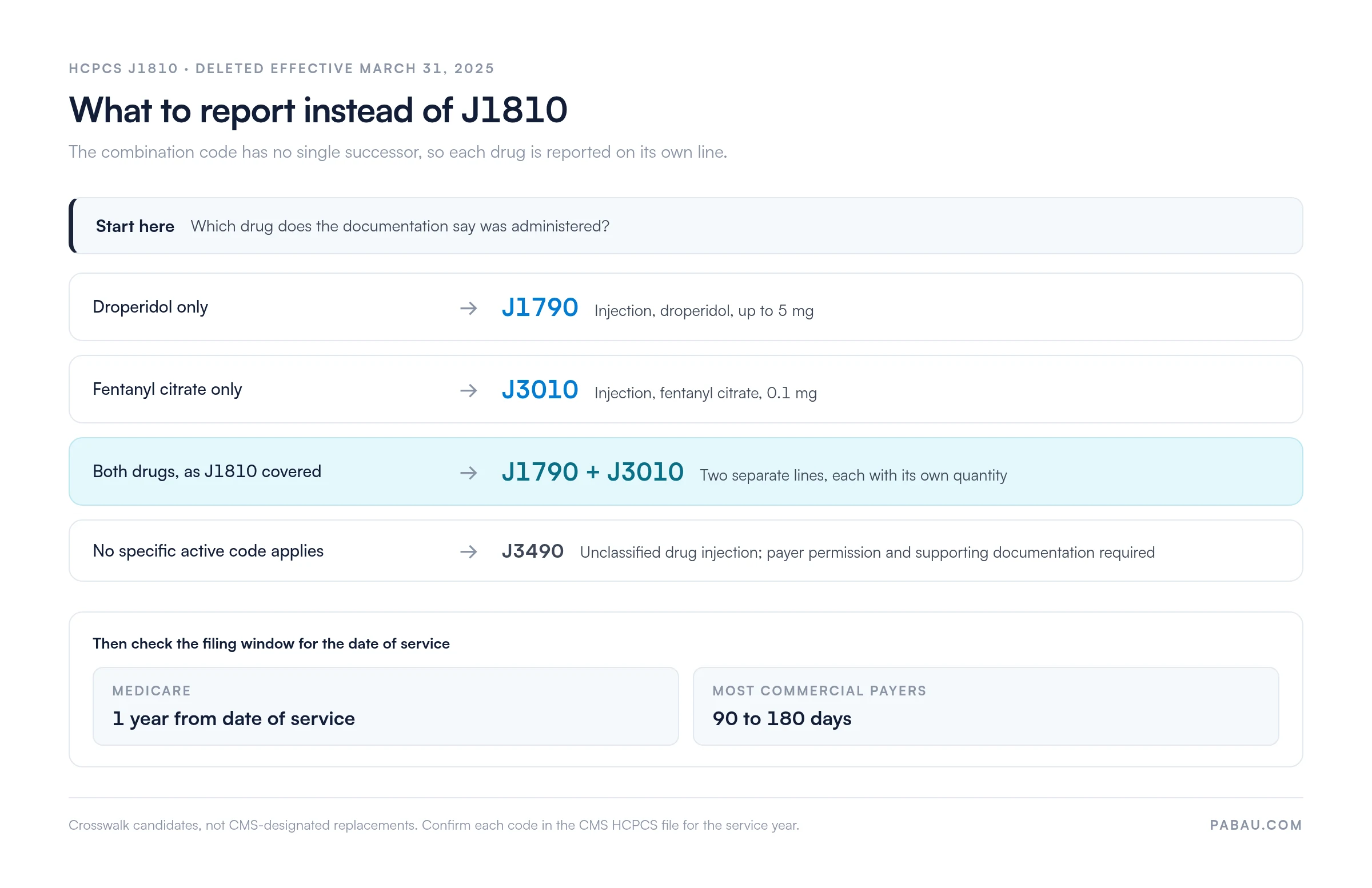
Before resubmitting any claim that originally used J1810, pull the CMS HCPCS Level II annual data file for the year of service. The correct crosswalk code depends on the specific year the service was rendered, not just the current active code set. Submit a corrected claim with the appropriate active code for that service year, and attach documentation explaining the correction.
Medicare will deny any claim submitted with HCPCS Code J1810. The code is deleted and not recognized in the Medicare Physician Fee Schedule or the Medicare Part B drug payment system. This applies to all Medicare Administrative Contractor (MAC) jurisdictions nationwide.
Historical Medicare reimbursement rates for J1810 are no longer published in active fee schedule data. Because the code is removed from the CMS HCPCS file, it does not appear in the CMS Physician Fee Schedule lookup tool. Any rate figures found in third-party reference databases reflect historical data only and have no current billing value.
For services rendered while J1810 was still active, three questions decide whether a corrected claim is worth filing:
Practical steps for billing staff encountering J1810 on claims or in a billing queue:
Catching a retired code before submission costs a fraction of working the denial afterward. Scrub your active code library against the current CMS HCPCS file each quarter. Drug codes deserve the closest look, since they change four times a year.
Every major payer class handles deleted HCPCS codes the same way: automatic denial. The table below summarizes what to expect when J1810 appears on a claim submitted to any payer today.
For Medicare, check the Local Coverage Determination or National Coverage Determination that applies to the replacement code before submitting. Commercial payers set their own drug fee schedules and often give different instructions for unclassified drug codes. Their provider manual or provider relations line will say which active code they expect. Keep a copy of that guidance on file whenever a code changes mid-claim.
Billers in anesthesia, procedural sedation, or pain management will meet related active J-codes alongside J1810 in historical records. The table below lists the ones referenced most often in adjacent clinical contexts. Verify current status against the CMS HCPCS release before billing.
Confirm every status in the table above against the current CMS HCPCS release. Drug and biological J-codes are revised quarterly, so a code active this quarter can be terminated in the next.
A retired code reaches the billing queue by a few predictable routes:
Each route ends the same way. The claim denies, and someone reworks it by hand.
Practice management software keeps that rework in one place. Pabau’s claims management software checks the fields each insurer requires before a claim is sent. It then tracks the claim’s status next to the schedule and the clinical note behind it. Billing staff review, correct, and resubmit without moving between separate systems. It will not tell you that a HCPCS code has been retired, so the quarterly code library check stays a manual task.
For a practice working through a backlog of historical claims, most of the job is matching each claim to the documentation behind it. Reviewing denials by code type then shows whether retired codes are a recurring problem on particular service lines or providers.
Audit your superbill templates and drug code libraries once a quarter, in the weeks before each CMS HCPCS release takes effect. Cross-reference every J-code in your templates against the incoming active file, and flag the ones that terminate. J1810 ended on March 31, a date no annual review would have caught in time.

Pabau’s claims management tools check insurer-required fields before submission and track each claim’s status next to the appointment and note it came from.

J1810 ended on March 31, 2025, and no payer will reimburse it now. The correction itself is mechanical. Report droperidol and fentanyl citrate on separate lines. Confirm both codes in the CMS HCPCS file for the service year, then file inside the payer’s timely filing window.
The trade-off worth remembering is timing rather than coding. A corrected claim filed inside the window is worth the rework. One filed outside it is a write-off, however correct the codes are.
Keeping this off next quarter’s denial list is a process question more than a coding one. Pabau helps billing teams work through denial codes with claim tracking and correction built into the platform your practice already runs. Book a demo to see how your team would handle a J1810 correction end to end.

Need to understand how medical billing works from the ground up? What is medical billing explains the full claim lifecycle, from charge capture to payment posting.
Working through a pile of denied claims? Denial management in healthcare covers the most common denial categories and how to build a systematic appeal workflow.
Evaluating billing software for your practice? Best medical billing software in the US breaks down the leading options by practice size and specialty.
HCPCS Code J1810 is a deleted HCPCS Level II J-code that described the injection of droperidol and fentanyl citrate, up to 2 ml ampule. It was used to bill for a combined neuroleptic analgesic agent administered parenterally, primarily in procedural sedation and anesthesia induction settings. The code is no longer active and cannot be billed to any payer.
No. HCPCS Code J1810 was deleted effective March 31, 2025, under the CMS fourth-quarter 2024 HCPCS update. Claims submitted with J1810 in 2025 or 2026 are automatically denied by Medicare, Medicaid, and most commercial payers.
J1810 covered droperidol, a butyrophenone neuroleptic, combined with fentanyl citrate, a Schedule II synthetic opioid. The two were delivered together in a single 2 ml ampule. The commercial product was known as Innovar. Both drugs are still administered clinically but are now billed under separate active J-codes rather than a combined code.
Providers should pull the CMS HCPCS file for the year of service. Identify the active code for droperidol and the active code for fentanyl citrate for that year. Submit the corrected claim inside the payer’s timely filing window. Document the code correction rationale and retain the documentation in the event of an audit. If timely filing limits have passed, the claim is unlikely to be recoverable.