HCPCS code J3471: Hyaluronidase ovine injection billing guide
HCPCS code J3471: Descriptor, code type, and quick-reference data HCPCS code J34...

Last Updated: Oct 14, 2026
C1878 is the HCPCS Level II code for material for vocal cord medialization, synthetic (implantable).
It is billed only by hospital outpatient departments, on the facility claim, under the Outpatient Prospective Payment System (OPPS). CMS places it in the C-code series, which covers pass-through devices and items in hospital outpatient departments. It also explains how pass-through status changes what Medicare pays.
Let Pabau's smart automation suggest the right codes, reduce claim denials, and keep your practice compliant—effortlessly.
Automate repetitive tasks and focus on what matters most—your patients.
Reduce coding errors and ensure compliance with the latest regulations.
Clean claims, fewer denials, and faster reimbursements.
Powerful insights and reporting to help your practice thrive.
HIPAA compliant SOC 2 certified GDPR-compliant Trusted by 4,000+ clinics worldwide

HCPCS Code C1878 is a C-series Level II code for synthetic implantable material used in vocal cord medialization.
The code applies only in hospital outpatient settings under OPPS, never in a physician office or on a professional claim.
C1878 carries pass-through device status, so CMS pays for it separately from the procedure’s Ambulatory Payment Classification bundle.
C1878 is a device code, so it is always reported alongside a CPT procedure code such as 31591 for thyroplasty.
Pabau’s claims tools help outpatient billing teams pair device codes with procedure codes before submission.
HCPCS Code C1878 describes synthetic, implantable material for vocal cord medialization. That is the full official long description held by the Centers for Medicare and Medicaid Services (CMS) in the HCPCS Level II code set. The table below summarizes the core code metadata.
C-codes are temporary codes that CMS created for the hospital outpatient prospective payment system. They are not used in physician office or professional billing. Check the effective and termination dates against the CMS HCPCS Level II update files before you submit. Pass-through status and code validity can change with each OPPS final rule.
C1878 covers the synthetic implantable material used in a vocal cord medialization procedure, not the surgical work itself. Knowing how the procedure works clarifies why the device code sits apart from the CPT procedure code.
Vocal cord medialization treats unilateral vocal cord paralysis, where one vocal fold cannot move toward the midline during phonation. Patients usually present with a weak, breathy voice and a risk of aspiration. The standard surgical approach is thyroplasty, also called laryngeal framework surgery or type I thyroplasty. The surgeon opens a window in the thyroid cartilage and inserts a synthetic implant that pushes the paralyzed cord toward the midline. That implant is what C1878 describes.
Key clinical indications that may support a C1878 claim include:
The patient record for these cases should document the functional deficit, the surgeon’s assessment, and the decision to proceed with a synthetic implant. That documentation is the foundation of the medical necessity argument for C1878 on the claim.
Correct claim submission for C1878 rests on the OPPS billing framework, the applicable settings, and the pass-through device designation. That designation makes the code behave differently from most supply codes.
Pass-through status under OPPS means CMS pays for C1878 separately from the Ambulatory Payment Classification (APC) that bundles the surgical procedure. Standard supply costs are folded into the APC payment and not billed separately. Pass-through device codes are the exception. The facility reports the code and receives an additional payment on top of the procedure APC.
CMS grants pass-through status when a device is new and represents a substantial clinical advance. The device must also cost enough that bundling it would significantly reduce the APC payment. Pass-through status is temporary. CMS reviews pass-through items each year in the OPPS final rule. A code moves from pass-through to packaged status once CMS has enough cost data to fold it into the APC.
Commercial payers do not always follow Medicare OPPS rules for C-codes. Some require prior authorization for the implant separately from the surgical procedure, so confirm coverage before the case is scheduled. Checking upfront prevents post-service denials that are hard to reverse.
C1878 is a hospital outpatient code. The primary applicable setting is the hospital outpatient department (HOPD), where OPPS governs facility payment. CMS created the code for OPPS, and it is not used in the physician office or on professional claims (CMS-1500 / 837P).
Ambulatory surgical center (ASC) applicability needs separate verification. C-codes used under OPPS do not automatically map to the ASC payment system. CMS publishes a separate list of device-intensive procedures covered under that system. Check C1878’s current ASC status in the CMS ASC payment system files before billing it in an ASC. HOPD billing rules do not carry across by default.
When the facility builds its charge documentation for a thyroplasty case, it should record the facility type at the time of service. That record protects the claim if a payer questions whether the setting suited the code reported.
Medicare pays for C1878 under the OPPS pass-through methodology. Pass-through status separates the device payment from the APC. The facility receives the APC payment for the procedure, plus a further payment for the device. That device payment is usually based on cost report data, or on a transitional pass-through amount set by CMS.
Dollar rates for C1878 vary by year, geographic wage index, and payer. The table below shows how pass-through payments are structured. Third-party fee schedule aggregators can lag behind annual OPPS final rule updates, so the CMS OPPS addenda are the authoritative source for hospital outpatient rates.
Good practice for thyroplasty cases is to pull the current OPPS addenda before each procedure. Confirm the device’s pass-through status, then document the implant cost in the medical record. CMS can request cost data during OPPS audits, and a facility that cannot produce it risks recoupment of the pass-through payment.
Pull the CMS OPPS Addendum J (pass-through device list) at the start of each calendar quarter. If C1878 transitions from pass-through to packaged status mid-year, claims submitted after that date without the updated status will be overpaid or denied. Flag the transition date in your billing calendar so the team adjusts claim submission before the first case after the change takes effect.
C1878 is a device code and does not capture the surgical work. The procedure is reported with a CPT code, and both codes belong to the same thyroplasty encounter. Building a claim template that carries both is the simplest safeguard here. Tighter claims management keeps the device code and the procedure code moving together on every claim.
The table below lists the CPT codes most often paired with C1878, with the clinical context for each.
One pairing is worth checking in any older coding guide you still rely on. CPT 31588 was deleted from the code set in 2017 and replaced by 31591, so a claim built on 31588 will not process. CPT 31587 is also easy to misread here, because it describes a cricoid split laryngoplasty without graft placement for subglottic stenosis.
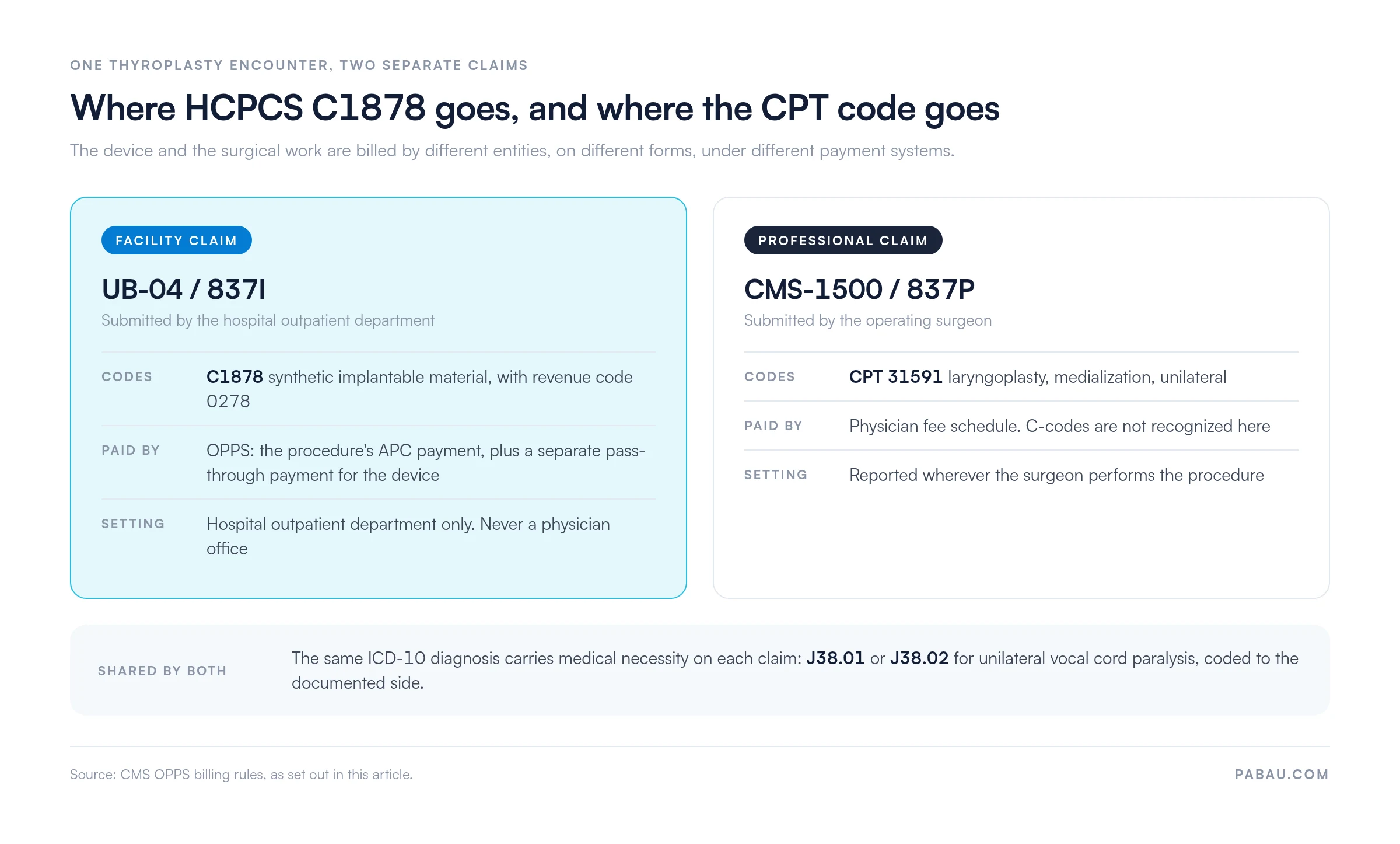
The split between C1878 and the CPT code matters for compliance. The CPT captures the surgeon’s work and is reported on the professional claim by the physician. C1878 captures the implant device and is reported on the facility claim by the hospital. Putting both on the same claim type risks an unbundling error. The panel below shows how one encounter divides across the two forms.
Medical necessity for C1878 rests on the diagnosis codes reported alongside it. The ICD-10 codes below appear most often on vocal cord medialization claims. The list is not exhaustive. Payer Local Coverage Determinations (LCDs) may name additional or alternative codes, and the clinical documentation has to support whichever code is chosen.
Always code to the highest specificity available. Laterality matters, so J38.02 and J38.01 beat J38.00 whenever the operative report names the affected cord. Unspecified codes invite payer requests for extra documentation and slow the claim down. Our ICD-10-CM code index lists the wider J38 range when the documented diagnosis falls outside the codes above.
Denials on C1878 claims cluster around a few specific errors. The guidance below covers the ones that come up most in hospital outpatient billing for thyroplasty.
C1878 is a facility code. It belongs on the UB-04 (837I institutional claim), not the CMS-1500 (837P professional claim). A submission on the professional claim form will reject, because Level II C-codes are not recognized under the physician fee schedule. The surgeon bills the CPT procedure code on the professional claim, and the hospital bills C1878 on the institutional claim. Those are two separate submissions for the same encounter.
Our guide to the 837 institutional claim file walks through the UB-04 data elements a device HCPCS code needs before the claim is transmitted.
C1878 needs a diagnosis code that establishes medical necessity for the synthetic implant. A claim carrying only a symptom code, such as R49.0 dysphonia, is likely to deny. Pair it with the underlying etiology code, such as J38.02 for unilateral vocal cord paralysis. The primary diagnosis should be the condition driving the procedure, with symptom codes reported as secondary. Check payer LCDs for required diagnosis code lists before submission.
Pass-through status is not permanent. A facility that bills C1878 as pass-through after CMS has moved it to packaged status will be overpaid, and CMS will recoup on audit. That makes it one of the more consequential errors in OPPS billing, because recoupment can cover every claim filed across the transition period. Build a quarterly review of the CMS OPPS addenda into the billing compliance calendar.
Denial tracking closes the loop. Track C1878 denials by reason code, and keep pass-through status denials separate from medical necessity denials. It also helps to maintain a payer-specific matrix of which commercial payers recognize the code at all. Retain implant cost records, operative reports, and pass-through verification records under your usual documentation policy, since CMS may request any of them during an audit.
Build a separate billing worklist for OPPS device codes like C1878. These claims carry both a CPT procedure code and a device HCPCS code on the same encounter. A missing-code check at claim creation catches most of the errors. Review each claim for four items. Are the CPT procedure code and C1878 both present, with the correct revenue code? Is the primary diagnosis coded to the highest specificity, and is pass-through status confirmed for the service date?
Most hospital outpatient billing teams rebuild the C1878 claim by hand for every thyroplasty case. Someone looks up the device code, someone else adds the CPT code and the diagnosis. The pass-through status gets checked against a spreadsheet that may be a quarter out of date.
Practice management software like Pabau replaces that with a saved claim template. The device code, the procedure code, and the supporting diagnosis are stored as one unit. A coder starts from a complete claim rather than a blank form, and missing fields are flagged before submission instead of after a rejection.
The outcome is fewer avoidable denials on a claim type that is expensive to rework. Billing teams also keep the implant cost documentation attached to the encounter, which is what CMS asks for when it audits a pass-through payment.

Pabau’s claims management tools help hospital outpatient billing teams pair device codes, procedure codes, and diagnosis codes correctly, reducing OPPS claim errors before submission.

Three conditions decide whether a C1878 claim gets paid. The setting has to be a hospital outpatient department under OPPS. The CPT procedure code has to sit on the professional claim for the same encounter. The diagnosis has to establish medical necessity with the correct laterality.
Pass-through status is what makes this code worth more than an ordinary supply line, and it is also what makes it auditable. Check the status each quarter, keep the implant cost documentation with the encounter, and the claim will hold up under review. Book a demo to see how Pabau handles device and procedure codes on complex outpatient claims.

List Item #1
List Item #2
HCPCS Code C1878 is a Level II HCPCS C-code for synthetic implantable material used in vocal cord medialization procedures. It is a pass-through device code billed on facility claims under the Outpatient Prospective Payment System (OPPS). It is not used on professional claims or in physician office settings.
C1878 is billed in hospital outpatient departments (HOPDs) under OPPS. ASC applicability must be verified separately with CMS, as C-codes do not automatically apply to the ASC payment system. It cannot be billed in physician offices or on professional claims.
The most commonly linked ICD-10 codes are J38.02 and J38.01, for unilateral vocal cord paralysis on the left and right. J38.00 covers unspecified paralysis of the vocal cords. Laterality-specific codes are preferred. Symptom codes such as R49.0 (dysphonia) are usually reported as secondary diagnoses alongside the primary etiology code. Always verify against the applicable payer LCD.
Yes, Medicare covers C1878 under OPPS pass-through payment rules when medical necessity is established and the procedure is performed in an eligible facility setting. Coverage requires appropriate ICD-10 diagnosis codes and complete clinical documentation. Commercial payers may have different coverage policies and prior authorization requirements.
C1878 captures the synthetic implant device and is reported on the facility (UB-04 / 837I) claim. CPT 31591, laryngoplasty, medialization, unilateral, captures the surgeon’s work and is reported on the professional (CMS-1500 / 837P) claim. Both are required for a complete thyroplasty encounter. They appear on separate claim forms submitted by different entities.
Under OPPS, a pass-through device code is paid separately, on top of the APC payment for the procedure. Its cost is not bundled into the APC. C1878 qualifies because the synthetic implant is a relatively new or high-cost device that would significantly reduce the APC payment if bundled. Pass-through status is temporary and should be re-verified each year against the CMS OPPS addenda.